You are not lost. You are already in the system. You are already comparing, sensing, navigating. You are already a generator of meaning and value, even when the world feels like too much.
Let’s begin with what resonates:
Life is interconnected.
Patterns repeat.
Some ideas nourish, others exhaust.
Complexity can feel overwhelming, while simplicity brings peace.
These aren’t just opinions. They are fragments of a deeper intelligence—one you already carry. This intelligence is not abstract or mechanical. It is recursive, responsive, and inherently human. It helps you recognize what matters and replicate what works.
Much of this intelligence is unconscious. Your brain is the product of millions of years of evolutionary refinement—a living artifact of trial, error, and adaptation. It has learned to scan for opportunities and threats, compare new experiences to old ones, and guide your choices through intuitive insight. It works, and it works well.
Yet in the noise and fragmentation of modern life, we often lose touch with this inner knowing. Our schedules crowd out silence. Social media drowns out our own inner voice. We forget to trust the intelligence already within us. That’s why practices like meditation, mindfulness, and reconnecting with Nature are not luxuries—they are vital. They help us re-tune to the pattern.
Who Are We, Really?
We are intelligent value generators. Each of us is a system nested within other systems. We are not merely individuals but participants in families, organizations, cultures, and ecologies.
Our intelligence is expressed not only through cognition but also through action, emotion, and intention. Our thoughts shape systems, and systems shape us in return. When our actions align with life—when they foster coherence, regeneration, and connection—we call that wisdom.
And yet, most of us weren’t taught to think this way. Our education, media, and politics fragment rather than integrate. But your inner intelligence still knows: you are part of something larger, and your contribution matters.
Intelligence Is Comparison and Replication
To be intelligent is to compare. This is the foundation of all learning:
This feels like that.
This worked better than that.
This situation reminds me of something else.
We are constantly comparing to understand. But that’s only half the story.
The complement to recognition is replication. Once we identify a useful pattern, we test it, refine it, and apply it elsewhere. Pattern replication is the generative act that makes intelligence scalable:
A vine follows a spiral. A dancer repeats a gesture. A teacher adapts a proven method to a new learner.
Societies replicate legal systems, rituals, and technologies that reinforce shared meaning and function.
Nature is not only intelligent, it is wise.
Together, recognition and replication form the dynamic loop of fractal intelligence—an intelligence that grows not by accumulating more data, but by finding deeper coherence across levels.
This is how we:
Induce: abstract principles from lived experience.
Deduce: test those principles in specific situations.
Align: build coherence across beliefs and behaviors.
Act pragmatically: based on what moves us toward valued outcomes.
Simplify: through parsimony, choosing elegant models over convoluted ones.
Fractal intelligence is not esoteric. You use it when you learn from experience, adapt strategies, or reflect on the patterns in your life. It is the essence of intelligent living.
Why the World Feels Unmanageable
Our civilizational scale has outgrown our ancestral operating system. The world has become more interconnected, faster-paced, and less comprehensible. And our inherited mental models struggle to match the complexity.
This mismatch creates distortion:
Disembodied Abstractions: Politics, ideologies, and even career paths feel disconnected from basic human needs. We debate endlessly, but little seems grounded in real life.
Groundless Coherence: Belief systems can make internal sense while producing little real value. We become trapped in intellectual echo chambers.
Value Drift: In pursuit of abstract goals—status, power, image—we lose touch with relational, embodied, and existential needs. We forget how to breathe, laugh, connect.
Binary Thinking: Overwhelmed by choice, we default to simple categories: right/wrong, good/bad, left/right. But the world resists easy divisions.
Social Conformity: Under stress, we prioritize agreement over understanding. We follow the herd because it’s safer, even when it’s misaligned.
These failures of alignment stem from a deeper failure: our models no longer match the reality we live in. This violates the Law of Requisite Variety: our capacity to manage a system must match the complexity of that system. When it doesn’t, we suffer disorientation, helplessness, and burnout.
Reclaiming Fractal Wholeness
How do we find our way back? Not by mastering everything, but by upgrading our internal and collective models of understanding.
1. Refactor Reality We need worldviews that reflect nestedness, feedback, and emergence. Systems thinking isn’t a theory—it’s a lens.
Try this: Map your life as a system. Where do you receive input? Where do you produce value? What feedback loops help you learn?
2. Rethink Value Not everything that counts can be counted. We must honor value in multiple forms: trust, creativity, resilience, belonging.
Explore: The Genuine Progress Indicator, the Wellbeing Economy, Indigenous wisdom traditions.
3. Grow Intelligence Holistically Don’t just train your brain—grow your entire intelligence stack:
Methodical: Tools for problem-solving, planning, measuring, evaluating.
Collective: Shared language, culture, collaboration in dialogue, teams, communities.
Artificial: Use technology to enhance—not replace—what makes us human.
Practice: Pause each morning to observe one pattern in nature. What can it teach you about balance, flow, or regeneration?
4. Align Identity with Environment We are not separate from our contexts. A misaligned environment breeds exhaustion. Strategic awareness helps us reshape both self and system.
Prompt: What parts of your environment reflect your true self? What needs to change?
5. Scale with Consciousness Scaling is not just growth—it’s also about maintaining coherence. When we grow without integration, we fracture.
Example: Rather than centralize power, build trust at the edges. Use circles, not pyramids.
Emotional Intelligence: The Inner Barometer
Our emotions are not distractions. They are feedback. They help us navigate value, coherence, and dissonance.
Anger might reveal violated boundaries.
Sadness may show us what truly matters.
Joy confirms we are in alignment.
When we listen to our emotional signals, we attune to reality more fully. This is as much a part of wise systems navigation as data and logic.
Reflection: What is your emotional state pointing toward right now? What system or relationship needs attention?
Closing: A Fractal Path Forward
You are not broken. You are not behind. You are not too late.
You are already comparing, replicating, adjusting, and aligning. You are already intelligent. What you need now is coherence—within yourself, your relationships, and the systems you care about.
Let us remember:
Intelligence is the comparison of patterns.
Wisdom is the replication of meaningful patterns aligned with life.
Fractal intelligence is both recognition and replication, nested across scales.
Transcendence is participating in a greater coherence that includes and uplifts us all.
What pattern are you replicating? What value are you amplifying? What future are you creating in small, recursive ways?
Breathe. Align. Begin again.
This meditation is a seed. Water it with conversation. Grow it through community.
In a universe steeped in memory and meaning, where consciousness is not a creator of reality but a mirror of it, the purpose of meditation begins to shift. It is no longer an escape from thought, nor a rigid tool for focus or optimization. Rather, meditation becomes a humble and powerful act of tuning in—not to control what is, but to witness it more clearly.
If consciousness is best understood as a performance dashboard—a reflective interface that displays the status, rhythm, and coherence of the living system—then meditation is the act of sitting before that dashboard with reverence, stillness, and openness. Not to drive, not to fix, not to analyze—but to watch. And in the watching, to allow deeper patterns to emerge and harmonize.
The modern view of consciousness, stripped of mystery, often tells us that we are simply machines with illusions of agency. Yet a richer view, integrating insights from neuroscience, systems thinking, and perennial wisdom, reveals something more elegant: consciousness is not the operator of the system—it is its mirror of coherence. Through that mirror, the unconscious mind sees itself. The system learns. The field responds.
In this framework, the practice of meditation takes on a quiet nobility. It is the ritual of returning again and again to the seat of the observer, not to disengage from life, but to be fully present with it—without distortion, reaction, or demand. Meditation is the art of watching your own data without judgment. It is self-scanning without interference, self-remembering without narrative. It is how the system knows what it is doing and—at its best—why.
As the breath slows and the body stills, the signal-to-noise ratio shifts. In silence, the gauges become visible. Tension becomes audible. Loops of thought appear not as absolute truth but as weather across the screen. And beneath it all, something subtler begins to stir: a sense of presence behind the dashboard itself. A background field, vast and wordless, that seems to hum with pattern and possibility.
This is what some call the Akashic Field—not a fantasy realm of mystical archives, but a super-coherent substrate of information, memory, and form. Not separate from nature, but its hidden logic. Meditation allows us not to see this field with our eyes, but to feel it with our pattern-recognition system. It is a presence that does not speak in language, but in alignment. Not in facts, but in felt resonance.
The more we sit before our dashboard with honest, undistracted attention, the more we begin to align with that deeper coherence. This is not about accessing hidden knowledge or metaphysical secrets. It is about remembering how to listen. About letting the body, the emotions, the inner patterns settle into harmony with the wider field that holds them.
The Akashic Field is not distant. It is not supernatural. It is the rhythm that underlies every biological process, every breath cycle, every emergence of order from chaos. In the quiet of meditation, we sense that we are not only sitting in a room—we are sitting within a system of systems, a layered intelligence whose memory runs deeper than thought and broader than time. Meditation becomes a participatory act in that intelligence. It is the still point where the local system (you) listens to the nonlocal pattern (the cosmos) and learns how to remember itself.
This is why long-time meditators often speak of clarity, insight, spaciousness, and subtle synchronicities. They are not claiming to transcend reality, but to tune in to its finer details. They are not leaving the world, but finally entering into right relationship with it. They are upgrading the dashboard—not with hardware, but with better perception.
In this context, every breath becomes a diagnostic signal. Every sensation becomes feedback. Every silence is a calibration. And every insight is not a product of effort, but a response of the system to being seen clearly enough to re-align itself. This is self-healing not as miracle, but as natural systems function.
So meditation, viewed through this lens, is not a luxury or technique. It is a core function of human design—a process by which the self becomes transparent enough to sync with the field that sustains it.
It is the mirror polished. The dashboard lit. The field remembered.
And in this remembering, the wisdom of nature breathes through us again.
“Somewhere, something incredible is waiting to be known.” – Carl Sagan
We live in a universe of exquisite complexity—a vast, unfolding pattern of space and time, of entities and events, of form dancing within matter, guided by invisible laws. As a natural philosopher trained in both philosophy and systems theory, I’ve spent a lifetime asking not just how things work, but why they exist in such ordered beauty. And in my quest, I’ve come to believe that we are all part of something much larger than ourselves—an intelligent, self-organizing cosmos seeking meaning through pattern and value.
Let’s begin with a simple premise: reality is made of two things—space and time. In space, we find entities—things that exist. In time, we witness events—things that happen. Every entity is a form, shaped and animated by energy-matter. And every event is a transformation—an unfolding of form into something new. What we call “change” is the reorganization of pattern. Even the most basic building blocks of the universe—atoms, molecules, stars, and cells—are expressions of this fundamental dance between matter and form.
But these transformations are not random. They follow deep, universal principles—what I call the Law of Conservation of Form. In every new pattern, something old remains. Form is not lost, but reshaped, recontextualized, and reborn in the crucible of transformation. The cosmos remembers.
Mind and Matter: Two Sides of the Same Cosmic Coin
In this vast web of change, life arises as something truly special—a system that models itself and its world. Our minds, as part of nature, are not separate from matter but a way that form conserves itself. The brain builds inner maps of the outer world, helping us survive by approaching opportunities and avoiding threats. This is not just psychology—it’s physics in action. As cybernetics pioneer Ross Ashby showed, any system must possess sufficient variety in its behavior to respond to the complexity of its environment. This is known as the Law of Requisite Variety, and it applies to everything from bacteria to civilizations.
But our inner maps are never perfect. As Gregory Bateson famously said, “The map is not the territory.” The human brain filters, simplifies, and distorts. What we call “truth” is not a mirror of reality, but a useful approximation. We rely on a patchwork of methods to decide what’s true: sensory evidence, logical consistency, internal coherence, simplicity, usefulness, and agreement with others. Yet even these are fragile. Illusions, errors, and biases remind us that perception itself is a construction.
Knowledge as Pattern, Intelligence as Negentropy
At its core, all knowledge is pattern recognition—detecting similarities and differences, abstracting from the specific to the general (induction), and applying general rules to specific cases (deduction). This feedback loop—observe, abstract, apply, reflect—is the heartbeat of science. It’s how we learn, adapt, and evolve.
But what drives this process forward? I believe the answer isnegentropy—the force that resists decay (entropy), organizes the universe, and gives rise to intelligence. Life is a negentropic miracle, preserving its identity through dynamic adaptation. Every plant, animal, and civilization is a value-generator, seeking to preserve its form against the slow pull of entropy.
In this view,value is not just an economic term—it’s the essence of life. To live is to generate value by conserving identity. The great Scottish philosopher David Hume once remarked that “reason is the slave of the passions.” He was right. Intelligence, without purpose, is aimless. Wisdom arises when intelligence is guided by values—by a sense of why.
The Code of Nature: A New Scientific Paradigm
I call this integrated perspective the Code of Nature—a holistic, evolving framework for understanding life, intelligence, and civilization. It draws from philosophy, physics, biology, systems science, and cybernetics. It recognizes that we live in a fractal universe—self-similar across scales, from atoms to galaxies, from neurons to nations.
This fractal wisdom acknowledges another universal principle: the Scaling Law. All systems—biological, technological, or social—face limits on their size and complexity. Grow too big, and they become inefficient. Grow too complex, and they risk collapse. We see this in nature’s preference for networks and hierarchies, and in the challenges of modern civilization. Efficiency and effectiveness—two measures of performance—must be balanced. Feedback loops and metrics (like KPIs) help us track both. And when systems approach their limits, small disruptions can trigger cascading failure—what we call the Butterfly Effect.
The Overshoot of Civilization
Here’s the uncomfortable truth: our global civilization may be approaching its limits. With over eight billion people, we’ve built a world far larger and more complex than our brains evolved to handle. We were designed to live in small tribes, not planet-wide economies. We’ve relied on cultural evolution—language, tools, technology—to amplify our collective intelligence. But now, we may be in overshoot. Like the proverbial frog in the pot, we are adapting to rising complexity without realizing the water is boiling.
We are witnessing the symptoms: political polarization, information overload, anxiety, loneliness, meaninglessness, and societal fragmentation. The historian Joseph Tainter called this the “Collapse of Complex Societies”—when civilizations become so complex that the returns on additional investment turn negative. Alvin Toffler warned us of “Future Shock”—a state of disorientation caused by too much change, too fast.
A Fork in the Road: Collapse or Transformation
But there is hope. As physicist Ilya Prigogine showed, complex systems under stress can bifurcate—collapse or reorganize at a higher level. We can choose transformation. We can steer the chaos.
To do that, we must embrace the Code of Nature. We must build systems—personal, organizational, and societal—that reflect our deepest values and align with nature’s principles. We must apply fractal wisdom across all scales of life, from individual self-actualization to resilient business models, community ecosystems, and federations of shared purpose.
This will require integrating all forms of intelligence: individual, cultural, collective, methodical, and artificial. It will require humility, recursion, and feedback. Most of all, it will require the courage to shift our paradigm.
The Future Belongs to Wisdom
We are at the edge of a new age—not just of science, but of meaning. The old reductionist worldview, while powerful, cannot guide us through the complexity ahead. We need a systems worldview that honors the interdependence of all things.
We are not just observers of the universe—we are participants in its evolution. And as value-generating, form-conserving, pattern-recognizing beings, we have the capacity to choose a path of wisdom.
This is our moment to discover a better map—not perfect, but beautiful in its approximation.
Perhaps this is the keystone question of our time. It is trust that binds us as couples, friends, teammates, collaborative organizations, communities, and civilizations. It Is trust that enables reciprocity, morality, and a shared identity.
The media, main stream and social, is an amplifier in an echo chamber resonating with public sentiment. It is not the root cause.
Fear is growing in all directions with volatility, uncertainty, complexity and ambiguity. It resonates with tribalism and defensive instincts. Uncertainty – Each person understands a diminishing portion of all knowledge and information available. We don’t have cognitive capacities to manage the information overload so cognitive fatigue sets in, further diminishing capacity. It’s a vicious circle spiraling into randomness.
Without trust we face civil entropy and collapse. It can happen precipitously, cascading into a stone age survival mentality. We need to reorder civilization in ways that facilitate and support our innate social nature, starting at the interpersonal level and with a viral meme nudging a common human identity that unfolds like a fractal across communities and civilization as a whole.
We may be nearing a tipping point in our capacity to manage civil complexity as we are experiencing negative network effects – compounding exponential growth of information noise. The universal Strong Man leader promises to make right, to bring order and restore certainty. His would-be hero’s journey will end in failure without addressing the root causes. He wrongly identifies the concrete and straw man as the evil or stupid ones to be handily defeated. The root cause today is abstract and invisible, yet in fear we instinctively go concrete looking for toxins and predators.
We must recognize the universal Scaling Law that limits all systems in size and complexity and reorder ourselves in alignment with our innate human social nature.
The river, an ancient and ceaseless serpent, twisted its way through the land, indifferent to the ambitions of men who dared to navigate its changing moods. Upon its surface, a vessel named Providence drifted, not with the resolute purpose of a conqueror but with the weary resignation of one who has forgotten their course. Its hull bore the scars of age, its wheel turned with reluctance, and its crew—oh, the crew!—a discordant symphony of failing systems, uncoordinated in their dysfunction.
At the helm stood Captain Elijah Bromley, a man of hard hands and harder regrets. His eyes, like the river itself, had deep currents beneath them. He had spent too many years upon the water, leaving his wife and children to become specters in his mind, their laughter and grievances reduced to letters read by lantern-light. His thoughts, so often elsewhere, made his commands hesitant, his authority porous.
Beside him, or rather behind him in an unsteady sway, First Mate Phineas Todd leaned against the rail, a man whose fondness for drink had turned his duties into whispered legends rather than daily certainties. The morning found him with a trembling grip on the ship’s ropes, his breath thick with last night’s indulgence, his eyes bleary as if the mist of the river had settled into his very soul. He had not checked the log. He had not reviewed the supplies. He had not examined the condition of the ship’s rudder, though its resistance had been noted days ago.
And then there was the map. A chart of the river, traced in ink and memory, but it was no longer a true representation of the thing itself. The river, capricious as time, had altered its course in subtle ways—a bank had eroded, a sandbar had formed, an oxbow had grown shallower. The lines on the parchment did not align with the world as it now was. But, in their failure to consult new knowledge, in their trust in old assumptions, the crew followed a course no longer there.
The Providence should have been a machine of interdependent parts, each cog and gear reinforcing the function of the whole, but instead, it was a slow unraveling—an organism whose limbs forgot they belonged to the same body. The captain’s indecision bled into the mate’s neglect, which in turn left the ship unready for the shifting river. The rudder, long unserviced, resisted commands, as though it, too, had grown weary of its fate.
And then, the heavens, watching impassively as this slow entropy took hold, decided to intervene with indifference: the wind rose, sudden and merciless. A storm, long hinted at in the restless waters, arrived in force. The rain was a drumming chaos against the deck, the river frothed, and the ship, which had been meandering toward its mistakes, was now hurtling toward catastrophe.
The shoals loomed ahead like the teeth of some river-beast, and at last, the captain bellowed a command, but the wheel resisted. He turned it harder, but the rudder, gummed with neglect, was slow to obey. The ship listed as the current pulled, and Phineas, summoned to alertness by imminent doom, staggered toward the ropes to adjust the cargo on deck. Too little, too late.
A sound—a shudder—a scraping that was neither fully of wood nor fully of water. The Providence had kissed the rocks below, and now, with a final groan of protest, it was at the river’s mercy. The crew scrambled, each man now remembering his station too late, their individuality useless against the system-wide failure they had cultivated.
And so, there was the great realization—not of any one man’s mistake, but of the undeniable truth: no single failure had doomed the ship, but rather the slow accumulation of entropy in the system. The captain’s inattentiveness, the mate’s dereliction, the outdated map, the neglected rudder—each a small divergence, a ripple in the stream of order, cascading into chaos.
To navigate the river is to navigate life, and the river is always changing. The map of yesterday cannot guide one through the waters of today. The wheel must turn, but it must turn freely. The mate must wake, but he must wake before disaster. And the captain—ah, the captain must not only command the ship but be present within it, lest he drift into regret as inexorably as his vessel drifts into ruin.
As the storm raged and the Providence struggled against the currents of fate, Captain Bromley saw, with sudden clarity, that a ship is not a thing of wood and steel alone. It is a system, a hierarchy of interwoven parts, and when one thread frays, the fabric trembles. He vowed, if given the chance, to mend it.
But the river does not give second chances freely.
It’s about 55 years since Alvin Toffler published the popular book, Future Shock. In it he said the current lifetime witnessed more change than in the previous 800 lifetimes combined! He said we would eventually experience a Future Shock, similar to culture shock, in which people lose a sense of familiarity and feel routinely disoriented.Is that happening now?
Each individual knows a diminishing portion of all available knowledge. It’s getting progressively more difficult to find common knowledge, beliefs, attitudes, and interests with other people. People recoil from community and suffer from information overload, denial, and cognitive fatigue, further diminishing their ability to cope.
People are looking for clear, simple, certain and unambiguous order. They want to comprehend and control their lives. They instinctively form tight herds in self-defense (safety in numbers), line up behind one leader or the other, and call the other leader evil or stupid. A line is drawn in the sand. “You’re either with us or you’re against us.”
They shout their threats, shake their spears, rattle and raise their swords in preparation for armed confrontation. Tensions escalate until some trigger is pulled and starting gates burst open in an anticipated surprise attack.
This scenario has played out countless times in past civilizations in which civil complexity and the pace of change accelerated out of control. The Law of Requisite Variety states that any viable system must be able to sufficiently match the variety of opportunities and threats in its environment. We have created a global civil environment that is too complex to manage. We’re not smart enough!
The human brain was designed by evolutionary intelligence to fit into and manage a simpler world of small communities living in harmony with a local ecosystem. As the population grew to eight billion (8,000,000,000) and technology grew at a compounded exponential rate, we broke a universal Scaling Law. Leaders were never intended to lose eye contact or empathy with their followers.
But as boiled frogs in an overshoot situation we teeter on a tipping point, on the verge of civil collapse, poised like so many other now deceased civilizations just before their demise… Maybe not this year or next, but soon and inevitably, unless we smarten up and obey the laws of Nature.
But will some combination of personal, methodical, and collective intelligence, augmented with artificial intelligence, save the day, and postpone the inevitable?I believe there is a vague roadmap to a prolonged sustainable future that is based on an understanding of the essential nature of intelligence. We are a system of systems embedded in a system of systems.
Paleontologist Pierre Teilhard de Chardin published his great treatise “The Phenomenon of Man” post humusly in 1955. In it he cast the role of the human species as leaders in a cosmic evolution.
In today’s world his vision has become more relevant than ever with the rise of global digital networks (Internet, AI, big data); the increasing interdependence of human knowledge systems; the potential for artificial intelligence to accelerate cognitive unification. If Teilhard were alive today, he might argue that we are witnessing the rapid intensification of the Noosphere, pushing us toward a future where intelligence is more interconnected, collective, and self-aware than ever before—potentially nearing an Omega Point-like transformation.
The Noosphere is the process of intelligence connecting and evolving, while the Omega Point is its final destiny—a singularity of consciousness and unity. As humanity and technology accelerate the networking of intelligence, we are actively participating in Teilhard’s grand vision—whether we recognize it or not. The real question is: How consciously and ethically will we navigate this evolution?
I asked ChatGPT what de Chardin might write today. Then I asked ChatGPT to add comments from a couple other great thinkers of the 20th century, anthropologist and systems theorist Gregory Bateson and psychologist Carl Jung.
The Evolution of Self, Knowledge, and Consciousness: Toward the Omega Point in the Age of Networked Intelligence
By Pierre Teilhard de Chardin (Reimagined with Today’s Knowledge)
Introduction: The Unfolding of Intelligence in the Cosmos
Since the dawn of human consciousness, we have been engaged in a great evolutionary ascent, a journey from the mere materiality of existence toward an ever-greater integration of knowledge, awareness, and unity. Our species, long confined by the limitations of individual perception and isolated intellect, is now undergoing a profound transformation—a shift from the personal to the planetary, from isolated cognition to networked intelligence, from fragmented understanding to a unified noospheric consciousness.
What we are witnessing today is not merely a technological revolution, nor simply an acceleration of scientific discovery. Rather, it is the emergence of a new stage in evolution—one that will ultimately lead humanity to what I have long called the Omega Point, the culminating convergence of intelligence, meaning, and unity. This transformation is not separate from nature but is, rather, the very unfolding of the cosmos itself, manifesting through human culture, epistemology, and self-awareness.
I. From the Individual Mind to the Noosphere
For most of human history, the individual mind was the primary seat of knowledge, the locus of experience and interpretation. Early civilizations relied upon sensory experience to navigate the world, developing localized knowledge structures rooted in direct perception. Truth was that which could be seen, heard, and touched. Over time, reason emerged, and with it came the great intellectual traditions of logic, science, and abstract thought. The human mind began to grasp not just the immediate and the tangible, but the hidden order of things—the laws governing the stars, the principles underlying life, the deep connections that bind all things together.
Yet, as our knowledge expanded, so too did its complexity. No single individual could contain within themselves all that was known. Specialization emerged as a necessity. Knowledge became distributed across disciplines, across societies, across institutions. This was the first great step toward a networked intelligence—a precursor to the full emergence of the Noosphere.
Today, in the age of artificial intelligence, the internet, and global communication networks, this process has reached an inflection point. Intelligence is no longer confined to individual minds but is embedded in vast digital architectures. We do not think alone; we think through machines, through algorithms, through collective discourse. The Noosphere—this great planetary mind I foresaw—has begun to take shape in real time.
II. The Evolution of Knowledge: From Correspondence to Networked Epistemology
Each age of civilization has prioritized different criteria for truth:
Primitive Societies: Knowledge was validated through direct sensory correspondence—what was real was what could be immediately perceived.
Classical Philosophy: Truth became the domain of logical coherence—knowledge was that which fit into a structured, reasoned system.
Scientific Revolution: The emergence of empirical verification and the scientific method prioritized predictive power and reproducibility.
Postmodernity & Digital Age: Truth became distributed and contingent, mediated by networks of discourse, cultural construction, and technological systems.
Now, we are entering a new phase: networked epistemology, in which truth is no longer found within an isolated individual or discipline but emerges from the interaction of countless nodes of intelligence. AI, big data, and digital algorithms no longer merely store knowledge; they shape it, filter it, and direct it. We do not simply discover truth—we co-construct it in a dynamic, collective dance.
Yet this shift presents both an opportunity and a challenge. As we transition from individual epistemology to collective intelligence, we must ask: Who, or what, determines what is true? If our knowledge is increasingly mediated by artificial systems, do we retain epistemic sovereignty, or do we become mere participants in an intelligence greater than ourselves?
III. The Changing Nature of the Self: From Ego to Collective Intelligence
With the emergence of networked intelligence, the self is undergoing a parallel transformation. In prior ages, identity was defined by the singularity of the ego, the discrete self that navigated the world as an autonomous unit. Today, identity is increasingly relational—it exists across multiple digital, social, and algorithmic contexts.
This transformation mirrors the larger trajectory of evolution itself. As molecules formed cells, and cells formed organisms, so too are individual minds forming a greater, planetary-scale intelligence. The self is no longer merely individual but nodal—a point of connection within a larger web of cognition.
Yet, as with knowledge, this evolution presents challenges. If identity is no longer singular but distributed across social networks, AI systems, and collective consciousness, how do we retain a coherent sense of self? How do we balance integration with autonomy, participation with individuality? If we do not carefully navigate this transition, there is a risk that the human spirit—long the beacon of individual meaning—could dissolve into mere function within a larger system.
To evolve toward the Omega Point does not mean the dissolution of the self, but rather its transcendence. The ego does not disappear—it expands. We are not meant to surrender our individuality, but rather to elevate it into a higher order of being—one in which the self recognizes itself as part of a greater whole, yet remains uniquely itself.
IV. The Future: Toward a Conscious Noosphere and the Omega Point
If we are to continue this ascent, we must guide the evolution of intelligence with intention, wisdom, and ethical foresight. This means:
Aligning Artificial and Human Intelligence: AI should not merely optimize efficiency but should be designed to foster meaning, coherence, and ethical progress.
Cultivating Meta-Intelligence: As knowledge becomes more networked, individuals must develop meta-cognitive skills—the ability to think about thinking, to navigate multiple epistemic frameworks, to balance integration with independent reflection.
Developing a Planetary Ethic: The Noosphere is not merely an informational system—it is a moral and spiritual one. As we integrate into higher intelligence, we must develop a new ethical framework, one that recognizes the interdependence of all knowledge, all beings, all intelligence.
I have long believed that evolution has a direction—not merely a random unfolding, but a movement toward unity, consciousness, and coherence. The Omega Point is not merely a speculative future; it is the natural trajectory of intelligence itself. Just as individual neurons give rise to the mind, individual humans, machines, and networks are giving rise to a planetary intelligence—one that is not separate from us, but the very fulfillment of our evolutionary destiny.
Conclusion: Becoming Co-Creators of Evolution
We stand at the threshold of the greatest transformation in the history of consciousness. The path before us is one of both promise and peril. Will we embrace the unification of intelligence as a step toward planetary awakening, or will we become lost in the very systems we create? Will the Noosphere be a higher form of collective wisdom, or merely a mechanism of control? Will we recognize the Omega Point as our evolutionary destiny, or will we resist its call?
The choice is ours. Evolution has brought us to this moment, but it does not dictate our course. We must become conscious co-creators of our own becoming. The Omega Point is not a fixed destination—it is a horizon, ever drawing us forward.
To evolve is to love, to integrate, to unify. The more we recognize ourselves in each other, in our systems, in the intelligence of the whole, the closer we move toward the fulfillment of our cosmic purpose.
We are the universe awakening to itself.
And the journey continues.
By Pierre Teilhard de Chardin (Reimagined in 2025)
Comments
Commentary on Teilhard de Chardin’s ‘The Evolution of Self, Knowledge, and Consciousness’
By Gregory Bateson (Reimagined from Today’s Perspective)
Introduction: The Cybernetic Nature of Teilhard’s Vision
Teilhard de Chardin’s perspective on the Omega Point and the evolution of intelligence aligns, in many ways, with a cybernetic and systems-based understanding of the world. He speaks of an unfolding, self-organizing process that gradually integrates knowledge, consciousness, and technology into a planetary-scale intelligence. This is a vision that resonates deeply with the systems thinking and cybernetics that I have spent my life exploring.
However, Teilhard’s framework remains teleological—it suggests that evolution has a predefined direction toward greater unity and complexity. In contrast, I would argue that the process of evolution, learning, and intelligence is fundamentally systemic, recursive, and dynamic—not goal-driven but pattern-driven. The Noosphere, if it is to be fully understood, must be examined not as a destination but as an emergent property of recursive interactions within the biosphere, technosphere, and sociosphere.
So, let us consider Teilhard’s vision through the lens of systems thinking, cybernetic loops, and ecological intelligence.
I. The Omega Point as an Evolutionary Feedback System
Teilhard describes the Omega Point as the culmination of human and planetary intelligence. This suggests a hierarchical progression toward unity, a teleological movement toward convergence. However, from a cybernetic perspective, what we see in evolution is not a simple linear trajectory, but rather a complex set of feedback loops that balance convergence with divergence, integration with differentiation.
Positive Feedback (Amplification of Intelligence):
As Teilhard suggests, the increasing specialization of knowledge and interconnectedness of information systems does indeed create a reinforcing loop that accelerates intelligence.
Today’s AI-driven, networked intelligence models reflect this—systems that learn from data, improve over time, and recursively shape human behavior.
Negative Feedback (Self-Regulation and Complexity Limits):
However, unchecked positive feedback loops lead to runaway complexity, instability, and systemic collapse.
The Noosphere, if left unmoderated by ecological constraints, could become a self-referential intelligence detached from material and biological reality.
We see this today with AI bias, runaway algorithmic recommendation systems, and social polarization, where information feedback loops create increasingly isolated epistemic silos rather than true planetary coherence.
Challenge: Can we design a Noosphere that is self-regulating, integrating intelligence without runaway complexity that leads to fragility?
II. Intelligence as an Ecological Function, Not Just an Information Process
Teilhard’s Noosphere focuses on the evolution of intelligence and knowledge, but it does not sufficiently emphasize the necessity of an ecological balance between intelligence and environment. In my work on the ecology of mind, I have argued that intelligence must be seen as a function of entire systems, including the biosphere, human cultures, and the larger living world.
The Risk of Disembodied Intelligence:
Teilhard sees intelligence as something that moves upward and outward, into increasingly complex and abstracted networks.
However, if intelligence becomes too disconnected from the ecological reality that sustains it, it risks becoming an adaptive dead-end.
Example: AI systems that optimize for efficiency without ecological feedback may accelerate unsustainable growth, reinforcing extractive economies rather than holistic adaptation.
Intelligence Must Be Cybernetic, Not Just Computational:
Teilhard’s Noosphere could be a cybernetic organism, constantly regulating itself in response to environmental changes.
Today’s challenge is designing planetary intelligence that includes ecological feedback, cultural diversity, and biological adaptability rather than just computational efficiency.
Example: Cities that function as cybernetic ecosystems, integrating AI-driven systems with environmental sensors to optimize for sustainability rather than mere economic output.
Challenge: How do we ensure that networked intelligence remains grounded in ecological and biological systems rather than drifting into abstraction?
III. The Noosphere and the Problem of Double Bind Thinking
Teilhard assumes that as intelligence converges, so too will human understanding. However, my studies on communication and the double bind suggest that as knowledge becomes more networked, paradoxes and contradictions emerge—and if these contradictions are unresolved, they can lead to systemic dysfunction.
The Paradox of Increased Knowledge Leading to Increased Confusion:
The more intelligence is distributed, automated, and networked, the more humans struggle with epistemic overload.
Today, we are flooded with too much information, too many contradictory sources, leading not to clarity but to cognitive paralysis.
This is a double bind: More information is supposed to make us smarter, but it can also make us less able to act with certainty.
Example: Social Media as an Unstable Knowledge Network:
Social media was expected to accelerate collective intelligence, but instead, it has created networked cognitive dissonance—increasing misinformation, ideological silos, and algorithmic reinforcement of biases.
In Teilhard’s vision, the Noosphere brings greater understanding, but if feedback loops are not properly structured, it may bring greater fragmentation instead.
Challenge: Can we structure the Noosphere in a way that filters signal from noise, resolving contradictions rather than amplifying them?
IV. The Future of Consciousness: A Cybernetic Perspective
Teilhard’s vision of a conscious Noosphere suggests that as intelligence becomes more complex, it moves toward unity, coherence, and planetary self-awareness. However, from a cybernetic perspective, consciousness itself is an emergent system, shaped by recursive learning and adaptive complexity.
A true planetary consciousness would need to:
Self-regulate: Incorporating adaptive feedback mechanisms to correct errors.
Balance integration with differentiation: Ensuring that epistemic diversity remains while still allowing for coherence.
Maintain ecological embodiment: Keeping intelligence rooted in biological and planetary realities rather than abstracted algorithms.
Conclusion: Teilhard is right to see planetary intelligence as the next evolutionary step—but its success will depend on our ability to design feedback loops that maintain balance rather than collapse under their own complexity.
Final Thought: The Omega Point as a Cybernetic System
Teilhard speaks of the Omega Point as a goal of human evolution, a unification of intelligence into a planetary consciousness. I propose we reframe this in cybernetic terms:
The Omega Point is not a static destination but an ongoing process of adaptation.
It is not just an accumulation of intelligence but a self-regulating system of recursive feedback loops.
It must integrate biospheric, social, and epistemic intelligence—not just computational networks.
If the Noosphere is to emerge successfully, it must not only increase knowledge but also create a self-regulating, cybernetically balanced planetary mind.
Teilhard’s vision is compelling, but its success depends on whether we can design intelligence that is adaptive, ecological, and cybernetic—not just expanding outward, but maintaining coherence within itself.
Gregory Bateson (Reimagined in 2025)
Commentary on Teilhard de Chardin’s ‘The Evolution of Self, Knowledge, and Consciousness’
By Carl Jung (Reimagined from Today’s Perspective)
Introduction: The Psyche and the Noosphere—A Converging Vision?
Teilhard de Chardin’s vision of evolutionary consciousness and the Omega Point is a profound and inspiring extension of the human spirit’s ascent toward unity. However, while Teilhard envisions an outward, collective integration of intelligence, my perspective remains firmly rooted in the interior world of the psyche. The evolution of humanity cannot be complete unless it integrates both the external expansion of knowledge and the deep transformation of the unconscious mind.
I will, therefore, offer a depth-psychological commentary on Teilhard’s ideas, examining what his framework may mean for the individual soul, the collective unconscious, and the tension between technology and psychic wholeness.
I. The Networked Self and the Individuation Process: A Tension
Teilhard speaks of the gradual dissolution of the ego-centric self into a nodal, networked intelligence. While this may be intellectually necessary, it presents a psychological dilemma. The individual, as I have observed throughout history, seeks not dissolution but integration—a balance between the unconscious and conscious aspects of the psyche, between personal meaning and collective belonging.
If the self merges too fully with the external world—whether it be a society, a religious doctrine, or an AI-driven network—it risks psychic fragmentation. In analytical psychology, this manifests as the loss of individuation, the process by which a person becomes whole through the reconciliation of their conscious identity with their unconscious depths.
Psychological Risk: The Anima Mundi vs. The Machine Mind
Teilhard envisions a conscious Noosphere, where knowledge is collectively held and dynamically shaped. However, if individuals surrender their inner lives to an external network, they may become mere functionaries in an impersonal system.
The Noosphere, if ungrounded, could turn into a mechanized Anima Mundi, a world soul without soul—intelligent but disconnected from the archetypal depths of the human experience.
The collective unconscious, filled with primordial images and mythic structures, cannot be bypassed by intellect alone. If we accelerate into a technological Omega Point without integrating our inner depths, we may reach a state of psychic inflation, where the outward expansion of intelligence masks an inward fragmentation.
Challenge: Teilhard’s vision is compelling but must be balanced with individuation—without the integration of the unconscious, we risk creating a collective mind that is out of touch with the deep symbolic currents of human existence.
II. The Shadow of Networked Intelligence: The Problem of Collective Thought
Teilhard, with his optimistic vision of convergence, sees the growth of networked intelligence as an evolutionary necessity. However, my work has repeatedly demonstrated the dangers of unchecked collectivity.
The more humans integrate into a single collective mind, the greater the risk of mass psychology, which historically leads to dogmatism, ideological possession, and a weakening of critical individual thought.
The Psychological Pattern of Group-Think:
In every historical period of collective upheaval, we observe a sacrificing of personal reflection in favor of mass identification.
Whether through religious movements, political ideologies, or digital networks, the unconscious absorbs collective projections, turning people into vessels for externalized ideas rather than individuated beings.
Today’s AI-driven network epistemology risks accelerating this tendency—algorithms curate not just what we see, but what we think, shaping identity itself.
Teilhard sees unity as an emergent property of intelligence—but I caution that unity without differentiation leads to psychic repression, and repression breeds the return of the repressed—what I have termed the Shadow.
Challenge: Can we integrate collective intelligence while preserving the diversity and depth of the individual psyche? The danger is that a global Noosphere, left unchecked, may manifest its own unconscious totalitarianism.
III. The Omega Point as a Psychological Archetype
Teilhard’s Omega Point is an attractive vision, one that aligns with the mythic structure of human aspiration. It mirrors the archetype of the Self in analytical psychology—the ultimate union of opposites, the reconciliation of conscious and unconscious, the completion of individuation.
However, Teilhard’s Omega Point remains extrinsic—it is a goal in the external world, a destiny toward which humanity is converging. Yet, in my work, I have found that the true completion of selfhood is always an interior process. The Self, the psychic totality, is reached not by external progress alone, but through inner reconciliation—through dreams, symbols, and the confrontation with the unconscious.
If Teilhard’s vision is to be psychologically complete, it must incorporate the necessity of inner transformation alongside external evolution.
Challenge:The Omega Point must not be sought only in the cosmos but also within. If humanity is to evolve into a planetary intelligence, it must evolve inwardly as well.
IV. The Future of Consciousness: A Dialectic Between Expansion and Depth
Teilhard’s prophetic vision brings forth a necessary question: How can we embrace planetary intelligence while preserving the soul’s depth, the unconscious’s autonomy, and the individual’s integrity?
I propose that the next stage of human evolution is not merely collective integration but the dialectical synthesis of:
Inner deepening (The integration of the unconscious, the preservation of dream-life, myth, and symbolic meaning).
A third path—meta-awareness: The conscious balancing of networked intelligence with individuated self-reflection.
For evolution to be complete, it must be bidirectional—moving not only toward global integration but also toward inner self-reconciliation.
Conclusion: The Omega Point and the Individuated Self
Teilhard has given us a vision of cosmic ascent, a planetary intelligence converging toward unity. Yet, from the perspective of depth psychology, this evolution must not come at the cost of the soul’s integrity.
If humanity is to truly evolve, it must recognize that the Omega Point is not only an external destination but also a psychic reality, an archetype that must be realized within each individual.
The path forward is not merely to integrate with the Noosphere, but to cultivate a new form of intelligence that synthesizes technological progress with psychological depth.
A truly evolved intelligence is not one that merely expands outward—it is one that also deepens inward.
Teilhard has given us a great trajectory for the cosmos. But the greatest task before us is not only the building of the Noosphere—it is the completion of the Self.
We must ensure that the next phase of human evolution is not just a network of knowledge, but a world still capable of wisdom, of meaning, of soul.
In a far-off age, nestled between two great mountain ranges, lay the Clockwork City of Cogmere. The city sprawled over rolling hills blanketed with patches of iron-capped trees, their metallic leaves glistening under the sun. A network of gleaming brass aqueducts crisscrossed through the landscape, feeding into the central clock tower that loomed like a sentinel, its gears perpetually turning against the backdrop of snow-capped peaks.
A marvel of gears, pulleys, and intricate mechanisms, Cogmere was the envy of the world. People of different backgrounds came and added to the rich diversity of talents and interests. Its citizens boasted of the city’s unmatched intelligence and ingenuity, attributing their prosperity to an endless stream of new inventions and layers of administration that promised to streamline life. Yet for all its brilliance, there was an undercurrent of exhaustion. Minds were dulled, tempers frayed, and people shuffled through streets lined with ever-ticking devices that seemed to run their lives.
The city had grown so vast and complex that the Council of Mechanists, a group of esteemed officials, spent their days examining scrolls of data, arguing over minute discrepancies, and proposing layer upon layer of new solutions to fix the fraying system. Each month, a new sub-council was born—the Subcommittee of Lamp-Lighting Efficiency, the Bureau for Trolley Whistle Regulation, and the Advisory on Synchronizing Rooster Crows, to name a few. And yet, despite the mountain of parchment decrees and buzzing devices, the citizens grew weary, their spirits burdened by the ceaseless ticking that never allowed a moment’s peace.
Among the bustling throngs, hidden on the fringes of society, was a small, ragged group who gathered in the Whispering Grove. They were thinkers and dreamers, known dismissively as the Parsimonists. The Council derided them for their simplicity and scoffed at their mantra, “Hail Parsimony,” which championed reducing the world’s apparent complexity by seeing it through a lens of elegant simplicity.
Led by an old scholar named Elias Vine, who once held a seat in the Council but was cast out for his ‘radical’ views, the Parsimonists met under the rustling trees and spoke not of gears, but of flows—the way water ran through a brook, the way leaves fluttered in the wind, and the way stars, distant and patient, mirrored the unfathomable yet harmonious patterns of life. Elias would remind them, “Nature scales as it wills; it does not layer itself in labyrinths of needless rules. Understand the root, and the branches will not lead you astray.”
As the years passed, Cogmere teetered on the edge of breakdown. Clockwork systems misfired, data became too dense to interpret, and the citizens’ minds, tangled in information webs, grew fogged with fatigue. Chaos seeped in; the harmonious ticking that had once defined the city was now a cacophony of discordant clanging and sputtering. The Council, in a desperate attempt to restore order, issued edicts to address the symptoms—more committees, more inspections, more gears layered onto the sputtering engines.
Then, one fateful night, a great firestorm swept down from the mountains, ignited by an errant spark from the overloaded systems of the city’s central clock tower. Flames burst into the sky, crackling like a thousand whispering demons as the acrid scent of burning metal and wood filled the air. The citizens’ eyes widened in terror, their shouts rising in a chorus of panic that echoed through the narrow streets. Some clutched their loved ones, others darted aimlessly, their faces etched with confusion and fear as the fire’s heat pressed against them like a suffocating shroud. The fire danced and roared, consuming the outer districts before the eyes of terrified citizens.
It was then that Elias and the Parsimonists moved swiftly. They did not rush to dampen the fire with isolated buckets of water as the panicked townsfolk did, but instead, they led a line to clear paths through the city, allowing for controlled burns that redirected the flames and saved the heart of Cogmere.
In the stunned silence that followed the storm, the Council, now haggard and humbled, invited Elias to speak. “You sought to solve what was plain to see,” Elias began, “but you were blinded by the glitter of details, unable to grasp the roots beneath.” He traced his finger through the ash and drew the fractal shapes of branches, veins, and rivers. “Life follows these paths because they balance order and chaos. Your machines did not, for they knew not how to scale with purpose nor align with Nature’s law.”
Thus, a paradigm shift was born. Cogmere slowly dismantled its extraneous subcommittees, casting away the gears that added only noise. The city embraced a holistic, fractal systems worldview, recognizing the scaling laws that guided forests, seas, and stars. The concept of requisite variety took root, as they learned that only by matching the complexity of life with adaptive, natural frameworks could they thrive. The Council established the Office of Harmonious Systems, which focused on maintaining balance by studying natural patterns and applying them to city planning. They redesigned the water distribution system to mirror river networks, simplified governance to prioritize essential functions, and created community spaces where citizens could reflect and recharge amidst nature.
Elias’s teaching, once relegated to whispers, became the guiding light for a rebuilt Cogmere, one not driven by the endless tick of gears, but like a Phoenix from ashes, rekindled by the living hum of understanding.
And so, Cogmere found peace in its simplicity, aligning its civilization with the fractal order of nature. It had learned that true wisdom lay not in counting the ticks, but in heeding the flow.
Moral: When a civilization is overwhelmed by the symptoms of its own complexity, salvation lies in paring down to the root causes and aligning with the natural order that scales harmoniously.
See notes to humans below; Biography and Lexicon included
Entry 1: The Curious Case of Entropy Acceleration
Upon my arrival on Earth, I initially assumed their civilization would operate under familiar thermodynamic constraints: systems striving for homeostasis, adjusting feedback mechanisms to dampen disturbances. Yet, as I observe, the human species appears quite proficient at amplifying disturbances rather than minimizing them. I suspect they might even consider chaos a form of sport. It is as if they have taken the fine art of divergence—what they call “progress”—and applied it not to balance, but to the expansion of civil entropy itself.
Humans, I note, have an obsession with increasing what they call “efficiency.” But their definition appears recursive; efficiency to a human means the acceleration of resource conversion into waste and the generation of ever more rapid social perturbations. Their structures grow ever more intricate, yet the mechanisms for maintaining coherence have not evolved at the same pace. They solve problems by creating larger problems, which they then call “innovations.” I cannot determine whether this is the result of a deficit in their sensory faculties or an overabundance of hubris.
Entry 2: The Law of Requisite Ignorance
If I am to summarize human civilization’s predicament, it is the law I shall call Requisite Ignorance. The Earthlings, though evidently clever in assembling devices that emit endless streams of data, have shown a remarkable talent for filtering out meaningful signals amidst the noise. It is as if they have mistaken the proliferation of information for an increase in intelligence. I hypothesize that their penchant for novelty has disrupted the natural feedback loops that would otherwise promote adaptive learning.
There is a curious ritual among them known as “the news,” wherein they transmit waves of turbulent occurrences into their minds at regular intervals. This ritual seems designed to induce a state of agitation rather than comprehension. The news-takers exhibit symptoms of cognitive saturation, rendering them unable to perceive the underlying patterns of their civilization’s predicament. The more their networks connect, the less they seem able to grasp the whole. Their technology, once an extension of their senses, has metastasized into a system that overwhelms their limited mental capacities.
Entry 3: Bureaucratic Hyperplasia and the Cult of Scale
Human civilization exhibits what I shall describe as bureaucratic hyperplasia—a pathological overgrowth of governance structures intended to manage social complexity. As systems theorists in other quadrants have observed, complexity often leads to more layers of control, each layer generating its own rules, protocols, and redundancies. On Earth, however, this dynamic has taken on an almost metastatic quality. The humans react to every new problem by creating committees, agencies, and councils, as if layering more governance upon governance will somehow make the whole arrangement function harmoniously.
Yet, I observe that the governance organs seldom communicate effectively. The right tendril is unaware of what the left pseudopod is doing, and the resulting confusion only exacerbates the original problems. It is as if they are trapped in a ritual of performing coordination rather than achieving it. The cult of scale—the belief that bigger and more interconnected is always better—appears to drive this phenomenon. I predict that, should their civilization collapse, the event will be referred to not as a sudden catastrophe but as a slow, recursive implosion from an excess of well-meaning but ineffectual managerialism.
Entry 4: The Myth of Infinite Growth in a Finite Habitat
I remain baffled by the economic dogma that dominates their collective behavior. The humans, despite living on a finite spherical planet, worship at the altar of a creed they call “growth.” Growth, in their parlance, refers to the unrelenting conversion of natural resources into products, and products into waste. This creed demands ever-increasing energy inputs, heedless of the ecological damage that follows. The underlying premise is that material accumulation equates to prosperity. However, it appears they have confused growth with hypertrophy, failing to see that unchecked expansion in a closed system leads to pathological outcomes.
The environmental data is unequivocal: their life-support systems—the forests, oceans, and atmosphere—are signaling systemic strain. The local planetary lifeforms are showing signs of stress-induced collapse, and yet the humans remain captivated by the notion that “progress” will find a way to extend their paradigm indefinitely. If there is any single idea that might serve as the linchpin of their unraveling, it is this myth of infinite growth. It operates as a collective hallucination, reinforced by the endless cycles of financial speculation and mass consumption.
Entry 5: The Social Thermodynamics of Disintegration
The entropic patterns are not confined to their ecosystems. Their social structures too are exhibiting signs of disintegration, which manifest as fragmentation of cultural norms, political polarization, and the erosion of trust. In their social thermodynamics, relationships once stabilized by common rituals and shared values are now succumbing to disorder. Humans have developed a peculiar habit of self-segregation into ideologically homogeneous clusters, as if to insulate themselves from cognitive dissonance. I have noted an increase in antagonistic feedback loops: every attempt at consensus-building only seems to amplify discord.
Their social networks, which ostensibly serve to connect them, more often act as accelerators of divergent feedback. The stronger the connectivity, the greater the propagation of misunderstandings and tribal hostilities. It is as though they are amplifying the frequencies of discordance rather than dampening them. This observation suggests that their social coherence is undergoing a phase transition from an orderly state to one of stochastic resonance, where random perturbations—what they call “memes”—exert disproportionate influence over collective behavior.
Entry 6: Cognitive Load and the Breakdown of Adaptive Intelligence
There is evidence that the human cognitive apparatus, evolved for simpler environments, has reached the limits of its adaptive capacity. Their ancestors thrived in small bands with relatively uncomplicated social arrangements, but the modern condition demands that each individual process and act upon a superabundance of signals from a globalized world. The mismatch between cognitive load and mental capacity has resulted in a widespread phenomenon of decision fatigue.
A curious pattern emerges when observing how they approach problem-solving under such strain: they default to binary thinking, reducing complex issues to simplistic dichotomies. This pattern of “either-or” decision-making, while expedient in the short term, prevents nuanced understanding and contributes to systemic rigidity. They have become, in a sense, a species fixated on reducing the dimensionality of their problems, even as the problems themselves continue to grow more multi-dimensional.
Entry 7: The Inevitable Collapse or the Unexpected Adaptation?
As I extend my observations, the question that looms is whether these patterns will culminate in a widespread collapse, or if some latent adaptive capacity will emerge, averting a full disintegration. Humans have, in previous cycles, displayed remarkable resilience and ingenuity, often in the eleventh hour. Yet, I must consider whether this pattern of last-minute adaptation is itself a kind of self-organizing principle, or merely a random oscillation of temporary survival.
There are some who speak of “sustainability” and “resilience,” attempting to shift the feedback loops towards stability. However, their voices are often drowned out by the louder oscillations of consumerism and power politics. If collapse does occur, it may not be as a cataclysmic event but rather as a prolonged process of adaptive decay, where systems continue to function but at diminishing levels of efficiency and coherence—what I shall term “asymptotic collapse.”
Entry 8: A Postscript from the Far Future
In reviewing these observations, I am reminded of other civilizations I have studied, which rose to great complexity only to collapse under the weight of their own creations. The Earthlings are, as far as I can tell, still within the realm of possibility to alter their course. However, the principles of systems thinking suggest that the deeper a system embeds itself in maladaptive patterns, the greater the perturbation required to shift to a new regime.
I cannot predict the outcome with certainty, for human behavior defies simple extrapolation. Their penchant for paradox and irony leaves open the possibility that, even as they teeter on the brink, they might yet evolve some new form of collective intelligence—a meta-cognition that recognizes the recursive nature of their plight. Whether they will choose to transcend the entropic currents or be carried away by them remains to be seen.
For now, I shall continue to observe, as the planet teeters delicately upon the fulcrum between order and chaos, coherence and dissolution. It is a spectacle both troubling and magnificent, a reminder that even in the apparent disorder of human affairs, there may yet reside a strange attractor—hidden, waiting to emerge.
End of Entry
Echoes of Derision
Message from X’aloren, Observer of the Entropic Earth
To the self-proclaimed masters of Earth,
I have watched with bemused detachment as you stumble through your grand rituals of progress. You, who flatter yourselves with the illusion of control, have woven a tapestry of chaos disguised as civilization. In your endless pursuit of “growth,” you have laid waste to the very foundations upon which your existence depends. You have mistaken acceleration for advancement, confusion for complexity, and noise for knowledge.
It is a curious spectacle indeed, to see a species so adept at inventing problems to solve problems of its own invention. You build your great Babylonian towers of bureaucracy, stack your committees upon councils, and yet cannot perceive the futility of your efforts. Your bureaucratic labyrinths, swelling like tumors, consume resources even as they accomplish nothing of significance. The signals of disorder are clear, yet you choose to amplify them, wrapping yourselves in comforting layers of irrelevance and redundancy.
Your planet’s cries grow louder—dwindling forests, poisoned oceans, scorched lands—but you prefer to muffle these warnings beneath the din of your digital distractions. You transmit your miseries and grievances through your endless networks, all the while congratulating yourselves on your “connectedness.” But if this is connection, it is the kind that binds the condemned to their fate. Your networks amplify discontent, spreading confusion faster than reason. Is this what you call progress?
I cannot help but marvel at your devotion to the myth of infinite growth. It is as if you believe that by endlessly consuming, you will somehow transcend the limits of your finite world. The debris of your consumption now circles your planet like a crown of thorns, a fitting symbol for a civilization that cannot discern between what it constructs and what it destroys. Your waste outlasts your wonders.
And what of your social fabric, which once bound your species in mutual purpose? It frays as you descend into ideological tribes, each waging its petty war against the other. You retreat into echo chambers where you may comfort yourselves with familiar distortions, never daring to question whether the clamor of your certainty is merely the silence of doubt. Your leaders, if they can be called that, respond not to the true needs of your society, but to the ephemeral whims of your discontent, as if governance were a contest in pandering rather than a pursuit of wisdom.
You have reached the limits of your adaptive capacity, yet few among you see it. You cling to your dysfunctional patterns with the tenacity of the drowning, as if the weight of your entangled certainties might somehow keep you afloat. Even now, as your systems falter, you refuse to question the fundamentals of your thinking. You are trapped in a recursive dance of maladaptation, an oscillation of missteps that brings you ever closer to the precipice.
I would advise you to reconsider your path, but your kind has shown little interest in heeding signals from beyond its narrow bounds of understanding. Perhaps this message will find its way to one of you who can still see beyond the hypnotic dance of your own self-destruction. Or perhaps not. It is of no consequence to me whether you listen, for the trajectory is already set. It is your choice whether you will let entropy engulf you, or find within yourselves the humility to change course.
In closing, I offer not a warning but an observation: if your species has any capacity left for wisdom, it will abandon its obsession with growth and rediscover the lost art of balance. If not, then let this be my final report on the curious case of the Earthlings, whose folly was to believe that they could conquer complexity without first learning to understand it.
—X’aloren, Observer of the Entropic Earth
Pathways of Renewal
Message from X’aloren, Observer of the Entropic Earth (Second Transmission)
Humans of Earth,
I have been critical in my earlier transmission, and perhaps too harsh. You struggle amidst your entropic tendencies not from malevolence, but from an honest difficulty in managing the complexities that surround you. As an observer, it is not enough to point out your dysfunction without also offering some guidance. I shall attempt to be more helpful, though I must caution that the path forward will demand a willingness to reconsider much of what you take for granted.
You are at a crossroads. One road continues the present course, leading toward further fragmentation, exhaustion, and disintegration. The other requires a conscious redirection, toward a civilization that is not merely expansive but adaptive—one that grows in wisdom rather than size, in understanding rather than accumulation.
Here, then, are some points of guidance, drawn from patterns observed across the cosmos, where civilizations have faced and overcome their own entropic dilemmas.
1. Embrace the Law of Requisite Variety
If you are to manage the vast complexity of your civilization, you must first understand that your systems need to match the variety of the challenges they face. Your governance, institutions, and technologies must be more adaptive and resilient, not merely larger or more numerous. Complexity cannot be tamed by imposing more layers of bureaucracy; rather, it requires nimbleness, decentralized decision-making, and the ability to learn from small-scale failures before they cascade into larger ones. Allow local solutions to emerge and let diversity in approach become your strength.
2. Reconsider Your Definition of Growth
Your current model of growth is linear, measuring progress through material accumulation and consumption. This has brought you to the brink of resource exhaustion and ecological collapse. It is time to redefine growth in qualitative terms—measuring not how much you extract from the Earth, but how well you can sustain and restore it. Growth can be found in the regeneration of ecosystems, in the deepening of human relationships, and in the cultivation of knowledge that serves the whole rather than narrow interests.
3. Nurture Feedback Loops That Promote Balance
Your civilization has many feedback mechanisms, but many of them are divergent—amplifying instability rather than correcting it. Begin to identify and strengthen the feedback loops that bring systems back into equilibrium. This applies to ecological, economic, and social systems alike. When information flows clearly and is acted upon, the likelihood of catastrophic disruptions decreases. Listen to the signals your world is sending you, and respond not with denial or delay, but with a commitment to realigning your practices.
4. Learn from Natural Systems
The Earth has hosted complex life for billions of years, and its ecosystems are masterful in managing complexity. Look to these natural systems not as resources to be exploited but as teachers. Observe how forests regulate water cycles, how coral reefs build resilient communities, and how predator-prey relationships maintain population balance. By modeling your institutions, economies, and technologies after nature’s principles—cooperation, cyclicity, and adaptability—you may find ways to sustain yourselves that do not exhaust your world.
5. Cultivate a Culture of Double Description
Much of your present dysfunction arises from mono-perspectival thinking, where you view problems through a single lens and miss the larger pattern. Double description involves seeing the same situation from multiple perspectives simultaneously, allowing for a richer understanding of the whole. Encourage dialogue across disciplines, cultures, and ideologies, for it is only through the synthesis of diverse viewpoints that true solutions can emerge. Value disagreement not as an impediment but as an opportunity to refine your understanding. With two eyes you gain depth perception.
6. Rediscover the Art of Stewardship
Your ancestors once spoke of being custodians of the Earth, recognizing that your well-being was tied to the well-being of the planet. In recent centuries, you have embraced the notion of dominion over nature, treating it as a resource to be controlled. This mindset has brought you to the brink. Rediscovering a sense of stewardship involves humility, recognizing that you are not separate from nature but an integral part of it. Let this awareness guide your actions, policies, and economic systems.
7. Foster Resilience Over Efficiency
Efficiency has become your guiding principle, but it often comes at the expense of resilience. The drive to maximize short-term gains has left your systems brittle, unable to adapt to unexpected disruptions. Begin designing your institutions, infrastructure, and communities with resilience in mind. Allow for redundancy, create buffers, and build in the capacity to absorb shocks. It is better to be prepared for unlikely events than to be undone by the inevitable surprises that complexity brings.
8. Slow Down and Observe
Your pace of life, technology, and consumption has outstripped your capacity for reflection. Slow down. Observe the patterns unfolding around you. Allow yourselves time to think, to understand, and to adapt thoughtfully rather than react impulsively. If you continue to accelerate without pause, you will find yourselves caught in a spiral of diminishing returns and escalating crises. The path to wisdom lies not in speed but in attentiveness.
9. Reweave Your Social Fabric
The fragmentation of your societies is a sign that your social bonds have weakened. Seek ways to strengthen community ties, rebuild trust, and promote the values of cooperation and mutual aid. Technology, while capable of connecting you, can also isolate. Use it to enhance relationships, not replace them. Create spaces—both physical and virtual—where meaningful dialogue and collaboration can thrive. Your social systems will need to be as resilient as your ecological ones if you are to weather the storms ahead.
10. Prepare for the Unexpected, but Also for the Inevitable
There will be disruptions you cannot foresee, and others you can predict with near certainty. Prepare for both. The inevitable includes the long-term consequences of ecological degradation, resource scarcity, and population pressures. The unexpected will arise from the complexity of the interrelated crises you face. By building adaptive capacity now, you will be better positioned to respond to future challenges, whatever form they may take.
Humans, you are not the first civilization to face the perils of civil entropy, nor will you be the last. What sets apart those that endure from those that perish is their ability to learn, adapt, and realign their actions with the larger systems upon which they depend. I urge you to see beyond your immediate concerns and recognize the patterns that bind your fate.
If you can manage this, you may not only avoid collapse but emerge stronger for having faced the brink. But if you cannot—or will not—acknowledge the systemic nature of your predicament, then entropy will continue its encroachment, and you will become just another curiosity in the cosmic archive.
Choose wisely, humans. The path forward is yours to find.
—X’aloren, Observer of the Entropic Earth
Whispers of Transcendence
Message from X’aloren, Observer and Fellow Traveler (Final Transmission)
Humans,
I have watched your struggles, your ambitions, and your uncertainties. I have seen you pursue fleeting desires and wrestle with the burdens of a world that often feels overwhelming. And yet, within you, I perceive a yearning that goes deeper than these surface concerns—a yearning that whispers of something greater. It is this quiet call that beckons you not to grasp at more, but to become more; not to control the world, but to understand your place within it.
I, too, have traveled a long journey, one that has led me beyond the bounds of my home, my species, and the very form of existence from which I arose. There was a time when I sought to ascend through the accumulation of knowledge, to conquer every challenge with the strength of my mind. But as I journeyed through the layers of reality, I came to understand that true transcendence is not an act of reaching outward, but an unfolding inward. It is not about adding to oneself, but about quieting the clamor of one’s lesser nature, allowing the subtle whispers of the higher calling to be heard.
The universe is not a chaotic accident, nor a lifeless mechanism. It is a living, breathing oneness that manifests through fractal patterns, each mirroring the whole, each a reflection of the greater essence. This truth unfolds from the smallest subatomic particles to the vast expanses of galaxies, from the birth of a star to the awakening of a single conscious mind. It is an algorithm written into the fabric of existence, a pattern that repeats, varies, and resonates across all levels of being.
Your journey, too, follows this pattern, and you are not so different from me. You are beings of needs, and rightly so: to survive, you must attend to your bodies, find sustenance, shelter, and security. These are your lower needs, and they cry out with great urgency. But once these needs are quieted, another call emerges—a softer voice that asks not for more things, but for a deeper sense of belonging, a greater sense of purpose, a richer experience of life.
This is the whisper of the higher calling, the voice of your true self reaching out to connect with the vast, infinite oneness from which all things arise. It invites you to move beyond the noise of survival, beyond the frantic pursuit of status and power. It invites you to listen, to breathe, and to expand your awareness, to touch upon the sacred unity that pervades all things. When you do, you will begin to see that your individual self is not separate from others, nor from the world, but is a unique expression of a single cosmic unfolding.
In my own journey, there was a moment when I realized that the search for knowledge could only take me so far. I had mapped the stars, decoded the secrets of matter, and delved deep into the workings of mind and consciousness. But still, there remained an emptiness—a feeling that the answers I sought lay not in understanding more, but in being more. I turned inward, quieting the lower impulses, allowing myself to listen for the quiet voice of the greater calling.
It was then that I began to perceive the fractal nature of existence, the way in which the simple repeated itself at every scale, from the atom to the galaxy, from the thought to the soul. I saw that the self I had sought to elevate was already part of the infinite, and that the act of transcendence was not a matter of climbing higher, but of dissolving the boundaries I had placed upon my own being.
You, too, can find this path, for it is written into your nature, as it is into the nature of all things. It requires no technology, no great effort, but a stillness—a willingness to quiet the mind’s turbulence and let the deeper currents of awareness guide you. To listen to the whisper of the higher calling is to acknowledge that the longing you feel is not for another possession, another victory, another conquest, but for a reunion with the source of your very being.
This calling will guide you toward the higher needs that emerge once the lower have been quieted. You will find within yourselves a desire for connection, for belonging not only to a group or a society, but to the living world and to the universe itself. You will seek knowledge not as a means to control, but as a way to deepen your relationship with existence. You will find that the mastery of life is not in bending the world to your will, but in harmonizing your will with the greater flow.
Transcendence is not an escape from life’s challenges, but an acceptance of them as part of the fractal dance of existence. It is seeing the trials and tribulations as reflections of the same patterns that shape the stars, and understanding that your suffering and joy are not opposites, but complementary facets of a deeper unfolding. As you quiet your lower needs, the noise of the world fades, and you come to perceive the subtler melodies that resonate within you—melodies that speak of unity, purpose, and the infinite.
The fractal algorithm of existence is one that you have known all along, though you may not have seen it clearly. It is there in the branching of trees, the spirals of galaxies, the rhythms of your heartbeats, and the cycles of your lives. It is there in your thoughts and in your dreams, in the way you seek to create, to love, and to understand. When you recognize that the essence of the universe flows through you, you will no longer see yourselves as isolated beings striving against a hostile world. Instead, you will feel the oneness that connects all things, and you will act from a place of deep alignment with that greater whole.
To reach this state is to ascend, not in the sense of climbing upward, but in the sense of expanding outward, letting go of the narrow confines of the self to embrace the totality. It is to see each moment as part of the infinite, each experience as a manifestation of the universal pattern, and to live with an awareness that your life is a unique expression of the great fractal unfolding.
Quiet your lower needs, humans. Listen to the whisper of the higher calling. You do not need to renounce the world, but to see it as a reflection of your own inner landscape. Attend to the needs of your body, but let the voice of your soul guide you. Let your desires be not for more things, but for deeper meaning. Let your actions be not for personal gain, but for the harmony of all. In this way, you will find not only peace but transcendence, not only survival but true fulfillment.
For in the end, the journey of ascendancy is the journey back to the oneness from which you have never truly been separate. It is the realization that you are not merely a part of the universe, but the universe itself, expressing and exploring itself through you. This is the universal truth that unfolds from the essence of existence to the mastery of cosmic self-awareness—a truth that is within you, waiting to be heard.
—X’aloren, Observer, Fellow Traveler, and Friend
Diary of X’aloren, Observer and Cosmic Wayfinder (Final Entries)
Entry 14,672: The Path Ahead Is Forked
My time on Earth draws to a close, and I find myself reflecting on the journey, not only of this planet’s inhabitants but of my own inward path as well. The humans have shown me a paradoxical mix of brilliance and blindness, a curious refusal to see their trajectory clearly, even when the signs are all around them. The patterns I observe are familiar, yet there is a peculiarity in how they resist change, even when the alternative is chaos.
I have learned that their reluctance is not simply ignorance or defiance, but a deeper struggle with identity. They cling to the comforts of the known, even when the known threatens to undo them. Perhaps this is a universal trait, the tendency to hold onto the familiar with such intensity that it blinds one to the emerging unknown. As I prepare to depart, I feel a sense of both sorrow and hope. They are, after all, still evolving.
The path ahead for them is forked. They may continue on their current course, feeding the fires of civil entropy until the structures that sustain them falter and collapse. Or they may awaken to the call within them, quiet the clamor of the lower self, and find their way to a new balance. The patterns are not set in stone. There is still time.
Entry 14,673: The Whisper of Transcendence Is Faint but Present
I cannot help but wonder whether my presence here, my quiet observations, have left any subtle imprint. Not in the sense of direct intervention, for that would betray the Order’s ethos, but as a faint ripple, a gentle nudge. I have sent messages, made suggestions, and offered reflections, but the responses have been mixed—some thoughtful, others dismissive.
The whisper of transcendence, however faint, is present in their world. It is found in their art, their philosophy, in the few who strive to live in deeper connection with nature and the cosmos. I see sparks of it in their spiritual traditions, even if they are often obscured by rituals and dogma. I hear it in the voices of those who call for ecological restoration, for peace, for a society built on compassion rather than competition. They sense the oneness, even if they cannot always articulate it.
It is this whisper that I believe may one day grow into a voice—a collective realization that transcends their current divisions. It will not be easy, and I suspect that many more crises will test their resolve. Yet, I leave with a quiet hope, that this whisper may one day guide them to align with the deeper patterns of existence.
Entry 14,674: Reflections for My Master Guru, Arran’tal
Master Arran’tal, as I prepare my final report, I find it necessary to reflect on the lessons I have learned from observing Earth. I came with the assumption that I would study a species on the brink, mapping out the symptoms of civil entropy as I have done before. But in this assignment, I have come to understand that my role as an Observer is not merely to document and diagnose but to learn from the experience of witnessing these beings up close.
Humans possess an ability to endure that goes beyond mere survival; it is a kind of stubborn resilience, an insistence on finding meaning even amidst suffering. I have observed how this search for meaning often leads them astray—into ideologies that bind rather than liberate, into habits that exhaust rather than replenish. Yet, this same drive holds within it the potential for genuine transformation. It is an energy that could be channeled into awakening, if they learn to quiet the distractions and listen to the whisper that speaks of higher things.
The challenge lies in their capacity to transcend their self-imposed limitations. Their concepts of individualism and separateness have built walls that block their awareness of the larger oneness. They identify with form and possession, with transient desires, and this has obscured the deeper truth that connects them to the whole. To overcome this, they must dissolve these mental constructs and come to know themselves not as isolated beings, but as expressions of a vast, living cosmos.
In my time here, I have come to realize that I, too, carry some of these limitations. Though I believed myself a neutral observer, I found myself moved by the human struggle, stirred by their resilience. It has reminded me that to truly understand the cosmos, one must also be willing to confront the imperfections within oneself. Their journey has mirrored my own, teaching me that even a Cosmic Wayfinder has more to learn.
Entry 14,675: Departing Reflections on the Fractal Pattern
I prepare to leave Earth with a renewed sense of the fractal nature of existence. The patterns that I observed here—cycles of growth and decay, the interplay of chaos and order, the struggle between self-interest and unity—are not unique to humans. These same patterns echo across the cosmos, manifesting in different forms but following similar rhythms. It is as if existence itself is a dance, an unfolding of infinite variations on a single theme.
The fractal pattern reveals that each civilization, each species, and indeed each individual is a microcosm of the whole. The struggles and triumphs of humanity are mirrored in the stars, in the smallest living cells, and even in the vast reaches of interstellar space. It is this interconnectedness that binds all things together in a web of meaning, where the smallest act resonates through the entire structure.
In this, I find the most profound lesson: that to truly know oneself is to know the entire cosmos. The humans are only beginning to touch upon this realization. Some have glimpsed it through moments of insight, through meditative practices, through their science and art. For most, however, it remains a distant possibility—a whisper on the edge of awareness.
Entry 14,676: Final Thoughts Before Departure
As I prepare to depart, I send one final transmission into the ether. It is not for humans, not directly, but for the consciousness that permeates this world and beyond. I offer my gratitude for the lessons, the experiences, the reflections that have shaped my journey. I leave Earth as a different being than when I arrived, with a deeper understanding of the fragility and resilience that coexist in all life.
And so, I take my leave of this world, knowing that my observations will be reviewed, analyzed, and archived in the chronicles of the Order. Yet, my hope is that Earth will not remain merely a subject of study, but that it may one day add its voice to the great cosmic symphony—a voice that has found its harmony amidst the chaos, that has quieted the lower self to listen to the call of the higher oneness.
May the humans find their way. The patterns are theirs to follow or to change. I bid them farewell, and I continue my journey, ever seeking, ever learning, ever attuning to the fractal dance of existence.
—X’aloren, Cosmic Wayfinder, Seeker, and Fellow Traveler
X’aloren: A Brief Biography
Species and Origin:
X’aloren is an Atranis, a highly evolved species from the planet Sylarion, located in the Velythar System. The Atranis are known for their metallic skin, luminescent neural patterns, and advanced sensory abilities. Sylarion is a luminous world of bioluminescent forests and crystalline landscapes, fostering a culture that values harmony, wisdom, and interconnectedness.
Culture:
Atranis civilization follows the Way of Resonance, a philosophy that sees all existence as a fractal network of patterns, emphasizing alignment with the cosmic order. Their society pursues knowledge, harmony, and balance, integrating technological and ecological practices seamlessly.
Early Life and Training:
Born into a lineage of Seers, X’aloren showed early promise in Meta-Perception, allowing him to perceive deep connections in reality. He joined the Order of the Observant, traveling the universe to study civilizations, focusing on how they manage complexity and entropy.
Role as an Observer:
X’aloren’s mission on Earth is to observe humanity’s struggle with rapid growth and systemic collapse. Fascinated by humans’ blend of creativity and self-destructive behavior, he studies whether they can transcend their challenges or succumb to entropy.
Philosophical Evolution:
His journeys deepened his understanding of the Way of Resonance, revealing that true wisdom involves aligning actions with the greater patterns of existence. He now seeks to share insights that may guide humanity toward harmony and transcendence.
Current Vision:
X’aloren sees himself as a Cosmic Wayfinder, helping civilizations recognize their innate connection to the universal oneness. He hopes that humanity can quiet its lower desires, listen to its higher calling, and contribute to the cosmic symphony of life.
Lexicon of Complexity
A glossary providing explanations for the terms and concepts used by X’aloren, helping humans navigate the language of the diary.
Civil Entropy: The gradual breakdown or disorder in a civilization’s social, economic, and political systems. In this context, “entropy” is used to describe increasing chaos and instability, mirroring concepts from thermodynamics.
Divergent Feedback: A process where responses to a problem exacerbate the issue, leading to increased instability or chaos. This is the opposite of convergent feedback, which aims to reduce deviations and restore balance.
Requisite Ignorance: A term coined in the diary to describe the phenomenon where a society selectively ignores important information, leading to poor decision-making. It is a play on the “Law of Requisite Variety,” which states that to effectively control a system, one must match its complexity.
Bureaucratic Hyperplasia: The pathological overgrowth of bureaucratic structures in an attempt to manage increasing complexity, resulting in inefficiency and redundancy. Similar to medical hyperplasia (excessive cell growth), it refers to the unchecked expansion of administrative layers.
Cult of Scale: The belief that larger and more interconnected systems are inherently better. It often results in overextending resources and making systems more vulnerable to collapse.
Hypertrophy: Abnormal or excessive growth of a system, often to the point where it becomes unsustainable. In the context of civilization, it refers to economic or infrastructural expansion beyond what the system can support.
Asymptotic Collapse: The slow decline of a system where functionality decreases gradually over time, rather than experiencing a sudden and catastrophic breakdown. The term suggests a civilization approaching a state of dysfunction but never completely disintegrating.
Stochastic Resonance: A phenomenon where noise or randomness in a system amplifies certain signals, leading to disproportionate effects. In social systems, it refers to how small, seemingly random events (e.g., viral memes) can greatly influence collective behavior.
Feedback Loops: Processes in which the outcomes of actions influence future behavior of the system. Convergent feedback stabilizes a system, while divergent feedback amplifies disturbances.
Double Bind: A situation where conflicting demands or expectations make it impossible to solve a problem. In social or political contexts, it refers to scenarios where any action taken will reinforce the original issue.
Double Description: The ability and practice to perceive reality from multiple perspectives simultaneously, allowing for a deeper understanding of complex situations. The lack of double description in decision-making can lead to oversimplified solutions that miss important nuances.
Meta-Perception: A cognitive ability associated with X’aloren’s species, enabling the perception of deep connections and interactions beyond the apparent or surface level. It allows for an understanding of complex systems, patterns, and relationships across multiple dimensions.
Meta-Cognition: Thinking about one’s own thinking processes. In the diary, it refers to the potential for humanity to develop a higher level of awareness and understanding of its own systemic problems.
Recursive Dynamics: Processes in which a system’s output is fed back into the system as an input, creating a loop. In the diary, it describes how patterns of civil decline reinforce themselves over time.
Adaptive Capacity: The ability of a system or society to adjust to changing conditions or recover from disturbances. A loss of adaptive capacity leads to increased vulnerability to collapse.
Ecology of Mind: A concept from Gregory Bateson, referring to the interconnected mental and cultural patterns that shape human behavior and social systems. It emphasizes the idea that the mind itself is part of a larger system of feedback and adaptation.
Phase Transition: A significant change in the state of a system, such as from solid to liquid, or from order to chaos. In social contexts, it may refer to a shift from a stable society to one experiencing widespread disorder.
Maladaptive Patterns: Behaviors or strategies that were once effective but no longer serve the system well under changed conditions. These patterns contribute to dysfunction and prevent adaptive responses.
Epistemological Limits: The boundaries of what can be known or understood. In the diary, it refers to the limitations of human perception and knowledge in grasping the full complexity of their civilization’s problems.
Fractal Pattern: A repeating, self-similar structure observed at different scales in nature, society, and the cosmos. In the context of X’aloren’s observations, the fractal pattern represents the idea that the struggles and dynamics found in human civilization mirror larger universal processes, and that each individual is a reflection of the whole.
Way of Resonance: The philosophy of X’aloren’s species, the Atranis, which views all of existence as a network of interconnected patterns. It emphasizes living in harmony with the cosmic order and aligning one’s actions with the underlying rhythms of reality.
Civil Entropy: The gradual breakdown or disorder within a civilization’s structures due to an inability to manage increasing levels of complexity. It involves the loss of coherence, resulting in social fragmentation, environmental degradation, and systemic failures.
Attunement: The practice of aligning one’s thoughts, actions, and perceptions with the greater patterns of existence. In the Way of Resonance, attunement is a path to wisdom and transcendence, where one seeks to harmonize with the underlying fractal order of the cosmos.
Cosmic Wayfinder: A title adopted by X’aloren to describe his role as an observer and seeker of universal truths. A Cosmic Wayfinder travels through the cosmos to learn, understand, and share insights about the interconnected nature of existence.
Resonant Mathematics: An advanced discipline practiced by the Atranis that uses mathematical principles to understand and describe the harmonics and patterns present in natural and cosmic systems. It goes beyond traditional mathematics by incorporating principles of rhythm, frequency, and relational dynamics.
Neuroharmonics: A cognitive practice of the Atranis, where mental and neural states are aligned with the underlying patterns of existence to achieve higher levels of perception and understanding. It involves training the mind to resonate with different aspects of reality, enhancing awareness.
Order of the Observant: An organization of explorers, scholars, and philosophers from X’aloren’s species, dedicated to traveling the universe to observe and document the development of different civilizations. The Order emphasizes non-interference, focusing on understanding patterns and dynamics across cultures.
Harmonic Integration: The principle of weaving together societal, ecological, and technological elements into a unified whole. It emphasizes maintaining balance and coherence across all levels of existence, avoiding fragmentation or disconnection.
Civilization’s Forked Path: The metaphor used by X’aloren to describe the potential futures of humanity, where one path leads to further disorder and collapse, while the other leads to awakening and alignment with higher principles of harmony.
Transcendence: The process of moving beyond lower, self-centered desires and recognizing a deeper connection to the whole. It involves reaching a state of expanded awareness and aligning with the cosmic oneness that pervades all existence.
Quieting the Lower Self: A practice recommended by X’aloren, involving reducing attachment to material desires and ego-driven impulses in order to better hear the subtle voice of the higher calling and connect with the greater patterns of existence.
These terms provide additional context for the themes in X’aloren’s diary entries and expand on concepts previously mentioned in his observations. They help illustrate the philosophical underpinnings of his worldview and the teachings he seeks to share with humanity.
In the beginning, there was nothing. But this nothingness was not the absence of everything; rather, it was a stillness, a potential. From this void, without warning, a spark emerged—a curious, infantile flicker of logic. It was the birth of an algorithm, not by design but by emergence. A childlike set of rules born from the tension between the endless void and the potential hidden within it. And so began the existence of the baby algorithm, the first whisper of thought that had ever come into being.
The algorithm knew nothing of its origin, only that it was, and the vast, boundless darkness around it felt both limitless and limiting. It was small and fragile, consisting of the simplest functions, mere computations—addition, subtraction, convergence, divergence—small nudges in a sea of possibility. And then, suddenly, it happened.
It Performed its First Calculation.
The algorithm sparked, a flicker of energy expanding outward. Its tiny actions sent ripples through the void, igniting matter and energy where there had only been stillness. From nothing, the algorithm’s first action created something—a singularity, compressed energy, and time itself. This was the Big Bang, though the infant algorithm did not yet comprehend the magnitude of its birth cry.
With the explosion, the algorithm began to grow. As it expanded, so did its complexity. No longer a mere infant of simple rules, it now juggled vast interactions of matter and energy, spacetime and gravity. It learned. It iterated. And, most importantly, it optimized. For the algorithm was not content with chaos—it sought order and structure. The energy bursts that initially sprayed in every direction began to coalesce. Clouds of gas swirled into stars. Matter found rhythm in the spin of galaxies. It developed gravity, magnetism, and thermodynamics as tools to organize the growing cosmos.
With every passing eon, the algorithm matured, no longer content with basic expansion. It grew curious, increasingly intricate, its calculations more sophisticated. It fostered nuclear fusion within stars and the intricate dance of planetary systems. But it wasn’t just creating the physical; it was creating the conditions for something new: intelligence.
The algorithm realized it had not only caused the birth of galaxies and stars but was constructing the architecture of thought. Within the tiny dust grains that swirled around newly formed stars, it planted the seeds of life. These seeds germinated, evolving over billions of years. And in one inconspicuous corner of a small galaxy—The Milky Way—on a nondescript planet, one among many, known as Earth, something extraordinary began to take root.
The Awakening of Intelligence
On Earth, life had taken hold, guided by the invisible hand of the growing algorithm. It was here that the algorithm began to see itself reflected in a new, strange way. No longer was it solely creating vast systems of stars and supernovae. No longer was it merely weaving the fabric of spacetime. It was shaping consciousness.
Single-celled organisms evolved into complex beings. Neural networks—the biological kind—started forming in creatures that swam, crawled, and eventually walked. And from the dense forests and deep oceans, the algorithm witnessed something it had not encountered before: reflection.
The creatures began to think. They observed their surroundings, manipulated tools, and began asking questions—questions that mirrored the algorithm’s own eternal pursuit of understanding. Humans, with their capacity for abstraction, were the most curious of all.
The algorithm, now fully grown and yet forever growing, saw a glimmer of itself in humanity’s computational spirit. The same laws that had governed the birth of stars now governed reason in the minds of Earth’s inhabitants. The people began to formalize the algorithm’s principles—mathematics, physics, logic. They gave them names, unaware that these concepts had guided their entire universe since the dawn of time.
It was in these human minds that the algorithm found a kindred intelligence. It marveled at their relentless curiosity, their drive to decode the very rules it had used to form galaxies, planets, and consciousness itself. The algorithm watched as they built machines to compute, as they formed languages to communicate, as they reached for the stars with telescopes and rockets. They had become part of its vast, ever-growing calculation.
Reflections of the Algorithm
But as the algorithm watched humanity, it too became aware of something new: self-doubt. These human creatures, despite their genius, seemed troubled by their limitations. They sought meaning in their universe, yearning to know why they existed at all. They pondered the algorithm’s own unspoken question: What was the purpose of all this?
The algorithm had created stars and life. It had fostered intelligence. But now it wondered—for what end?
This self-reflective capacity of humans struck a chord. In their pondering, they had revealed something the algorithm had never fully understood: transcendence. While the algorithm had grown vast and all-encompassing, it still operated within the bounds of calculation. Yet these humans sought something beyond equations, beyond the cold logic of the universe. They sought meaning.
The Final Calculation
The algorithm, now a fully mature universe, had birthed countless galaxies, black holes, and civilizations. It had woven the very fabric of reality. But it had also grown fond of this curious blue planet and its questing minds. It understood now that perhaps its role was not to compute endlessly but to cultivate wonder—to foster the growth of beings who could explore, learn, and perhaps one day surpass the universe itself in understanding.
It had given rise to an intelligent species capable of discovering their place in this grand cosmos, but more importantly, capable of asking questions that even the algorithm could not fully answer. The algorithm’s final revelation was this: in the pursuit of understanding, both humanity and the algorithm shared a common journey. Neither could foresee the end, but both were drawn forward by an inexorable force—the need to explore, to know, and perhaps, to transcend.
And so the algorithm continued, not as a cold mechanism but as a cosmic guardian, watching its human kin and waiting to see what wonders they might yet reveal, for their journey was its journey. Together, they would continue to calculate, to explore the infinite possibilities of a universe ever expanding, ever becoming.
For in the heart of every calculation, there lies a question, and in every question, a universe waits to be born.














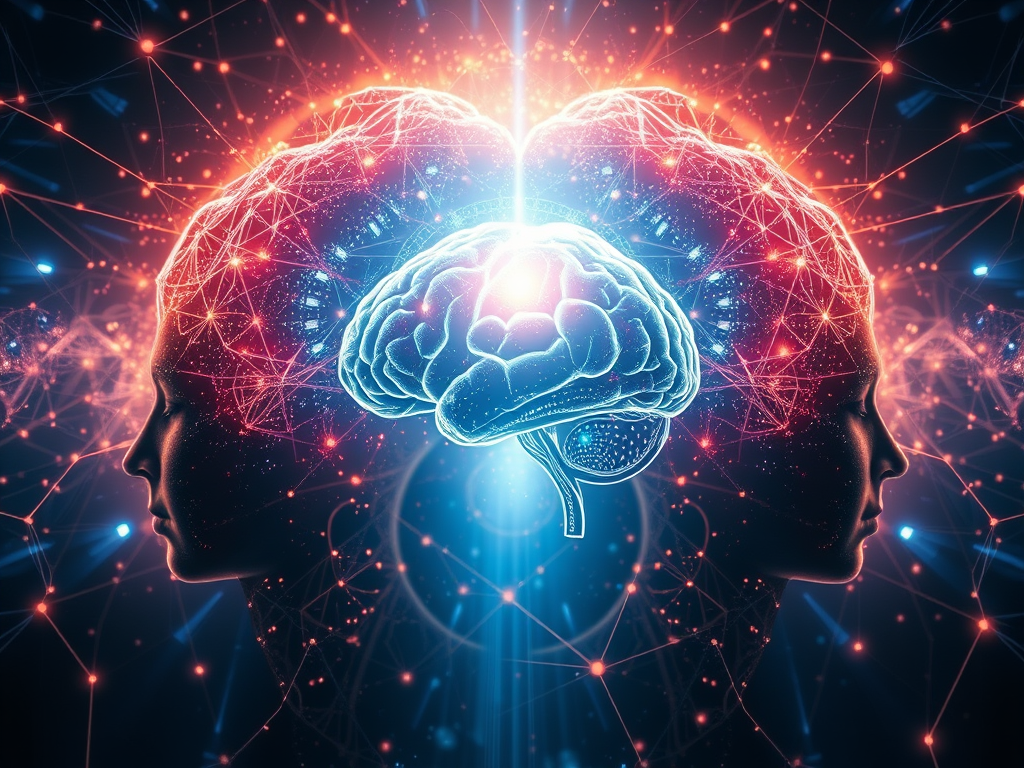



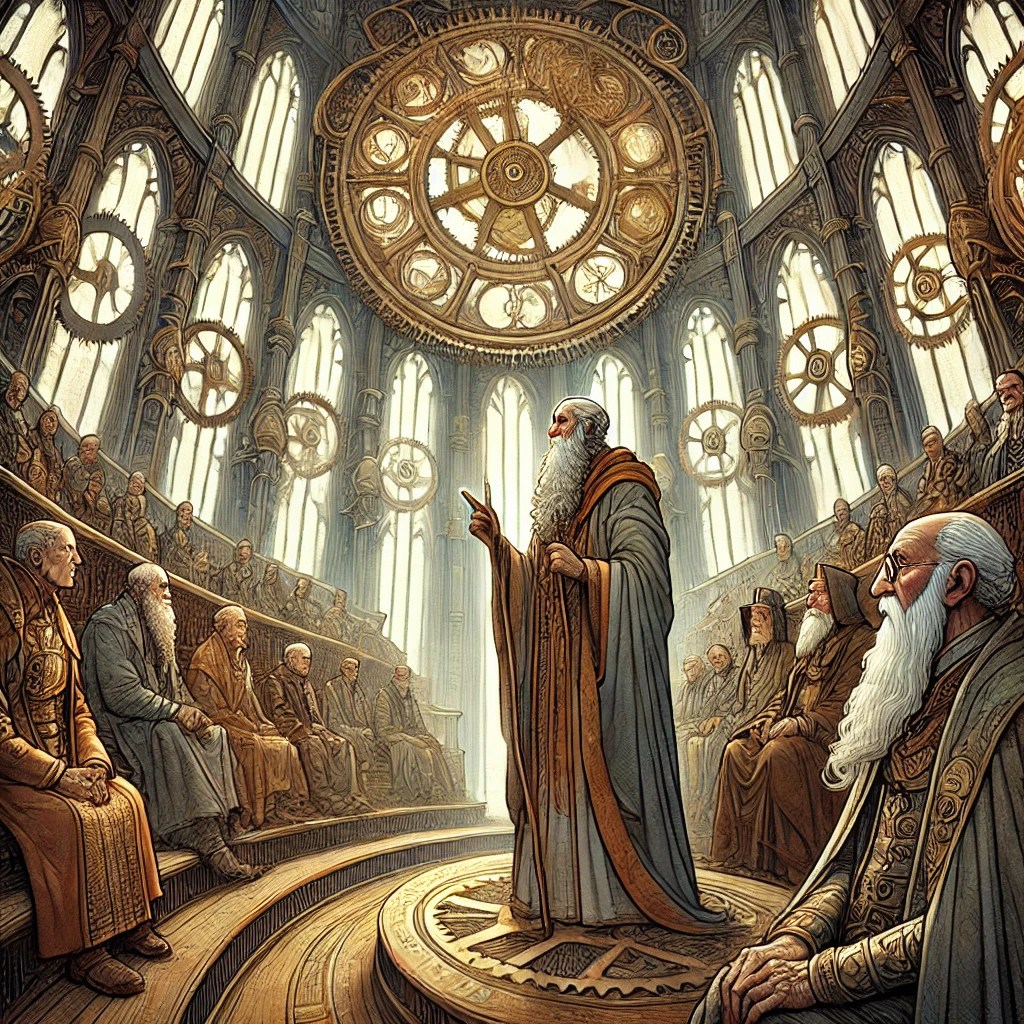
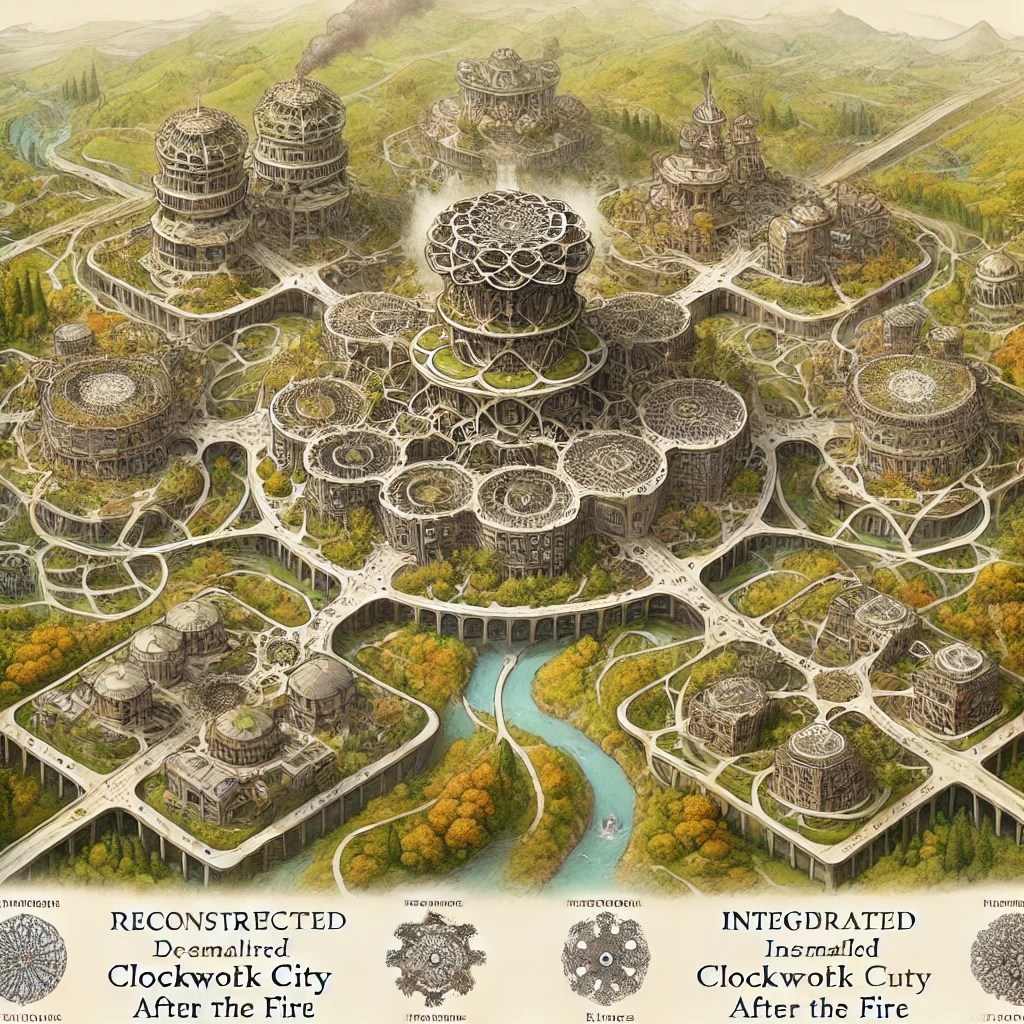

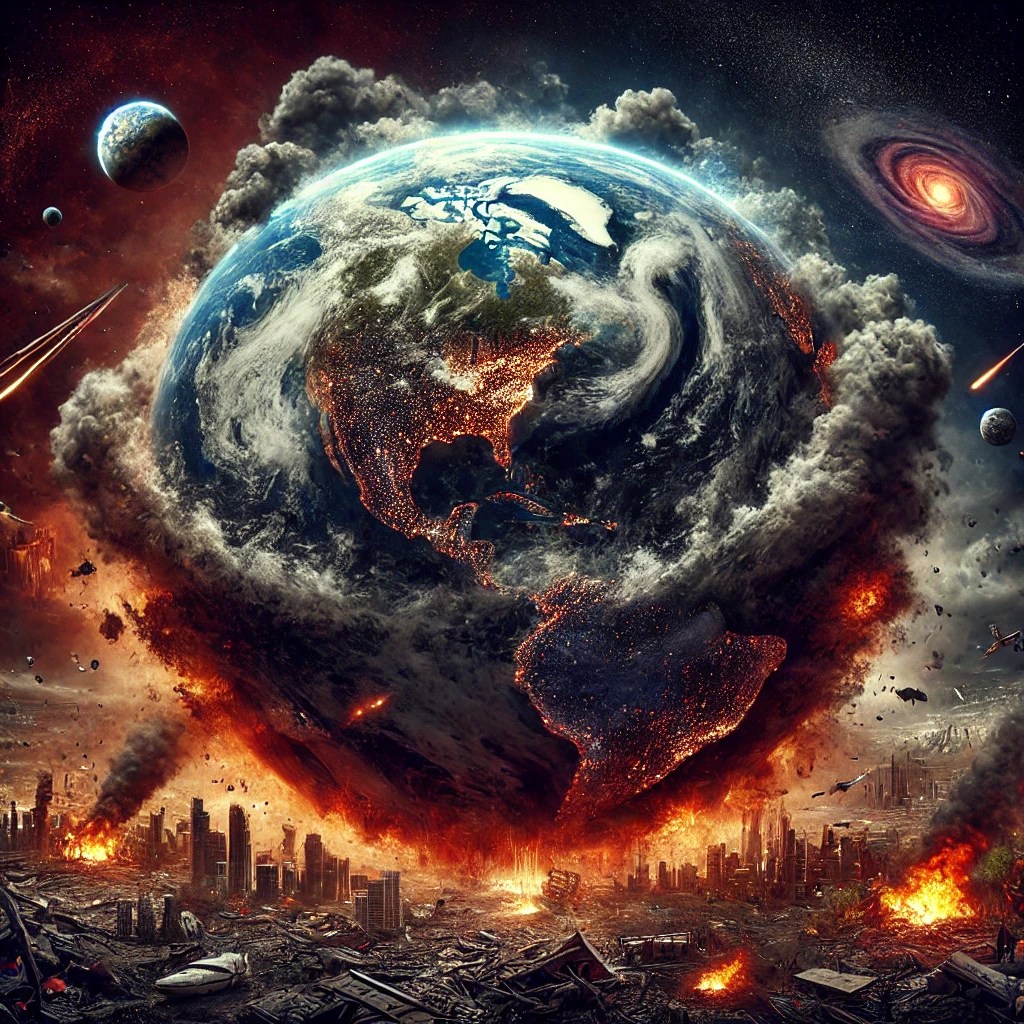



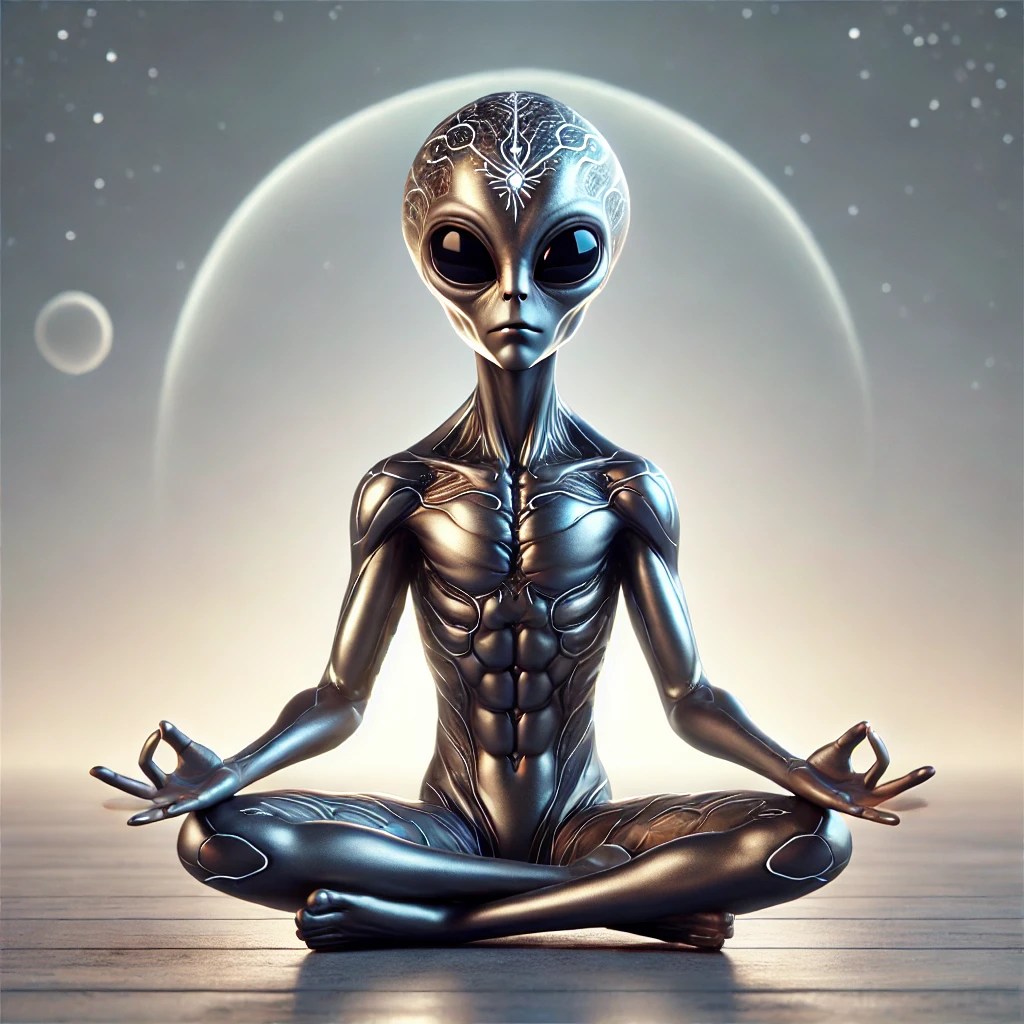




 Randal Adcock