Dear Diary: I’m afraid that we’re missing the boat. In all the confusion in today’s world, we are missing what’s driving the confusion. We’re all preoccupied with the dazzling crazy symptoms, so much so that we can’t look away and beyond the superficial to the deeper root causes. What is driving everyone crazy with information overload, misinformation, disinformation, FOMO, imposter syndrome, cognitive fatigue, decision fatigue and fatigue fatigue, is something that requires distance, perspective, calm reflection, and deliberation. There is one root cause, albeit abstract cause, that is driving everything that is driving us all crazy. It is the rapid pace of progress. We have too many opportunities, so many that we can’t just pick one and invest sufficient time and effort to drive it through to fruition. We’re distracted by emerging opportunities all around us, including the opportunity to see what the other 8 billion humans have to say about things on social media. We have billions of challenges too. So many we’re overwhelmed with a sense of pointlessness, utter defeat. We were born to make a difference, to add value in this world, but every time we turn to do something it seems futile. There are too many twists and turns, too many complications to find a positive outcome. It didn’t happen overnight. It took at least the last 500 years to reach this apex, this tipping point of development. One can trace these historical points of high leverage, such as early global trade missions, cross-cultural learning and adoption, incorporation, the printing press, the stock markets, public education, discovery of the laws of physics, automation and manufacturing economies of scale, discovery and harnessing of both fossil fuels and electricity, electronic mass communication, digital intelligence… Each of these innovations produced compounding exponential growth of civil progress. Yet our brains, though better informed and educated, remain locked in biological status quo. Our brains were designed by countless eons of evolutionary trial and error to function in a small locale with enough food and water within walking distance, to work with about 150 to 200 family and friends we knew face to face, cradle to grave, in a community of trust and respect. Our social instincts served us well. But through the past thousand years, various societies incrementally grew beyond that scale to gradually extend our social instincts artificially. We had religious and moral codes as aids to extend our empathy and compassion into the abstract to accommodate the strangers. It happened one step at a time so we didn’t notice the bigger picture changing. Each new generation born into the emerging world took their starting point for granted as part of nature. But now we can look back and see that we weren’t the only civilization that suffered from success. We now know of a couple dozen lost and forgotten but rediscovered civilizations. We know them by their artifacts, simpler ones burried deeper beneath later sophisticated ones. We find them under metres of soil, sand, roots of trees. Studies in economics have shown that companies and governments alike are subject to diseconomies of scale. They are in fact not too big to fail, but actually fail because they are too big. In the corporate world this has been observed time after time for decades. But now we see that there is in fact a universal scaling law that applies to all organizations, all organisms, all physical structures, and… yes, all civilizations! Eventually, all civilizations, if successful, will become so large and complex that they become unmanageable. Well, here we are! The left-right political polarization, the ethnic cleansing, the coccooning behavior, the growing wealth gap, cancel culture, on and on, are symptoms of the simple fact of civil complexity. People are seeing the world from a safety point of view. They see evil enemies everywhere. That’s what our primitive instincts tell us, that there is a threatening presence here. However, we may be the only civilization that has been able to uncover and learn from the mistakes of past civilizations. We have learned that history repeats itself, never perfectly, but persistently. Let’s think about that for a moment. History repeats. It’s cyclical. Like a fractal unfolding.
Ah-ha! If everything is a fractal, then we can find a way to decipher the code of that fractal and thereby find the simplicity beneath the civil complexity. Deciphering that root fractal formula may not be so difficult. We know about balance, convergence and divergence, attraction and repulsion, approach and avoidance, love and hate. We know that the cosmos is logical, using both inductive an deductive processes to produce “negentropy” or intelligence, against the force of entropy. If success has given us complexity, and too much complexity has given us failure, then maybe simplicity can keep progress alive against the current tendency toward civil entropy.
The Post-Westphalian Ecosystem of Power: Structural Meta-Forces, Fractal Diffusion of Authority, and the Convergence Hypothesis
Preface
Whenever someone talks about global power networks, a familiar accusation surfaces: “That sounds like a conspiracy theory.” The label can silence legitimate inquiry, yet history reminds us that conspiracies—real ones—have always existed. By definition, a conspiracy is simply a coordinated effort by a few individuals to steer events or decisions in ways hidden from public view. From backroom deals and corporate cartels to covert intelligence operations, such coordination has shaped societies for centuries.
This article isn’t about secret plots; it’s about visible systems. The world’s centers of power have shifted. Nation-states still matter, but they now share the stage with transnational corporations, digital platforms, financial networks, and private security firms. Together, these forces form what can be called the Post-Westphalian Global Ecosystem of Power—a web of influence that transcends borders and challenges traditional notions of sovereignty, accountability, and governance.
To make these dynamics tangible, the article is accompanied by an interactive dashboard that lets readers explore ten interlinked “meta-forces” driving this transformation—from financial meta-governance and private military power to algorithmic sovereignty and cognitive warfare. Each dataset reveals part of a much larger structural shift toward networked, data-driven, and privately coordinated systems of global influence. The goal is not to provoke fear but to promote systemic literacy—a clearer understanding of how today’s world truly operates.
Yet beneath this analysis lies a deeper challenge. Humanity has not yet made the necessary paradigm shifts to accommodate the exponential growth of our population, technologies, infrastructure, and interdependence. We continue to manage global complexity with mental models designed for simpler, slower systems. As our networks expand and our decisions ripple instantly across the planet, the gap between our inherited institutions and our lived reality widens.
To bridge that gap, we must rediscover and apply the principle of subsidiarity—the natural tendency of living systems to organize from the bottom up, through local autonomy, cooperation, and feedback. Subsidiarity reflects our socio-biological foundations: the way communities, ecosystems, and organisms sustain coherence through distributed intelligence rather than centralized control. Reinvoking this principle is not a retreat from globalization but a path toward balance—allowing the global system to function as a living network of nested, self-organizing wholes.
The Post-Westphalian Global Ecosystem of Power is therefore not only an analytical model but an invitation: to evolve our collective understanding of governance, reconnect our structures of power with the organic logic of life, and redesign civilization to thrive within the limits and intelligence of nature itself.
I. Introduction: Defining the Post-Westphalian Shift and Structural Meta-Forces
A. The End of Exclusive Sovereignty: From Westphalian Order to Multi-Actor Governance
The traditional geopolitical paradigm, predicated on the nation-state as the exclusive holder of sovereignty (the Westphalian model), is demonstrably dissolving. The contemporary global system operates under conditions of Post-Westphalian Governance, where authority is distributed, multi-level, and complexly shared among various actors. This systemic shift profoundly impacts international relations and global problem-solving, requiring analysts to move beyond traditional state-centric theories to understand how the world functions.
In this diffused architecture, non-state actors play a crucial role. Multinational Corporations (MNCs) often wield economic power and global reach that surpass those of many nation-states. Non-Governmental Organizations (NGOs) and International Organizations (IOs), such as the United Nations (UN) and the World Trade Organization (WTO), further shape global outcomes through a dynamic web of interactions. The erosion of exclusive state sovereignty validates the core assertion that power is diffusing into networks.
B. Conceptual Alignment: Interpreting “Structural Meta-Forces” and “Fractal Systems Subsidiarity” (UCoN)
The assertion that “structural meta-forces” are shaping the global system refers precisely to these emergent layers of influence. These forces operate beneath and between traditional categories of power (government, market, civil society), yet they increasingly determine political, economic, and social outcomes. They represent the effective transfer of traditionally sovereign functions—such as the definition of law, the management of systemic risk, and the control of information—to non-state entities.
When people feel anxious or threatened, they often look upward for strong, centralized authority. Power and decision-making “escalate” to national leaders, big institutions, or even charismatic figures who promise safety and order. This is a natural human reaction during uncertain times—but it weakens local problem-solving and erodes trust at the community level.
Subsidiarity, in contrast, is the principle that decisions should be made at the lowest level competent to handle them. It keeps authority close to where the effects are felt, allowing people and communities to respond quickly, creatively, and with local knowledge. In a healthy system, subsidiarity and escalation stay in dynamic balance: local actors handle most challenges, while higher levels only step in when coordination or shared resources are truly needed.
Using the fractal systems approach of the Unified Code of Nature (UCoN), we can analyze how this balance shifts across five interconnected domains—Political, Economic, Informational, Ecological, and Societal (the PEIES model). When anxiety drives escalation, these domains become centralized and rigid. When trust and capability grow at lower levels, subsidiarity reasserts itself, and the system becomes more adaptive and resilient.
Studies of globalization show that these same forces operate worldwide. As global interdependence increases, we see patterned convergence in how societies organize power and respond to complexity. The UCoN framework helps us see these repeating patterns and design feedback loops that restore subsidiarity where it has been lost, creating a more balanced and self-correcting global order.
C. The Central Thesis: Assessing the Claims of Power Convergence and Organized Elite Effort
The data overwhelmingly validates the premise that non-state actors are acquiring state-like authority, leading to a profound diffusion and fragmentation of sovereignty. Therefore, the existence of parallel structural meta-forces is confirmed. The question then becomes one of intentionality: whether this convergence is the result of a singular, centrally organized elite effort or the necessary consequence of systemic convergence driven by efficiency, optimization, network effects, and shared risk management needs.
This report posits that while powerful elite interests benefit from and actively exploit the diffusion of power, the resulting convergence is primarily systemic. The organized effort is not typically a clandestine command structure, but rather the concerted, documented actions of regulatory capture and the strategic utilization of interlocking directorates and specialized knowledge (epistemic authority) to optimize global outcomes for concentrated capital.
When any organizations grow too large or hierarchical, they often fall victim to what economists call diseconomies of scale—the point at which size and complexity begin to destroy efficiency rather than enhance it. As layers of management multiply, communication slows, feedback weakens, and decisions become disconnected from local realities. The very structure meant to coordinate activity starts to smother initiative and responsiveness. Large hierarchies concentrate information and authority at the top, where leaders are too far removed from ground truth to adapt quickly, while those below lose both motivation and the freedom to innovate. Over time, these internal frictions create waste, rigidity, and moral fatigue, leaving the organization unable to sense or respond effectively to change. In systems terms, the feedback loops grow too long and the requisite variety too low, making the whole enterprise brittle—an inevitable consequence of scale without subsidiarity.
D. The PMSC Paradigm: Establishing Private Security as the Benchmark for Diffused Authority
The rise of Private Military and Security Companies (PMSCs) serves as the foundational prototype for the structural meta-forces analyzed herein. PMSCs signify the privatization of the state’s historical monopoly on legitimate violence. This privatization is not a novel phenomenon; it echoes the corporate concessions established during the colonial era. In historical concessions, such as those granted in the Congo Free State, private companies were explicitly assigned powers traditionally associated with government, including the monopoly over violence and the authority to impose taxation. This demonstrates a continuity in sovereignty arbitrage—the leveraging of weak or absent state authority for private gain—where control of economic extraction and control of coercion are intrinsically linked.
The following table establishes the structural benchmark against which the subsequent domain analyses are compared, demonstrating how non-state actors across all domains are adopting functions analogous to the privatized authority of PMSCs.
Structural Meta-Forces: Foundational Comparison to PMSCs
Fractal Domain
Structural Phenomenon
Influence Scale (PMSC Analogue)
Systemic Effect (PMSC Analogue)
Political
Charter Cities/Private Jurisdictional Zones
Arbitrage of State Law (Territorial Control)
Diffusion of Legal Authority and Sovereignty Bypass
Economic
Mega Asset Managers (The Big Three)
Controlling Capital Flows (Systemic Coercion)
Financialization of Policy and Implicit Regulatory Capture
Informational
Corporate-Intelligence Fusion (AI/Palantir)
Algorithmic Definition of Targets (Executive Function Transfer)
Codified Surveillance and Automated Policymaking
II. The Political Domain: Jurisdictional Arbitrage and the Privatization of Order
A. Private Jurisdictional Sovereignty: Analysis of Charter Cities and SEZs
The structural meta-force in the political domain is the strategic effort to bypass or arbitrarily rewrite state law by creating semi-autonomous private jurisdictional zones. Projects like Honduras Próspera represent modern attempts to establish charter cities that operate under independent legal, tax, and regulatory systems. This challenges the fundamental Westphalian notion of singular, centralized territorial sovereignty.
Historically, this phenomenon has deep roots. Colonial powers routinely granted concessions to private companies across Africa, assigning them powers of taxation and the monopoly over violence to facilitate resource extraction. For instance, in the Congo Free State, large concessions were granted to private entities who were the primary stakeholders, resulting in extraction through extreme violence and the co-option of local leaders. The modern rise of private jurisdictions, while often framed as “pro-innovation governance frameworks,” functions as a contemporary form of this sovereignty arbitrage.
The movement toward charter cities and private concessions is interpreted not merely as a policy preference, but as a deliberate financial optimization strategy. Capital seeks to relocate governance outside of restrictive democratic oversight to maximize efficiency and externalize political risk. This systematic process turns the inherent instability of the Post-Westphalian order into a financial opportunity, specifically by leveraging regulatory competition. The primary systemic effect is therefore the fragmentation of political legitimacy, where effective authority is transferred to the actor—state or non-state—offering the most capital-favorable legal environment, often without popular consent.
B. Non-State Actors as De Facto Policymakers and the Democratic Deficit
In the global system, non-state actors exert significant political authority, even without formal democratic legitimation or accountability. Their claim to authority is often based on institutional competence and epistemic authority—the claim to “know better” and to possess the specialized technical knowledge required to apply specific normative standards to actors and issues.
This specialized authority allows political and economic elites to circumvent the political obstacles inherent in democracy. As governance institutions are increasingly perceived as “remote, bureaucratic, elite-driven and unresponsive to popular will,” non-state actors offer efficient, technical solutions, thereby enabling elites to “bypass the onerous processes of persuasion and consensus-seeking that democracy requires”. This phenomenon generates a significant democratic deficit as policy issues are decided outside the direct control of citizens.
The underlying structure of this power transfer suggests an integration of force and law. The core function of PMSCs is privatized coercion. Historically, private concessions combined this coercion (the PMSC analogue) with legislative power (taxation/law-making). Therefore, modern jurisdictional zones (like Próspera) cannot function as complete structural meta-forces without an integrated security dimension. The structural meta-force in the political domain is the integrated corporate offering of Law-as-a-Service paired with Security-as-a-Service, ensuring the stability required for capital accumulation under privatized rule.
III. The Economic Domain: Global Financial Architecture and Resource Control
A. The Rise of the Big Three: Asset Managers as Systemic Controllers
The economic structural meta-force is the concentration of financial influence in the hands of a few mega asset managers, often collectively referred to as the “Big Three” (BlackRock, Vanguard, and State Street). These firms control trillions in investments, giving them staggering influence over global markets, corporations, and even governments.
This power derives fundamentally from their structural position. Due to the vast size of their index funds, their stakes in mega-corporations (such as Walmart and Amazon) are too large to sell off without destabilizing the entire market. This position dictates that these managers cannot simply manage company-specific risk; they must manage portfolio-wide systemic risk. The normative thrust of this systemic risk management requires them to intervene in policy areas like improving social stability and mitigating climate change. This constitutes de facto policy implementation imposed through financial leverage, effectively bypassing traditional democratic legislative processes.
The dominance of these asset managers is interpreted as primarily structural. It is derived from the systemic mechanics of index funds and portfolio size (“too big to sell”), rather than originating from a malicious intent to control. However, this structural position is subsequently exploited by elites to co-opt regulation and advance financial self-interest—for example, reducing portfolio-wide climate risk is fundamentally an act of financial self-preservation. Consequently, this blurs the line between market governance and government, as decisions aimed at optimizing financial returns become functionally identical to public policy.
B. Financialization of Policy and Regulatory Co-option
The influence of mega-asset managers raises serious governance concerns. There is a tangible risk that their policymaking initiatives, even those framed as benign, “will take the onus off of government to provide solutions better calibrated toward advancing public welfare”. This effect is compounded by the tendency toward regulatory capture. The co-opting of regulation is a common goal of self-regulatory regimes, often supported by corporate America, suggesting that even BlackRock’s own green policies may be undermining true progress by pre-empting more stringent public regulations.
C. Critical Resource Cartels: State-Corporate Alliances
The control over critical global resources confirms the existence of highly organized state-corporate efforts. Securing essential critical mineral opportunities, particularly in regions like Africa, necessitates a highly coordinated inter-agency strategy by powerful states (e.g., the United States). This effort mobilizes government agencies—including the Development Finance Corporation (DFC) for infrastructure, the Export Import Bank (EXIM) for financing, and the State and Treasury Departments for strategic negotiation and fiscal instruments.
This coordinated government action is explicitly designed to forge partnerships with African nations, effectively constructing geo-economic cartels aimed at securing resource control. This confirms that modern geo-economic push for resources echoes the historical model of corporate resource extraction during the colonial era. Today’s methodology substitutes outright violence (the historical PMSC equivalent) with complex financial instruments (DFC, EXIM) and coordinated regulatory and diplomatic pressure. This demonstrates that the Post-Westphalian system perpetuates neocolonial extraction dynamics, simply utilizing financial coercion and inter-agency organization in place of overt military enforcement. Resource control remains a fundamental structural meta-force driven by elite convergence.
IV. The Informational Domain: Algorithmic Authority and the Geopolitics of Data
A. The Corporate-Intelligence Fusion Complex and Algorithmic Policymaking
A key structural meta-force is the fusion of private corporate technology with government intelligence and enforcement capabilities. Companies like Palantir Technologies partner with agencies such as U.S. Immigration and Customs Enforcement (ICE) to deploy sophisticated systems, like ImmigrationOS, utilizing artificial intelligence and data mining to identify, track, and flag individuals.
This partnership results in a substantial transfer of executive power. The architecture of these AI systems—including decisions regarding which data is integrated, which patterns trigger alerts, and what criteria are prioritized—constitutes a form of policymaking in absentia. By designing the tools, the private contractor effectively establishes the operating rules. This establishment of Algorithmic Sovereignty, where a proprietary algorithm dictates state action, fundamentally compromises governmental accountability. This situation is further complicated by revealed conflicts of interest, such as key political figures holding substantial financial stakes in these government contractors , underscoring the risk of the government’s dependence on elite-backed, proprietary technology.
Effective democratic governance requires transparency and accountability in decision-making. By ceding crucial system design functions to private, often opaque entities, the state forfeits transparency, enabling unchecked and automated policy implementation.
B. Infrastructure Control: Geopolitics of Subsea Data and Cloud Sovereignty
Control over the physical infrastructure of global data transfer represents a foundational structural meta-force. The global informational network relies on critical infrastructure, specifically subsea data cables. The security, deployment, and governance of these cables are heavily influenced by geopolitical developments and great power dynamics.
Control over this physical layer of global information flow is strategically analogous to controlling the sea lanes that facilitated historical imperial economic domains. This provides foundational control necessary to leverage the upper layers of algorithmic and cognitive power.
C. Cognitive Warfare and the Erosion of Reality Consensus
The evolution of warfare into the cognitive domain confirms the strategic targeting of the human mind as the primary battleground. Cognitive Warfare (CW) moves beyond traditional Psychological Operations (PsyOps) by leveraging scientific advances in the digital age and artificial intelligence.
CW utilizes strategic messaging, narrative building, and AI-enabled social media tools (such as TikTok) to shape public opinion, target specific populations, and influence the global ‘world view’. This dynamic points to the emergence of a PsyOps-as-a-Service ecosystem, where private contractors, potentially linked to intelligence firms or PMSCs, provide sophisticated narrative shaping capabilities.
The systems-level effect observed is the convergence of these layers of control—Physical infrastructure , Algorithmic definition , and Cognitive targeting. The integration of these components under networked elite control facilitates the attainment of Epistemic Authority. This is control not just over data, but over the shared perception of reality, allowing specialized non-state actors to define what is warranted and what is true.
V. The Ecological Domain: Private Regulatory Regimes and Climate Mercantilism
A. Global Environmental Governance: The Shift to Private Authority
The ecological structural meta-force is the prevalence of private regulatory systems in global environmental governance. Since the 2015 Paris Agreement, international treaties have relied substantially on the private sector’s voluntary willingness to combat climate change.
These private regulatory regimes, which are now the established norm in the contemporary global economy, include Environmental, Social, and Governance (ESG) reporting, carbon accounting, and specific certification schemes for agriculture and forestry. This system grants significant authority to the financial sector and corporations in defining environmental policy outcomes.
B. Regulatory Capture and Climate Mercantilism
The reliance on private regulation is deeply contested. Critics argue that firms deploy these “modest private regulations as a political strategy to pre-empt or delay more stringent public regulations”. This is a clear case of regulatory capture, sometimes characterized as “transition-washing” or “green-hushing.” This regulatory avoidance is intrinsically linked to the historical necessity for private power to secure resource exploitation, often enforced by private coercion. The modern analogue uses compliance standards, such as ESG metrics driven by asset managers , to justify continued resource access and financial viability.
When climate governance is driven by financial sector metrics, the core motivation shifts from ecological preservation to portfolio optimization. Environmental stability is thus framed as a financial asset necessary to secure long-term capital returns, effectively commodifying planetary health. This reinforces the power of asset managers who claim epistemic authority in managing this global risk.
C. Resource Scarcity, Geopolitics, and Power Concentration
The collective response to resource scarcity, exemplified by the coordinated inter-agency strategies of powerful nations seeking critical mineral supplies , further validates the organized effort within the structural meta-force. The convergence in this domain is the structural alignment of the financial industry’s long-term risk strategy with the corporate objective of regulatory resistance. This elite consensus favors specialized market mechanisms, controlled by MNCs and asset managers, over democratic governance in managing global resources, directly substantiating the claim that elites seek to bypass public processes by establishing parallel regulatory systems.
VI. The Societal Domain: Biotechnological Power and Elite Governance
A. The Biotechnological Complex: Proprietary Control over Synthetic Genomics
In the societal domain, a critical structural meta-force is the concentration of biotechnological capability. Advances in synthetic genomics allow for the rapid computational design and chemical synthesis of gene- and genome-length DNA. This technological acceleration grants immense power for application in areas ranging from high-value pharmaceuticals and biofuels to rapid response manufacturing of vaccines during pandemics.
However, this sophisticated capability is increasingly controlled by a “proliferation of companies with proprietary technologies”. Although costs are decreasing, control over the fundamental blueprints and tools for manipulating biological life remains centralized among commercial actors. This concentration of control over core research acceleration and response mechanisms establishes a Biotechnological Power Complex that determines societal outcomes based on profit motive and intellectual property rights.
B. The Democratic Deficit in Standard Setting
The privatization of this fundamental technology reinforces the broader democratic deficit observed across the domains. Non-state actors operating as standard setters in biology, technology, and finance operate without formal accountability or legitimation. Their authority is based on specialized knowledge—epistemic authority—the claim that their institutional competence provides superior outcomes compared to the cumbersome nature of democratic processes. This mirrors the justifications employed by corporate intelligence firms and financial asset managers.
Proprietary control over synthetic genomics dictates the fundamental trajectory of human health and biology based on commercial interests. The structural meta-force accelerates inequality and vulnerability, as foundational technological power (both biological and digital) becomes concentrated and managed by non-accountable technical elites. This phenomenon confirms a systemic effect: the convergence of epistemic elites—coders, scientists, and financial engineers—who command specialized knowledge, enabling them to bypass political barriers and reinforce centralized control.
VII. Synthesis and Conclusion: The Convergence Hypothesis
A. Reliable Sources and Confirmation: Summarizing the Empirical Validation
The analysis confirms the assertion that a set of parallel structural meta-forces defines the post-Westphalian ecosystem, each acting as an emergent layer of influence that fundamentally diffuses sovereignty and authority away from the state.
Validated Structural Phenomena:
Political: Arbitrage of sovereignty through Charter Cities and modern concessions.
Economic: Functional policymaking driven by Asset Manager Control of systemic risk.
Informational: The transfer of executive function via Corporate-Intelligence Fusion and the establishment of Algorithmic Sovereignty.
Ecological: Regulatory pre-emption via private ESG standards and the formation of state-corporate Resource Cartels.
Societal: Centralization of Biopower through proprietary Synthetic Genomics.
B. Analyzing the Nature of Convergence: Systemic Feedback Loops vs. Organized Effort
The data supports the academic concept of global systemic convergence. These meta-forces intersect deeply: asset managers leveraging financial metrics (Economic) to drive environmental policy (Ecological), which creates demand for resource cartels (Economic/Political), often relying on privatized security (PMSC analogue).
The analysis concludes that the convergence is driven primarily by structural necessity—the inherent alignment of interests focused on risk reduction, technological efficiency, and capital optimization. The evidence for a singular, centrally commanded “organized elite effort” is circumstantial, yet coordination is clearly established through powerful, documented mechanisms:
Regulatory Capture: Concerted elite strategy to delay or co-opt stringent public regulation by promoting self-regulatory regimes.
Interlocking Elites: Shared financial interests and personal relationships among political figures and major technology/financial contractors.
Epistemic Consensus: A shared conviction among specialized technical and financial elites that their competence justifies bypassing democratic mandates to manage complex global systems.
C. The “Fractal Subsidiarity” Framework: Re-evaluating the UCoN Model
The user’s framework, based on fractal subsidiarity (UCoN), is validated as an appropriate structure for mapping multi-level power diffusion. The flow of authority is indeed determined by subsidiarity—authority flows to the level deemed most capable or efficient. However, the analysis highlights that the greatest systemic risk is the tendency for authority to flow consistently toward specialized private competence (Epistemic Authority) , bypassing the fractal domains of public or democratic legitimacy entirely.
Analysis of Non-State Actor Authority and the Convergence Hypothesis
Form of Authority
Source of Legitimacy/Power
Evidence of Systemic Convergence
Assessment of “Organized Elite Effort”
Political/Legal Arbitrage
Institutional Competence; Control of Law/Territory
Historical continuity of sovereignty arbitrage structures
High evidence of coordination in specific state-corporate ventures (e.g., critical mineral procurement )
Financial/Market Control
Structural Position (Too Big to Fail/Sell); Index Tracking
Moderate evidence of organization; driven primarily by structural necessity, but exploited through self-regulatory capture
Epistemic/Algorithmic
Control over Data Flows and AI Architecture
Integration of physical infrastructure (cables) with cognitive warfare capabilities
High evidence of intentional coordination via proprietary system design and revolving door conflicts of interest
Regulatory/Ecological
Voluntary Regulatory Schemes (ESG, Certification)
Strategic lobbying to pre-empt public regulation and manage political risk exposure
Moderate evidence of organization; concerted effort to establish soft law as a barrier against hard law
D. Recommendations for Mitigating the Democratic Deficit in the Post-Westphalian Age
To counter the systemic convergence of unaccountable power and mitigate the democratic deficit inherent in the post-Westphalian ecosystem, targeted policy interventions must focus on reclaiming public control over infrastructure, policy implementation, and foundational knowledge:
Mandating Algorithmic Transparency: Governments must establish legal requirements for open-source disclosure, or mandatory independent third-party audits, of corporate-designed AI systems (e.g., those used for tracking and enforcement) that implement state policy. This is essential to challenge Algorithmic Sovereignty and ensure the architecture of the system aligns with public mandates, not private interests.
Redefining Systemic Risk Governance: Public oversight mechanisms must be legislated for mega-asset managers to ensure that interventions intended to manage systemic risk are truly calibrated toward advancing public welfare rather than purely serving financial self-interest. This involves subjecting large-scale financial management decisions, often framed as private ESG initiatives, to public scrutiny.
Reclaiming Epistemic Authority: Significant public investment is required to fund robust, independent, non-proprietary research institutions (especially in genomics, AI ethics, and data infrastructure governance). This measure is necessary to counter the dominance of proprietary corporate knowledge, challenge the rationale for elite bypass , and ensure that the foundational tools shaping the societal trajectory remain within the public domain.
I am tackling a highly complex task: validating a theoretical model that describes the “post-Westphalian ecosystem of power.” This model asserts that global power is diffusing into networks governed by a convergence of private actors—including security firms, financial giants, digital platforms, and biotech complexes. My goal is to find credible academic and authoritative journalistic sources that either confirm or contradict these ten structural meta-forces and the overarching hypothesis of an organized effort by elite groups.
Identifying Key Power Structures
My analysis is synthesizing the user’s ten assertions into five major domains for targeted research. These domains include the foundational theory of diffused power; the influence of megafunds (BlackRock, Vanguard) and private equity in ‘Financial Meta-Governance’; the combined effects of ‘Platform Sovereignties’ and ‘Intelligence-Corporate Fusion’; the role of private actors in ‘Resource Cartels’ and ‘Climate Governance’; and the convergence of ‘Biological, Cognitive, and Urban Power’ (biotech, psyops, private cities).
Plan for Sourcing Evidence
To efficiently cover this expansive framework, I’ve designed a multi-node search plan. I will first validate the core theoretical premise (‘post-Westphalian power diffusion’) and then conduct grouped searches on the financial, informational, resource, and biological/cognitive assertions. This approach allows me to maximize the breadth of coverage while ensuring I leave sufficient resources for deep dives into any highly relevant documents or reports I discover.
I have successfully validated the core academic framework underpinning the user’s theoretical model. Sources confirm the concept of ‘Post-Westphalian Governance,’ noting that authority is shifting beyond nation-states to include distributed networks of non-state actors like multinational corporations and NGOs, whose economic power can surpass that of many governments. This confirms the overall framing of power diffusing into complex networks.
Confirmed Structural Phenomena
My research has confirmed substantial evidence supporting several key structural forces identified in the user’s framework. Specifically, I found strong support for the influence of megafunds (BlackRock, Vanguard) acting as de facto regulators; the reality of ‘Intelligence-Corporate Fusion’ (e.g., Palantir’s role in government data systems); the rapid growth of private, proprietary ‘Synthetic Genomics’ technology, raising the specter of ‘privatization of life’s code’; and the emergence of sophisticated ‘Cognitive Warfare’ utilizing AI to target the human mind as a ‘key battleground.’
Identifying Key Information Gaps
While many assertions have been corroborated, critical information gaps remain concerning the explicit linkage between these structural forces, particularly around the core hypothesis of an ‘organized convergence of powers’ by elite groups. I also lack specific details on the security component of resource cartels (e.g., the role of PMSCs in critical mineral acquisition), the governance mechanisms of large AI models, the geopolitical dependencies on cloud infrastructure, and the critiques of private ‘Urban Fortress Governance’ and ‘Geoengineering Regimes.’
My Next Research Strategy
To complete the validation of this comprehensive framework, my next step is to conduct deep-dive research focused on three crucial areas. First, I will specifically test the ‘convergence’ hypothesis to find sources that either support or contradict the theory of a coordinated effort among these private power networks. Second, I will investigate the nexus between critical resource control and the private security apparatus, combined with the critique of private urban governance. Finally, I will focus on the geopolitical implications of cloud computing, AI governance, and the regulatory challenges posed by geoengineering technologies.
I have successfully sourced reliable, authoritative information that validates the structural model proposed, confirming the existence and systemic effects of all ten ‘meta-forces.’ The academic and policy literature confirms that power is diffusing beyond the state to unaccountable, non-state actors in areas like private security, finance, digital communication, and biotechnology. This extensive evidence supports the view that we are operating in a ‘post-Westphalian’ environment where governance is increasingly handled by corporate and financial systems rather than public institutions.
Addressing the ‘Elite Convergence’ Hypothesis
A key objective was to validate the user’s assertion that this power shift is an ‘organized effort or efforts by elite groups.’ My research confirms the existence of ‘elite-driven governance’ and a ‘democratic deficit’ where political and economic elites bypass public consensus. Critiques of asset managers (BlackRock) and climate governance initiatives (ESG) reveal that reliance on the private sector can be a political strategy to ‘pre-empt or delay more stringent public regulations.’ While authoritative sources focus on *structural convergence* driven by market logic and political opportunity, they do not provide evidence of a *conscious, verifiable conspiracy* or coordinated plot between disparate entities like a Russian PMC and a US asset manager.
Confirming Governance Analogies
I found specific evidence supporting the historical and structural analogies within the framework. The assertion of ‘Neocolonial Resource Cartels’ is supported by sources showing the contemporary dynamics of critical mineral extraction in Africa, and the historical critique of private entities (like colonial concession companies) being assigned quasi-governmental powers, including the monopoly over violence and taxation. Similarly, the critique of ‘Urban Fortress Governance’ is validated by analysis of Special Economic Zones and Charter Cities being ‘experiments in private governance’ that compound sovereignty concerns.
Concluding the Comprehensive Analysis
I have completed the validation of the entire UCoN framework, providing sources for all ten phenomena, including the geopolitical dependencies on data infrastructure (subsea cables), the central role of the private sector in AI policy, and the dominance of market-based solutions in climate governance. With the confirmation of the structural assertions and a nuanced understanding of the ‘convergence’ critique, I have sufficient information to synthesize a final comprehensive report that addresses the user’s request without needing further information retrieval.
Cross-cultural impact assessment (CCIA) is in a formative stage of development. It is evolving to meet requirements demanded by situations of rapid acculturation, particularly as fossil fuel resource development impinges on the lives of Canada’s Indigenous people. CCIA is emerging as a special and unique adaptation of standard social impact assessment (SIA).
As it emerges and evolves, researchers doing CCIA must be aware of the purpose and specific nature of CCIA. They must be able to see its potentials and limitations in describing, explaining, predicting, and controlling cross-cultural impacts. Researchers should also be aware of the body of social science theory which supports CCIA, defines it, and makes it possible. The processes involved in conducting CCIA research should be understood as the main substance and activity of CCIA.
To achieve this understanding, this report is divided into three sections: A. CCIA: An Introduction; B. Theoretical Framework for CCIA Methodology; and C. The CCIA Research Process.
The first section deals with questions concerning the purpose and setting of CCIA; who is involved and in what ways; and required modifications to SIA in the cross-cultural situation. It is argued that for assessing impacts to Indigenous culture caused by fossil fuel resource development projects, standard SIA topical content is inadequate and its research process methods are inappropriate, as they stand. Modifications are needed to address more fully the study of the Indigenous subjective culture (values, beliefs, identity, language, etc.). Changes to the research process involve a more intensive and extensive community participation program, and more comprehensive modelling and simulation than is common in SIA.
The theoretical framework for CCIA methodology points out various considerations in doing CCIA research. The Indigenous community and culture are viewed as an interpersonal information processing system. The way in which local people construct their representations of reality is different from the way other groups construct their realities. The local perspectives shared among residents constitute a cultural perspective paradigm and are to be studied as a whole system of inter-related causes and effects. A scientific thinking process is discussed which is to serve as a basis for thinking in the actual research process.
The relationship between resource development project and Indigenous community is also discussed as a background to the subject to be researched.
The CCIA research process consists of seven stages:
Community–proponent liaison
Issue identification
Model-building
Data collection
Simulation and gaming
Projection
Assessment and mitigation
Each stage is developed in terms of the purpose, methods used, problems encountered, relationships to other stages, and the nature of subjects studied. Stress is put on the community-based nature of the research and the flexibility required to accommodate uncertainty in the process.
Special note should be made of the fact that this report presents only one range of possible approaches to studying cross-cultural impacts. It is an approach that is very adaptable as it can be used to produce information of any desired complexity or simplicity. If time, money, or professional resources are short, simple models and simulations can be built. If more complete and reliable projections and assessments are needed, complex models and simulations can be built. It can also be changed on the location to suit needs and resources available as they arise.
The report is an attempt to integrate various scientific and humanistic ideas and perspectives to be used with an end to minimize negative impacts and maximizing positive impacts to Indigenous culture. It is not a study of cross-cultural impacts, but a proposal for how such a study can be constructed and carried out.
It is not a study of impacts to the development proponent, although acculturation and impaction are two-way streets. Impacts to the proponent (corporate organization, policy, ideology, and project development) must remain the topic of other reports. However, it is important that CCIA be conducted for the proponent corporation so that it can respond best to the demands of cross-cultural interaction. A cooperative mutual learning centre should be established on the community or project site to facilitate maximum understanding of the rapid acculturation.
CCIA Report Structure
Section A
Section B
Section C
CCIA: An Introduction
Theoretical Framework of CCIA Methodology
CCIA Research Process
1. Fossil Fuel Resource Development Projects
1. Science and Knowledge Processes
1. Community–Proponent Liaison
2. Indigenous Communities
2. Systemic Causation
2. Issue Identification
3. Standard SIA
3. Subjective Reality Construction
3. Model-Building
4. Inadequacy of SIA Content
4. Cultural Perspective Paradigms
4. Data Collection
5. Inappropriateness of SIA Process
5. Nature and Study of Impaction
5. Simulation and Gaming
6. Summary of CCIA Problem
6. Summary of Theoretical Framework
6. Projection
7. Assessment and Mitigation
8. Summary of Research Process
Here’s a polished draft of Section A.1 – Fossil Fuel Resource Development Projects, with subsections Impacts and Corporate Objectives fully merged and lightly cleaned for readability while preserving the original meaning and tone:
Petro-Canada’s main interest is to develop fossil fuel resources in order to make money and serve the Canadian public through the economy. To do this requires finding resource reserves, getting the resource out of the ground, transporting it to refineries for processing, processing it, and transporting the product to consumers. At various stages along the way, development projects (seismic exploration, drilling, pipelines, refineries, etc.) come into contact with Indigenous communities. These are often in the hinterlands of northern Canada but also occur near southern urban Canadian centers.
These projects may be temporary, such as exploration activities, or they may be long term, such as wells, pipelines, or refineries. In either case they may have long-term consequences for local ecologies and Indigenous cultures.
A.1.a Impacts
Impacts are changes made to a community as a result of these kinds of activities. They are not initiated by the community but are caused by the activities of a development proponent. The impacts or effects of these projects may be due to direct cross-cultural contact—as in employment, education, or infrastructural development (roads, houses, sewers, services)—or indirect effects, such as environmental changes caused by projects.
For example, fishing can be affected by refinery effluents, hunting by air traffic noise, and farming by roads and land clearance.
Impacts can be perceived in two ways: either positive or negative. Local residents often disagree about which they are. Some Indigenous people may prefer to maintain traditional educational practices, while others may wish to learn trade skills for wage employment. Often compromises are required.
Employment opportunities are often made available to local residents first, with on-the-job training and orientation offered to local Indigenous hires. Yet, depending on how well people are prepared for industrial labor and urban Canadian cultural expectations, difficulties can arise. They may feel “out of place” in a white-dominated workforce, lose face as they learn through mistakes, or encounter misunderstandings with Euro-Canadians. Their lifestyles can be disrupted as they have less time to hunt or fish, and must rely on store food. Cultural heritage can become devalued or dismissed by outsiders, leading to hurt and confusion.
Negative social impacts such as alcoholism, family violence, and suicide can occur as a result of rapid cultural change. These impacts can be mitigated if cooperative planning between corporation and community takes place. Cross-Cultural Impact Assessment (CCIA) can be used to identify and help plan for these impacts.
A.1.b Corporate Objectives
Although the corporate motive is often thought of as profit, this is not the only corporate interest. Corporations are part of society and should be concerned not only with maintaining the “status quo” but also with the quality of life of people they contact. As the public becomes more informed of corporate powers and activities, corporations are increasingly expected to act in socially responsible ways. Petro-Canada’s environmental and social policies reflect this trend.
Differing perspectives exist, however, between corporations and communities. Energy corporations often focus on profit for shareholders, while communities emphasize human resources, quality of life, and self-reliance. Indigenous communities seek local control of development for autonomy and independence. These interests must be reconciled so that they coexist and ideally complement one another.
From the industry perspective, cooperation with Indigenous communities can be achieved for several reasons. According to Doug Bowie, Vice President for Environmental and Social Affairs at Petro-Canada (May 1981), corporate motivation for cooperation falls into four levels:
Regulation – Cooperation is required by government regulation.
Economic feasibility – Cooperation avoids risks and reduces expenses due to mistakes.
Public opinion – Cooperation is necessary to satisfy public opinion.
Social responsibility – Cooperation is desirable as a fulfillment of social responsibility.
The motivation for cooperation can strongly influence the success of CCIA. The higher the motivation, the more reliable and valid the results are likely to be. Often, however, the extent of cooperation depends on how much the corporation needs or wants from the Indigenous community rather than the projected impacts on the community. This tendency is reflected in the tools used in analysis.
Cost-benefit analysis, for instance, is often a tool for proponents only, offering only rough estimates of cultural impacts. CCIA should be designed for both the community and the proponent. Together they are better positioned to plan mitigation measures and direct development to create positive opportunities. Cost-benefit analysis can still be used to evaluate corporate outcomes but should not define the whole process.
Community-based impact assessment represents a stronger commitment to cooperation. It satisfies all four levels of motivation, provides opportunities for fuller appreciation of community perspectives, and helps maintain community autonomy, integrity, and cultural identity. For the corporation, it reduces risks, costs, and delays by ensuring impacts are identified and addressed early.
Community-based CCIA relies heavily on local voluntary and employed resources, encouraging extensive participation and fostering close cooperative relationships between proponent and community. This ensures that the maximum amount of local information is used, making the impact process more predictable and controllable. Community-based CCIA will be discussed further later in the report.
Indigenous communities are quite different from each other in their traditional cultures, and in how they have changed through acculturation. Indigenous community development is one means being tried to help overcome impacts of industrialization.
A.2.a Diversity of Groups
Indigenous communities consist of a population of distinct people who share a common culture in a particular locality. They may be treaty First Nations peoples, non-treaty Indians, Inuit, Métis, or any combination. They may be distinguished by linguistic groupings such as Algonkian, Athapaskin, Sioux, or Iroquois; by ecological zones such as sub-arctic, arctic, boreal forest, plains, or coastal; or by other categories like treaty number, economic subsistence or extent of experience and ability in dealing with government and industry.
There is a wide variety of types of Indigenous communities. Unlike urban Canadian communities, Indigenous communities are generally relatively isolated. That is, they are not as socially and economically interdependent with external communities as urban communities are. They maintain their differences as a result.
A.2.b Traditional Group Similarities
However, despite their differences there are substantial similarities between Indigenous communities. Traditionally, most Indigenous groups were hunting and gathering bands or tribes. They could be described in the following terms:
small groups: bands or camps
fluid or unstable group organization (forming and dissolving), personalities more important
high mobility; nomadism
taking from the environment rather than replenishment of it; hunting, fishing, foraging
little authoritarian leadership
little specialization
division of labour by sex and age
egalitarian society (little social stratification)
ideology of kinship, but not rigid
little “ownership” of resources
lack of strict territoriality
feuding, but not large scale war
polytheistic religion (many gods or spirits).
These characteristics were generally true but not always—exceptions were common.
Some Indigenous people were horticulturalists, namely the Iroquois. They could be characterized as having:
investment in the environment; planting, tilling
tendency toward stable groups; settled or semi-settled communities
division of labour based primarily on sex and age
basically, social equality; though social stratification may occur as reliance on cultivation increases
pervasive ideology of kinship; kin groups become important
development of notions of territoriality
feuding on group level; wars may occur
polytheistic religion, with or without a high god; ancestral veneration occurs.²
These classes of culture, hunting-gathering and horticulturism, are ideal types which likely describe no particular culture perfectly. Indigenous Canadians depended very much on the natural environment’s ability to produce food but their technologies enabled them to adapt to changing ecological conditions. Their culture evolved over perhaps 40,000 years of life on the North American continent.
Needless to say, modern Indigenous communities usually are no longer of hunting-gathering or horticulturalist cultures. Many pressures of acculturation have forced many of them into dependent economies struggling for any cultural identity.
A modern Indigenous culture tends to have these characteristics:
larger, more stable settlement
mixed economy: agriculture, trapping, hunting and fishing, wage labour, welfare, cottage industry
increased social stratification and division of labour
more formal education
dependence on government for development of resources – increasing in autonomy
more industrial technology
more interdependence with other communities and more communication concerning outside issues
monotheistic religion.
Indigenous communities adapt to pressures of urban Canada in differing ways and so the diversity among Indigenous cultures increases. These characteristics are still only partly true of any particular community. A culture is a very adaptive thing.
A.2.c Culture: Two Realities
Frank Vivelo defines culture as “the shared patterns of learned belief and behavior constituting the total lifeway of people; the totality of tools, acts, thoughts and institutions of any given human population.”³ By this definition it must be understood that culture consists of two realities: the physical (observable, objective, or empirical) reality, and the mental (experiential, subjective or psychological) reality. Though we do not know exactly how the two realities are connected, and some people believe there is only one reality, for the purposes of study we must treat them differently. Physical reality is directly observable (in common sense) and mental reality is not.
² Adapted from Frank Vivelo, Cultural Anthropology Handbook, pp. 53, 66, 1978. ³ Frank Vivelo, p. 242, 1978.
Though we can observe outward behavior of Indigenous people (or others) along with their technologies and essentially agree on what we see, we may differ greatly on how we interpret what is seen. We construct different mental representations of physical reality. The representations constructed by different people within a culture may be quite similar but representations constructed by people of different cultures could be very different. The culture one belongs to is very important in determining how one constructs his mental representation of physical reality.
A.2.d Subjective Culture
What another person sees in his reality is very difficult to determine at the best of times, but when a researcher from a petroleum corporation is trying to study the mental reality of an Indigenous culture, he must first construct a culturally biased representation of the observed behavior (the physical reality) of the Indigenous persons and then speculate on what this behavior means to them. In other words, there is no way to directly observe how anyone, especially of a different culture, makes sense of his world.
Some ways of describing the value and belief systems of Indigenous culture have been suggested by anthropologists. Traditionally, Indigenous people, living close to nature, maintained values and beliefs that were very essential for survival in their environment. They believed in harmony, not exploitation, in that destroying natural resources meant self-destruction. Many practiced calculated conservation. The ultimate test of truth of a belief was practice — a belief must be useful. This meant that truth was contextual — what works in one situation may or may not work in another. Beliefs must be adaptive as conditions change. Yet stability in the system was maintained by myths, folklore, and customs handed down orally from generation to generation. These concerned general do’s and don’ts (totems and taboos) that were required for survival and personal fulfillment.
Another aspect of subjective culture is the need for cultural identity and pride. Indigenous people, like all other groups or classes of people, need to feel good about their heritage. It is often expressed as ethnocentrism (cultural pride) or xenophobia — “we are the best” and fear of outsiders, respectively. A certain minimum amount of cultural identity and pride is required for cultural stability and development. Today, modern Indigenous people have had much of their cultural identity destroyed by urban Canadian attempts to assimilate them and make them economically and politically dependent.
As far as cognitive style or thinking style is concerned, Indigenous people have traditionally made extensive use of analogy — finding similarities among differences in experience. This is a pre-scientific style in which the use of inductive and abstract reasoning is underdeveloped. This is part of the cross-cultural communication problem.
Indigenous values are an issue of vital concern to modern communities. The National Indian Brotherhood has stated in a policy paper to the Minister of Indian Affairs and Northern Development that Indian children should be learning that “happiness and satisfaction come from pride in one’s self, understanding one’s fellowmen, and, living in harmony with nature”:
Pride encourages us to recognize and use our talents, as well as to master the skills needed to make a living;
Understanding our fellowmen will enable us to meet other Canadians on an equal footing, respecting cultural differences while pooling resources for the common good;
Living in harmony with nature will ensure preservation of the balance between man and his environment which is necessary for the future of our planet, as well as for fostering the climate in which Indian Wisdom has always flourished.
In brief the values here are:
Self-reliance;
Respect for personal freedom;
Generosity;
Respect for nature;
Wisdom.
A.2.e Indigenous Community Development
Regardless of differences, all Indigenous Canadian communities are faced with threats to their lifestyle, their values, and beliefs.
In 1940 the Minister of the Interior, J.A. Crear, declared that the First Nations peoples were not “mentally and temperamentally equipped to compete successfully with the White population” and that therefore the government was abandoning its efforts “to equip the Indian to work and live in the white urban communities…”. The government-sponsored Hawthorn Report of 1967, which dealt in some detail with the conditions and problems of the First Nations peoples, stressed that: “…the general aim of the federal government’s present policy is based on the necessity of integrating First Nations peoples into Canadian society.” Indian leaders were suspicious of this approach, which they feared would mean “assimilation by coercion” rather than “participation by consent.”
The federal and provincial governments have, until the seventies, been making decisions for Indigenous people, without much consultation and without invitation to Indigenous communities to participate in administration.
One means of achieving control over their destiny is through Indigenous community development. This is locally initiated and regulated human and economic resource development. If a paternalistic attitude of the Federal Government has ensured that Indigenous people are kept dependent instead of self-reliant, being “kept” has stifled the learning of skills and the adapting of values and beliefs required for making a satisfactory living in the modern world. Many band councils and determined groups are now building their own schools, services and businesses. They adopt organizational styles and methods which are consistent with traditional styles and methods. They develop cooperatives, craft industries, adult education programs and social service centres. They have voluntary non-profit associations, and some are recovering almost lost or forgotten ceremonies and arts.
Some of this independence has been possible because of revenues from fossil fuel development, but much has been done by sheer will-power and self-education. These people are learning to use experts and consultants when necessary and to support local initiatives toward professional development. CCIA can be used by Indigenous people doing community development for planning and evaluation at the local level.
A.2.f Acculturation
The main continuous debate for Indigenous peoples seems to be how to maintain elements of traditional culture while adapting to new social, economic and political pressures and opportunities. When a fossil fuel resource development project impacts an Indigenous community, rapid acculturation can take place which can cause much confusion over cultural change. Acculturation may be defined as:
“cultural change that is initiated by the conjunction of two or more autonomous cultural systems. Its dynamics can be seen as the selective adaption of value systems, the processes of integration and differentiation, the generation of developmental sequences, and the operation of role determinants and personality factors.” ⁶
It is therefore very important that both the development proponent (i.e., Petro-Canada) and the Indigenous communities affected by the development projects be informed about possible cross-cultural impacts before these happen. The role of CCIA can be very essential in planning cultural development locally.
Perfect — here’s the final merged OCR text for Section A.3 (Standard Social Impact Assessment) with the last piece you just provided included:
Because of the special nature of impacts on Indigenous Communities by fossil fuel resource development projects, SIA should be reconsidered. “SIA’s often proceed on a common sense, ad hoc basis.”“To date, much … social impact assessment has been largely descriptive, unsystematic, and seldom comprehensively analytical.” These words, spoken by professionals in SIA, capture the current state-of-the-art in SIA. It is only a decade old and though it is based on the tradition of western social science it is a policy science and hence its fore-runners are only post World War II occurrences. SIA has been adapted and modified for a wide variety of situations, now including the cross-cultural setting.
A.3.a SIA for Whom and for What?
Generally speaking, SIA is a method used by developers, requested by governments, to determine how their development projects will affect the immediate human environments. The results of SIA are used by governments to determine what mitigation or compensation the proponent should be charged with if the project is to proceed. They are also used by the development proponent to determine whether the project is economically feasible, considering mitigation and compensation.
Another consequence of the SIA study, frequently only incidental, is to create community awareness of the proposed project. The awareness may or may not result in community action for or against the project.
SIA is usually done in a mono-cultural setting, or where both development proponent and affected community are assumed to be essentially of the same culture. However, a closer analysis of any situation will show that there are always cultural differences between social groups. These differences may be associated with geographic locality, economic class, ethnic origin, political status or ideology, education levels, or other shared personal attributes.
Canada has often been considered a cultural mosaic, a society of people or communities sharing some values and beliefs but not others. Whereas there are some similar cultural elements shared by all, there are differences which make each person and community different. When differences between Indigenous and urban-industrial Canadian communities are involved in a study and can be seen to include substantial cultural components, standard SIA must reflect the extent of those differences.
If SIA should always consider community impacts from the perspective of those impacted, more attention should be given to local perspectives when these are most different from the researcher’s perspective.
When impacts are clearly of a cross-cultural variety (energy resource development – Indigenous Community) the local perspective or understanding and evaluation of potential impacts must be given greater emphasis. The “objective” impacts to economy, demography, technology or infrastructure should be seen from the local perspective. This is because local people have to live with the changes or stop them in the ways they understand and value them in the context of their culture. The same applies to impacts to the subjective culture.
On a continuum then, CCIA is SIA which is designed to emphasize the study of impacts of acculturation where cultural differences between proponent and community involved are relatively large:
Standard SIA ————————————————————— CCIA Cultural Homogeneity —————————— Cultural Heterogeneity
A.3.b Actors and Their Roles in SIA
The developers are the initiators of the SIA process as they want to develop a resource such as oil, gas or coal (or highways, high-rises, parkland, power dams, etc.). They are responsible for conducting the SIA. They are responsible for ensuring a minimum of disruptions to local human environments which require mitigation or compensation for imposed changes.
The governments involved represent the public interest in general. They set regulations, guidelines and criteria for evaluation of SIA results. Governments may have unofficial objectives as well, such as development itself or use of SIA information for other purposes.
The communities who are to be affected by development participate in SIA via public participation programs. Ideally, they are given the opportunity to become informed about the project and to give their ideas and opinions to the proponent and government officials. Public participation is seldom popular among community residents unless the project is potentially highly dangerous to their way of life. Residents are frequently suspicious of SIA community liaison officers and doubtful that they really care about the community. Residents should be encouraged to participate by demonstrating the potential rewards to be experienced. Public participation is practically essential in SIA if valuable information is to be recovered.
A.3.c The Process…Briefly
The SIA process starts with review of literature about the community (local newspapers, government statistics, historical records, etc.) and some preliminary discussions with residents. Issues of concern to the community are identified and serve as the basis of SIA focus. Data collection usually consists of taking an inventory of socio-economic data (population, incomes, buildings, services, etc.) that can most easily be quantified. Indicators are used as “measuring sticks” of various directly unmeasurable variables such as social cohesion, religious commitment or mental health. The profiling of the community involves integrating the data to get a clearer picture of the state of the community.
From this profile two projections are made about the future development of the community. One scenario depicts the future of the community with the development project; the other, the future without the project. This is to determine the extent of change due to the project itself.
The likely significant consequences of going ahead or stopping the project are then assessed. Sometimes an evaluative stage is also completed but this may be considered the responsibility of government and corporate decision-makers.
SIA has depended largely on quantitative analysis and cost-benefit analysis as final decision-makers like the simplicity of numbers and dollars. However, much of SIA does require the use of such techniques as social surveys, interviews and public meetings, all of which imply a heavy qualitative component. The expression of values, beliefs, opinions and attitudes can only be quantified after suitable categories have been applied in their analysis.
As was mentioned earlier, SIA is in an early stage of development. Many methods have been applied and different theories have been used in constructing methodologies. SIA has been guided quite a bit by practice, considering the individual circumstances differing with each project. Differences also occur as the researchers’ expertise and professional backgrounds differ.
The use of the SIA scheme in designing CCIA content and process should be studied in relation to the cross-cultural setting.
Got it. Here’s the clean OCR + merged draft for A.4 (from the start through subsections a, b, c, and d up to this latest page):
SIA is different from CCIA in the focus of the subject matter studied. The differences may be discussed in terms of objectives, quantitative–qualitative distinctions, disciplinary conceptual framework, causation, and the subjective–objective orientation. The objective is to find the necessary modifications of SIA as extensive cultural change is possible.
A.4.a Cultural Differences
The main objective of SIA is to assess impacts on observable social variables assuming little substantial change to subjective culture. When the impactor and impactee are of very similar cultures this objective may be satisfactory. However, when fossil fuel resource development projects impact Indigenous communities a cross-cultural impact situation results and different emphasis needs to be given.
Traditional Indigenous and Euro-Canadians do not interpret their realities in the same way. Changes to or impacts on Indigenous communities must be understood in the same way the local residents understand them. Special efforts need to be made so that sharing information and perspectives leads to the fullest understanding between the two groups about the nature of potential cultural change.
More specifically, this means that CCIA must include an extensive analysis of values, beliefs, attitudes, identities, folklore and thinking styles of the Indigenous people to be impacted. These aspects of culture are systematically related to each of the objective cultural aspects, such as technology, social behavior, social organization, and so on.
The local value and belief system must be studied rigorously to determine how it will control and regulate changes throughout the whole culture. In addition to calculating or researching local incomes, for example, as SIAs usually stress, more attention must be given to how local Indigenous people view their incomes. School attendance records must be interpreted in light of local social and economic opportunities, values and beliefs. Often SIAs will determine the number of certified tradesmen in the local job market. CCIA should be capable of showing how many residents actually have practical skills and abilities or potential and desire for employment.
A standard SIA might project an increased demand for social services in an impact area. In a cross-cultural setting a CCIA could be used to project a need for a particular type of service designed for the local culture. This could also mean recommending “preventive” labour practices such as appropriate time off, work and cultural orientation, or hiring family groups as work teams, in addition to “curative” measures like counselling, treatment for alcohol abuse or pay raises.
A.4.b Quantitative – Qualitative Differences
Because of greater emphasis on subjective culture and its direct observation may be impossible, methods used will be primarily qualitative, not quantitative, in CCIA. Values and beliefs, for example, are very difficult to quantify. Values may be prioritized and beliefs may be categorized, but at this time no measurement instruments are available for those that are unobservable.
The causal and logical patterns between beliefs and between values can be traced with difficulty, but this art will improve with practice and computer use. Eventually, quantitative data on subjective culture may be possible.
A.4.c Non-Disciplinary Conceptual Framework
SIA has usually depended on either disciplinary, multi- or cross-disciplinary, or interdisciplinary conceptual frameworks for the analysis of its subject matter. But these frameworks cannot fully represent Indigenous culture.
Indigenous culture, like Indigenous thought, is conceptually broken down in different ways than urban Canadian culture. Western social scientific thought is generally adapted to Western society. It is divided into disciplines of history, sociology, psychology, economics, political science, human geography and anthropology. Of these, only anthropology can be considered fully interdisciplinary, as it studies the whole socio-cultural system, but even anthropology imposes on its subject a set of concepts that make sense mainly for Western social scientists.
Indigenous culture requires more than these concepts as Indigenous people see their culture in different terms. Multidisciplinary or cross-disciplinary analysis lacks the integration of information that is needed to accurately represent the actual integration that occurs among parts and events within a culture. Even a fully interdisciplinary analysis cannot capture the “holism” that is present in an actual culture.
The “holism” of a non-disciplinary analysis implies that no set special causal relationships are to be considered isolated. The economy, social organization, cultural psychology, politics and technology of a community must be seen as a whole system, not as isolated systems studied separately and then theoretically integrated.
Only a non-disciplinary conceptual framework can incorporate the ideas about their cultures that Indigenous people have. A non-disciplinary analysis can be designed by CCIA researchers and concerned Indigenous people as required to meet both sets of standards. The outline of such a framework is offered later in this report.
A.4.d Patterns of Causation
Working within a non-disciplinary conceptual framework, a researcher must be prepared to analyze any causal relationship within a community or culture. Several patterns of causal relationships have been determined: uni-linear, multi-linear, non-linear, mutual and cyclical. SIA generally has depended on the social science models of causation which are usually based on linear, multi-linear and non-linear patterns.
Uni-linear causation is simple: A causes B in a constant relationship or at a constant rate, regardless of conditions. This view is usually highly abstracted from empirical observations and is unrealistic. It helps researchers simplify complex situations by deleting information.
Multi-linear causation is also fairly straightforward: A and B and C together cause D, in a constant relationship or at a constant rate, regardless of time and place. It too is an abstraction for simplification.
In the case of non-linear causation the relationship or rate of causation varies depending on conditions of time and place. Multi-factor and single-pair-factor relationships can be non-linear.
In mutual causal relationships A causes B which simultaneously causes A. Things cause each other to change or to continue. This view of causation is most realistic when combined with multi-factoral causation and thought of in terms of time. The result is cyclical causation: ABC→A¹B¹C¹ → A²B²C², … AⁿBⁿCⁿ; or ABC⇄DEF; or DEF⇄ABC.
This is the analytical tool needed for understanding culture. When it is used to interpret relationships in a whole community the set of relationships between factors or variables constitutes a systemic or network pattern of causes.
Examples of Causal Relations
# Type
Example
1. Uni-linear
An increase in family income causes a proportional increase in household technology.
2. Multi-linear
Decreases in illiteracy, unemployment and child abuse together cause proportional decreases in crime rates.
3. Non-linear
At first, new residents are novelties, but later, further new residents are commonplace. (statement of person-perception change)
4. Mutual
The way in which George speaks influences the way Mike listens, and how Mike listens affects the way George speaks.
5. Cyclical (Mutually Reinforcing or Counteracting)
Each time a citizen’s group goes to city council they are met with greater objections to their proposals. Because of this the group demands more in their proposals. The conflict escalates, each group blaming the other.
6. Systemic
Available housing depends on incomes which depend on employment which depends on education which depends on parental values which depend on social status which depends on housing. Each is influenced by all of the others simultaneously.
These examples illustrate various forms of, and perspectives on causal relations. The most realistic pattern is the one which makes most use of available information, the systemic pattern. It includes each of the other patterns as subsystem components. In the study of Indigenous communities it must be possible to synthesize these subsystem components or to isolate them depending on the purpose of analysis. A subsystem component such as the impact of employment on the values of Indigenous people toward their families can be seen as a unilinear (single pair) relationship, for simplicity, or as part of the systemic pattern for realism.
Summarizing the content of CCIA, a non-disciplinary systemic analysis of the Indigenous perspective of cultural impacts is required. The subjective reality of Indigenous people differs from that of urban Canadians, is not directly observable, is presently unquantifiable and is the seat of control of the physical culture. It is necessary to find out how the subjective experiences (values, beliefs, identity, thinking) may be impacted and how they will regulate observable changes.
There are several problems in trying to apply the SIA process to the cross-cultural situation just as there are in applying its content. Special attention must be given to
cross-cultural communication
the extensive interpretation of subjective experiences through conversation and observation of behavior
the problem of rapid acculturation and uncertainty; and finally,
the diversity among Indigenous groups.
A.5.a Cross-Cultural Communication
In conducting CCIA the community liaison, public participation, and participatory research component processes involve extensive cross-cultural communication. Whether researchers are Indigenous or White, information gathered on site must eventually be translated into the language of policy decision makers. Two symbolic universes come into contact and barriers are formed where concepts in one language do not have equivalents in the other. Two-way learning of these different concepts must take place if the two cultures are to communicate. Body language, gestures, expressions and differing uses of language must be understood as well, as they convey meanings that words cannot.
The very significance of having a meeting cannot be assumed as it might be in a mono-cultural setting. The use of questionnaires, interviews and public meetings cannot be adopted from mono-cultural SIA processes. Arranging times, places, specific issues to be addressed and appropriate behavior mean different things in the two cultures. Changes must be made in these methods.
Bias, either intentional or unintentional, should be avoided at all costs, although it may never be eliminated. Self-analysis, or introspection should be considered whenever there is any doubt about bias and objectivity – ask yourself to be honest and thorough.
A.5.b Analysis of Subjective Reality
As the main subject matter is subjective, that is, how the local Indigenous people think about their everyday experiences, special methods of analysis must be used. There are methods (ethnomethodology, for instance) which are designed for this purpose. Usually, these consist of getting to know the local people on an equal basis, living like they do and empathizing with them. This process takes quite a long period of close interaction with the people but skilled researchers can learn to observe and interpret observations quickly. As this method is developing a history certain rules or principles of observation and interpretation are becoming common. It is learned that certain similarities and differences occur between cultures and these become expectations that speed analysis.
Another indispensable method that is gaining repute is participatory or community-based research. This means not only public participation but, among other things, hiring local qualified or trainable residents for designing and doing the research. These indigenous researchers are given considerable freedom, guidance and resources to report on how local people perceive and value their community and culture. It is sometimes felt that as insiders they have less bias and fewer misconceptions about local concerns. However, these researchers may be biased in favour of local sentiments, they may be partisan to particular insider groups and they may have difficulty translating the local Indigenous culture into urban Canadian language. These problems could be partly overcome by having both insiders and outsiders on the research team.
SIA methods of social surveys and statistical analysis cannot penetrate into subjective reality of peoples of a different culture. Even the use of social indicators has to be greatly modified for CCIA. Social indicators, such as suicide rates, divorce rates, participation in voluntary associations, all could have different meanings in Indigenous communities. How these rates are to be interpreted brings us back to subjective analysis.
A.5.c Rapid Acculturation
Rapid acculturation (cultural interaction and change) can happen when a fossil fuel resource development project locates near an Indigenous community. This creates much confusion and uncertainty for both groups involved. The uncertainty leads to speculation, rumors, gossip and incorrect information. In a state of confusion anything can happen, there is little predictability. It is therefore necessary to have continuous contact, communication and input to the CCIA process. In a mono-cultural SIA study, the subjective cultural variables are considered relatively constant in analysis, assumed to change very little. If there is in fact little change, prediction can be fairly reliable. But in CCIA, information used in simulating the community must be updated more frequently and completely as changes take place. Cross-cultural changes can have very pervasive impacts. Cultural changes may be fast and temporary or slow and permanent. They may be reversed, as in “trial-and-error” development, or cumulative, as in multiplier or exponential growth development. Changes in the way people view their world can be more devastating than changes in community infrastructure or technology, because values and beliefs are the controls at the community level.
Intensive community research and planning may be required in preparation and regulation of cultural development. Again this means close interaction and cooperation between proponent and community.
A.5.d Diversity of Indigenous Communities
The diversity of Indigenous groups in Canada leads to the need for flexibility in CCIA process methodology. Indigenous cultures vary in ways that urban Canadian culture does not. Although SIA includes some very versatile tools most SIA researchers are not prepared for differences in say, communication styles of Inuit, Metis and Dene. CCIA researchers must be prepared to design processes to simulate northern communities with 90% unemployment rates, traditional hunting-gathering bands or modern industrialized near-urban communities. Without such adaptability the CCIA process could bias or falsify information from communities.
In order to answer the questions raised at the beginning of this section a CCIA researcher must consider several issues:
the nature of the development project:
serving the interests of shareholders and the energy needs of the economy
instigating CCIA for self (proponent), government and community needs
policy regarding protection of natural and human environments
the points of contact between project and community
approach taken in cooperation with community
meeting government regulations.
the nature of the community:
demographic and ethnic composition and history
how points of contact with project are impacted respond and adapt
how community can use CCIA as a planning tool
how proponent is viewed – cooperation, suspicion, avoidance
level of community competency in dealing with industry and government
components of cultural system potentially impacted
state of knowledge in cultural anthropology
community’s values, goals and aspirations.
the nature of SIA and CCIA:
the subject matter of impaction – objective or subjective reality
type of information – qualitative or quantitative
the end use of information by proponent, governments and community
relationships between proponent, government and community – cooperation, avoidance, confusion
steps, stages, phases in CCIA process
theory, approach, strategy, methodology, methods and techniques available for employment and their actual use
way in which all considerations are related and integrated
time, money, resources available.
In short, these are the problems involved in doing CCIA. The final statement produced in a CCIA says what will likely happen to the Indigenous community and its culture as a result of the fossil fuel resource development project. If it is designed for use by proponent and community it can be used as a tool in planning community and cultural development. The proponent can use it to reduce risks and uncertainty and so minimize costs and delays.
Although it is evident that the development proponent is impacted as well, in its interaction with Indigenous communities, the subject is beyond the resources at hand for the present report. However, it should be kept in mind that the corporate organization is in many ways similar to a community and that it functions within its own sub-culture of urban Canadian society. A cross-cultural corporate impact assessment might look similar to the CCIA developed in this report.
Now that the problems of CCIA have been identified a theoretical framework must be developed from which a detailed CCIA methodology can be designed.
In light of the problem of CCIA as defined in the first section the methods proposed for achieving a final CCIA statement will require rationale and justification. The study of methods and their use constitutes a methodology and this consists of a set of theoretical concepts and assumptions. Because no single theory seems adequate or wholly appropriate for making sense of CCIA methods, concepts from various theoretical perspectives need to be synthesized or welded together for that purpose. The result is to be a “holistic” or non-disciplinary theoretical framework.
This framework will draw from: 1. theory of science and knowledge processes; 2. theory of systemic causation; 3. theory of subjective reality construction; 4. theory of cultural perspective paradigms; and 5. ideas on the nature and study of impaction. Combining these sets of ideas creates the basis not only for the interpretation of methods but for their invention and/or adaptation.
Perhaps ideally, for the study of Indigenous communities and cultures there should be an Indigenous science. Such an anthropology built by Indigenous people and based on Indigenous cognitive styles or thought, if it is ever to be realized, will be a long way off in the future. This report may however, encourage that enterprise.
One central set of concepts ties together the theoretical framework. Essentially, both the science of CCIA research and the community being studied consist of information processes. Homo sapiens is a conscious information processing biological organism. He exists because he keeps a mental map of his surroundings complete with charted dangers and attractions. The mental map or representation guides human behavior toward survival and the achievement of happiness.
Researchers doing CCIA in an Indigenous community must somehow represent the community and its culture so that the development proponent can act out development plans and fulfill its goals without destroying those of the community. Science provides a system of procedures to follow to help create that representation. Scientific reasoning, however, is not different from the logical-empirical reasoning of common sense, it is simply more consistent, coherent and systematic. All processes, rules, criteria and products of scientific information processing are basic to human thinking, but they have been refined to greater efficiency and effectiveness. Whether a scientific truth is better than a common sense truth is a matter of personal judgement and often depends on applications.
The empirical content of the social sciences has evolved over the past century. The theories, hypotheses and concepts help in the interpretation of a socio-cultural system. They are tentative, not final truths. They may be true in one situation but not in another. Yet, they form the framework of interpretation of social phenomena and give it special meaning. CCIA researchers apply their knowledge and get a perspective on the Indigenous community and culture studied. They are information processors.
The Indigenous community also functions as an information processor, with all its processes, rules, criteria and products that help its residents make sense of the world. It is these processing components which determine how the Indigenous community as a whole and as individual residents will respond to impacts from fossil fuel resource development. The information processing procedures and mechanisms need to be studied.
The impact situation is viewed differently from proponent and community. Each group has evolved its own way of representing reality. How the two interact and affect each other must be understood. Therefore, the proponent’s information processing procedures and mechanisms must be understood as well.
The only way to understand the local Indigenous perspective is to have the local people participate in the design of the research. This will help ensure that the right categories of thought and value are used and that communication is complete and without urban Canadian bias.
In the chapters that follow, the case for this outlook on research and community is argued for more clearly and thoroughly.
The task of designing a CCIA research methodology is accomplished by viewing the summary of the CCIA problem through the theoretical framework that follows.
Science as a process consists of a series of steps that deal with the understanding of experiences. Two primary activities in the process are empirical research and theory construction. In CCIA researchers are interested in how to get relevant information about an Indigenous community’s culture (empirical research) and how to make sense of that information (theory construction). Thus the methodology of CCIA must be designed for these two activities. An overview of some important parts of scientific processes and their roles in knowledge follows.
B.1.a Steps of Scientific Thought
Historically, science is a product of Western civilization with roots in ancient Greek philosophy. It has evolved through centuries of practice, trial and error and speculation. One central set of ideas that has become clear and distinct in the scientific process concerns the use of logical deduction and induction. Although there is much controversy surrounding issues of induction, the logic of scientific reasoning can be expressed in the following way:
empirical observation of objective reality (perception);
description of observations (conceptualization);
identification of causal relations (explanation);
construction of general explanation of observed and unobserved objects and events (induction);
construction of hypotheses or predictions about yet unobserved objects or events (deduction);
empirical observation anticipating (or not anticipating) predicted objects or events; return to step one.
This sequence of steps in the logic of science is cyclical so it is misleading to start or stop at any particular step. Another way of expressing these pertains to the objectives of science – to describe, explain, predict and control phenomena (objects and events as experienced). In CCIA the researchers will be using these various levels of thinking in order to analyze and plan for cultural impacts.
B.1.b Levels of Knowledge
It will also be useful to understand more particularly, the various levels of scientific knowledge into which the various ideas in CCIA may be sorted. These levels can be broken down into:
paradigms
theories
models
simulations
empirical data
Briefly these can be interpreted to mean the following things:
Paradigm (Para-dime): a system of thought characteristic of or common to a group or population of people; utilizing a core set of ideas that creates coherence and orientation for the whole system; perspective used to interpret a science, religion, philosophy or political-economic ideology, etc.; the broadest sense in which values, beliefs or ideas are related. Examples: scientific perspective of empiricism or logical positivism; religious perspective of polytheism.
Theory: an integrated set of concepts construed to represent or potentially explain a general kind of experience (phenomenon) usually in causal terms; considered to be potentially valid for both observed and unobserved phenomena of the same type. Examples: scientific theory of atomic structures; common sense theory of: people who are similar are attracted to each other.
Model: a type of theory that uses physical structures or two dimensional figures (diagrams or pictures) to represent a phenomenon; in some way functions or operates like the real system that is represented. Examples: scientific model of atomic substructures (rods and spheres representing particles and bonds); common sense model airplane, or map of geography (may or may not be used as an explanatory device); human anatomy used to explain social organization: brain = government, legs = transportation modes, circulatory system = economy, etc.
Simulation: a type of model that includes proportional representation; acts like the real thing through time; may employ exact empirical data about the real system; used to make predictions, forecasts or projections concerning changes in the real system as component variables may be manipulated quantitatively. Examples: scientific simulation of aircraft flight using scaled down planes in wind tunnel; psychology experiments with “Prisoners Dilemma” – laboratory controlled human cooperative behavior.
Empirical Data: minimally interpreted information gained by observation of publicly observable phenomena; about some system believed to be real, not imaginary; can be biased by perception as perception involves selection and organization of data; must be interpreted conceptually and possibly theoretically before being understood; can be classified as nominal, ordinal, interval or ratio levels of qualitative – quantitative measurement. Examples: social science statistics on incomes and observed mob behaviour; heights and weights of children; verbal expression of values held.
It is not known to what extent these levels of information, belief or knowledge are universally human and how much is culturally determined. Thoughts and thought processes might be understood differently by Indigenous people (or others) and they may in fact operate differently. There may be substantial differences in cognitive style (patterns and modes of thinking).
B.1.c Examples of Use
It is helpful to know the level of analysis reflected in certain beliefs about Indigenous cultures. Whether the researcher chooses to use a Western social scientific paradigm or develop an Indigenous analytical paradigm, for example, is an important decision considering the relative amounts of structured information contained in each. The value of theories that were previously simply assumed by a researcher may be put in doubt by empirical data. It is important to be able to select the appropriate data from observations for the construction of simulations so that good predictions can be made.
Scientific reasoning can be used to get from one level of knowledge to another. By using more abstract and general reasoning in induction knowledge becomes more simplistic and loses its concreteness or realism. Thus in understanding the most abstract ideas in the Indigenous culture a paradigm is constructed that runs parallel to the paradigm used by the researcher. When this level of analysis is used by the researcher he may become less sure of the validity of his interpretation. Then hypotheses should be deduced from theories about the Indigenous cultural paradigm so that the ideas about the paradigm can be tested in predicted empirical observations. Scaling up and down the levels of knowledge is a continuous process as higher level knowledge is always being adjusted to explain, predict and control empirical observations.
Another key concept in scientific thinking is that of causation. Science attempts to understand events in terms of causal relationships. It was mentioned earlier that the systemic causal network pattern of explanation could serve in the analysis of cultures. If this view is taken, as it is in this report, then it is possible to look at a culture or a cross-cultural impact situation as a whole system. The systemic causation paradigm of science can be used to create theories about an Indigenous community’s culture, model its subsystem components, simulate its development and predict or project future impacts.
B.2.a Real and Conceptual Cultural Subsystems
In the systems view of a community all subsystems, real and conceptual, are causally interdependent. The “real” subsystems such as families, institutions, organizations, individuals and so on, rely on each other for the satisfaction of their material and mental or psychological needs. Conceptual subsystems, which depend on cultural cognitive styles, could be divided into the subject matters of the various social sciences – economy, politics, social organization and psychological systems. Non-disciplinary systemic means of distinguishing conceptual subsystems may be exemplified by cybernetic (science of control and communication) terminology: control, regulator, environment transformer, target effect, feedback and information flows and energy flows. These cybernetic subsystems are interdependent on a basis of structural – functional logistics. That is, they depend on each other logically to explain the structures and their functions in a community (see Figure 1):
Transformer: Social organization, behavior, exchange, technology;
Target Effect: Community needs (i.e. food, shelter, association, etc.);
Control: Traditional values, beliefs, customs, etc.
Environment: Social, physical, biological.
Other system science views of a community and its culture have been designed as well. One that simplifies the community greatly conceives the community as consisting of three basic components: input or detector (sensing, thinking, knowing), throughput or selector (valuing, wanting, choosing), and output or effector (acting, doing, behaving). Each real subsystem of a community, a family for instance, has structures to function for detection of problem situations, selection of problem solutions, and effecting or carrying out problem solutions (see Figure 2).
Another systems view of community focuses on the dynamics of variable interaction. This model of system dynamics makes possible computer simulations of community by using quantitative values for variables and mathematical equations for relationships between variables. This model uses the feedback loop concept extensively (see Figure 3).
B.2.b What is a System?
In essence, a system is a network of subsystems and patterned relationships between subsystems which form a whole that is relatively independent of systems beyond its boundaries. The subsystems remain in these relationships as long as their needs are met or until they are displaced by other forces or processes. Change can take place initiated by internal development or evolution or by impacts from external or environmental systems. For example, a traditional Indigenous community consisting of a number of families living together may stay together as long as there is enough food in the area to support them or until there is disagreement among them concerning sharing of responsibilities or resources. Thus, a theory on the determinants of social cohesion may be constructed.
It is generally believed that systems strive for a balance or equilibrium of flows of energy and information between subsystems. In a community this could mean that there is sharing of food so that all are equally well fed. But depending on local values, this may mean that each is fed in proportion to his contribution to the common good. Either way the equilibrium concept applies, only local priority systems differ.
Systems also strive for some degree of growth, or development. This could be represented in attempts to find a better way of building shelters, or a better way of generating local employment. It is not simply “improvement” but some qualitative change in means used to satisfy needs or solve problems.
The mechanism that makes the achieving and maintaining of equilibrium and growth possible is the feedback loop. Feedback loops consist of exchanges of information (or materials) between subsystems. Negative feedback information in the form of a hungry baby’s cry causes a parent or older sibling to provide the needed food. Knowledge about the local supply of food serves as feedback which causes food providers to get the food. In the same way, if an Indigenous group feels that its demands for more information from a developer are not being heeded it can provide the developer with feedback (letters, protests, public statements) to encourage compliance.
Positive feedback is used in reinforcing growth and development. When a new idea is acted on to solve a problem its success encourages further use of the idea. For example, if an Indigenous person tries wage labour for the first time and likes it he may encourage other members of his family or community to try it. Of course, if he does not like it this will constitute negative feedback as he will discourage others from trying it.
Literally, thousands of examples of feedback can be given because all communication is used to indicate to others that needs are or are not being met adequately. Once a message is communicated the receiver decides how to respond (supply for requests, deny requests, etc.) and acts on that decision.
B.2.c The “Holistic” Community System
It is at this point that we realize the “holistic” nature of the community system. Communications can take place, along with exchanges of material goods and services, between any number or combination of community real subsystems. Each subsystem must decide, on the basis of its value and belief criteria, what other subsystems to interact with.
On the basis of communications and a description of a job to be done (and other unspecified criteria) an employer hires one of many job applicants. One can imagine the number of possible alternative considerations the employer could evaluate for each applicant. Above all, his decisions may be irrational, partly rational or highly rational. Thus, in this single social phenomenon of hiring, there is high uncertainty as to the outcome.
A community made up of hundreds of these decisions everyday could never be fully simulated. The task of minimizing the uncertainty and reducing the variety of possible outcomes in a given situation requires that the researcher determine as many key operating factors as possible and discover their main relationships.
Just as one can get to know an employer and can guess fairly accurately which of the job applicants is most likely to be chosen, it is possible for a CCIA researcher to get to know an Indigenous community and its people and estimate how they will respond to certain defined impacts. Acquaintance ensures not certainty but a greater probability of development projections.
If CCIA researchers use the systemic causation perspective it is possible to account for many or most of the important variables operating in an Indigenous community. Models and simulations of systemic causation in Indigenous communities can be constructed and used to systematically project cross-cultural impacts. They can be used by local residents to plan their community’s cultural development on an ongoing basis.
One aspect of vital importance in an Indigenous community’s culture is the subjective reality and its components of values, beliefs, identity and cognitive style. These form the main control mechanism of any culture nd can be explained in systems concepts. How Indigenous people think, what they believe and what they value determine how they act in any problem-solving situation. Their identity and pride motivate the use of culturally prescribed behavior and problem solutions.
If the theory of science and knowledge processes provide a logic for CCIA methodology, and the theory of systemic causation provides the structure of the subject to be studied (systemic causation) then the theory of subjective reality construction provides the humanistic perspective to the subject studied. In other words, a framework for the study and methods of CCIA must include insight into and empathy for the “humanness” of culture and community. Along with a set of theories as to how to study the human and subjective character of Indigenous communities, this section can facilitate, inspire and encourage CCIA researchers to acquire a sense of empathy for the people to be studied. Remember that how Indigenous communities view impinging fossil fuel resource development projects and how this perspective is impacted is the primary subject of study.
B.3.a Perspective
The key term in reality construction is “perspective”. By this it is meant that knowledge is contextual or dependent on: 1. the biology of the human brain; 2. personal learning experiences; and 3. the system of shared values and beliefs in the culture of a community. Each person in each community in each culture has a different perspective on the nature of things. At different times in a person’s life or in community’s (or culture’s) development different perspectives are used or held. “A perspective is an ordered view of one’s world – what is taken for granted about the attributes of various objects, events, and human nature… it constitutes the matrix [conceptual structure] through which one perceives his environment”.⁹
A perspective allows us to see a dynamic changing world as relatively stable, orderly and predictable. It serves as the basis of our actions and it can be changed depending on the successes of our actions:
The human being identifies with a number of social worlds [people], learns through communication the perspectives of these social worlds, and uses these perspectives to define or interpret situations that are encountered. Individuals also perceive the effects of their actions, reflect on the usefulness of their perspectives, and adjust them in the ongoing situation.¹⁰
⁹ Tamotsu Shibutani, 1955:564, in Joel Charon, Symbolic Interactionism, 1979. ¹⁰ Joel M. Charon, Symbolic Interactionism, 1979.
B.3.b Study of Subjective Reality Construction
Subjective reality construction concerns the processes involved in making sense of everyday experiences. The problems associated with this issue can be expressed in the following questions:
1. What is the nature, essence and meaning of experiences such as sense-perceptions, thoughts and emotions? (philosophy studied in phenomenology and epistemology).
2. What is the role of knowledge in a community in relation to social organization and social behavior? (studied in sociology of knowledge)
3. What are the objective characteristics and processes of a community’s belief system? (studied in sociology of belief)
4. What rules or processes are used in a culture to construct subjective realities or to interpret experiences? (studied in ethnomethodology)
5. How are beliefs, behaviors and organizations characterized and understood by people within the culture? (studied in ethnoscience, cognitive anthropology)
6. How can a description of one culture be compared with a description of another? and how do they compare? (studied in ethnology)
7. How can beliefs, behaviors and organizations be characterized and understood by people outside the culture? and what are these beliefs, behaviors and organizations? (studied in ethnography)
8. How do people of a culture give meaning and definition to their social interactions? (studied in symbolic interactionism, social psychology)
9. How are personalities and cultures interdependent? How do personalities vary from culture to culture? and how can personality be studied cross-culturally? (studied in “culture and personality” – a sub-discipline of anthropology and psychology)
In light of the assumptions about “perspective” certain questions listed above gain prominence. For the purposes of conducting CCIA in an Indigenous community impacted by a fossil fuel resource development project, researchers should determine the relationship between social organization, technology and behavior, on one hand, and value, belief and symbol systems and identity on the other hand. This is a main task of the research team (see Appendix Figure 9).
B.3.c Insider and Outsider Researchers
If researchers from inside and outside the community are employed, two perspectives can be used and developed: how local Indigenous people view the relationship, and how urban Canadian social scientists (for example) view the relationship. The two perspectives can then be synthesized, if desired, into what could be a more realistic, or at least politically acceptable, perspective.
Each researcher, insider and outsider, can in addition, try to determine how the other is making sense of, or interpreting, experiences in discovering the relationship under study.
This teamwork approach can also be used in describing the belief system of the community as it exists independent of believers. The belief system, as a cultural phenomenon, has an existence independent of those people who participate in it. For instance, an Indigenous community having been stable or persistent over a period of fifty years undergoes continuous changes in membership. Perhaps no original members are still residents. Yet it is likely that local beliefs held in the beginning still exist in the community. Parts of the belief system may be forgotten, others added or changed, often without anyone taking notice.
Beliefs can be adopted as part of a personal perspective simply because of friendship between two people. If one wishes to be accepted by someone, accepting his beliefs as your own, regardless of their truth or other value, can help one gain acceptance. The same applies if one wishes to be accepted into an Indigenous community. Rejection of their ideas, values or beliefs, prevents the formation of empathy and an identity bond between the outsiders and insiders.
If outside researchers go into an Indigenous community with respect and readiness to learn of the value of local Indigenous culture their chances of finding what they want are greatly increased. They will also help prevent negative impacts and general uncooperative attitudes.
B.3.d The Symbol System
As subjective realities are symbolic representations or constructions of experience it is necessary to understand the symbol system of local Indigenous people. Values, beliefs, attitudes and so on, are all expressed and given meaning in symbolic systems. Language is the main objective means of communicating experiences. There may be “private languages” used only by individuals thinking by themselves but this is not social or cultural phenomenon. There may be important non-linguistic means of communication but usually these means (gestures, facial expressions, grunts, etc.) do not express discrete ideas, beliefs or values by themselves.
Words symbolize concepts, and concepts are abstract or classified representations of aspects of experience. They are ways of organizing, manipulating and simplifying experiences to make sense of them. In different languages experiences are usually classified in somewhat different ways. For example, Indigenous people using an Indigenous language might refer to a cup and use a word roughly equivalent to “drinking utensil”. The Indigenous experience of a cup is conceptualized or classified by its function.¹¹ In English, “cup” refers not only to the function but to certain structural aspects which distinguish the experience of a cup from the experience of a glass or a dipper. So not only do words differ between languages but so do the concepts they symbolize. As a result of this difference in structuring experience no perfect translation can occur in the meanings of words of different languages.
Words are only a basic unit of language. Different meanings are expressed by the use of sentence structures depending on the cultural perspective. The logical relationships between words or concepts that are expressed in sentences can refer to different levels and types of inference and implication. Grammatical differences in the use of pronouns, connectives, subject-predicate distinctions are also common.
To understand how Indigenous people think researchers should learn the local language.
¹¹ George Calliou, Petro-Canada, per. com., July, 1981.
B.3.e Cultural Identity
As the Indigenous languages are quickly disappearing, so are traditional ways of thinking and traditional values and beliefs. Young people are raised in a world very different from the worlds of their parents and grandparents. Without an inherited perspective modern Indigenous people are struggling for a cultural identity. As a central part of the subjective reality (“who am I?”….”how am I to act and live?”), identity, its confusion and underdevelopment, have serious consequences for the maintenance of the consistency, coherence, certainty and reliability of the whole system of Indigenous thought and culture. How Indigenous communities will deal with impacts from fossil fuel resource development projects is therefore highly unpredictable unless attempts are made to develop local identity and a sense of valid cause and meaning for living. Cooperative attempts between development proponent and Indigenous community to rationally plan and control this development demands some common “world view”. To share in some basic goals or philosophies about nature and life can bring otherwise widely divergent interests into focus for compromise and mutual growth and fulfillment.
This cooperative subjective reality construction process must begin and end with a spirit of empathy and human compassion – qualities that are natural unless inhibited by attentions focused on cultural differences rather than on human similarities. The research methods for doing successful CCIA are only tools. They must be used skillfully, with insights of both scientist and artist but above all, with the goal of viewing people as “ends” and not as “means”. Humans are to be appreciated and treated as self-respecting “things-in-themselves” not as “things-for-something-else”. Experiencing the rewards of this attitude as it is employed in CCIA will reinforce the empathy.
If we take our notions of scientific knowledge, systemic causation and subjective reality and apply them to the study of Indigenous culture the result is a cultural perspective paradigm. This means an analysis of the whole of a community’s thinking – from shared perceptions to a common world view; and valuing – from norms about how to talk to strangers to reverence for the presence of gods. While some central aspects of Indigenous perspective may be very stable and predictable other, more peripheral aspects are very temporary. A methodology for CCIA must take into account a wide range of relatively changing cognitive (rational) and evaluative variables. Essentially, this section discusses one general view on the structure, function and dynamics of cultural perspective paradigms. It includes a summary of cognitive and evaluative components and processes and their relationships to behaviour and personality.
This perspective is to be used by insider and/or outsider CCIA researchers as a guide for the application of methods to the subject matter. It is based on assumptions from psychology and information processing sciences as they pertain to cognitive-evaluative processes in general, regardless of cultural content. The job of CCIA is to fill in the perspective that is specific to an Indigenous community’s culture. A simulation of the local Indigenous cultural perspective paradigm, as an information processing system is a main goal of CCIA research as proposed here.
B.4.a What is a Cultural Perspective Paradigm?
A cultural perspective paradigm may be spoken of as a system of thoughts, values, beliefs, attitudes and thinking processes that are common to and shared by a group or population. These basic components form: 1. prescriptions for behavior; 2. constraints on personality; and 3. the subject of cultural identification. In other words, people living according to a particular cultural perspective paradigm see the world through it. They act as if it is a true subjective construction of reality and act out problem-solutions assuming its truth. Individual differences in perspective are limited by it and defined in terms of it. Each person identifies himself in relation to his cultural perspective paradigm.
An urban White Canadian may identify himself as a businessman in a corporation, a father in a nuclear family, a Land owning tax payer and a Christian. An Indigenous Canadian may identify himself as a provider and caretaker for his family, a hunter, a religious being and a captured citizen of Canada (for example). Distinctions between cultural identities are becoming blurred.
The basic components of the cultural perspective paradigm, as subjective reality, pertain to each of the objective traits and customs of the culture. There are values, beliefs and meanings for particular behaviors, organizations, technologies and each of their associated patterns and uses. What makes a cultural perspective paradigm a paradigm is the fact that the system of basic components forming the subjective reality has a unique character or orientation or style. That is, each of the values, beliefs (etc.) within the system share a common significance, or are all somehow related to a central set of abstract ideas.
For example, in urban Canadian culture, pleasures of material comforts, aspirations for wealth and prestige, fascination with gadgets and high technology and so on, seem to be involved in most values and beliefs. They are common criteria for valuation.
In an Indigenous culture, independence, kinship, harmony with nature, spirituality and subsistence or survival technologies may be central issues in understanding anything. These are, however, changing.
B.4.b The Cognitive Dimension
CCIA research should include simulation of the various components involved in the Indigenous cultural perspective paradigm. As part of the information processing system they play a major role in determining cultural change.
The cognitive dimension of the cultural perspective paradigm is a rational system composed of various components: thought processes, rules and criteria and products. These components are hypothetical and should be used only as long as they work to explain cognitive phenomena. Other components could be more useful.
The cognitive or rational processes of the cultural perspective paradigm roughly run parallel to those of scientific reasoning, if our assumptions about thinking are correct. They are: sensation, perception, classification, explanation and rational evaluation (checking use of criteria). These components form a general process whereby data in experience is organized into higher levels of abstract information to become beliefs and knowledge.
B.4.c Cognitive Process Rules
The process rules that differ from culture to culture in the formation of cognitive styles include the use of:
similarities and comparison, or unification
differences and contrast, or separation
induction and generalization
deduction and instantiation
feedback correction.
In the process of abstraction similarities in experience are united to create classifications that result in concept formation. Classes of experience are used to separate differences in experience. The two process components are complementary. Similarities and differences in experience help define each other. For instance, the definition of “woman” helps to make clear the definition of “man”. The definition of “pen” is related to the definition of “pencil”.
Concepts are understood by the similarities and differences they represent.
Indigenous use of classification and abstraction traditionally depends on similarities and differences in the function or use of things, whereas White uses have depended more on the structural similarities and differences.
Explanation consists of determining the relationship between observed things. At the general level of explanation, differences in the use of induction and deduction can be seen between Indigenous and urban Canadians. White culture has depended on more extensive use of abstract classification for explaining similar and different structural, functional and causal relationships. Indigenous cultures have depended more on analogies, or comparison of one relationship to another without an abstract classification that refers to the common ideas within the relationships compared.
To illustrate this, consider the use of the concept “systems” which refers to sets of components and their relationships that may be biological or social in nature. In a traditional Indigenous cultural perspective paradigm, the equivalent idea might be expressed as, “our band is like a human…. hunters are like arms, elders are like a mind, our friendships are like bones”.
Feedback evaluation is the process of reflecting on how reality has been structured through the various other processes and finding errors, confusion or low levels of uncertainty that need to be corrected. This is an extremely important process as it is clear that without it, first conclusions arrived at would remain and might falsify any thoughts based on them.
B.4.d Cognitive Process Criteria
The processes used in subjective reality construction by a community require certain criteria that also vary from culture to culture. The style of usage of these criteria are highly related to the style of the process usage. These criteria are:
logical consistency
coherence
completion
correspondence; and
pragmatics.
Logical consistency concerns the rules used to relate concepts to each other in their definitions. How is the definition of “tree” related to the definition of “spirit” or the definition of “life”? Ideas are all dependent on each other through rules of logic. If “tree” is defined by Indigenous people as an organism having roots and leaves, this definition is consistent with the definition of “life”, and is then related to the definition of spirit.
Coherence refers to how well a concept, belief or theory helps support a whole system of thought. It depends partly on the consistency of the idea with others in the system but the coherence is more dependent on the consistency of the idea with paradigmatic orientations, or the most central and common ideas in the system. Submission to European dominance is coherent within the general Indigenous belief in harmony with nature.
Completion simply refers to the demand for further information in a thought process. There may be differences in the levels of satisfaction between members of two cultures who are both told that there will be vast changes occurring soon. There are different needs for knowing the whole story.
Correspondence is a criterion used to determine the relationship between a concept or a belief and the experience to which it refers. How well does the concept of health describe or explain a behavior observed? Does a predicted observation correspond to the actual observation? How are Indigenous spiritual beliefs verified in experience?
Pragmatics refers to the question, “Is this idea useful, or would another idea be better for this purpose?” Some concepts are more useful than others in the way they express the value of objects or events for particular ends.
All of these criteria are used at various points throughout the process of subjective reality construction. How they are used differs from culture to culture and results, along with differing uses of the processes themselves, in cognitive style. The system of thought can only be understood systemically as all components (particular ideas, beliefs, concepts, etc.) are logically and/or causally interdependent. The scientific process of analysis can be used to model the Indigenous cultural perspective paradigm’s cognitive style in the conceptual framework of systemic causation.
B.4.e The Evaluative Dimension
Understanding the evaluative dimension in the information processing scheme of the Indigenous culture is important as it includes the whole system of local Indigenous values. In CCIA an attempt must be made to simulate the evaluation processes, rules, criteria and products.
The evaluative components of the cultural perspective paradigm have emotive value. That is, they activate responses to perceived problem situations. Each idea, belief or theory is assessed in relation to a set of ideals that are biologically founded and ensure survival. If a local resident sees a foreign transport truck approaching him quickly, and he believes that if it hits him he will get hurt or killed, then the consequences of these perceptions and beliefs are evaluated: “I don’t want pain or death”, and action is motivated in light of a decision believed to solve the problem: “get out of the way of the truck!”
B.4.f Evaluative Process Variables
The processes used in determining the appropriate emotive responses to the given situation or information include: 1. reflex responses (direct nervous connection between sensation and corrective behavior); 2. comparison of the perceived situation with an ideal; 3. prioritization of ideals according to tested value; 4. decision of emotional responses; 5. decision of behavioral responses; and 6. feedback evaluation.
Reflex responses may not be influenced by culture unless through early childhood experiences. In comparing two sets of information, the given and the ideal, the analysis of similarities and differences is similar to abstraction. However, the intent is not to classify but to see what changes in the given situation are required to meet ideal specifications. “How can we restore our traditional ways”?
Prioritization of ideals is a process of organizing beliefs or ideas or concepts according to the value of the things they refer to. The value is dependent on contexts, as a gun may be useful for hunting game but not for digging a hole. Selecting and ordering solutions to problems means, for example, that avoiding an enemy is better than fighting him, and befriending him is better than avoiding him.
Emotional responses to a comparison and selection process signals the decision to plan and activate problem solution behavior. Emotional responses can be radical, or highly emotional, or reserved and subtle. This varies too, from culture to culture. Deciding on the emotional response stems from comparison and prioritization. Indigenous personality traits are often discussed with emphasis on emotional elements.
The decision to act out a particular problem solution or behavioral response is the process involving “how” “when”, “where” and other rational matters concerning the achieving of concrete ends. It is highly integrated with the emotive response process and depends on it to an extent determined by a cultural tradition. Planning in Indigenous traditional cultures is very different from European planning.
The feedback system in the evaluative dimensions of a cultural perspective paradigm consists of relaying information in sensations, perceptions, emotions, etc., that convey error in value judgements and which must be corrected.
It operates between the other processes and with the full range of criteria required in the evaluative processes. Indigenous people may be quite inwardly reflective on evaluation.
The components of the evaluative or emotive system consist of: 1. pleasure and pain, for sensation; 2. aesthetic appeal, for perception; 3. fear, hate and attraction for emotional response to situations; and 4. pride, remorse, indignation and praise, for moral behavior. These component classes of evaluative action are given different attention in different cultures.
B.4.g Evaluative Process Criteria
The criteria in evaluative processes by Indigenous people may look something like these in CCIA simulation:
the instinctive ideals for food, sex, belonging etc.,
learned associations between certain experiences and consequent pleasure or pain;
understood causal relations between things associated with pleasure and pain;
classes of things and causal relations associated with emotions;
known behaviors associated with pleasure and pain or emotions; and
innate priorities between different experiences of emotion and sensation.
Many of these criteria are specialized through learning and by cultural traditions, but the foundation is biologically human.
The values and attitudes that are generated by the emotive processes can only have meaning in the context of the associated cognitive system. A value on hunting, for example, can only be understood in terms of the meaning of “hunting” in the conceptual framework, which is based on the actual behavior of hunting and all of the related experiences.
An attitude toward wage labour that is held by Indigenous people who are affected by a fossil fuel resource development project is constructed on the basis of how wage labour is interpreted rationally and evaluated in relation to an ideal lifestyle. To be more concrete, when the corporate when corporate representatives explain what their project is about to an Indigenous community, both parties involved make assumptions about the context of the information as it is given and as it is received. The Indigenous people will try to translate urban Canadian concepts such as wage labour, frame housing, education and alcoholism into their conceptual framework (their cultural cognitive paradigm). They will form some idea using their style of cognitive component use, processing and criteria. They will then systematically compare this impression of the problem situation with their existing ideals about lifestyle. They will draw on their prioritized values to decide how to respond emotionally and how to act on the problem situation. In order to do these they incorporate evaluation criteria such as: “will this make us hungry and cold…or will it enable us to be full and warm?”; “should alcohol be associated with pleasure or with misery?”; “is it better to have more physical comforts such as appliances or to have family togetherness?”.
Feedback on the evaluation and cognitive processes would be in continuous operation, linking the various processes and then results. New information and values from the urban Canadian cultural perspective paradigm can influence traditional cognitive and evaluative processes. New uses of criteria can be shared.
B.4.h Behavioral Styles
Behavioral styles that are produced as a result of a cultural perspective paradigm can be described as attitudes or general readiness to respond to particular situations. They can be broken down into several observable variable continuums or typologies:
sociability: introversion-extroversion
power: dominant-submissive or aggressive-passive
defense: fight-flight
adaptation: creative-innovative-traditional
exchange: dependent-interdependent-independent or consumer-producer
leadership: conformist-leader-non-conformist
attraction: approach-avoidance
Other ways of describing behavioral styles may be invented or discovered and used as well to suit the CCIA researchers. General behavioral patterns observed in a community have continuity, practical functions, consistency between situations, and coherence as a whole. These characteristics reflect the same characteristics in the subjective reality. As a result, observed behaviors can be used to support or discount ideas postulated about the subjective reality. Determining these behavior patterns and interpreting them with reference to the subjective reality will help in predicting behavioral responses to impacts of petroleum resource development projects. If an historic account of the community shows that it usually responds to White outsiders by withdrawal (or introversion), avoidance and by inventing new adaptive behaviors this can be relied upon in CCIA, to some extent to predict future responses. However, this observation must be interpreted in relation to currently expressed attitudes because learning does occur and not all learning depends on direct trial and error experiences. Local Indigenous people may learn by talking with other Indigenous groups, reading books and newspapers, watching T.V. or by going to school. Rates and directions of changes of attitudes and perspectives must be determined as these can occur before the behaviors they pertain to are required and observed.
B.4.i Personality
Although personality is a “personal” phenomenon and belongs to the study of psychology it is a cause and consequence of culture. Culture limits the types of personalities that are possible within it. Social controls such as child-rearing practices (reinforcement, modelling, guidance, etc.), customs, norms and standards shape an individual’s behavior and perspective. In turn, outstanding individuals can radically change or stabilize a culture. Leaders, non-conformists, outsiders and other people whose personalities take to the limit the personality that is acceptable to a community can change the community’s further beliefs, values and patterns of behavior.
B.4.j Summary
To summarize the cultural perspective paradigm, it consists of a framework of thought and evaluation components, their processes and criteria. The system of causally and logically interdependent processes produce a system of beliefs and values which constitute a subjective reality. The subjective reality which is unique to and common to a community or group is the substantive character of a cultural perspective. When the cultural perspective is described and made coherent by a central set of abstract ideas and ideals it becomes a complete cultural perspective paradigm. The cultural perspective paradigm then serves the community or group in coordinating collective and individual behaviors to solve problems, achieve personality fulfillment and develop shared cultural identity.
Understanding the cultural perspective paradigm is necessary in doing CCIA because it is a complex and sensitive thing which when impacted could lead to loss of cultural identity, social problems such as divorce and breakdown of family, or to improved community infrastructure, planning and education, to name only a few possible effects. It is hoped that a view of cultural perspective paradigms such as the one given here will help in the understanding of CCIA, even though it is simplistic and could easily be improved upon. The processes, rules, criteria and products can be organized into simulations such as those given in Figure 18 to 22 in Appendix. These are only examples.
In applying the foregoing components of the theoretical framework it is necessary to see how the impacter (energy corporation) and the impactee (Indigenous community) interact. The methodology of CCIA would not be complete without an analysis of the relationship between the two as it develops through time and interactions. This section discusses impacter – impactee interdependence through, 1. feedback; 2. cross-cultural perspective paradigm interaction; 3. acculturation and 4. the roles of knowledge and value systems.
Because the development proponent initiates change in the region of an Indigenous community it has special responsibility to ensure that the community receives a minimum of negative impacts and a maximum of reasonable positive impacts. Although the proponent is usually more powerful economically and politically, if it is to help the Indigenous community be resistant to negative impacts and benefit from opportunities, the proponent must use the community’s criteria for determining negative and positive impacts. This is the first basis for cooperative action.
B.5.a Feedback Interaction
The relationship between a development proponent (i.e., Petro-Canada) and an Indigenous community at a fossil fuel resource development site can be illustrated with the help of feedback loops. Cybernetic models can show how the two systems need each other to fulfill their goals (see Figures 4,5,6).
Development proponent and Indigenous community interact through a common natural environment and at work and community sites. Decision making and problem solving for both requires inputs from the: 1. natural environment; 2. work and community sites; 3. controls (values, objectives etc); and 4. from state of need satisfaction or project consequences. CCIA is primarily concerned with project and community sites and community target effects, regulation and control. Control, regulation and communication, in the cybernetic terminology, are the subjects of the cultural perspective paradigm.
The development proponent may need surface rights to work on Indigenous people’s land. To get it they will pay the local community in money or resources that the community needs for development. The project may require local manpower, so local Indigenous people are given wage income required for buying goods to
The development proponent initiates project development and CCIA. It is responsible for minimizing negative impacts while optimizing positive impacts on the Indigenous community. CCIA research conducted on community site (see below) results in a final product that meets corporate and government regulations.
Figure 5: Indigenous Community System
The community participates in CCIA research and in the project (labour, services, etc.) as the project impacts the community. CCIA research takes place in the community and identifies needs and resources for local community development.
As they interact, community and proponent develop patterns of communication and exchange, and their roles in relation to each other become defined. Good communication, mutual understanding and cooperative dispositions are required for a smooth running relationship.
support families or traditional lifestyles (guns for hunting, for example). The CCIA that is required by the government to be done by the proponent can be used by local Indigenous residents for community development planning. In exchange, the community can give the proponents researchers information needed for the CCIA.
Other means of cooperating may be beneficial for both groups. Joint ventures are becoming more common and the hiring of Indigenous people for CCIA and environmental impact assessment is also occurring. New strategies are being worked-out between groups on the basis of their individual needs, resources and objectives (see Figure 7).
CCIA as a formal means of contact between proponent and community involves extensive information exchange. The proponent is responsible for giving the community all the information it requires to plan around proposed development. The community is responsible for giving all information needed by the proponent to construct a simulation of the community for the projection of impacts. If the two groups cooperate both benefit. Through time this interaction of information exchange can become less formal and both will acquire a very clear understanding of the situation. A relationship could evolve whereby further points of cooperation become possible.
Table 1: Contributions and Rewards of Cooperation Proponent Community Possible Contributions To Cooperative Activities -Information about project -Employment, training and wages -Compensation for negative impacts -CCIA designed for community and proponent use -Develop community infrastructure as as required -Payments for land surface rights, or royalties -Information about Community -Local manpower -Use of existing Community infrastructure -Participation in CCIA research -Use of land surface rights for project -Cooperations in planning needed infrastructure development Possible Rewards Of Cooperative Activities -More reliable impact projections -Reduced costs due to delays and mistakes -Satisfied government requirements -Good public image -Clear social conscience -Cultural awareness and corporate development -Use of CCIA as a planning tool for development -Income from employment, compensation and royalties or payments. -Job training and education -Access to experts and consultants -Cultural awareness and community development
Figure 7
Inputs and Outputs of Cooperation
If a cooperative relationship is established both groups benefit by receiving rewards not possible otherwise. In CCIA research a pool of shared information results. Total costs for research of the same resulting quality are much reduced when the community and proponent cooperate.
The action of one modifies the action of the other through feedback.
B.5.b The Subjective Perspectives
As the cooperative interaction proceeds the two cultural perspective paradigms develop a set of values, beliefs and thinking, evaluating styles which are compatible in both paradigms and which serve as a channel for communication. The two paradigms become sensible to each other if the process of cooperative interaction continues long enough and does not stop when conflicts or misunderstandings arise. One means of increasing the probability of this happening is to hire both insiders and outsiders on the CCIA research team. If insiders and outsiders work closely together with similar objectives and resources but different original perspectives then cooperation will be easier; of course the will to succeed is essential.
One main intent implied in this report is that an understanding of the cross-cultural situation will create more sympathy and willingness to cooperate. Differences that lead to conflicts can be understood in terms of cultural perspective paradigms and then action can be taken to address the problems squarely.
B.5.c Acculturation
Acculturation in the interaction between an energy resource developer and an Indigenous community can be explained as a series of three phases: contact, conflict and adaptation.
In the contact phase there is “feeling out”; or listening and inquiring without a lot of offering of information. Both groups want to “wait and see” or “find out more” and “don’t show the cards”. Identification of issues, and problems, concerns and “what’s in it for us?” are typical for both in this stage.
Conflicts arise often as it is realized that needs or wants are not being met. Sometimes impatience, indecision, distrust or personal offense start the conflicts. Other times it is simply poor communication or lack of interest. The two groups probably do work on different time tables and this can create wrong impressions: “they’re stalling to see how much they can get out of us”, or “they’re in a hurry to pull the wool over our eyes”.
The reverse can also be true as illustrated in the interpretation of values on lifestyle: “these people don’t want to plan anything; they live one day to the next”, or “these people don’t want to help us; they want to assimilate us”. Both the proponent and the community can incorrectly interpret a statement by putting it into an incorrect context. Realizing the other’s perspective is different, assumptions based on common sense, rumors, hearsay and suspicion are used. Reality is always more complicated than rumors and clichés.
In this adaptation phase of acculturation conflicts are resolved and in the process new means of cooperation are invented. An understanding is arrived at concerning how to work out joint problems and the confusion and uncertainty of the first two phases are reduced. Learning of new styles of thought and evaluation increase the abilities of both groups to construct their subjective realities. For more information on acculturation see Appendix.
B.5.d The Role of Knowledge and Value
Knowledge and value play important roles in the interaction between proponent and community. The understanding of how a belief and value system changes can prepare both for their own developments. Realizing the changes that could take place in their own perspectives as a result of acculturation, the process of acculturation can be taken seriously and used as a tool to better understanding and evaluation of reality. Confident that changes can be rationally and voluntarily controlled to a large extent, anyone wishing to have the best of two perspectives and two cultures can pursue that ambition readily. In addition, “triangulation”, or the identification of two perspectives on a particular aspect of experience, could enlighten a process of developing a totally new perspective, better than and different from the two former perspectives.
The process of bringing to life the cultural perspective paradigms in one way reduces uncertainty of predictions of future impacts on the paradigm. If the process of subjective reality construction is more rational and intentional then it is more predictable and controllable, provided one understands the logic of the system. But if it is to become more rational and intentional it can change unexpectedly to. Traditional habitual patterns of subjective reality construction could be counted on even when it seemed unwise. Rational and intentional development can result in new ways of solving problems. As the problem solutions are more important than predicting problem solutions it seems that rational intentional development should be preferred.
If cooperation is maintained throughout the CCIA process and is the basis of all interaction between proponent and community, the two groups can draw on a pool of resources that neither could have independently. The CCIA, as a cooperative enterprize, can be adjusted continually as it is used to plan for developments by proponent and community. It can be added to and drawn from continuously as required. Feedback on information contained in the CCIA, from proponent and community can serve to reinforce the information, or to change it, or to eliminate it (see Table 1).
Ideas on scientific and knowledge processes, systemic causation, subjective reality construction, cultural perspective paradigms and the nature and study of impaction all contribute to a framework within which a methodology for CCIA must be understood and constructed.
Scientific thinking involves several levels of information processing and their resulting levels of knowledge. CCIA requires thinking and knowledge at each of these levels. Modelling and simulation will be discussed in the next section to show how to make sense of data collected through empirical research.
Systemic causation refers to the fact that within a system of interdependent subsystems all components mutually cause each other to stabilize or to develop. It should be used in CCIA as a way of understanding the causal relationships between components of a community and its culture and between the community and external systems, such as a fossil fuel resource development project. These causal relations are to be modelled and simulated by the researchers.
Subjective reality construction consists of the processes and dynamics of interpreting experience. In doing CCIA researchers must understand the “perspective” of local Indigenous residents. Understanding Indigenous subjective reality construction involves a number of questions about value, belief, symbol, thinking and valuing systems but a main requirement is empathy and some identity relationship between researchers and community residents.
Pulling these three sets of ideas together results in a rough theory on the causal system underlying the logic of perspectives – cultural perspective paradigms. This theory can be used and adapted to understand the perspective of an Indigenous community or a development proponent. It can be developed for simulation by community insiders and outside researchers for use by community development planners and proponent and government decision makers.
Finally, regarding the nature and study of impaction, how the proponent and the community interact shows how the CCIA process fits into the relationship by providing a pool of information that both groups contribute to and draw from. The CCIA can become a shared perspective through which proponent and community can communicate and negotiate.
The next section, the CCIA Research Process, is constructed with the help of the theoretical framework developed in this section.
continue to use the concepts of cognitive and evaluative processes. CCIA researchers will find it useful to understand what values and beliefs a community has and what kinds of information it processes in order to know how it will behave in relation to a development project.
In the CCIA methodology therefore, both information processing concepts and evaluative processes must be identified and related to each other. The evaluative process is as important as the cognitive process because the evaluative process is the control mechanism of a cultural system. Evaluation decides the priorities, goals and objectives of the whole system. Evaluation is the process that brings about social integration and solidarity and, along with cognitive processes, it helps to explain the socialization of individuals into the community culture.
The psychological assumptions used here are simple. The human being is seen as an information processor. He is also seen as a valuing and evaluating person. The two functions are combined in such a way that one supports the other. That is, perception and cognition are dependent on evaluation and evaluation is dependent on perception and cognition.
B.2.a Causal Relationships
The study of CCIA is primarily the study of causal relationships. Researchers must find out what causes what, and how, in an Indigenous culture. Causal relationships may be simple or complex, linear or non-linear, direct or indirect.
A simple linear causal relationship is one in which A causes B, and B causes C. A complex causal relationship is one in which A causes B, B causes C, and C causes A. A direct causal relationship is one in which A causes B without going through any other variables. An indirect causal relationship is one in which A causes B through another variable C.
In culture, causal relationships are usually complex, non-linear, and indirect. For example, a development project (A) may cause employment (B), which causes income (C), which causes changes in values (D), which in turn affect political power (E), which may influence future projects (A). This is a cyclical causal relationship.
B.2.b Systemic Change
Systemic change occurs when a change in one part of a system causes changes in other parts of the system. These changes may be small or large, temporary or permanent, reversible or irreversible.
The introduction of a new technology, such as the snowmobile, is an example of systemic change. It affects hunting practices (economic), family life (social), attitudes toward tradition (psychological), and distribution of power (political).
Systemic change may be planned or unplanned, desirable or undesirable, anticipated or unanticipated. A CCIA researcher must attempt to predict the systemic changes that will result from a development project and assess their desirability from the point of view of the Indigenous community.
B.2.b What is a System?
In essence, a system is a network of subsystems and patterned relationships between subsystems which form a whole that is relatively independent of systems beyond its boundaries. The subsystems remain in these relationships as long as their needs are met or until they are displaced by other subsystems which are more effective in meeting their needs. A system can therefore be seen as both stable and dynamic, persisting in time and changing in response to environmental pressures.
The community as a system consists of social, cultural, physical, biological, and psychological subsystems. All subsystems are interrelated and interdependent; none can be completely separated from the others. The community is also part of larger systems such as regions, nations, and the global economy, while also containing smaller systems such as families, schools, and workplaces. Each subsystem contributes to the overall functioning of the community and depends on other subsystems for survival and effectiveness.
B.2.c System Boundaries
The concept of system boundaries is essential in defining what is and what is not included in a system. Boundaries may be physical (geographical territory), cultural (values, beliefs, norms), organizational (membership, roles), or functional (tasks, processes). Boundaries are not rigid; they are permeable, allowing exchanges of energy, matter, information, and values with the environment.
In the context of an Indigenous community, boundaries are influenced by traditional practices, cultural heritage, kinship networks, and external pressures such as government policies and resource development projects. Recognizing these boundaries is critical in conducting CCIA, since it helps determine the scope of analysis, the inclusion of relevant subsystems, and the identification of external influences.
B.2.d System Functions
Systems are purposeful; they have functions which serve the needs of their members and maintain the stability of the whole. Functions may include production, reproduction, socialization, adaptation, regulation, and goal attainment. Each function is carried out by specific subsystems, which in turn interact with each other to maintain balance.
For Indigenous communities, functions may include preserving cultural identity, transmitting traditional knowledge, maintaining social cohesion, managing resources sustainably, and negotiating relationships with external systems. When external interventions such as fossil fuel development occur, they may disrupt or reinforce these functions, leading to cultural change or adaptation.
B.2.e System Feedback and Regulation
A key feature of systems is feedback—the process by which information about past or present performance is used to regulate future behavior. Feedback may be positive (amplifying change) or negative (stabilizing and correcting). In community systems, feedback operates through communication, norms, and decision-making structures.
For example, if resource development causes environmental damage, feedback from community members may result in collective action, protest, or adaptation of practices. Effective CCIA must therefore pay attention to feedback mechanisms in Indigenous communities, recognizing both traditional forms (e.g., councils, elders’ guidance) and modern forms (e.g., negotiations with governments or corporations).
B.2.f Systemic Causation in CCIA
The systemic causation approach views impacts not as isolated events but as interconnected processes within a network of subsystems. An external impact such as the introduction of wage labor may affect family organization, cultural identity, education, and values simultaneously. These changes may then produce further effects, reinforcing or counteracting the initial impact.
CCIA must therefore model causal chains and feedback loops across multiple subsystems to anticipate the range of possible outcomes. This holistic approach provides a more realistic understanding of cross-cultural impacts and helps in designing strategies for minimizing harm and maximizing community well-being.
The concepts presented in the theoretical framework for the CCIA methodology are intended to be incorporated into the design of methods for the CCIA process.
At the various stages in the CCIA process scientific thought processes will result in different levels of knowledge produced. Empirical research, theory construction, simulation and projection (prediction), are engaged in again and again, not in unilinear fashion but through feedback between all levels of analysis and stages in the CCIA process.
Because the intent is to get a systemic or “holistic” perspective on the impacted community, the perspective is constructed by continuously rebuilding from a simple causal model to a more complex simulation. Through time the whole CCIA process is developing, each stage simultaneously growing in complexity and organization. It is: 1. lead by community – proponent liaison; followed by issue; 2. identification; feeding 3. model-building; which guides 4. data collection; to fill in 5. simulation; that produces 6. projections; which are the basis of 7. evaluation and mitigation planning. The progress of later stages influences the ongoing earlier stages through feedback connections. Early stages can shape the design of later stages before they are operating.
The ideas concerning the subject matter, i.e. cultural perspective paradigms and subjective reality construction, are most relevant in the design of methods for model-building, data collection and simulation. At these stages methods are required for: 1. determining the relevant impact information required; 2. getting the data which is reliable, valid, accurate and precise; and 3. using the data to produce useful information about future impacts.
Perspective and impaction are useful concepts especially in the design of approaches to community-proponent liaison, issue identification, and evaluation and mitigation planning. To be aware of differing perspectives and how they interact is important at any point of cooperation but at these stages of CCIA there is a particularly strong involvement of values. Successful mutual adaptation between proponent and community is the final objective of community based CCIA.
Community-proponent liaison refers to the communication between community and proponent that establishes and maintains mutual understanding. It consists of symbolic interaction and a shared set of rules or norms that guide behavior and use of language so that meanings are exchanged with a minimum of misunderstanding and conflict. Thus the process of developing good liaison requires full cooperation between community and proponent and agreement on means and ends to be achieved by liaison.
C.1.a Considerations In A Strategy
Community-proponent liaison is required at each stage of the community based CCIA research process. There must be agreement about the extent of community and proponent participation at each stage. The roles that each party plays should be well defined although these roles should be adaptable as conditions change and new information becomes available. Responsibilities and rewards should be clear. The means by which the two parties work together is also a part of community liaison.
The proponent must consider costs and benefits of liaising with the community through different processes. Four levels of participation by the community can be identified: 1. one way information, take or give information; 2. persuasion of community opinion by the proponent; 3. consultation with the community; and 4. partnership between proponent and community. The choice of strategy reflects the corporate policies, objectives and understanding of the situation.
For the community a decision on liaison strategy is also based on costs and benefits. The community decides between: 1. one way information, take or give information; 2. two way information, take and give; and 3. cooperation as a partner with proponent. Of course, a community may not want any interaction.
C.1.b Cross-Cultural Communication Approaches
The community-proponent liaison agreement should take into consideration the problems of cross-cultural differences. If different cultural perspective paradigms are to find mutual grounds for interaction, no simple one way communication will function. One way communication implies no interaction and a minimum of understanding between parties. Feedback or two way communication, is required so that perceptions can be checked. One should ask if he is understanding the other’s perspective correctly. There should be opportunities for listeners to tell speakers their perspective so that speakers can “speak the language” of the listeners. Through this interaction a common body of knowledge is formed about which both groups can communicate and through which further shared understanding can be acquired. Both benefit.
The corporate persuasion strategy is predominantly a one way communication type with the exception that enough listening on the part of the proponent is intended to convince the community that it is being heard. This strategy does not result in the proponent getting the valid and complete information that it requires because the local Indigenous perspective is not understood or appreciated. The Indigenous community may have seen this strategy often enough that they no longer submit to it.
In the consultation strategy of the proponent, advice is sought from the community on the proponent’s terms. Consultation may not be taken seriously if the community is not assured of being fully heard and that what they say will affect development. The local people may want all the facts before commenting. They may want to be guaranteed some degree of partnership so that they can plan the development of their community around the resource development project and its impacts.
Partnership between proponent and community facilitates the construction of the fullest perspective on the impaction process. If all available information from the perspectives of the Indigenous community and the development proponent is synthesized then both parties are best equipped to deal with any change or development that might take place.
From the Indigenous perspective, partnership with the proponent prepares the community not for assimilation and not for isolation but for informed rational planning of cultural development. Partnership allows the Indigenous community freedom to choose the extent of adaptation to urban Canadian culture and it gives the community the resources to use that freedom wisely.
For the proponent, partnership with the community permits better projection and control of project impacts. It will facilitate a relationship in which community resources can be used or developed without political barriers.
C.1.c Community Based Research
Some degree of partnership forms the basis of community-based impact assessment. If both proponent and community have significant inputs and control in the CCIA process, each will be rewarded with a tool and a final statement that are better than if either party were to do CCIA alone. The points of contact between proponent and community range long before and after CCIA research. There is need for good liaison from the time the first representative of the proponent sets foot near the community to the time the last one leaves. At any time impacts can occur which are needless, or they can get out of control. Rumours may start on both sides which can prevent or slow cooperation later on. Uninformed workers or residents could accidently interfere with the functioning or operations of the other party.
From the proponent’s perspective community input into CCIA stages is to be valued. Issue identification in CCIA requires primarily the local Indigenous perspective. Without community input at this stage and in the design of the methods used, there is no issue identification. Researchers from the local population can be hired to ensure that concerted effort is put into defining local issues, topics of interest and concern to local Natives. How to identify local issues may be found or known only by local Natives.
In model-building, community input is required to construct models that make best sense of the cultural perspective paradigm and that is comprehensible by local Natives who may wish to use the models.
Data collection also demands local Indigenous researchers because most research techniques used in urban Canadian settings do not apply to Indigenous culture, as they are. Techniques must be adapted and assessed by criteria that the local Indigenous people use in addition to standard social science criteria. Someone who knows what local people are saying and meaning and also knows what information is being sought will be best equipped to know when questions are answered properly.
In simulation and gaming, local participation is needed to see if the simulation accurately represents how the community works. Residents can also be a part of the simulation in gaming or playing with it to find greater accuracy, validity, precision and reliability. Simulations must be designed to be used by the residents so they can use it in planning community development if they wish.
In the projection stage, impacts that are projected to occur in the community have to be sensible to residents. They should be able to understand how and why the impact is likely to occur so that they can assess the consequences and act accordingly.
Assessing and mitigating impacts involves planning for and around them. What changes the local people want and do not want can only be decided by local people. The Indigenous cultural perspective paradigm will never be fully appreciated by outsiders so Indigenous people must have an opportunity to act directly on what they know and want concerning community and cultural development.
C.1.d Liaison Methods
The means used in community-proponent liaison can involve a number of methods. Public meetings, hearings, seminars, forums and workshops can all be used if adapted to the local setting and if the understanding of these affairs by local Indigenous people is taken into consideration. What do these affairs mean to them? What have their experiences with them been like in the past? The best way of adapting these methods is in cooperation with local people themselves.
Meeting regularly with existing community organizations, institutions, leaders or other interest groups can also be effective provided terms of relationships are understood and agreed upon.
Citizen committees can be formed to act as an ongoing community voice. This requires that the committee properly represent those it is supposed to present. Who is on the committee may be decided by the proponent, by local organizations or groups or by election. The committee may also be open to the public so that any interested resident can participate. If local Indigenous persons are hired as CCIA researchers, responsibility for hiring and supervising them may be given to this citizen’s committee. This independence can help create some balance of control that is required for cooperative participation on the part of the community.
C.1.e Communication Techniques
To help in the communication process various presentation techniques are available. The use of films about fossil fuel resource development, social research, community development or Indigenous culture and acculturation can help everyone interested to understand the whole situation and the other’s point of view. Slide and tape presentations can be made and used for the same purpose, with more local issue content. Proponent, community or government, can each use their own imaginations in presentation techniques. Even local films can be made. Maps, charts, models or theatrical plays can be used to communicate when words alone are insufficient.
The words and language are important too, and researchers, insiders and outsiders, should be familiar with the different communication styles used by the two interacting cultures.
C.1.f Summary
As the CCIA research process progresses, changes in liaison may be required. Different stages of research require different roles and responsibilities in participation. Improvement in relations can also be made as mutual understandings develop. It is important that some liaison strategy is agreed upon before it is necessary, so that research problems can be addressed with a minimum of confusion. Community-proponent liaison sets the stage for all cooperative activities and is the basic foundation of community-based CCIA research.
In this stage in the CCIA research process issues that are of concern to community, proponent and government are identified. The three groups must meet in one setting or another, preferably in the community, to discuss what each group wants to know and what they want done. Three main topics frame the discussion: 1. what is the nature of the problem; 2. what needs must be met; and 3. what resources are available. Each group should become prepared to answer these questions from their perspectives and to learn the answers the others have prepared. They have a number of means available to answer these questions. If the community is short on resources it can be helped by the government or proponent, without interference in the subject matter of the answers.
C.2.a Research Issues
In identifying issues, the community-proponent liaison component for each of the research stages can be outlined and agreed upon. The basic design of the research stages can also be outlined as required to satisfy initial needs. These considerations are issues of potential concern to all parties.
Issue identification is not only an initial stage but may be referred to again and again in the course of the research to be developed into a fuller general picture of impaction. Each issue should be modelled so that it is seen as a set of variables in interdependent causal relationships. An issue should be defined so that it can be studied empirically and relevant data can be collected. It should be possible to simulate the issue in a way that produces useful projections on outcomes of changes to the subject at issue. Some idea of what to do with an outcome as projected is part of the issue.
For example, if the issue is the impact on local education by a resource development project: 1. models developed will show causal relationships between the project and local education; 2. data collected will provide inputs of values for variables and rates of interaction into the model; 3. a simulation resulting from steps 1 and 2 will facilitate gaming of the project-education relationship; 4. projected trends in impacts to education will be produced through simulation; and 5. the projected impacts will be assessed and mitigation measures will be planned. At any point along the way the issue may have to be reformulated or amended.
C.2.b Issue Organization
The issues identified should be organized so that they can be handled systematically in the research process. How categories or classes of issues are invented will depend on the three parties as they interact and discuss the issues. A theoretical framework should be constructed with some basis in social science theory. Issues may be sorted according to causal relatedness, structural similarities, functional similarities or process similarities. They may be organized by spatial or temporal relatedness or by scientific discipline. Causal relatedness is recommended here because the model and simulation designs proposed are of causal system types. Causal relatedness is the primary focus of most scientific explanation. It has proven most useful.
Having organized the issues into a system, model-building is the next stage. Organization of information will greatly help modelling and further stages of research by ensuring that related issues are dealt with at the same time and in similar ways.
C.2.c Methods of Issue Identification
The common methods used to identify issues include literature review, general survey and observation. The main idea is to find out what impacts could conceivably occur, which ones are most important and how in general could these impacts be handled. Each group of interested people could identify issues that they feel are important from their perspective.
Literature review concerns surveying any written material about the proponent’s activities and projects, the Indigenous community or government interests in the area. The sources may be books such as history texts or local histories, autobiographies, social science texts on SIA or acculturation, books on corporate ideology and organization, the fossil fuel industry or government goals, strategies and plans. Newspapers published locally or by the proponent carry much information on concerns, interests and events. Records of births and deaths, marriages, immigration and emigration, statistics on population, incomes and income distribution and so on can be surveyed quickly to get a general picture of the composition of the community. Records about the proponent’s past and present activities can be surveyed by the community.
Because of the cross-cultural aspect of the research and the special attention to subjective reality construction, it is absolutely essential that any ethnographic studies of the Indigenous people in the region or of similar regions be reviewed. These studies can serve as a rich source of issues that could be important. Ethnographic studies analize the whole lifestyle, culture or lifeways of the people, including their ways of thinking and valuing.
A general survey of an Indigenous community could cue researchers to many local unique or timely events. Outsiders can develop a sense of the community viability, stability or preparedness for change. It is important to find out: 1. who are the leaders; 2. what organizations exist; 3. what infrastructure is in place; 4. what social problems are obvious; and 5. what resources are available or needed. The survey may consist of a guided tour by an insider, a set of informal interviews and discussions with people met or by general public meetings. All the insights possible should be explored as possible leads or clues to important issues.
Of course, the community may conduct a survey of the proponent as well. If the proponent invites Indigenous residents to inspect the proposed project site and visit developed project sites or even office settings, these opportunities can help residents identify issues of importance to them. If no invitation is offered, the residents should consider asking about it. Indigenous people should ask themselves: 1. what would it be like to live close to such a project; 2. what would it be like to work at it; 3. how would the community and its people change if more urban Canadian influence is to take place (education, income, services, social problems, etc.) Holding local Indigenous meetings and discussions are also valuable in sharing ideas.
Finally, by simply observing ongoing affairs at the community level researchers can gain a feel for and intuition about the community’s strengths and weaknesses concerning coping with change or taking advantage of opportunities. By casual conversation with residents one can sense their awareness of issues or the depth of their understanding of potential impacts. At the same time, the CCIA research process can gain its humanistic character, the empathy for the people as their lives are about to be affected by outside intervention. It would be ideal if final decision makers could share in this experience.
C.2.d Summary
Issue identification is the process of getting an organized general impression of problems, needs and resources that could arise in the impaction of a resource development project on an Indigenous community. The impression is best informed if it consists of a cooperative pooling of perspectives from community, proponent and government. The variety of methods used by the groups is limited only by imagination and money. In most cases the methods need not be expensive but if assistance is required resources could be shared. A clear statement of issues sets the foundation for model-building.
Model-building as it is used here, is the process of constructing a representation of the causal relationships between key variables in a community or culture. It is a process of analizing the issues identified to determine which factors in the Indigenous community are important to study. The factors are isolated and treated in a special way so that they are thought of as dependent variables (or effects) and independent variables (or causes). As variables representing factors are manipulated conceptually their causal relationships are determined.
For example, an issue of the erosion of tradition values about family is broken down to component factors: the process of erosion, traditional values, and family. Other relevant factors such as wage incomes, formal education, and domestic or household technology (for instance) are identified as important to the issue. When these factors are thought of in terms of their causal relationships they become variables as well and must be defined clearly for the purpose of operationalizing the model. In other words, “family” and “values” must be defined in some way which will permit empirical observation and possibly measurement. Since the subject of analysis is Indigenous community and culture it would be appropriate to define these variables in ways meaningful to local Indigenous people. (See Figure 12, Appendix).
Variables constitute the main components of a model but their relationships are just as important. To find out how a resource development project has an impact on traditional Indigenous values about family researchers must trace the sequences of causal relationships between the two. If, for instance, Indigenous men are employed in wage labour on the project site less time may be spent at home with the family. A father’s circle of affairs and contacts could change focus and he may come to value the adult male co-worker relationships more, in relation to values on home and family relationships. Thus a causal system is identified.
However, the model required for simulating a community and its culture needs to be systemic. Causal relations are feedback loops. As the father’s values shift slightly away from family to the work environment, stresses put on the father by the family or friends can either remind him of the importance of family and thus bring back tradition, or the stresses could pressure him to adapt more rigidly to a strictly “provider” role. In real life this situation would be much more complex but the totality of interdependent variables will cause some degree of change and stability regarding traditional values and behaviors.
So a model consists of a set of variables and their relationships as they represent a real social or cultural system.
C.3.a Steps of Model-Building
The process of building a model starts with an analysis of the issues identified and organized, and it demands creative scientific reasoning that will result in diagrams or figures showing graphically the relevant variables and their causal relationships.
In issue identification the irrelevant or less relevant information about the community is ignored. When the model is being constructed a further selection of relevant information takes place. Some issues may be redefined as their relationships with other more meaningful issues are uncovered. Perhaps new issues will be identified as the model is constructed.
Further organization of issues takes place as factors are isolated and then integrated as variables into causal relationships. This requires imagination because the complexity involved in systemic causal networks must be pieced together one step at a time even though several issues will undoubtedly be highly inter-related. Selecting the important relationships to be modelled also demands the use of various ready-made social science theories and concepts.
The main work in model-building is theory construction and this scientific thought process is inductive. It depends greatly on the researchers’ imagination and creativity. One suggestion is to work through small and relatively simple models for single issues then gradually integrate them all together into more complex models. (See Figure 13, Appendix).
Issues, like actual systems, can be arranged hierarchically, larger ones being made up of smaller ones which in turn are made up of even smaller ones. A general sketch of the relatedness of issues can be produced based on the work done at the issue identification stage. As small issues become modelled the whole sketch gets filled in and serves as the basis of an overall model.
In representing graphically the variables and their relationships a system of symbols is used. Each researcher can use his own symbols provided a key or translation of the symbols is included. Symbols can be invented to represent different ways variables are related causally. The symbol system may be simple or complex to suit the researcher’s needs and the model user’s convenience.
C.3.b Purpose and Use of Models
A model is used by researchers, interested community residents or proponent representatives to see fairly quickly and easily the whole impaction situation between the development project and the Indigenous community. It is to take a very complex real system (the community and its culture) and a common sense view of it (issues identified) and result in a comprehensive systematic analysis that is simpler than reality and more valid and reliable than common sense.
A model is used here to guide data collection strategies, methods and techniques. The model identifies the relevant empirical information that must be collected in order to produce a simulation, or working model, of the community. The model also serves as a skeleton for simulations.
Generally, in SIA two futuristic scenarios of a possible impaction situation are produced: one that shows a community with the project, and one that shows the community without the project. In CCIA a similar approach is recommended. Two models resulting in two simulations are to be produced: one with the project in the community, and one without. The main idea is to be able to see fairly distinctly how the project might change the community two, five, ten or twenty years from the beginning. Without a comparison of impacted and unimpacted communities it is extremely difficult to determine the community change that is attributable to the project. A simulation of the community without project impacts is of no use to the development proponent by itself, but a simulation of the project impacted community alone will not show that some change indicated is going to happen anyway or would never happen without the project.
If the models are developed by insiders and outsiders working together the biases that each group bring with them can be minimized. Each group has better insight into different aspects of the situation. Insiders know how local Natives think and live but may not be able to disengage from local issues, such as inter-group rivalry. They may not be able to draw on social science theory either. Outside researchers can put information into a social science perspective and are likely more able to keep out of local issues. But they do not have a local Indigenous perspective.
C.3.c The Subject of the Model
What is to be modelled? The issues identified could range from worries about increased alcohol consumption to the changing views on the nature of God. Some examples of subjects are listed here which together could be seen as forming a whole system:
History, modernization, acculturation: a. North American First Nations peoples, Metis, Inuit; b. regional and local historical developments; c. response to urban Canadian macro-culture influences: cultural lag, transfer of technology, patterns of governmental determinism; d. the role of learning and experience at the community level; e. the system of local Indigenous values and beliefs concerning acculturation.
The social and ecological environments: a. present interdependence of socio-cultural systems; dynamic interaction of community with others; b. Indigenous perspectives and perceptions of the social environment; relations with outsiders; c. dependence and interdependence on the land fish and wildlife; d. a comparison of Indigenous and White values and attitudes toward the ecosystem;
Interaction of fossil fuel resource development project and Indigenous community: a. employment: training, orientation, relations; b. payments: wages, compensation, royalties; c. services: health and medical care, food, social services, recreation, etc.; d. environment: ecosystem changes, roads, farmland, traplines, wildlife, fish, etc.
Social organization and technology: a. adaptive and creative group problem-solving behavior; b. ceremonies, rituals, customs; i.e., stabilizing group activities; c. social organizational and institutional development; d. role of technology in production; e. material exchange and distribution; f. interpersonal decision making; g. social needs and resources; h. organization for education.
Impacts on social organization and technology: a. institutional or subsystem change: family, band, tribe, associations, schools, etc.; b. social structure change: stratification, integration, specialization, division of labour, etc.; c. change in means of production: labour, technology, land; d. money management and wage incomes; e. change in exchange and decision making structures.
Value, belief and symbol systems – cultural perspective paradigm and subjective reality construction: a. socialization – myth, model and reinforcement; b. acquisition of knowledge, learning styles, mode and setting; c. acquisition of values, totems, taboos, attitudes; d. language learning, symbolic interaction, orientation and role of symbols in conceptual development; e. thinking, problem-solving, decision-making, creativity, innovation, stability; f. identity and self-esteem.
Impacts on value, belief and symbol systems: a. changes in methods and content of socialization; b. changes in information processing and criteria; c. value change and evaluation process changes; d. changes in language use, conceptual development; e. impacts to cognitive style; f. change to cultural identity, the important role of identity in acculturation.
Communication and control functions: a. information flows and patterns; b. symbolic interaction processes; c. roles of values, beliefs, identity in system control (i.e. ideals, goals, criteria, orientation, etc.); d. development of the control function and system; e. roles of exchange behavior, organization, authority structure and regulation;
Impacts to communication and control: a. specialized knowledge and conceptual confusion; b. bilingualism, information entropy or loss of meaning; c. value erosion, cultural identity confusion; d. communication pattern changes; e. loss of face, ego strength and self-esteem; f. fight or flight, approach – avoidance behavioral responses;
Stability and growth: a. dual objectives, payoff schemes, gaming, opportunity cost; b. value variation and priorities as a function of identity and experience; c. the role of learning and experience; d. feedback in development processes; e. pragmatics, risk, uncertainty and other criteria of decision-making.
Community dynamics during impacting: a. response to variety and uncertainty; b. rapid adaptation and confusion; c. the role of personalities; d. cognitive consonance and analogy of old and new ways, insider and outsider perspectives; e. communication and control in action; f. personal coping mechanisms – isolation, insulation, selective exposure, waiting, etc.
Community operation after impacting: a. sorting and settling after shake-up; b. new order, roles, relationships; c. synthesis of lessons into whole culture – diffusion of ideas, beliefs, values; d. feedback and evaluation in continuous development; e. communication and control in action.
Value change – information and uncertainty: a. consequences of cultural lag (technologies change before values change); b. informed judgement, unstable criteria, need for completion; c. pragmatics, trial and error, and heuristics; d. values on interdependence, autonomy, self-sufficiency and cultural identity coherence.
Evolutionary dynamics: a. change from within the system; b. change from outside the system; c. group learning and collective intelligence; d. achieving stability and certainty as a collective phenomenon.
Each of these issues and their associated factors and variables must be seen from a perspective that is developed between local Indigenous insiders and urban Canadian social science outsiders. Not only should these subjects be modelled but how the local Indigenous people understand them should be modelled, that is, their cultural perspective paradigm should be modelled. A general model of a local Indigenous cultural perspective paradigm could take the form in Figure 21, (Appendix).
In this model the products of information processing (values, beliefs, etc.) can be stored in the memory (of individual community residents) and recalled to serve as criteria in various other processes. The objective in using this particular model is to find out the particular processes, rules criteria and products that are used and created in the minds of local Indigenous residents. (See Figures 18, 19, 20, Appendix).
Another model (Figure 22, Appendix) is an example of how the community socio-cultural system can be explained. Communication, material exchange, authority relations and social organization are categories of similar processes each of which draws on shared values and beliefs for the production of social interactions.
C.3.d Typologies
It may be helpful to draw on any of the well known social and cultural typologies. These are models which compare and contrast different kinds of social and cultural systems. The best known of these are as follows:
—
Author
Typology
Ferdinand Tonnies
Peasant Community – Industrial Society
Max Weber —
Traditional-Revolutionary-Rational Societies
Magoroh Maruyama
Unidirectional Causal ParadigmRandom Process ParadigmMutual Causal Paradigm
Many typologies depict social evolution on a continuum of modernization. A typical anthropological perspective shows evolution along several cultural organization types:
Hunting and gathering
Horticulture
Agriculture
Pastoralism
Industrialism12
Modernization includes the processes of increasing division of labour, increasing social stratification, increasing population groupings, increasing use of complex technology and changes in family organization. The problems of rapid modernization are evident all over the world in this century. Urban migration, unemployment, urban poverty, economic disparity run parallel in time with standardization, concentration of power and information, and widespread social alienation and deviance.
One typology which focuses on paradigms of thought and value is offered by Maruyama:
Unidirectional causal paradigm: European and North American origin; characterized by: hierarchical organization, extensive classification, anthropocentric value orientation, quantitative analysis, homogenistic or “one truth” thinking, and competitive relationships.
Random process paradigm: associated with liberal democracy; characterized by: egocentrism (individual rights), isolationism (“to each his own”), atomism (extensive separation of thoughts), non-contextual relativism (individual value orientations), and personal creativity.
Mutual causal paradigm: common in traditional cultures (including Indigenous Canadians); characterized by: non-hierarchical organization, heterogenetic (non-standardization), symbiotic (complementary relationships), harmonistic, contextual truth and value, relational (awareness of connections) and poly-ocular or multi-perspectives.13
In model-building for an Indigenous community, researchers should be aware of the consequences of two or more paradigms interacting. If a model of the local cultural perspective paradigm is built researchers should show how the paradigm might change as it interacts with the urban Canadian paradigm. At what points will changes take place? in process classifications? in the rules or criteria used? Will changes be greater in subjective or objective cultural features? How will changes in communication styles impact value processes?
CCIA is a very complex task that requires researchers to ask many questions that can only be answered much later and perhaps never very satisfactorily. Yet without asking and trying to answer no progress is made.
C.3.e Summary
Model-building consists of a number of steps of selecting and organizing information so as to produce a graphic representation of a real community or socio-cultural system. The model or models produced enable researchers and users to see in a systematic yet relatively simplified way what a community consists of. A model showing a set of variables and their causal relationships is used to guide data collection and will serve as the basis for simulation of the community and its future developments.
Typologies can be used to inform researchers of differences between the two socio-cultural systems interacting in proponent – community relations.
13 Magoroh Maruyama “Paradigmatology and its Application to Cross-Disciplinary, Cross-Professional and Cross-Cultural Communication”, 1974.
Data is to be collected from the Indigenous community and about the Indigenous community so that it can be fed into the models constructed and turn them into simulations. The variables identified in the model must be defined in such a way that empirical data about them can be collected. The variable, defined in this way is an indicator. It is used by the researcher as a measurement tool to determine the state of the underlying causal factors. Statistics are the values associated with these indicators. For instance, the number of suicides in the community in the past year is a statistic, suicide is the indicator, the variable may be mental health and the factor at issue may be social cohesion or alienation.
Data can be in the finished form of statistics, (i.e.,quantified) or in the qualitative form such as stated values and beliefs, names, dates and places, or descriptions of observed behavior. The quantitative values, such as rates of occurrence of specific behaviors, or number of times a particular value is expressed in a local newspaper, or the percentage of negative responses to a question in an interview schedule, are the most valuable data. However, often these values are not reliable or available because research methods are inadequate. When the values are deemed unreliable the level of measurement can be reduced from interval scale (1,2,3,4…) to ordinal scale (smaller than – larger than) or nominal scale (A,B,C…). This means, for instance, reducing a statement about the number of negative responses to a question, eg. 35 out of 50, to “medium – high negative response”, or to “local people generally do not value vacations in Florida”.
C.4.a Levels of Measurement
There are essentially four levels of measurement into which data may be classified: nominal, ordinal, interval and ratio. In most cases in social science, ratio scale is never possible.
Nominal scale refers to the naming of a relationship or variable. For example, if a question has two possible answers – yes and no, true or false, it is using the nominal scale. If we wish to compare two Indigenous interest groups with respect to their attitudes toward petroleum resource development, response categories may be labelled “pro-development”, “anti-development” and “selective development”.
Ordinal scale uses classification as well but ranks the categories in relationship to each other:
Question: How much development would you like to see in the community in the next five years? Response: 1. None; 2. little; 3. lots; 4. as much as possible.
No numbers are used in the ordinal scale so comparison of responses leads to little more than common-sense evaluation or prioritization.
At the interval scale level of measurement there are exact intervals between response categories:
Question: How much would you have your local government contribute to a cooperative development venture? Response: 1. $ 0,000.00 2. $ 5,000.00 3. $10,000.00 4. $15,000.00 5. $20,000.00
If a simulation is to be developed which will generate projections of exact degrees or quantities of community change then interval scale measurement is required.
Because measurement methods are not well developed for studying subjective perspectives interval scale measurement is not appropriate. Data will have to be collected for simulation at the ordinal scale level. Projecting exact quantities of cultural impacts is not possible at this time.
In order to acquire data at the ordinal level, nominal level data must be available first. Choosing appropriate categories or classes of possible responses or answers to questions is the first step in data collection. Regardless of the methods used in data collection, data must be organized to be meaningful. For each indicator used a number of ways of describing findings about the indicator can be invented. For example, suicide could be described in terms of the victim’s religion, economic status, age or place of birth. Or it could be described in terms of time, date and place, victim’s reason given (if any), whether the victim was married, single, divorced or widowed, and so on.
Likewise, value descriptions could be categorized. Values on family can be described in terms of time spent together, events experienced together, who is considered family, extent of resource sharing, sacrifices of personal opportunities for sake of family members, or references to family in casual conversation. Many other examples can be invented.
To achieve ordinal level or scale of measurement, responses must be ranked in relation to each other. Local suicide rates could be compared with those of other similar, or dissimilar, communities resulting in measurement of relatively high, low or medium suicide frequencies. More transients than local residents may commit suicide, for instance, or more single men and married women than married men and single women. A basis of comparison of data is established.
In relation to values on family, perhaps the average amount of time spent with family could be compared with that of residents of other communities. Families of community A spent more time together than families in community B, who spent more time together than families in community C, and so on. Or, families in group X of a community speak of their families more frequently than families in groups Y and Z.
In any case, the data to be collected should be meaningful in the scheme of factor-variable-indicator analysis. The researcher is searching for data that is comparable to data of other communities, other community sub-groups, the community’s past and to data concerning other indicators. Is the community’s traditional culture more intact than that of other Indigenous communities that have successfully dealt with cross-cultural impacts? Is the community more cohesive, or are residents more mutually supportive than they were fifty years ago? Do local residents prefer hunting or wage incomes as a means of keeping the family together? Data must be ordinal for evaluation of the community’s cul ture. Data showing changes through time and correlated with other changes are particularly important for projecting future changes.
C.4.b Cross-Sectional and Longitudinal Analysis
Two ways of looking at the community perspectives exist: What variety and continuity exist among the personal perspectives in the community (cross-sectional analysis), and how have local perspectives changed or developed over the years (longitudinal analysis)? Both are important in simulating the community.
Cross-sectional analysis gets at data that to greater or lesser extent represent the range of perspectives held in the community. It is to determine the majority views and the minority views and roughly which values, beliefs and attitudes are common or representative. This analysis is best represented in the community survey method. Each person or a representative sample of residents is to respond to a particular set of questions. The diversity of responses then represents the diversity of values, beliefs or attitudes across the community.
Longitudinal analysis, best represented in oral or written autobiographies (or diaries), is a selective sample of how local perspectives have changed over the years. The element of development through time is important in determining trends in local Indigenous culture. Data collected could show that local Indigenous people have either become more rigid or more flexible in their feelings toward interaction with White outsiders. They could show that values about religion or technology have changed. These kinds of “historical” data are necessary if projections about future cultural impacts and changes are to be possible.
C.4.c Bias
Bias is the systematic distortion of truth that is unaccounted for in data collection. Basically, there are three ways in which bias may interfere with the collection of valid reliable data. The researcher, the subjects (local residents) and the study environment can each introduce their own biases.
The researcher can easily, purposefully or accidently, be looking for evidence to prove a hidden hypothesis or theory. This can be done by limiting questions or asking them in such a way as to get responses that do not reveal the truth or the whole truth. If a researcher asks an Indigenous person what level of formal education he has without inquiring about traditional and non-formal education, the whole truth is not told. Information about local education is then biased.
The subjects of CCIA research can also bias data by not giving the truth or the whole truth, and again it may be purposeful or accidental. If an Indigenous resident is asked to reveal his values on watching T.V. he may not think of all the things that he has learned about urban Canadian society, for instance, knowledge which he may actually value highly. A more reliable way to assess this value, and thus avoid an interpretive bias, is to observe the subject’s actual behavior of watching T.V.
The bias introduced in data collection by the study environment can be exemplified in cases of participant observation. If subjects are aware that they are being observed and studied, the situation can take on new meaning. No longer are the participants simply distributing portions of a cache to the family and community, for example, but they are doing so in a way modified by expectations about the researcher’s interest. The recorded description of the event is then biased, as the situation does not completely represent a common occurrence alone.
Bias can be reduced by having the research team made up of both insiders and outsiders, by using random and representative sampling techniques and by using standardized questionnaire formats.
If both insiders and outsiders are used they can help each other identify their biases. A bias common to urban Canadians may be obvious to Indigenous persons. Local Indigenous biases may be readily identified by urban Canadian researchers. Both working together may see into situational biases.
Random and representative sampling refer to the means used to select subjects to question or to observe. In random sampling, the researchers have no personal preferences in the sample of the local population but people are selected by chance or at random. In representative sampling a choice is made to select subjects in proportion to the various groupings or classifications of community subsystems. For instance, researchers may interview or observe members of associations, churches, interest groups, economic classes, political powers, educational statuses, marital statuses, age groups and so on. The intent is to leave no one out of the analysis. Data can be collected which represents proportionally the interests or perspectives of all groups and classes.
By using standardized questionnaire formats a survey researcher or interviewer can ask all people identical questions so that differences in responses represent only differences in attitudes, values and beliefs and not differences in the meanings of questions. Still some bias can result if the interviewer acts or appears differently from respondent to respondent. This too, should be as standard as possible. If differences occur, as sometimes it is necessary (respondents differ in language proficiency and literacy) these should be accounted for accordingly.
Ultimately, the best way to minimize bias is to get as many perspectives on an issue as possible. By using different indicators and different methods to study essentially a single issue, factor or variable, data resulting can be checked against each other. If discrepancies in resulting data occur it can be due to bias or to measurement of slightly different subject matters. Reanalysis or redesign of approaches taken may be necessary. A table of selected data collection methods is given in the Appendix. (Table 4).
C.4.d. Valuable Data
If the data collected is to be useful in constructing a simulation out of a model the data must be as valid, reliable, precise and accurate as possible.
Validity refers to the quality of the data in so far as it is a measure of the issue that it is supposed to be a measure of. Does the data refer to the indicators, variables and factors that it is supposed to? Is the researcher measuring what he thinks he is measuring? The use of suicide data as a measure of social cohesion may be invalid if a researcher makes assumptions about the relationship between suicide and social cohesion based on urban Canadian society instead of local Indigenous culture. Suicide may have meanings locally that are irrelevant to social cohesion.
Reliability concerns how well a study’s results can be replicated. If a study is conducted again and again, do researchers get the same results each time? The assumption is that if the same results occur each time then the same thing is being measured each time.
Precision is to be strived for in data as it pertains to highest level of measurement possible. The exact number of things studied or their exact degree of relationship, help in producing precise predictions.
Even if data is a measure of what it is supposed to measure, if it measures the thing similarly repeatedly and measures it very exactly, the data may not be accurate. Accuracy refers to the data’s representation of reality in so far as the measurement corresponds to the values, quantitatively (or qualitatively), of the thing being measured.
Finally, if data collected is valid, reliable, precise and accurate it should be available for any and all the issues, factors and variables that form the structure of the model and simulation.
C.4.e. Continuous Collection
As the CCIA research process proceeds, demands for further data will arise. The model and simulation become more complex, the variables multiply and divide and they become more interdependent. Data collection must keep up by supplying data which increases in quality and quantity. The data must become more refined, specifying more detailed sources of variation.
In suicide, for instance, researchers may first only be interested in an overall rate. But if it becomes evident that certain sectors of the local population are having more difficulty with acculturation a breakdown in suicide rates may be necessary. Age, sex, and marital status may become important if researchers are trying to establish a relationship between stress caused by acculturation and the traditional Indigenous culture’s age, sex and parental social roles.
Further breakdowns may be needed to specify the extent to which the suicide rates for, say, young single male adults is influenced by transient’s rates. It may also be important to know how many of the relevant suicides are rela ted to alcohol and drug abuse, unemployment or family dependency.
As the research progresses it may be discovered that new variables must be studied. If, for example, values were originally conceived of within a framework slightly biased in favour of urban Canadian understanding of values, it could be found that certain types of values were not considered. Perhaps issues identified values concerning religion but not the traditional Indigenous perspective on religion. It may be that part way through simulation it is realized that religion constitutes the largest part of the local value system. In that case, researchers may wish to explore further certain central factors in local Indigenous religion which were at first hidden and very subtle.
Data collection must be flexible so as to accommodate unexpected changes in conditions. Political situations could arise between community and proponent and make available new resources or close off previous ones. It must also be flexible so that if it is seen to interfere with community life or has negative impacts on the community, it can be changed. Original plans for participant observation may be dissolved if it causes a negative reaction in local public opinion toward the proponent. Social surveys may have to be stopped or changed if people become annoyed with them.
Of course, the best strategy is to stay in close contact with the community so that if any problems arise they can be rectified immediately or even prevented.
C.4.f Summary
Data collection is the process of gathering information about the Indigenous community. The data is used to make a model into a simulation of the community so that projections about future impacts on the community can be made. A wide variety of collection methods and techniques are available, each with its advantages and disadvantages. In most cases methods will have to be adapted to suit the specific needs of the community research.
The ordinal scale of measurement is most appropriate for studying the local Indigenous cultural perspective paradigm. Cross-sectional and longitudinal analysis are required to get a “holistic” perspective which represents both the full range of local perspectives and how these have developed through time. Bias can be introduced into data collection by researchers, subjects and situations. In each case precautions are needed to minimize these biases.
Data, in order to be useful in simulating the community, must be as valid, reliable, precise and accurate as possible. Errors, unclear results or other short-comings may be amplified in a simulation so that small mistakes in data become big mistakes in projected impacts.
As the CCIA research process proceeds, new inputs of data will be required for the simulation. Data collection methods may have to be changed or stopped as well. One method of providing continuous input into a simulation is to have selected community residents play with the simulation as a game, making some of the rules as they go. This will be discussed in the next section.
A simulation is a symbolic and abstract representation of a real system. The real system in this case is the Indigenous community and its culture. The model (or models) used to guide data collection is also used as a skeleton for the simulation. The data collected is entered into the model making it represent more closely the composition of the Indigenous community. As the model begins to function or operate through time, with changes corresponding to those in the actual community, it becomes a simulation.
Like the model, the simulation must select only the important elements of the community to be simulated. The simulation results in a whole picture of the community minus those excluded characteristics which make the community real. The picture can be set in motion so that the values and rates associated with variables and their relationships change through time and interaction. The patterns of relationships change as well. Trends emerge and become clear.
C.5.a. An Example Simulation
This can be demonstrated using identity and productivity as an example. Researchers may find through data collected, that two general issues identified – identity and productivity – are related causally. They might find that as cultural identity, shared among Indigenous community residents, increases, Indigenous productive performance increases. Similarly, if that identity decreases, productivity decreases. Also, productivity influences identity.
The identity could be discussed in terms of coherence (degree of mutual support among cultural ideas and among residents), and cultural pride. (Each of these can be measured in a number of ways). Productivity could include the number and quality of traditional goods and services produced, or industrial labour performance.
Values given to identity and productivity are not static, they change as a result of the interaction of many variables in the community. At the time of initial data collection their values may be Ix and Px and the rate of the relationship may be R(IxPx). Because identity and productivity are in a mutual causal relationship they can become relatively stabilized in relation to each other. If productivity is high, or increasing, identity will be relatively high, or increasing. At a certain threshold point, however, things could reverse or the rates of increase could change (Iz, Pz, R(IzPz)). An outside influence on this paired relationship could reduce one of the pair, and thus reduce the other, and cause a decreasing cycle of productivity and identity.
This is apparently true in the history of Canadian Indigenous people. When Europeans came to inhabit North America they dominated the Indigenous people in most ways except hunting and gathering. The European technology, language and state of knowledge were imposed on the Natives causing traditional cultural identity to decrease in coherence and strength. This led to a decrease in traditional productivity except for trapping. When Indigenous people were then put on reservations or persuaded to settle in communities this furthered the decrease in traditional productivity and caused still further decreases in identity.
Below critical values (thresholds) for identity and productivity it is very difficult to start the upward trend again. Low identity (low self-esteem, low cohesion) reinforces low productivity which in turn keeps identity low. This is a positive feedback loop.
In a more useful simulation, all the main factors in the community that influence identity and productivity should be simulated together. If researchers identify the Indigenous craft industry as a source of cultural identity and pride, this may give clues as to which means of production should be emphasized in any community development program.
When all major contributing factors are simulated, the result is an extremely complex “motion picture” of change and development which serves as the basis for projecting future impacts on an Indigenous community.
C.5.b. Simulation Building
To build the simulation one starts with the skeleton of variables and their relationships constituting the initial model. The values found for these variables through data collection are inserted into the model along with discovered rates for relationships. To put the model in motion, interval scale rates and values may be put into mathematical equations and worked out. If ordinal scale measurement is to be used, mathematical equations are not possible so researchers must use one of two possible methods: educated guess or trial and error computations.
Using the educated guess method researchers must use the ordinal scale data and guess at roughly how quickly a change in one variable or a set of variables is to take place. For example, if it is shown that cultural values concerning family have remained quite stable relative to values on the use of traditional technologies, researchers can fairly safely assume that this will remain true. But if the difference in rates of change are accounted for in the context of variables which are no longer going to be stable or present, (such as the extent of actual contact with urban Canadian families) then greater risks are present in deciding relative change rates. The same sort of estimation must take place in assessing changes in rates of causal relationships.
The other method of calculating change, the trial-and-error computation method, consists of assigning interval scale data to upgrade ordinal scale data so that mathematical equations can be made. This also requires educated guessing but changes in assigned interval scale values and rates can be made by trial-and-error testing. If an assigned value seems to create unrealistic changes in other variable values then it should be increased or decreased accordingly. Over the long run this method could result in better projections but more work is involved. One should not be deceived into thinking that resulting data is as accurate as it is precise.
Another approach or strategy to take when building the simulation is to build piecemeal, or section by section. The simulation can be taken apart or put together in sections corresponding to the main issues identified. If impacts of the resource development project on local employment is an issue, for instance, a simulation of all main factors related to employment can be built. Of course no single section simulation is complete until it includes inputs from all the other issues and factors simulated. The sections must be put together as a whole once completed.
Simulations should be built along the two model scenarios – with resource development project, and without. This is to account for the extent to which a proposed resource development project is responsible for community changes. The purpose of the simulation, remember, is to assess these impacts to Indigenous culture so that mitigation or compensation measures can be administered to minimize negative impacts and optimize positive impacts on the community.
The assessment of projected impacts is to be dealt with in a later section.
C.5.c. Criteria of a Good Representation
If a simulation is to be valuable in providing a basis for assessment of project impacts it must satisfy certain criteria. The simulation is a simple perspective, similar to a personal subjective construction of reality or a cultural perspective paradigm. It is therefore required to meet the same kind of standards for representation: consistency, coherence, correspondence, completeness and pragmatics.
Consistency can be seen between variables in interaction. If changes in values of variable A account for changes in values for variable B, but changes in values for variable C also account for them, variables A and C cannot be consistent as causes of changes in B. They are incompatible or inconsistent.
Coherence is the property of a simulation characterized by the mutual support of the component variables and their relationships. If the simulation runs smoothly, with each variable value and relationship rate changing within realistic bounds this indicates coherence. Incoherence means that changes within one variable or sector of the simulation cannot be supported or accommodated appropriately by other variables or sectors.
The simulation should correspond to the Indigenous community system. For every major factor and causal relation at issue in the community there should be some representative variable and relationship with an appropriately corresponding value or rate operating in the simulation. If some main factors are neglected the simulation will lose the correspondence of values to empirical data more rapidly as time progresses. Correspondence must be updated by new empirical data inputs into the simulation periodically. This is because there will always be factors in the real community which cannot be simulated, and which cause the community to change in ways the simulation does not.
Completeness in a simulation refers to the inclusion of as many of the important variables as are required to produce output projections of high certainty. The more variables, corresponding to factors, that are included, the more complete will be the projections made. Projections will then be more specific about impacts and fewer potential impacts will be missed.
The simulation must be useful in making realistic projections; it must be pragmatic. It must be able to produce projections about what impacts will likely happen, the extent of the impacts, when these will take place, and how the resource development project is responsible.
Finally, these criteria: consistency, coherence, correspondence, completeness and pragmatics, together overlap. They are not always conceptually or practically separable. But a general awareness of them while the simulation is being built and used will help ensure a better quality simulation and reduce error and uncertainty in the final products.
C.5.d. Gaming
An important way of using the simulation as it is being constructed, and which aids in further construction and refinement, is a process called gaming. Gaming is the process of playing with the simulation as though it were a game.
The simulation is built to a point where essentially all the variables and relationships are in place with some degree of values and rates built in from empirical data. At this point the researchers inform community residents about the use of the simulation as a game. Resident subjects are selected so as to produce a representative sample of the Indigenous community population. They are permitted to act in the game as they would as individuals if faced with a situation such as the one laid out in the simulation. In this way the residents test the simulation.
For example, the subject (resident) is asked to respond to a complex problem:
1. the local community desires economic resource development: resources X, Y, Z.
2. a fossil fuel resource corporation proposes to build an oil refinery within fifty miles of this isolated community: components X, Y, Z.
3. the Indigenous residents want to maintain their traditional values pertaining to family, nature, personal integrity, etc.
4. the resource development proponent promises to offer employment to local Indigenous people: jobs X, Y, Z.
5. the development project also has the potential to disrupt the local Indigenous culture in the following ways: A, B, C, ….
6. you are asked by the local council to vote in favour of or against contributing community resources to a cooperative venture with the development proponent, in which the proponent offers to upgrade those resources: A, B, C.
7. vote yes or no or request further information – specify ……
Other situations and questions are given, and in each case, responses are recorded. In this way the existing assumed simulation is tested and expanded. The values and rates can be adjusted, refined or added or eliminated in response to this direct community input.
To be more venturesome, the simulation data itself can be played with by the residents. Although the research team consists of both insiders and outsiders, the inside researchers may not be representative of all community perspectives, and they may have become biased by working as researchers. How residents observing the construction of the simulation change variable values and rates, or even the variables and their relationships, can be recorded.
The results of the gaming, having been recorded, can be used to immediately change the simulation for each subject or they can be accumulated and analized so the simulation is changed periodically following a number of subjects’ games.
Games can be made so that a number of subjects play simultaneously, each playing a similar or different role. They can play as collaborators or as opponents. Residents representing community interests could control simulation of the community and its resources while representatives of the proponent could control simulation of proponent or project activities. An example of this follows:
Proponent
Community
1. assess proponent objectives: A, B, C….
1. assess community objectives: A, B, C….
2. assess community objectives: A, B, C….
2. assess proponent objectives: A, B, C….
3. assess points of potential impact: X, Y, Z..
3. assess points of potential impact: X, Y, Z.
4. make an offer to mitigate or compensate
4. make an offer to contribute resources, or refuse.
5. accept or reject community’s offer
5. accept or reject proponent’s offer.
6. make new offer or request.
6. make new offer or request.
It must be remembered that this is only an example of a gaming-simulation and is designed to show how human players can be used to get more realistic data concerning the perspectives of Indigenous residents and proponents. This example is not of an actual mitigation and compensation negotiation process.
Gaming-simulation can be the most effective means of giving Indigenous community residents both the information regarding the complex process of impaction in their community, and the opportunity to deal with these potential changes.
Their subjective perspectives provide the input to the formation of a simulation of the shared community perspective or cultural perspective paradigm. The simulation will show how local people construct their subjective realities so that changes in the cultural perspective paradigm can be assessed by the proponent and community prior to actual impacts. The community can use this understanding to prepare for such changes, or to prevent them. The gaming-simulation also represents the objective reality of the community and its relationship to the resource development project. Impacts between the subjective and objective realities should be clear as well, to both proponent and community.
C.5.e. Ongoing Adjustments and Fine Tuning
As the simulation building process proceeds the need for changes at the model-building and data collection stages may become apparent. Perhaps new issues will be identified too. New information or frameworks could then result in changes at the simulation stage.
Once projections are produced and assessment begins, these also can demand changes in simulation.
It is possible to work through some of the sections of simulation to test the results in projection and assessment before completing simulation of all sections. Some needed changes in approaches, basic strategies or methods could be identified and implemented without rebuilding the entire simulation.
Fine tuning involves continual cross-checking and verification of data as it functions in the simulation. This can include use of gaming but also trial and error running of simulations using educated guesses to assess realistic outputs.
One major difficulty in running a simulation is to get simultaneous interactions. As attention is focused on changes in one set of variables and relationships, other changes should be taking place elsewhere. But if ordinal scale data is used and no mathematical equation or set of equations can be used to show the effects of simultaneous changes, then the researchers must simply make time intervals of changes as small as possible. If the time intervals of changes are quite small researchers must then take each and every variable and its relationships individually and estimate consequences before going on to the next time interval.
For instance, if the simulation includes six variables and their relationships at time 1, the researcher must study each value and rate individually, assuming some starting point and an ending point. At time 2 the researcher starts at the same place and determines how much change to expect at that variable depending on the results of change on the variables from the first time interval. At time 3, again each variable’s value and each relationship’s rate change as a consequence of inputs from final changes made in the previous interval.
Time intervals are artificial as they are decided on by the researcher to control conceptually the rates of change in input into each variable or relationship. If intervals are large the researcher is ignoring much of the continuous simultaneous inputs and outputs to and from the variables and relationships. If intervals are small better accounts of continuous simultaneous inputs and outputs are achieved. There is a payoff between the level of certainty achieved and the cost of time and effort in achieving the certainty. Smaller time intervals result in more certainty in the final projections but it costs more to use them than to use large intervals.
C.5.f. Summary
Simulation and gaming are constructed as empirical data is applied to a model so that changes in a community approximately correspond to changes in the simulation. Human players used to enter data make a simulation into a gaming-simulation.
Building a simulation depends on the scale of measurement of the input data and can be achieved piecemeal by filling in the skeleton model. Two simulations should be constructed so that the extent of change caused by the resource development project can be determined.
The representation of the community implicit in the simulation can be assessed in terms of consistency, coherence, correspondence, completeness and pragmatics.
Gaming can help researchers build their simulation as “active” data is entered by representative subjects. It also helps residents to understand, predict and control potential impacts on their culture.
Changes may have to be made continually in simulation as new information becomes available from other research stages. Refining the simulation involves running the simulation over and over, achieving greater certainty in output projections.
A projection is a statement about a future state of the community that is derived from the extention of trends worked out through simulations. The projection can be expressed in terms of specific impact consequences or a limited range of possible impact consequences.
In working out projections special consideration must be given to levels of certainty and probability. Certainty is, of course, never attainable, but the greatest possible certainty should be strived for. The complexity of simulation means much tinkering with variables and values, relationships and rates, is required. Feedback loops throughout the simulation can cause quite unexpected developments and must be watched carefully. How far impacts diffuse through a community is another question to be wrestled with. Theoretically, there is no end to the influence of impacts on the system.
Because the final projection is a statement consisting of data about future impacts, that data must satisfy criteria in the same way the initial empirical data collected should.
In order to speed up the projection process or to increase the complexity and certainty of the final product, computer simulation is recommended. Although computerized mathematical calculations can only be carried out with interval scale data, much can be done to organize and graphically represent ordinal scale data.
The simulation (or simulations) should produce two sets of projections, one including the fossil fuel resource development project and the other excluding it. This is so the impacts due to the project can be assessed separate from impacts due to other influences.
C.6.a. Aims
Because the ultimate aim of CCIA research is to facilitate processes that minimize negative impacts and optimize positive impacts for the community, a certain degree of uncertainty is acceptable in the projections. The community, aided by researchers, can use the simulation and projections to create their community development strategies and plans. Certainty, then, is not so important in the projections themselves, although the more the better, as the community is put in a position to control local development better and achieve certainty in that way. The aim is to make development happen, not simply to guess at what might happen. Still the community needs projections which are as certain as possible.
C.6.b. Making Projections
A projection includes a final outcome for a variable’s value or a relationship’s rate. The variables that are specifically of interest in CCIA are those related to issues identified by local Indigenous people, issues concerning local and traditional values, lifestyle, technology and community infrastructure, for examples. In this report CCIA is designed to produce projections concerning impacts to the cultural perspective paradigm of Indigenous people. This also involves projecting impacts to the objective or material culture as well.
Projections may be produced for any desired time period, from a matter of days to decades. However, the longer the span the less reliable or certain the results will be. The correspondence between the actual community and its simulation decays as the many factors in the community which are not simulated have their impacts on community change.
Projections should be built up from short term to long term with each time interval studied building on the previous ones. The variable values and relationship rates become obsolete fairly quickly especially in the simulation involving impacts from a resource development project.
In simulating the community with impacts from a resource development project the introduction of project stages can immediately alter the existing values and rates. The “baseline” data entered into the simulation initially is established usually without a known relationship to any similar project. In other words, researchers do not know how the values and rates will change in response to the project stages, as they have little data concerning such a relationship. One suggestion to help overcome this is to study similar situations elsewhere. By analysing the changes in similar Indigenous communities caused by similar resource development researchers can get some idea of rates and directions of future changes to the simulated community.
Data concerning how the community and its Indigenous culture responded to previous acculturation will also help determine these rates and directions. This process involves a large measure of inductive reasoning and speculation. It is for this reason best to produce a range of projected possible impacts rather than one or a few.
C.6.c. Gaming
As in the simulation building process gaming can play an important role in producing projections. If enough players are used, either together or separately, they can alter the simulation in many ways producing many development scenarios. The scenarios are projections of the whole community, the final state of the community simulation up to the specified time period. Of the many scenarios produced a selection process can eliminate those which are least likely or reliable.
The quality of projections produced will evolve in the same way and at the same time the products of other CCIA research stages evolve. At first, projections are made for sections of the simulation. Feedback from game players improve these and already assessment and mitigation ideas form. These ideas help players decide what they want in terms of the projection quality and content. Later, complete scenario projections are compiled.
C.6.d. Computer Use
If the simulations are developed on computer programs data can be entered, organized, stored and retrieved quickly and easily. For the game player’s use of the computer a trained user can either demonstrate the operation or act as a user for the players. Graphics can be used to illustrate the simulation as a whole or section by section. Changes can be made instantly and reversed if desired. In this way projections can be produced continuously, each with slight variations from the others.
If interval data is used, mathematical equations can be developed for relationships and variables. The computations can be worked out quickly and easily on a computer.
Computers are capable of simplifying or reducing research tasks to be undertaken and so more complexity can be handled in simulation projections. More variables and relationships can be dealt with as well as more frequent changes in values and rates. Smaller time intervals of analysis can be afforded if other tasks are eliminated by computer use. There may be other advantages to the use of computer.
C.6.e. Criteria of a Good Projection
A projection which is to be useful in planning for mitigation and compensation for impacts must be probable, precise and accurate.
The projected impacts must be more likely to happen than not, given the situation as it stands. No one can be expected to account for all possible contrary conditions, such as “acts of God”. As soon as people see and understand the projection their future behavior will be different than it would have been without the projection being seen. But it is sufficient that of all contemporary possible outcomes the projected impact selected is most likely. Gaming can produce further projections but sooner or later it has to end, and decisions have to be made.
The projected impacts should be as precise as possible. What extent of change will occur to the various variable values and relationship rates? This refers to the level or scale of measurement, interval scale preferred, but also to precision within the measurement scale.
Accuracy of projected impacts concerns the notion of qualitative truth. It is not a measure of likelihood or of exactness but of the general classification of impact qualities. For instance, the researcher should ask if a value will in fact increase or decrease; will the relationship actually change; or would the local Indigenous people respond with a particular action. Once these qualitative matters are determined one can then attribute a probability and a degree of precision.
It should be noted that the validity of projected impacts is determined mostly by the validity of the model and the empirical data entered into the simulation.
C.6.f. Summary
Deriving projections from a simulation of an Indigenous community involves working through changes within the whole system step by step. Changes in variable values and relationship rates occur simultaneously in the community so when simulating for future states, by educated guess or by mathematical calculation, these values and rates must be studied for the smallest time periods that are economically feasible. Computers can help speed the process by reducing menial tasks and by simplifying the organization of information.
Certainty of projected outcomes should be maximized and the level of probability should be roughly known. The projections can be used by the community to increase their control over local development and in that way create a level of certainty that impacts will be handled effectively (with support from the proponent).
Gaming and testing projections for satisfaction of criteria are carried out to ensure the creation of the most useful information about future impacts on the Indigenous community.
This final stage of CCIA research should result in two outcomes: 1. a continuous flow of evaluative data from simulations involving various mitigation scenarios; and 2. a final document stating the alternative scenarios and a preliminary evaluation of the projected impacts for each.
Assessment involves the interpretation of projected impacts so that they can be evaluated and/or mitigated later. Mitigation refers to changes made in the fossil fuel resource development plans to reduce negative impacts on the Indigenous community or increase positive impacts. Where no such changes are possible negative impacts must be compensated by the proponent in payment or in positive impacts.
The evaluation and mitigation of impacts are processes undertaken by proponent, government and community decision makers, not by researchers. The assessment statement produced by researchers is a main input into the evaluation and mitigation processes.
C.7.a. Continuous Output Data
In the projection stage of research, data produced for future impacts assumed a set of development project variables. These variables remained relatively static and all projections were based on them. In this stage the project variables can be adjusted by researchers or by game players to suit the needs wants or values of community residents and within bounds roughly acceptable to the proponent.
From this process a continuous stream of data can be produced if the number of possible alternative project plans is large. A range of optional impact scenarios results. Each of these scenarios are assessed, and the assessed impacts are roughly evaluated or compared.
Each impact scenario projected is assessed by researchers and residents in terms of:
directions of changes (increases or decreases, growth or decay, negative or positive, etc.)
magnitudes of changes (levels, numbers, sizes, etc.)
rough costs of changes (to community or to proponent, to government)
duration of impact (long term, short term)
further consequences of impact
avoidability or inevitability of impact
reversibility of changes
how much change can the community absorb before breakdown?
to what extent does the project contribute to the changes?
These questions about particular impacts are answered and the answers, form the objective criteria of evaluation.
Throughout the assessment generation process subjective evaluation is taking place on the part of researchers and residents. The researchers must be careful to design a preliminary selection of mitigation scenarios if resident game players are to be used. If too many scenarios exist, residents gaming with simulation projections could easily become confused. If they get confused their evaluation of impact scenarios will not be representative. The projected scenarios of mitigation and impacts must be clear and distinct because subjective responses to the scenarios can be difficult for the residents to sense or decide.
For example, if a resident is asked to assess a change in punctuality in his work habits, the scenario should indicate a limited range of values acceptable to the proponent concerning a worker’s punctuality. It should also include the main variables in his lifestyle’s daily routine which could be affected by the various punctuality values. (The punctuality values might be expressed in time intervals: i.e., minutes, hours, days; or in frequencies of unpunctual appearances, for example.) The resident’s subjective evaluation of a particular scenario takes place as he considers the objective criteria. He may decide that only some of the options are acceptable, or he may rank order his preferences.
When a reasonably representative sample of the local population have made their assessments and personal evaluations, the results can be compiled. Some idea of the range of mitigation and impact scenarios that are acceptable to the community is produced and represents the values and beliefs of that population.
C.7.b. The Final Assessment Statement
Once the assessments and personal evaluations for the various mitigation and impact scenarios are completed and compiled the results must be expressed in a final assessment statement.
This statement, possibly quite lengthy, should include a description of the selected mitigation and impact scenarios, how they were derived and the assessment results for each impact. The statement should also include a measure of the personal preferences for each scenario. The scenarios can be prioritized according to community popularity. This preliminary evaluation will help narrow the choices to be made at the final evaluation and mitigation stages.
C.7.c. The Role of Assessment in CCIA Research
The final assessment statement is the main final product of the CCIA research process. It is the result of the combined inputs and information processing of all the research stages. However, if the assessment is not adequate or indicates some failure at any earlier point in the research, changes may have to be made. Researchers may find that certain issues, factors, variables, indicators or empirical data are missing or faulty. They may find that as a result of their own impact on the community, data is already obsolete. Perhaps local values have changed during the research process so that assessments based on initial issues identified are not valid.
At any point during the research process bits of information uncovered or produced can initiate or add to the design of assessment strategies and procedures. As the research proceeds these initial ideas are reinforced by feedback or suppressed by negative feedback from new information. If simple assessment tests are run on the first projections produced, success of the methods and techniques or criteria can modify the assessment procedures or the way in which further projections are constructed.
The research process as a whole system consists of feedback loops for any possible combination of stages or methods. It is important to think of the whole process as a unit so that maximum use of available information results.
The CCIA research process, as community-based impact assessment process, consists of a number of stages, each involving the Indigenous community and the energy resource development proponent. The process requires cooperative contributions from community and proponent and serves as a source of information for both, and government, so that impacts can be assessed and mitigated or compensated where necessary.
The process begins with the design of and agreement on a community – proponent liaison strategy. This sets the stage for cooperative activity required in empirical research and theory construction.
The community, seen as a “holistic” system of variables and causal relationships (some objective and some subjective), is selectively modelled, analized, and simulated. The simulations are used to project future impacts which are assessed.
The final product of the CCIA research process is an assessment document which serves decision makers in evaluating the impaction process and making mitigative changes.
In this report cross-cultural impact assessment is defined as the study of changes to Indigenous communities caused by fossil fuel resource development projects. Although changes occur to both community and development proponent the main focus has been on Indigenous communities. CCIA is seen as a type of SIA with modifications in certain areas of both content and process to facilitate a greater stress on cross-cultural problems and consequently, the subjective reality of value, belief and symbolic systems.
A theoretical framework is provided as the basis of construction and interpretation of a CCIA methodology. This framework includes a brief analysis of thought, evaluation and symbolization processes as used by social science researchers, and as the subjects of study in a socio-cultural system and as they function in impaction, or rapid acculturation. Essentially, the community with its culture is viewed as an interpersonal information processing system.
The process of CCIA research involves a series of stages in which information about the community and its culture is processed and a final assessment statement is produced. The main questions asked in the research process are: “How will the proposed resource development project affect the objective and subjective culture of local Indigenous communities?”; “How can these negative impacts be minimized and positive impacts maximized?”; and “How do local Indigenous people view these impacts?” The quality of the answers rests on how well simulations, projections and assessments represent reality and the community’s future, especially in relation to local value and belief systems.
Two important factors need to be stressed in viewing CCIA. CCIA as a type of SIA, with a theoretical basis and a process methodology, should be community-based, and should be viewed as a highly integrated system. In other words, CCIA should be a cooperative enterprise of development proponent and impacted community; and, it should be designed and used in such a way that any output can serve as an input.
Community-Based Assessment
Elaborating on the first of these factors, CCIA is a means of describing, explaining, predicting and controlling cultural change and development. A culture consists of an organized system of values, beliefs, symbols, behaviour patterns and technologies. It is clear that they fit together and form a whole – each subsystem dependent on the others. Each of these subsystems serves a purpose in fulfilling the lives of the residents. They are all explained and rationalized by these human participants in the context of the local cultural perspective paradigm. Only the local people have a full understanding and appreciation of the meaning of life within that culture. They do not merely understand their culture and their cultural perspective paradigm, they have it, use it and live their lives by it. Outside researchers, even participant observers, can never have the same perspective as the local Indigenous people and will never understand the culture in the same way local Natives do.
It is necessary, therefore, to include local residents in CCIA research in a very close and intimate way with outside researchers. A research team made up of both outsiders (urban Canadian social scientists) and insiders can work toward a common goal. Each can provide insights and perspectives that the other cannot. They can together identify cultural similarities and differences and points of contact, conflict and adaptation. They can together design a specific CCIA research process that satisfies the needs, interests and cognitive styles of community and proponent.
If gaming-simulation is used, this method offers an excellent means of getting almost direct measurement of local values and beliefs. The hypothetical situations simulated have elements of controlled complexity and realism concerning possible future states. Gaming responses are better indicators of actual future behaviour than survey or interview responses, and they are more easily interpreted and measured than descriptions of observed behaviour. Gaming-simulation also functions as a teaching device. As players run simulations and projections they get a better understanding of impacts and are then in a better position to control local development.
On the question of the use of CCIA in control of community cultural development, it is certainly the community’s place to control local development. The proponent is interested that impacts are controlled but the ethics of humanism prescribe that the proponent is in a position to only support the community’s control. This means providing reasonable resources to mitigate or compensate negative impacts in ways the community chooses. For these choices to be informed and reasonable the community needs access to resources for CCIA. There are few set rules of organization, behaviour or ethical conduct. These must be searched for or designed with conscience and humane integrity.
CCIA as a System
The other main factor in CCIA that should be stressed is its systemic nature. CCIA as a research system is made up of stages of information gathering and processing. Any information produced by CCIA can be evaluated to inform research designers so they can decide to continue existing strategies, methods and techniques or change them. If the information produced at a particular stage is of poor quality, for any reason, this constitutes negative feedback and corrective research designs must be made. If it is of good quality, the processes used should continue or be increased as required for more information. This is a positive feedback loop.
The same idea holds for the design of the purpose and theory of CCIA. The purpose which CCIA is to fulfill may have to be modified as CCIA projects are tried and tested. Further developments in the definition of CCIA could result too, as limits and potentials are learned.
The theoretical framework for CCIA research methodology must also evolve. Knowledge is not static but adaptive. Researchers should always be working between theory and empirical data: theory guiding data collection, data supporting or refuting theory. Each time a new concept, explanation or hypothesis is created a new chance for truth is revealed. Each time these are refuted or denied, falsehoods are dispelled.
CCIA has an important place in social and policy sciences. It can play a crucial role in determining the future of human systems if it considers the proper place and significance of human participants and if it is designed to develop in its capacity to represent complex human systems effectively.
Figure 9: Socio-Cultural Cybernetic System
➞➞ ENERGY / MATERIAL FLOW ——➞ CONTROL INFORMATION
INFORMATION
Adapted from Ross W. Ashby, An Introduction To Cybernetics, 1963
In this figure the cybernetic components are separated into objective and subjective cultural realities. Objective culture is controlled and regulated by the subjective culture through information processing. The regulator changes the transformer depending on how the effects produced compare with ideal effects in the control.
Table 2 Acculturation Types (Examples)
Type of Acculturation
Retention of Cultural Identity?
Positive Relationship to Dominant Society?
Assimilation
No
Yes
Integration
Yes
Yes
Rejection
Yes
No
Deculturation
No
No
Amado M. Padilla, ed. Acculturation: Theory, Models and Some New Findings, 1980
Here is an example of a table used to organize information and present it clearly. Answers to the questions in this case define the types of acculturation.
Figure 10 Acculturational Differences: Age and Sex
The above figure offers an example of how to represent variations in rates of acculturation. This example is specific to a situation and is not meant to represent all acculturation settings (i.e. sex and age difference for Indigenous Canadians).
Six issues in acculturation are shown with their possible changes in status through the three phases of acculturation: contact, conflict (crisis), and adaptation. These issues are acculturative stress, attitudes, identity, personality, cognitive style, and language. Each begins from a traditional baseline (e.g., low stress level, traditional attitudes, traditional identity, traditional personality, traditional functioning, and traditional language) and may evolve along different trajectories. For stress, outcomes range from high to medium or low stress. Attitudes can shift toward assimilation, integration, or rejection. Identity may change toward dominant culture identity, “ethnic” identity, or return to traditional identity. Personality may evolve to resemble more of the dominant culture, synthesis, or quasi-traditional forms. Cognitive style may result in more dominant culture functioning, bicultural style, or a return to traditional style. Language can move toward complete shift, bilingualism, or language maintenance. These illustrate the range of possible adaptive and maladaptive responses within the process of acculturation. 【Amado M. Padilla, ed., Acculturation as Adaption, John Berry, 1980, p. 18】
Table 3 Five Value Orientation and the Range of Variations Postulated for Each
Orientation
Evil
Neutral
Mixture of Good-and-Evil
Good
Human Nature
Mutable / Immutable
Mutable / Immutable
Mutable / Immutable
Mutable / Immutable
Man-nature
Subjugation-to-Nature
Harmony-with-Nature
Mastery-over-Nature
Time
Past
Present
Future
Activity
Being
Being-in-Becoming
Doing
Relational
Linearity
Collaterality
Individualism
Florence Rock Kluckhohn, and Fred Strodbeck,Variations In Value Orientations, 1961
This typology matrix was developed to help classify different common value and belief systems. Each value system can be compared with others on the basis of its belief or value orientation toward certain key universal cultural factors. It can be used to help conceptualize issues identified.
Most of us sense it, even if we can’t always put it into words: life keeps getting more complicated. Every year brings more forms to fill out, more apps to master, more passwords to remember, and more rules we’re expected to follow. For many people, it feels like the world is being built for somebody else—and in a way, it is.
Our civilization is designed and managed by a relatively small group of very smart, highly educated people. Engineers, lawyers, policy experts, and administrators—people with advanced degrees and gifted intellects—spend their working lives building the systems that the rest of us depend on: financial services, government regulations, contracts, websites, medical protocols. They spend their days talking to one another in technical language and assuming that what is clear to them should be clear to everyone.
No one is deliberately trying to exclude ordinary people. But there is a hidden bias built into the way our world is designed. Because the designers and managers are trained to think in specialized complex ways, they naturally create systems that make sense to them. The result is a world full of complexity that often overwhelms the very people it is supposed to serve.
Ordinary People in an Extraordinary Maze
Now imagine stepping into the shoes of an average citizen (not hard to do?). You finished high school, you work hard, and your strengths are practical. Maybe your IQ is around 90—not uncommon at all.
Here’s what daily life looks like:
Navigating the web means confronting dozens of privacy agreements that nobody reads and websites with no consistent rules.
Legal and financial documents are written in a language only specialists can understand.
Health care instructions assume a high level of literacy and comfort with medical terms.
Politics feels like a shouting match where nothing really makes sense.
For many, admitting confusion feels like admitting weakness. So people quietly cope by sticking with familiar brands, trusting friends and family, or avoiding tough decisions altogether.
Even the Experts Feel It
Educated professionals talk about living in a “VUCA” world—one that is Volatile, Uncertain, Complex, and Ambiguous. If eventhey feel swamped, what hope is there for everyone else?
For most people, the problem is not just information overload. It’s life overload—a constant sense of being one step behind, never fully catching up. The stress of trying to cope only adds to fatigue, which further reduces mental sharpness. In this way, complexity can actually drive down effective intelligence across the population.
Specialization Doesn’t Save Us
One of the ironies of our modern world is that even the so-called “experts” are ordinary people outside their narrow fields. A brilliant cardiologist may be utterly lost when reading a tax form. A skilled software engineer may have no idea how to navigate a legal contract.
Specialization helps us manage complexity in slices, but it doesn’t solve the bigger problem: we’ve built a civilization so complicated that no one—no matter how smart or educated—can fully understand it. In most areas of life, each of us is a novice. The supposed divide between the “elites” and the “ordinary people” may not be as wide as it appears, though the burdens fall hardest on those with fewer resources and less training.
The Consequences of a Cognitive Mismatch
The gap between how the world is built and how most people navigate it has serious effects:
Civic disengagement: Politics feels incomprehensible, so many citizens stop paying attention—or fall for simplistic slogans.
Consumer vulnerability: People sign contracts they don’t understand or fall prey to scams.
Health risks: Misunderstood prescriptions and instructions lead to real harm.
Mistrust: When systems feel impossible to grasp, suspicion grows. Conspiracy theories can seem more believable than official explanations.
This creates a dangerous spiral: complexity grows, people grow more fatigued, and in response experts add even more complicated solutions. Each turn of the spiral pushes ordinary people further to the margins.
A System Designed Beyond Human Limits
This is not a matter of individual intelligence. It’s a structural problem, a deep systemic bias. Our civilization has scaled beyond the cognitive carrying capacity of most human beings. For most of history, daily life matched the abilities of ordinary people. Today, even routine acts—shopping for health insurance, filing taxes, or navigating digital platforms—require skills that once belonged only to elites.
In short, the world has outgrown us.
What Can Be Done?
We don’t have to accept this mismatch as inevitable. There are ways to make our systems more human-friendly:
Radical simplification: Write laws, contracts, and instructions at a middle-school reading level.
Standardization: Develop universal design principles—like traffic signs—for digital and legal life.
Mediating intelligence: Use AI or trusted cooperatives to translate complexity into plain language.
Subsidiarity: Push decision-making down to the lowest effective level to build and reinforce resilience, where problems are simpler and more relatable.
Narrative reframing: Help people see where their choices still matter, so they don’t feel powerless.
Respecting the Struggle
If you sometimes feel lost in today’s world, you are not alone. The struggle is not a personal failing. It is the symptom of a deeper systemic bias: the world is being built for people who think differently than most of us.
The irony is that even experts are only experts in small slices of life. Outside their specialty, they too are ordinary. Recognizing that truth may be the first step toward rebuilding trust and designing systems that serve everyone.
Because in the end, a civilization that only works for the highly educated few will not work for long. The challenge of our time is to build a world that makes sense for all of us—not just the ones who designed it.
By Noam Chomsky & William F. Buckley Jr. (in imagined dialogue)
What if these two discussed the failure of political science?
Chomsky: Let us begin with a shared premise, Mr. Buckley: The inherited ideologies of the 20th century—whether dressed in the proletarian garb of Marxism or the tailored austerity of market libertarianism—have profoundly failed to capture the true nature of the human condition. They were, in effect, experiments conducted on the false premise that man is either clay to be molded or a self-maximizing automaton liberated by markets. Both conceptions are dangerously misleading.
Buckley: I will grant you this, Professor Chomsky: the doctrinaire visions of the left, with their relentless re-engineering of man and society, have long offended the conservative intellect. But I suspect you will not be surprised that I am equally inclined to critique the unfettered faith in markets so often advanced by my own side. Human dignity, after all, is not an economic abstraction. Nor is moral order reducible to aggregate preferences.
Chomsky: Indeed. And the error both our traditions have made—yours in its sanctification of traditional structures, mine in its revolutionary fervor—is the failure to ground political thought in the biological and psychological realities of our species. We are not blank slates. Nor are we Hobbesian brutes. We are, instead, deeply social, reciprocating creatures—capable of moral judgment, cooperative endeavor, and the transmission of cultural knowledge—shaped by evolutionary pressures over millions of years.
Buckley: You touch here on a truth that neither Rousseau nor Ayn Rand could accept. Human beings, though diverse in thought and aspiration, share a common architecture of mind. The rejection of this architecture—by progressive ideologues who think identity can be endlessly redefined, and by technocrats who believe algorithms can replace judgment—has led to alienation and, worse, to policy regimes unmoored from reality.
Chomsky: Quite right. Take, for instance, the universal desire for fairness—a trait observable in children and even in some primates. This is not an ideological construct; it is a cognitive adaptation. And yet, our political institutions are blind to it. They are constructed on the basis of abstractions: “rational choice,” “market equilibrium,” “class struggle.” The empirical study of how people actually think, feel, and relate is largely ignored in favor of ideological purity.
Buckley: This brings us, then, to the crux. If political science is to be more than the handmaiden of competing utopias, it must become a discipline grounded in what is true about human nature—not merely what is fashionable to believe. The alternative is a continued descent into moral confusion, cultural fragmentation, and technocratic tyranny.
Chomsky: What we need is a scientific political philosophy—one that draws upon the findings of evolutionary biology, developmental psychology, cognitive science, anthropology, and systems theory. This new foundation must recognize the dual nature of our species: biologically constrained, yet culturally fluid; self-interested, yet cooperative; capable of reason, yet prone to bias and manipulation.
Buckley: Such a foundation would not deliver perfect answers, nor should we expect it to. But it would provide limits—a sense of what can be changed, and what must be preserved. That, after all, is the essence of both science and conservatism. And I dare say, even radicals such as yourself, Professor, would prefer a revolution tethered to reality than one launched into the void.
Chomsky: Precisely. And perhaps we might begin by rejecting the false dichotomies that plague our discourse—public vs. private, individual vs. collective, tradition vs. progress. These are not binary opposites but points along a spectrum that must be navigated by an intelligent system, much like the human brain itself.
Buckley: It is a sign of the times that such a moderate proposal sounds radical. But perhaps radical moderation is what is required now. Let the left abandon its fantasy of the infinitely malleable human. Let the right relinquish its fetish for inflexible order. Let us build, instead, a political science of requisite variety—adaptive, resilient, and deeply human to match the requirements and opportunities in our respective environments.
Chomsky: A politics that does not treat people as economic digits or revolutionary instruments, but as moral agents embedded in history, biology, and society. That is the task. Not of left or right—but of intelligence.
Conclusion:
In this imagined collaboration, we—avatars of two ideological poles—find common cause in the rejection of failed abstractions. We call not for a new ideology, but a new discipline: one that respects the nature of the human animal, the systems in which it lives, and the fragile civilization it struggles to maintain. It is time to stop writing on the blank slate and start reading what is already inscribed within us.
Appendix: Biographical Notes
Noam Chomsky Noam Chomsky (b. 1928) is a renowned American linguist, philosopher, cognitive scientist, historian, and social critic, often described as the “father of modern linguistics.” A long-time professor at the Massachusetts Institute of Technology (MIT) and later at the University of Arizona, Chomsky revolutionized the study of language with his theory of universal grammar, asserting that the ability to acquire language is innate to the human mind. Beyond academia, he has been a fierce critic of U.S. foreign policy, corporate power, and ideological manipulation, becoming one of the most cited living intellectuals across multiple disciplines. His work bridges empirical science and moral philosophy in the pursuit of truth and justice.
William F. Buckley Jr. William F. Buckley Jr. (1925–2008) was an American public intellectual, conservative author, and founder of National Review, widely credited with shaping the modern American conservative movement. A Yale-educated polymath with a razor-sharp wit, Buckley brought intellectual rigor to postwar conservatism, challenging both the excesses of liberalism and the populist fringes of the right. As host of the influential television show Firing Line, he introduced generations to the power of civil debate. A defender of individual liberty, tradition, and limited government, Buckley also remained committed to literary style and philosophical depth, often engaging ideological opponents with eloquence and respect.
By Randal Adcock, with a hat tip to Tom Peters and Alvin Toffler
“If you’re not confused, you’re not paying attention.” — Tom Peters “The illiterate of the 21st century will not be those who cannot read and write, but those who cannot learn, unlearn, and relearn.” — Alvin Toffler
We are standing on the burning platform of civilization. This isn’t a drill.
From Wall Street boardrooms to village cooperatives, from TikTok teens to overburdened single parents, we are all managers now. Managers of attention. Managers of ecosystems. Managers of fragile supply chains, of values, of our personal data streams, and of our very identity. And whether we admit it or not, we are managing a system careening toward collapse—unless we radically change how we think, decide, act, and collaborate.
The stakes could not be higher. The clock is ticking louder. It’s VUCA time—Volatility, Uncertainty, Complexity, and Ambiguity—on steroids. What Alvin Toffler warned us about over 55 years ago—future shock, cultural lag, overwhelmed institutions—is now our baseline. And as Tom Peters might shout from the stage: “This is NOT a systems problem. It’s a SYSTEMS problem!!”
THE OLD MAPS ARE FAILING
Let’s tell the truth. The management paradigms we’ve inherited—linear, siloed, control-based, quarterly-obsessed—are obsolete. They were built for factories, not fractals. They were designed for a world of hierarchy, not hyper-connectivity.
Joseph Tainter, in The Collapse of Complex Societies, showed us that civilizations don’t collapse because of singular failures. They collapse because their management of complexity fails. They keep throwing more rules, more bureaucracy, more technology at problems that require something entirely different: a deeper order of understanding. A systemic, recursive, and philosophical upgrade.
When societies grow too complex to manage with their prevailing mental models, they burn out—fast. And here we are.
THE DEEP SYSTEMIC BIASES THAT GOT US HERE
Let’s take off the blindfold. We suffer from civilizational-scale cognitive biases:
Biological Bias: Our brains evolved to survive the immediate threat, not to navigate global supply chains or climate tipping points.
Cultural Bias: We inherited myths of dominance, linear progress, and infinite growth on a finite planet.
Technological Bias: We mistake tools for solutions and conflate efficiency with wisdom.
Managerial Bias: We manage silos, KPIs, and shareholder returns, but ignore the health of the whole system.
These are not just bugs in the software—they are architectural flaws in our operating system. And yet we keep trying to fix tomorrow with yesterday’s tools.
THE GROUND-LEVEL PARADIGM SHIFT: UPGRADE OR OBLIVION
We need a ground-level paradigm shift—not top-down, not technocratic, but grassroots, grounded in daily reality and universal in truth. A Code of Nature—a systems philosophy that reflects the recursive, self-organizing, intelligence-generating patterns of the living world. A UCoN: Unified Code of Nature.
Here’s the radical idea:
What if we managed our lives, businesses, and institutions with the same wisdom by which Nature manages forests, coral reefs, and neural networks?
What if management stopped being about control and started being about alignment, feedback, resilience, emergence, subsidiarity, escalation only when needed, and the Law of Requisite Variety?
That’s not woo-woo—it’s the very core of systems science, cybernetics, and evolution. This is convergent intelligence applied to our divergent realities.
THE NEW PHILOSOPHY OF MANAGEMENT: SYSTEMS IN SERVICE OF LIFE
The new philosophy of management isn’t about titles. It’s about roles and relationships. It says:
Every person is a manager of their system. Of their energy, values, enterprise, niche, and impact.
Every organization is a living system. It must evolve or decay.
Every solution must pass the test of coherence across scales. Is it good for me, my team, my community, the biosphere?
Every decision is a bet on the future. Let’s make smarter bets—grounded in feedback, foresight, and fractal wisdom.
This is what Toffler called for when he spoke of “learning, unlearning, and relearning.” And what Peters demanded when he said, “Excellence is not an aspiration. It’s a precondition for survival.”
IF NOT NOW, WHEN?
This is not a time for minor adjustments. It’s a time to reframe reality. To replace brittle hierarchies with resilient networks. To replace mindless scale with fractal subsidiarity. To shift from ego-systems to eco-systems. From domination to coordination.
Because when we manage from fear, we centralize. When we manage from wisdom, we synchronize.
The new manager doesn’t wear a suit. She grows food, builds platforms, hosts communities, teaches resilience, maps feedback loops. He listens, adapts, fails forward, and scales only what works. They are you. They are us.
CLOSING CALL: MANAGE THE SHIFT OR BE MANAGED BY IT
Civil collapse is not a future scenario. It is a process already in motion. The question is not whether systems will change—it’s whether we will learn to manage that change with the intelligence, grace, and principles of the living systems we are embedded in.
The Code of Nature is calling. VUCA is knocking. The old maps are burning. And we are all managers now.
Want a map? Start here:
Learn systems thinking.
Build local economies.
Reinvent business as value-generation networks.
Practice subsidiarity and collective intelligence.
Use technology in alignment with life, not as its master.
Rewrite your own inner code.
The paradigm shift begins when you choose to manage your world differently.
Dear Diary: I hope people are not frightened by my words. I don’t see myself as Henrietta calling, “the sky is falling”. I’m not the Boy Who Cried Wolf! I don’t see myself as a Doomsday Prophet.
I am a social scientist with a Master of Arts in Community Development who wrote a thesis on “Community Systems Science: A Paradigm for Development“. I worked in business development, community economic development, studied adult education, life skills, and business analysis. I taught business planning at the college level, and practiced cognitive coaching for new entrepreneurs.
I discovered that the patterns of intelligence run like threads throughout Nature, from the subatomic to galaxy clusters. The patterns of intelligence run counter to entropy, the tendency towards disorder. Intelligence uses feedback correction, or circular causation, to hone in on valued goals to create and preserve order.
But, all systems have constraints, limits, thresholds, and boundaries. They have minimum and maximum size and complexity (patterns of interdependence). They must follow logic and laws of Nature. The laws of Requisite Variety and Scale are universal and apply to human civilization.
We can see throughout history a cyclical pattern of civil collapse. We see the abandoned ruins, the tales of Babylon, Rome, the Maya, the Incas, and so on. All became too complex to manage. Civil complexity can grow faster and bigger than our intelligence can manage.
Enter the traditional Strong Man, long the hero of our tribal ancestors, the one who promises order in exchange for your loyalty. The pack is formed. The herd gathers. We make ourselves bigger. The Strong Man confidently consults, plans, delegates, coordinates, and executes order. Efficient and effective. Right?
But what worked in tribal defence against attackers fails utterly against the invisible villain of civil complexity. Our brains were designed by evolutionary intelligence to serve in small communities in local ecosystems. We have not scaled up our social order appropriately to manage a thousand, a million, or a billion people.
Not only that, but the role of the Strong Man’s hierarchy was always supposed to be temporary. Once the external threat was dealt with and dispensed, the life of community-as-network would resume. Small teams of men hunted. Small groups of women foraged with children in tow. Campfire circles showcased elder wisdom. Crafters contributed according to their talents and interests.
Enter the Holy Man. He tries to decode Nature and morality to offer an eternal universal moral code, extrapolating from empathy. He draws from traditional tales, fables, myths, and parables, from revered ancestors to lay out the essence of the Code. Intuitively following the biology of predators and prey, approach and avoidance, He encodes a morality for insiders and a different one for outsiders. He is right to think the Code is eternal and universal, but, unfortunately, our knowledge keeps growing and refining. That moral code needs to evolve as we learn more about human nature through psychology and the social sciences.
Not only this, but the Code needs to be enforced. Beyond the force of empathy itself, we need an authority and a social contract with consequences. But this, too, makes a permanent hierarchy that divides us by class. Order is imposed and we are born into that order.
Call up the Man of Science. He knows the way to truth. He prepares hypotheses concerning the way of Nature. He tests those hypotheses in the lab or by careful scrutiny. If successful, he writes a universal law. If not, he can falsify and eliminate the hypothesis and move on.
But the Man of Science is only human, not a titan or demigod. His nature, like ours, is prone to arrogance when given a chance and too many kudos. He takes his professor’s teachings as gospel and preserves the intellectual order in a paradigm. It is The Radical, the Outcast Man of Science, who enters to disrupt the legacy paradigm and present an alternative model of reality. He knows “the map is not the territory”. While the territory stands firm, the map is continuously rewritten.
So, when I forecast a civil entropy and collapse, it is a call to attention. We need a new social order that matches our inherent social intelligence. We need to see our leaders eye-to-eye to read their body language, their intentions. We need to recognize that morality is based on our limited capacity for empathy and that we have a different morality for outsiders. Clinical studies in social psychology of affinity clearly show this.
Unlike our polarized political ideologies of hierarchies and networks, the reality of our human nature is to exploit both hierarchy and network as appropriate to our requirements. We instinctively gather into hierarchies for defense. Normally we organize into families, clans, and teams or groups to get things done. Today we recognize that in management span of control (up to six members to supervise). In economics we also recognize diseconomies of scale and negative network effects, but we are yet to learn how these rules apply.
I know my prognostications can be depressing. That depression can lead to withdrawal and cognitive fatigue. But I try to end my rants with a solution. I do believe we need a new social order that is based on getting back to our inherent human nature, a subset of the Code of Nature. We are breaking the Scaling Law with reckless abandon. We are breaking the law of Requisite Variety by failing to manage the civil complexity.
The Strong Man tries to reduce complexity by imposing uniformity and conformity, failing to exploit our inherent diversities. The Holy Man tries to align us with the goodness of Nature but fails to stay current with our growing knowledge. The Man of Science, like the Holy One, stagnates entrenched in yesterday’s map.
I’m not saying that we have to leave behind modern technologies. We just have to make social order a higher priority. We need an accounting and accountability for all human values.
In my 1982 thesis I showed that a community is an intelligent system. We form collective intelligence so naturally we don’t even notice it. Community collective intelligence is a natural extension of personal and group intelligence. We should go with the flow of Nature and stop building giant organizations that have economic scale but not proportional social scale.
Giant corporations and governments lose their humanity and fail to manage the diversity of our human requirements and capacities. They feel no empathy or moral commitments to their staff, clients, or other stakeholders. It’s a diseconomy of scale. To do this phase transition, this paradigm shift, we need to develop our our personal leadership potentials. We need to stop putting our confidence and trust in influencers, elected politicians, and corporate leaders. They are invested in the legacy civil order which is clearly failing.
A generation ago, the typical arc of a young man’s life followed a predictable script: graduate, get a job, move out, maybe get married, build a life. Today, that script is in shreds—and for a growing cohort of young men in the West, it’s not being rewritten so much as left blank.
In record numbers, single men in their twenties and thirties are living at home with their parents, unemployed or underemployed, and emotionally adrift. They’re not lazy. They’re not unintelligent. And they’re not unique to one zip code or income bracket. They are, as psychologist Niobe Way might say, “invisible boys”—lost not in rebellion, but in retreat.
Let’s unpack what’s going on—and how we might begin to reverse the drift.
The Numbers Don’t Lie
In 2020, the Pew Research Center reported a startling statistic: over half of young adults aged 18–29 in the United States were living with their parents, surpassing even the Great Depression-era record. Among men aged 25–34, nearly 1 in 5 were still at home, and disproportionately not working.
Zoom out across the Western world and the pattern repeats. In Italy, Spain, and Greece, that figure jumps to 50–70%. Even in Canada, over a thirdof men aged 20–34 live with their parents.
What about women? While they, too, face economic challenges and high housing costs, they’re less likely to remain at home long term—and more likely to be working or engaged in unpaid caregiving, which provides a degree of purpose and social recognition. Their pathways to independence may also be delayed, but they’re often buffered by stronger social networks and cultural acceptance of non-work roles.
The Psychology of Stagnation
Here’s where it gets interesting—and sobering.
When a young man is unemployed and socially isolated, his mental health doesn’t just suffer. It fragments.
Multiple studies show a high correlation between long-term joblessness and depression. Add in social withdrawal, a diminished sense of purpose, and the ever-present glow of digital escapism (hello, gaming marathons and infinite scroll), and you’ve got a psychological perfect storm.
Some develop what’s been dubbed “hikikomori syndrome,” a term imported from Japan to describe people—mainly men—who isolate themselves from society for months or even years at a time. Others slip into what psychologists call “anhedonia“—the loss of pleasure or motivation—often misread as laziness or apathy when, in fact, it’s a sign of deeper psychic pain.
The most painful part? These young men know they’re falling behind. And the shame of that knowledge becomes yet another weight on their shoulders, amplifying their despair.
By contrast, young women in similar living situations often retain some psychological anchoring—whether through caregiving, education, or stronger emotional support networks. Women are more likely to seek help, talk about their feelings, and maintain peer relationships. Men, conditioned to be stoic and self-reliant, are more likely to suffer in silence.
The Power of Purpose
Here’s where the Daniel Pink in me comes in. Because the antidote to stagnation isn’t just a job. It’s purpose.
What drives human behavior, especially in challenging times, is what I call the trifecta of motivation: autonomy, mastery, and purpose. The problem is, our systems aren’t giving these young men much of any of the three.
Autonomy? Hard to feel independent when you’re 30 and sharing a bathroom with your parents.
Mastery? Without meaningful work or skill-building opportunities, the feedback loop of competence withers.
Purpose? Without a clear role in society, many retreat from it altogether.
Interestingly, many women find purpose in less visible or unpaid roles, such as elder care, child care, or community support. These roles are not always empowering, but they’re socially validated and can provide psychological meaning. For men, equivalent roles are far less available—or socially acceptable.
What Can Be Done?
This isn’t a crisis of character. It’s a crisis of coherence. And we need solutions that match the scale of the problem.
Reimagine Work and Education: Let’s build flexible pathways that align with individual strengths—not just college or nothing. Apprenticeships. Remote freelance ecosystems. Micro-credentialing. Purposeful gig work with upward mobility.
Design Onramps, Not Off-Ramps: Community programs, co-living spaces, and mentorship models can give isolated men a reentry point into life and work—without shame or stigma.
Leverage Technology with Intention: If screens are the escape, they can also be the bridge. AI-guided coaching, digital apprenticeships, and gamified learning could turn passive consumption into active transformation.
Destigmatize Help-Seeking: We need a cultural shift in how we talk about male emotional pain. Vulnerability is not weakness. It’s a survival skill.
A Brighter Horizon
Here’s the truth: every “lost” young man has a story. Behind each is a mix of economic forces, psychological friction, and cultural confusion. But that doesn’t mean the story has to end in a cul-de-sac of despair.
With the right tools and mindset—and a culture that values development over achievement—we can help these men rewrite their scripts.
And maybe, just maybe, the next chapter will be one of belonging, contribution, and momentum.
“Community Systems Science: A Paradigm For Development” introduces a framework for applying general systems science to human communities, divided into three main parts: Theory, Analysis, and Synthesis. Part One explores the essence of community and its evolution, presenting the idea of communities as self-sustaining systems rooted in human nature and survival instincts. Part Two dissects community structure and function, comparing communities across an evolutionary continuum and highlighting elements like networks and development processes. Part Three illustrates how communities can be designed and managed using system principles, with examples such as space colony design and cross-cultural development. While successful in its aim, the document acknowledges potential alternative approaches and unresolved issues in community systems science.
Community Systems Science: A Paradigm For Development was undertaken as a result of the author’s felt need to understand and to help others understand the complete human community. This task has involved four major objectives. The first set of objectives, and most general, are taken from the group of objectives often attributed to science in general: to identify, describe, explain, predict, and control community. The second is to integrate the perspectives of the traditional social sciences – history, human geography, economics, political science, sociology, social psychology and anthropology.
The third objective is to provide a means by which one can view community as a whole, not merely as a sum of parts. The last objective is to be able to represent and control the processes of dynamic change in community behavior. Each of these objectives, if achieved, would allow one to understand the complete community in some way.
The rationale for choosing the particular divisions found here among parts and chapters is the author’s- belief that human reason functions to produce a theory or model of reality through the processes of taking things apart and putting them together (analysis and synthesis). Also, it was felt that there are basically two ways of viewing anything: cross-sectional and longitudinal perspectives. That is, in terms of a cross-section of organization and a longitudinal record of change. The result, of course, is theory, analysis, and synthesis viewed in terms of organization and change.
The development orientation for this scientific paradigm was chosen because the only real reason to understand anything is to finally be able to control phenomena for one’s advantage. Understanding community may be interesting in itself, but without leading to community development control such understanding is left wanting. An effort was made to make the examples of communities used representative of the wide spectrum of known varieties. This was done to reinforce the claim that communities have universal similarities and that development principles can be applied anywhere at any time.
Much literature research and creative critical thinking was done in the preparation of this work. Because it covers so many topics the thesis could not be fairly expected to deal with each topic as well as some readers would desire. The main task was to bring together in a coherent fashion information from many different disciplines and case studies. Many of the ideas researched are on the cutting edge of science. They may be controversial or disputable, but they are usually very thought-provoking. After well over a century of analytical positivism in science it is time to bring old ideas together with the help of new ones.
Systems science is one relatively new way of -integrating diverse sciences and enabling holistic perspectives. But because it dares to challenge and alter the scientific status quo it is open to many criticisms for not complying with established criteria in scientific methodology. For one thing, in emphasizing integration, process, and synthesis, systems science tends to demand extensive creative induction. It cannot, by its very nature, always comply with the demand for deductive logical certainty. Scientists must begin to realize that endless reduction of reality into its atoms leads to a body of knowledge and people who are isolated from one another. In their isolation, by specialization, members of a scientific community become disintegrated, and the community becomes a mere fluid sum of parts. Knowledge must grow by integration as well as differentiation if it is to represent reality. The relations between entities must be studied as well as the entities themselves.
It may fairly be said that the role of science is to reduce uncertainty and irrationality; science never succeeds in eliminating either of these. Knowledge will always be finite while ignorance eternally infinite. Man’s ignorance begins in his essence, the irrational and unknowable value-laden foundations of thought. To introspect is to proceed in a seemingly infinite regression of more subtle assumptions, yet one must accept some initial assumptions if one is to get anywhere. Once thought is in action ideas can be selected on the basis of their fruitfulness. The ideas composing the main body of systems science seem to this author to offer the best currently available set of operational assumptions for scientific reasoning. The fruitfulness of these systems ideas is to be demonstrated in this thesis. These ideas do not replace or try to influence value judgements in any predetermined way, they are instruments that help make value judgements easier and more successful in determining the user’s desired outcomes.
Many different approaches and applications of system science are now available. They are not all consistent with one another on all issues. Control, communication, information and game theories, cybernetics, artificial intelligence, and operations research are some of the special areas within systems science. Applications to social science by Talcott Parsons, Walter Buckley, Alfred Kuhn, and others are all very different from each other, even though the same central concepts and principles are used. There seems to be little consensus on any single social systems theory. After reading their works and others I have acquired more or less an intuition concerning the application of systems theory to social theory. I have made no attempt to deal with mathematical questions in this thesis.
The application of mathematics will, however, be the next step in the development of community systems science. The main systems model used here is based on Ashby’s cybernetic model. Other ideas presented are synthesized from various sources.
In the social sciences the systems approach to analysis has often been contrasted to the “conflict” model of analysis. The position presented here is that social conflict can be treated as a type of functional differentiation — functional, provided that it is accompanied by enough integration so that underlying conflict social groups can still maintain a sense of common humanity and purpose. In this way I have tried to show that systems theory is capable of answering questions the conflict model is supposed to answer. The conflict approach pays too much attention to the antithesis phase of dialectics and not enough attention to synthesis. Theoretically, the systems approach will include explanations of any social phenomena, and do so with a minimum of instrumental bias. Only the reader can judge how valuable a contribution Community Systems Science: A Paradigm for Development is to the growing body of systems science literature.
I would like to thank Dr. Richard Jung for his valuable contribution to my understanding of systems applications to social theory. Dr. Richard Jung, of the Department of Sociology and the Centre for Advanced Study In Theoretical Psychology, was not able to help me complete the thesis as committee chairperson.
I would like to thank Dr. David Wangler, of the Division of Community Development and the Department of Education Foundations, for his intellectual stimulation and constructive criticism throughout the thesis preparation.
Thanks also go to Dr. Ray Rink, of the Department of Electrical Engineering, for valuable guidance and feedback concerning my use of systems theory. My committee chairperson.
Dr. Regna Darnell, of the Department of Anthropology, deserves special thanks for her painstaking reviews and editing assistance. Dr. Darnell has been a source of continuous support and guidance.
I would also like to thank the staff of Petro-Canada’s Department of Environmental and Social Affairs. They provided for me a much-needed opportunity to apply systems theory to real life problems. During the summer of 1981, I wrote a report on cross cultural impact assessment for Petro-Canada. The results have been incorporated throughout this thesis and particularly in Chapter 3.2.
Very special thanks go to my wife, Lori Bissell, for her patience in seeing me through the preparation of this thesis.
0.1 Introduction
The following parts and chapters constitute an attempt to show how systems science can be applied to the study and development of human communities. By covering issues of universal, evolution, networks, development, engineering, and management, the thesis should provide new and useful insights into the nature of communities.
Community systems theory is to offer a general conceptual framework for the interpretation of any empirical observations of communities. Outlines of community universals and evolution are to guide thinking about organization and change in general. They set the stage for the application of theory in community analysis and synthesis.
In Community Systems Analysis the general theoretical framework is used to show how particular communities can be taken apart conceptually for study. In Community Systems Synthesis, the last part, the framework is used to show how communities can be created and controlled.
No definition of community is presupposed, it is argued for throughout the thesis. Using this approach, the thesis tries to convince the reader that if he/she thinks of community as an organization of various resources standing between a population and its environment, and which is changed according to the felt needs and values of the population, he/she will have a clear, distinct, and useful understanding of human community. This basic proposal is elaborated on in the second and third parts where community is the subject of analysis and synthesis. It is also argued that if one understands the nature of community organization and change, then there is a strong foundation established for community development practice. The inherent principles in communities can be exploited for intentional and rational control of development.
The six cases of communities taken from anthropological literature and used as examples for analysis were chosen to represent human communities across the globe and at different places in cultural development. They are also selected to be paired with particular networks, so in each case, the network analyzed is of some anthropological significance.
In Chapter 3.1 the design of a space colony is used to exemplify systems engineering. It is chosen because of the important role systems engineering will play in the actual design and construction of space colonies. It is also an interesting prospect as it includes such issues as the future of human community, complete design for self-sufficiency, and the use of creative imagination in community design.
In Chapter 3.2, an example of cross-cultural development between Canadian native people and fossil fuel resource development proponents is used to illustrate systems management of communities. This choice was made because of the growing frequency of cross-cultural encounters around the world. Rapid acculturation is going to continue to increase as the world’s population and communication systems increase.
Community systems theory is presented here as an organized set of ideas concerning the nature and evolution of community. These ideas are abstract representations of reality, beginning with substance and form and ending with networks and development. Human community may be studied in terms of universal characteristics and their genesis in human nature. In this way community development practice may be guided by an understanding of the inherent limitations and potentialities of people vis-a-vis organizations. In other words, we should only expect people to be able to engage in a specific range of social behaviours. General systems theory will be used to enlighten traditional social theory, and this will result in a community systems theory. General systems theory is a growing body of ideas which try to explain how things, particularly living things, are organized to achieve specific organizational goals through self-regulation. Human community is like a life form in its organizational behaviour and can, therefore, be understood in terms of the concepts and principles of general systems theory. Systems theory can be used to explain universals of community organization and the principles of change involved in community evolution. When this task has been achieved, community systems theory will be applied to the analysis and synthesis of communities.
Community universals are those characteristics of human communities which are common to all, regardless of time or place. Communities may be understood to have causal and logical structures that function in maintaining human populations within a range of satisfactory living standards. Causal and logical processes joined together in a special way create a self-sustaining system. This system is a pattern of organization that can be seen in six different ways in any community. Semiotic, time, space, communication, material, and command networks combine to produce the substance and form in communities. It is important to identify these networks and their relationships so that balanced development takes place in a controlled manner.
1.1.1 General Universals
To speak of universals, or of elementary particles, is to speak metaphysically. There is no empirical basis for these ideas, only intuition or perhaps logic. The ideas that follow in this section may be metaphysical ideas, but they may be useful in organizing ideas which have empirical bases. If there are unchanging laws governing all behaviour and processes in the universe then it is with these laws that we should start in our pursuit of understanding of human communities.
Let us suppose that the universe consists of two things only: substance and form, and that these are embedded in time and space. Substance may be equated with energy, and form with patterned relations. In other words, form is the ordered pattern of causal influences between instances of substance. Mental information consists of representations of these patterns. With complete information all changes in pattern are fully explainable and predictable. Further, particular instances of substance may be referred to as entities, while particular instances of form will be called relationships.
Substance and form are abstract concepts which in reality are never isolated. They are always found together in organization. By definition, then, organization is a set of entities and their relationships. Organization is located in space. In the temporal dimension, entities and their relationships exhibit change. Together, organization and change create system.
As substance and form, in all their potentially infinite manifest organizations, change, it becomes evident that there are unchanging laws of change. There are essentially two kinds of change in the universe: change of substance and change of form.
The first kind of change is described by the laws of logical inference, the second, by the laws of thermodynamics, or of general causation. By the logical laws, information is transmitted. By the causal laws, energy is transformed.
There are also two general kinds of organization: organizations that control themselves, and organizations that do not. In organizations that control themselves relationships are such that they are not affected by a change in substance. The laws of logic govern the application of the laws of causation, in uncontrolled organizations, the laws of causation govern the application of the laws of logic.
Controlled organizations, governed by the laws of logic, are called open systems. This is because they are open to energy inputs from outside their bounds but are closed to information inputs. They change in substance, not in form. Uncontrolled organizations, governed by the laws of causation, are called dosed systems. They are closed to energy inputs, and they change in form, not substance. The universe as a whole is a closed system. There are apparently no inputs of energy from elsewhere. There is no empirical evidence of any god who controls the whole thing with an end to create order.
According to physical observations, (as opposed to spiritual revelations) the universe as a whole is approaching a state of maximum disorder. That is, a state in which all causal relations are equal in information — all events are destined to become randomly distributed.
Human community is a temporary isolated instance of a reversal of this trend. Like life forms, communities are open systems. In communities, causal relations become more organized and each relationship contains increasing amounts of information, provided, of course, that the community is viable. The next section will attempt to make more clear how communities are organized in relation to other open systems in general.
1.1.2 General Systems Theory
The universal characteristics of human community can be best explained by reference to those concepts and principles which have been identified as common to all open systems. General systems theory provides such a set of ideas as it defines systems as collections of inter dependent entities in a patterned formation (von Bertalanffy, 1 968). This means that a system, such as a community, consists of entities (energy) and patterned relationships (information). An open system, as mentioned earlier, is a system with inputs from its environment. It is a synthesis of two processes of change: causation and logical inference. Structure and process are two concepts that help reveal the nature of causation and logical inference and their functions in systems.
1.1. 2.1 Structure
Structure, in the sense used here, refers to the structure of change in organizations. It consists of an antecedent and a consequent, or input and output. It describes two states of an organization separated in time, in the case of causation, or separated in space, in the case of logical inference. The two constant structures in terms of which systems can be understood are the causal structure and the logical structure.
Processes governed by the laws of causation or logical inference make the changes between antecedent and consequent in a system’s structure.
All systems consist of structured change. Communities consist of energy in many forms. People, human behaviour, capital and technology, food and vegetation all contain energy. Community is a system of informed energy. One useful way of thinking about energy in all its diverse forms is through its behavioural structure. All things in the physical universe can be described in terms of energy and its alternate state, mass.
Motion, force, and electro-magnetic waves, for example, obey the law of conservation of energy. This first law of thermodynamics states that energy cannot be created or destroyed but only transformed.
All energy changes from one state to another, from an antecedent, cause, to a consequent, effect (See Figure 1). A universal condition stated in the second law of thermodynamics exists for closed systems whereby causes are more organized than effects. This is the tendency for all energy to become random , to end in a state of maximum entropy. Entropy is a measure of disorganization. As entropy (or disorganization) increases, the causal influences among entities become equal, in other words, a state of equilibrium is approached in which the information needed to predict behaviour becomes so diffusely distributed as to be practically lost. It means that there is lower probability of any particular event occurring as entropy increases.
Figure 1.
Causal Structure
If an environment of a community is considered a cause , and its population an effect, the population would die without a continuous input of energy from the environment. But a community is more than a collection of energies. It is capable of maintaining a particular formation in spite of a change in energy. A community can remain essentially the same even with a complete turnover in its population. The energy that passes through the community becomes more disorganized as its information is used to support community organization. This issue concerns the need for information in the control of systems. In order to achieve and maintain its desired level of organization, a system must consume the effects of input entities by filtering them out and rearranging them to suit its needs. Once removed from the input organization, the special characteristics of these entities leave the remainder of the input less organized.
Let us assume that the universe is deterministic, but also, that we lack complete information about any particular causal event. The amount of information in any organization is at any time, constant It is a record of all simultaneous causal relationships, and must, therefore, always sum to certainty — a perfect explanation of organizational behaviour. Only incomplete knowledge of this information leads to predictions with probability of less than 1. However, when a system is highly organized, the causal relationships are controlled so that little interference occurs among entities. Highly organized systems, such as open systems, exhibit regular, or repetitive, behaviour patterns. Information needed to predict changes in behaviour is therefore more easily acquired. As systems become disorganized it becomes more difficult to get this information. Events appear to become more random or controlled by chance. Acquired information reduces our cognitive uncertainty about any organization (Orians, 1 973,349).
Where fewer causal relations are involved, more information is contained in each causal relationship. As the number of entities in an organization increases, so do the number of relationships. The total information involved is then increased, even if the individual behaviours of entities are relatively understood. In very complex organizations, where there are a large number of entities, general systems theory and simulations are needed to acquire the information required for explanation, prediction, and control. This is the case for human communities.
Human communities are complex systems. They can be more or less organized, goal-seeking, and self-regulating. An understanding of how a community works involves the identification of causal relationships. A community has its own information processing capacity which makes possible self-control, and which permits the community as whole to avoid the general trend toward increasing entropy. This information processing capacity can be explained with reference to the structure of logical inference.
The simple logical structure of information behaviour runs parallel, conceptually, to the simple causal structure of energy behaviour. Information in an antecedent, premise, is imposed on a consequent, conclusion (Figure 2). The pattern forming the premise is duplicated in the form of a conclusion. The first law of logical inference is that patterns of relationships are maintained between premise and conclusion when transferred. There is no loss of information in either premise or conclusion if there is no interference from outside the simple structure. The information need not be contained in language as it is in symbolic logic. It can be the pattern of relationships in any organization.
Figure 2.
Logical Structure
This logical inference structure and its associated law underlie all living forms of energy. It is required for any achievement or maintenance of higher levels of organization. However, it does not defy the second law of thermodynamics because the net effect in the structure is increased entropy. Imagine a gasoline engine burning gases to maintain its rotary pattern of output. The heat produced by combustion is only partly used to turn the engine crank. Likewise free energy flowing through a community is only partly preserved in the organization of the community. This is the second law of logical inference: logical activities create waste energy.
In a human community this logical structure exists between the minds and the physical resources and behaviours of the population. It is -essentially the same type of structure present in cell development and division. The pattern for cell development is kept in a premise known as the DNA code. It is used as the basis of the conclusion, the body of the cell. In communities and cells alike, conclusions are consistent with premises and energy is used to make the pattern transmission. The specific operations contained in
the causal and logical structures make limited and regular changes to inputs. These operations, or processes, perform organized change.
1.1. 2.2 Process
The structures of causation and logical inference contain processes best described as transducers (Ashby, 1958, 44) Transducers alter inputs according to certain laws or principles to create outputs. In the causal structure transducers, located between cause and effect, will be referred to as transformers. They change the pattern of relationships in the input energy according to the laws of causation (Figure 3).
Figure 3.
Causal Process
In logical structures transducers will be called transmitters, as they are located between premise and conclusion to duplicate information. They do this according to the laws of logic. Transformers lose information and conserve energy, while transmitters conserve information and lose energy (Figure 4).
Community transformers consist of all the materials and behaviours used to
convert energy into useful forms for the population’s needs (Figure 5). Transmitters are collective decision-making and problem-solving activities carried out by the population to make ideals and traditions become actual behaviours and materials (Figure 6).
The specific activities of the transformer and transmitter are parallel in that, if considered separately, both are only capable of making one kind of change, reduction. Either information is lost or energy is lost. However, if considered in combination these two structures are able to increase both energy and information within their bounds. Such a combination results in an open system.
Figure 4.
Logical Process
Figure 5.
Community Causal Process
Figure 6.
Community Logical Process
1.1. 2.3 System
If a transformer of a causal structure is operated on by the transmitter of a logical structure, an open system is created (Figure 7). The information transmitted to the transformer from the premise makes the transformer a primary conclusion. When it transforms energy from cause to effect, the effect becomes a secondary conclusion. The premise provides information which causation has lost and the cause provides energy which logical inference uses. The two structures support each other.
An open system is one that has an environmental source of energy (von Bertalanffy, 1 968,75). In this case the environment is the cause. By definition, a system has no control over its cause. It is a given. The environment of a community is defined as any arrangement of physical, biological, or social entities which have not been organized or altered by the community. The boundaries between community and environment in any particular case are difficult to define because there are degrees of control by the community. Domestic plants and animals can be considered a part of a community, whereas wild ones may not be so considered. Of course, residents are a part of it, but visitors from elsewhere are not so likely to be. The criteria used to make this distinction vary from community to community.
The result of the union of causal and logical structures is that the causal effect becomes isomorphic to the premise as the pattern originally in the cause is partially replaced by the transformer. If the information in the effect is greater than that in the cause then, except for the energy lost in the transmission, entropy has been reversed.
This means that the transformer can perform the opposite to information reduction. It acquires this ability from the logical inference structure. This new process may be called equifinality. Equifinality is the tendency to achieve a particular high level of organization regardless of initial causal conditions (von Bertalanffy, 1968,74). Such a tendency is a highly improbable one, and of course requires input energy in order to occur.
The logical inference structure also becomes capable of an opposite process as it can begin to grow in energy content. The amount of energy in the structure is not continually reduced but can accumulate because of its connection with a source. The open system is governed by the first laws of logic and causation.
Together the two structures forming a whole system have a new pair of properties which distinguish them from their isolated states. These are equifinality and growth. But an additional process can also be created. If information can be relayed from both the causal and effect states to the transmitter, then inductive inferences can be carried out. Feedback, information from the effect to the transmitter, tells the transmitter if its message to the transformer was successful in creating a reproduction of the ideal state defined by the premise. Any discrepancy between the two results in the transmission of new information to the transformer. Thus, feedback provides a variable minor premise which alters the primary and secondary conclusions (transformer and effect).
Feedforward from the cause to the transmitter also serves as a minor premise that can alter conclusions. This feedforward makes changes in the transformer possible before changes in causal conditions effects it. It is the combined information from cause and premise, either in the effect first or directly in the transmitter, which creates mutated information that can be selected for survival. Any of this new information that becomes independent of the original premise and is embodied in an effect is a candidate for evolutionary progress. The information from original premise and cause, however combined, can become a new premise in a new system. If the combination has the ability to generate more certainty in its effects, that is, reproduce itself more reliably with the same variety of causal inputs, then the synthesis of original cause and premise will have been inductive.
This synthesis could take place between premise and cause alone. It may have happened in the most rudimentary of early systems, such as in the formation of proteins. Feedback and feedforward make this synthesis more likely and more successful because they enable a transmitter to complete the synthesis according to certain rules and criteria that may exist in the premise for such processes. The transmitter, in addition to being able to discriminate between ideal and non-ideal, is capable of analogizing. In this way the similarities between premise and feedback/ feedforward inputs can be used to create more general or abstract information. Not mere combinations of information, but higher levels of it can be formed according to certain rules called heuristics. Heuristic rules of induction are functionally similar but opposite to algorithms (logical rules) of deduction.
Heuristics are rules learned through experience of similarities among differences. They are like statistical hypotheses in that they are arrived at through induction and do not offer certainty, only probability.
As these systems have become better organized through mutation, combination and induction, they have acquired the ability to learn from information processing. They no longer depend entirely on generational changes to improve information processing abilities. By learning a system can use the minor premises taken from feedback and feedforward and use these not only in the immediate situation but store them for future use as major premises. For animals such as primates, instincts (major premises) are not used for completely determined behaviour sets but for more general types of behaviour that need to be detailed in light of what may best be described as heuristics.
In human communities learned information can be shared so that the total information available to an individual is greater than that which is instinctive or personally acquired. Induction can also be expanded even further than at the individual level, and the total environmental variety that can be reduced by the community is greatly increased (Figure 8). The non-material culture of a community consists of shared language, beliefs, and values — meaning that is derived from experience through induction guided by heuristics.
Underlying the preceding discussion is another statement of law. There has been a law of requisite variety identified to explain the success of systems. According to this law a premise and transmitter must be able to provide requisite appropriate variety to the transformer to counter any and all of the variety in the cause (Ashby, 1958, 206). The transformer must be designed by the transmitter and premise to handle the causal input variety with alterations that result in the desired effect. Informational disturbance from the cause must be minimized or eliminated if there is to be successful embodiment of ideals in the effect. In a sense then, two conclusions follow from the premises, the transformer design and the ideal effect. Each is a synthesis of energy from the cause and information from the premise. Enough energy from the cause is also needed to feed the system. Thinking and doing use energy or create waste energy.
Now these general systems concepts and principles must be applied to social systems. The following discussion will help show how general systems theory can be used to identify, describe, explain, predict, and control social phenomena.
Figure 7. General System
Figure 8. Community System
1.1.3 General Social Theory
In order to find suitable subject matter for a theory of community systems, a look at the traditional breakdown of social science theory is needed.
General systems theory can be applied to the study of social science matters just as it can be applied to cells, organisms, and computers. In each case a logical structure imposes organization on a causal process and results in an effect which is relatively isomorphic to the original premise.
Traditionally the study of society, civilization, culture and institutions has been broken down into conceptual networks. Cultural ecology and economics study the flow of energy matter and money through a community or society. Human and cultural geography study the organization of people and institutions in space. Sociology studies patterns of social interaction, particularly symbolic interaction. Political science and law study the system of roles, rights and responsibilities in a community or society, particularly as these effect control of social interaction.
Anthropology is generally thought to cover all matters in a culture, however, perhaps the most significant contribution this social science has made is in the area of cognitive style or cognitive paradigms. It is in the empirical study of subjective culture that psychology has been shown by anthropology to have an important relationship to social organization. Cross-cultural psychology, as a discipline of anthropology and cognitive psychology, has begun to determine the nature of this fundamental relationship. Sociology of knowledge has also approached this issue, but primarily from a theoretical viewpoint.
Finally, history, long considered a mere record-keeping descriptive science of the past, holds the key to the study of the organization of time in a society. This view of socially organized time has yet to be accepted but the growth of futurology may provide a catalyst in the reconstruction of the traditional view of history. Futurology is the science which studies the possible sequence of events following trends shown to be developing in the present.
If we take the essential subject matter of these disciplines of social science a new conceptual framework can be devised which is most amenable to a community Systems theory. The following table pairs science and subject of science:
Table 1. Community Networks
COGNITIVE ANTHROPOLOGY
SEMIOTICS
HISTORY
TIME
HUMAN GEOGRAPHY
SPACE
SOCIOLOGY
COMMUNICATION
ECONOMICS
MATTER
POLITICAL SCIENCE
COMMAND
The list on the right constitutes the set of community networks. These networks can be studied in terms of the concepts and principles of general systems theory. The following sections will attempt to make clear how each network consists of processes which impose information on energy.
1.1. 3.1 Semiotics
The semiotic network of a community is the set of values, beliefs and symbols that are held in common by a population (Figure 9). It is also the relationships between these ideas, and the means by which they are created, altered and used. It is the collective thought, mind and identity of a population. It is a shared model of reality. Although not all ideas are equally shared, there is a coherence among ideas which unifies them. In the terminology of systems used previously, the information network makes up both premise and transmitter for each of the other networks and their integration. In this way the semiotic network is special, but it is also to be viewed as a peer or sibling to the others.
This is so because it too is partially dependent on new inputs from the community’s environment and serves personal needs inherent in the population. Computer simulations of the information networks of a community may be capable of giving an adequate representation of the complex values, beliefs, and symbols (See Chapter 3.2).
Figure 9. Semiotics
1.1. 3.2 Time
The temporal network organizes community events in a time sequence (Figure 10). It does this for the past, present and future. In each community there is some standard or set of standard units of time which are used to relate events to one another. The standard may be natural, like the positions of the sun during the day, or artificial, like the minutes and hours on a clock. In either case unscheduled time is environmental to the community, a cause which is to be given order in terms of community affairs. Organized time is necessary to satisfy human needs for predictability and regularity and for some degree of variety. Calendars and timetables are common means used to represent organized time.
Figure 10. Time
1.1. 3. 3 Space
Spatial networks deal with the organization of people and things in space (Figure 11). They determine who and what goes where. The area to be occupied is the environment for the community and it must be transformed into a pattern of subspaces designated for special purposes. Transportation routes, residential, commercial, agricultural, and industrial areas (or zones), are common categories of organized space which meet the needs of a community population. These divisions are often represented on maps and blueprints.
Figure 11. Space
1.1. 3. 4 Communication
Communities include patterns of symbolic interaction. There is an opportunity for communication at every interpersonal contact, or among any members of the population. Only some of these possible relationships are used for this purpose. The complete set of possibilities is the environment of the communication network, and the organized pattern of symbolic interactions are selected from this set according to the needs and desires felt by the population (Figure 12). These needs and desires may be personal or institutional, informal or formal, but the means of selecting and using channels for communication are at least partly culturally determined. Sociograms, statistics and sociometrics may be used to represent the general patterns of symbolic interaction.
Figure 12.Communication
1.1.3.5 Material
The material network of a community most resembles the general model in systems theory. Although other networks operate on the same laws and principles, they modify a pre-existing pattern of energy on a different scale (Figure 13). The material network is defined in this context as the system that organizes things, not in space or time, or with respect to symbols, but concrete things- in-themselves. It transforms matter that is not useful, or is harmful to the population, and makes it useful and harmless. The material environment of this network is all things that have not previously been altered by the population. The creation and use of tools are an important part of the transformation process. Solar collectors, for example, represent a major kind of transformation. Econometrics and certain ethnographic techniques can be used to illustrate the flow of matter through a community.
Figure 13. Material Culture
1.1. 3.6 Command
In every community there are many kinds of decisions to be made concerning how people are to behave. To ensure that these decisions are made effectively for the population, a special network is required (Figure 14). The command network takes as its environment the set of all possible functional behaviours and organizes these into sets of roles to be performed by certain people. Each role with its associated rights and responsibilities is given a status in an organization of roles. Behaviour is then relatively coordinated and regular. Each person is given a set of roles and knows what to do in particular situations. At the same time each learns that the behaviour of others can be reasonably predictable. The different roles should be designed to be complementary, so that behaviours are at a minimum of conflict Hierarchical structural charts can be used to show the overall organization of roles.
If these community networks are integrated conceptually as they are concretely, a coherent theory of community systems organization results. It is important to see how the networks combine to produce a coherent goal-oriented and self-regulating community system. A discussion of this now follows.
Figure 14. Command
1.1.4 Community Systems Organization
To summarize the last few sections, a community can be thought of as a system of six networks. Semiotics, time, space, communication, matter and command are the basic parameters of any social phenomenon. In each case there is information (organization) imposed on some environmental source of energy. The result is, in most cases, a satisfaction of human needs in the population according to criteria maintained in the minds of that population.
A complete definition of the general systems model in light of general social theory is now needed (Review Figure 8). The causal structure of a community system shall consist of environment (cause), community organization (transformer), and population (effect). The logical structure shall include non-material culture (premise), community organizer (transmitter), and feedforward and feedback (minor premises). The environment is the source of energy resources and disturbances which are modified by the community organization to achieve ideal population states. The ideal population states and the rules and criteria for organization are represented in non-material culture. The community organizer is informed by feedback and feedforward about the present states of the population and environment. It uses this information in combination with that from non-material culture to change the community organization until the desired feedback is received.
Since no community event, activity, or thing can exist without some consequences for each network, any community phenomenon must be defined in terms of its relationships to other phenomena in these six ‘dimensions’ of networks.
For example, a man’s behaviour while working in his yard may have consequences for each network. The semiotic network may be altered by the impact of his artistic expression conveyed in the floral arrangements. The time he spends in the yard effects the time he spends with his family and at work. The use of his yard for gardens may be against local zoning bylaws. His relationship with his wife could be strained if he does not talk with her enough. Harvesting a few vegetables could alter the local food market by changing the family buying habits. Finally, his friends may consider him with more or less respect as he becomes known as a ‘gardener’ in the status structure.
These are but an insignificant fraction of the possible consequences of such a mundane cultural activity. Yet it serves to demonstrate the interdependence of all behaviour in a community. There may be other networks as well as these six, but they are based on subjects identified by social scientists over the past couple of hundred years and seem to be very useful. Together, these six networks roughly define the scope of social science.
1.1. 4.1 Network Integration
It has been argued that community phenomena can be described in terms of their status across six dimensions. This implies that in order to create ideal phenomena in the population state the information concerning those phenomena in relation to the six networks has to be integrated. The status of a phenomenon in one network can limit its possible status in another network. Just as a full description of an object in space requires a specification of status on three dimensions, community phenomena require specification on six. Such a phenomenon could be unsatisfactory for reasons corresponding to the six networks.
The problem of integrating information about these networks is solved by either personal or interpersonal thought in the semiotic network. It is accomplished in the language and with values and beliefs that are common to all or most of the members of the population. Of course, there is also input from individuals which is not culturally determined, but the extent and style of this input are influenced by community information.
Once information about phenomena, defined in terms of the networks, is integrated, it becomes a pattern which can be implemented in community organization. In other words, the six networks composing the community organization become related to one another in a way prescribed by the non-material culture and the community organizer.
An instance of this integration is shown in the relocation of a Kung Bushmen camp. The hunters of the camp decide among themselves to move to a better location when local herds become scarce. It is the hunters who decide to move, where and when to move. Whose decisions these are is largely culturally determined for the command network. The decision to move is itself a direct involvement of the semiotic network.
Where to move and when are problems of the space and time networks. The decision is also based on the relative scarcity and abundance of energy resources, a material network concern. Finally, moving will be discussed between those who are affected by it, which involves communication. In this way a major decision is broken down to minor decisions that are to some extent predetermined by the traditions of the community.
Six different types of organizational patterns must be made to fit together without inconsistency and without conflict. Yet at the same time they must accomplish their joint tasks of making environmental inputs into ideal conditions for the population.
Usually, this process of integration is not without many initial inconsistencies and conflicts. The Bushmen, for instance, in relocating, sometimes have to decide to move before there is agreement on where to move to. Such pay-off’ decisions are by far the rule rather than the exception in network integration. They result in suboptimization of network requirements but optimization of overall community performance. This means that instead of the best solution being arrived at for each individual network, sacrifices have to be made.
Generally, decisions are made to favour those networks in which the population is approaching some critical threshold. The threshold is simply a level (or value) of development, or resources, that is either too great or too little to maintain the population. The Kung Bushmen may have to move because a lower threshold has been reached in their food supply. This would take precedence over the desire to wait until consensus has been reached on where to move to. In that case suboptimization has occurred. The fluctuating relative values could be expressed using supply and demand graphs. These graphs, established through trend analysis, show how the various network thresholds compare.
1.1. 4.2 Balanced Development
Over several generations a stable community develops fairly regular rules and criteria for meeting needs and maintaining satisfaction. As new members become a part of the population, by birth and immigration, they are taught these rules and criteria so their behaviour is fairly predictable and controllable. These rules and criteria (algorithms and heuristics) change gradually as new situations are encountered. They maintain a certain resemblance to the original and the more elementary ones. The body of information evolves so that useful values, beliefs and symbols are kept while those that are not are rejected and forgotten.
Continually the body of information grows. The rate of growth may be generally low, as in hunting and gathering communities, or great, as in industrial communities. But in order to satisfy all the needs of the population, the rate of growth should be roughly equal among the networks in the long run.
Unbalanced development can result in failure to satisfy human needs. If a very well developed network coexists with a poorly developed one, network integration can become very difficult to manage. The community as a whole has certain thresholds just as the networks have. The important thresholds for the whole community concern attention to the network thresholds. As unbalanced development increases, and becomes more complex, it becomes more difficult for residents to be sensitive to, or aware of, network thresholds. Short term attention to underdeveloped networks may be necessary.
In advanced industrial societies, communities have well developed material networks. However, their semiotic networks have not progressed at the same rate. Information has proliferated but no equally major change has occurred in information organization. Perhaps the use of advanced computers and telecommunications can help rectify the problem to some extent, but a new way of thinking is needed. General systems thinking can play an important role in organizing information, as it is interdisciplinary and is capable of integrating the progressively more specialized information caused by the industrial revolution.
In the long run, cultural evolution can resolve these kinds of imbalances. But, if communities are sufficiently understood, balanced development can be built in and continually managed. This does, however, require some holistic perspective such as use of general systems theory. Using community systems theory, community development practitioners can gain some rational control over cultural evolution and use the inherent principles of change to control development.
1.1. 4.3 Summary
In summarizing this first chapter, communities consist of a causal structure and a logical structure in an interdependent relationship. This system structure can be seen in six different ways in a community; in semiotics, time, space, communication, material, and command. It is important that one or more of these networks do not get overdeveloped while others are underdeveloped, as this leads to the failure of the community to meet human needs. To understand how evolution has managed the development of communities, an investigation of theory on the psychological, social, and ecological foundations of community is in order.
If community development practitioners are to help communities acquire self-control, it is important that they understand why communities exist and how they have evolved. Community development may be thought of as the ‘fine tuning’ of community evolution. The principles of change inherent in evolution are to be applied in development
The theory of evolution of human community concerns the progressive selection of life forms that are able to handle greater variety and complexity in their environments while maintaining adequate levels of need satisfaction and reproduction. Evolution is the result of the law of requisite variety. Life forms with greater capacity to respond to environmental variety, in relation to their variety of needs, survive those with less capacity. Each progressive level of organization of life forms, from amoeba to man, represents an improvement in the ability of individual ”species” to identify and adapt to its environment for self-preservation and reproduction. The information capacities of life forms increases through evolution. Human community, like a life form, is built upon the abilities of its constituent subsystems. In communities, the subsystems are people and institutions. Their abilities are used to preserve the community and its population. Human populations making up communities consist of the collective needs and abilities of individual persons. Inherent in these persons are the capacity and preference for social interaction. This makes community organization possible. The shape of community as it has evolved is also dependent on the ecosystems in which human populations exist. In brief, community has evolved as an intermediary device of human populations for protection from and exploitation of their environments.
1.2.1 Information
Human communities are made up of subsystems which are in some ways similar and in some ways different. How these similarities and differences are organized will determine the information capacity of the community. In other words, how the similar and different needs and resources of a population are ordered determines the success of community resources in turning useless and harmful environmental elements into useful and harmless factors for need satisfaction. The ability of a community to identify and use valuable naturally occurring elements also rests on this information capacity. Over tens of thousands of years of evolution, human communities have improved in their capacities of identification and adaptation. This evolution is partly genetic and partly cultural.
Essentially, what the community must be able to do is determine if a particular environmental element is directly useful to its population. If it is identified as useful, then it is used as is’, when and where it is needed. If the element is not useful “as is”, the community must be able to adapt either the element or its population’s need so that the element becomes useful, or at least harmless. Information processing required in this task is done by the community organizer. The organizer must be able to compare environmental and populations states, and, using value criteria provided by non-material culture, decide what to do. It must be able to apply the laws of logic to organizational information.
1. 2.1.1 Differentiation
According to the law of requisite variety, the greater the number of things a system can identify and adapt to, the greater is its chance of survival and reproduction. It takes a lot of variety in a system to properly deal with the vast information in an ecosystem. Micro-organisms and insects, for instance, are relatively simple life forms, yet they thrive just about anywhere on earth. They do this for essentially two reasons: they mutate easily and they are very prolific. The information needed to reduce the variety of destructive things and events in the environment is contained not in individuals but in the population. The population generates enough different kinds of individuals that surely some of them will be properly designed to survive the conditions and reproduce their own strain.
Human beings, however different they may be from one another, are capable of acquiring a vast amount of information and skill from experience. In fact, they have to learn in order to survive; there are few built-in detailed programs for survival. In addition, the reproductive rate for humans is very low compared to other species. Instead of proliferating, people have very general programs built in genetically which cause relatively extensive dependence on learning about environmental conditions, identifying objects and events and responding appropriately for survival.
Whether insects or human are considered matters little when referring to evolutionary principles. Natural selection favours those life forms which have more information appropriate to their needs in relation to their environments. Reproductive and mutation rates and individual learning are two means of acquiring and using the needed information. Another means is cooperative interaction. Individuals who separately do not have the requisite variety of abilities can pool their resources to meet their needs. The most elementary of these cooperative interactions is sexual intercourse for reproduction. Reproduction is a mutual need for both sexes which can only be achieved, in most life forms, by cooperative interaction. Information from both parents is synthesized to form new original offspring. In human communities, personal interactions have become differentiated into the six networks outlined in the first chapter. These networks become further differentiated culturally into institutional subsystems. Each network and each institution serves a special function in the community. This is how communities increase their information capacities.
1. 2.1.2 Integration
The fundamental pattern underlying these different ways of getting and using requisite information is the integration of differentiated units. In each case different abilities are united and coordinated by a common body. In insects the variety provided by mutation is controlled by genetic structures themselves, which in essence are similar between individuals of a species. In sexual reproduction, different sets of genes are united according to the common basic structure of each. Learning processes, including identification and adaptation, involve the use of basic mental faculties and behavioural potentials to integrate different ideas and behaviours. In other words, differences are managed by similarities.
The function of integration is not to reduce the negative impacts of environmental influences or to increase positive impacts, but to control the different activities that fulfill these tasks. It performs conflict-resolution through self-regulation and goal-orientation. Because of this, the system that integrates differences has less information than is contained in those differences, but more information that is common to them. It only needs to be able to identify and adapt to the similarities among the differences. It has a general overview of network and institutional subsystem relations ■ 31 and their overall goals.
In order to coordinate the actions of the differentiated subsystems and to fulfill their individual and common needs with their individual and common resources, the integrating system must weigh the costs and benefits of the various ways of combining subsystem actions in achieving the goals. On the one hand there is a common goal to be optimal, and on the other, competing needs of complementary subsystems.
This task of integrating different complementary subsystems is needed anywhere there are substantial conflicts operating. While one integrator works to coordinate its subsystems, other integrators do likewise. Then these different integrating systems performing different integrations need to be integrated. Systems performing integration at this level also need integrating. A hierarchy of systems controlling other subsystems emerges, with the end result being an extremely complex system of subsystems integrating different subsystems (Parsons, 1977). Conflicts at one level are resolved at the next higher level. If the hierarchy is relatively flat, with a higher degree of differentiation than integration, it is relatively flexible and effective in meeting various needs. If it is relatively high and narrow, in other words, has relatively greater integration in relation to differentiation, then it is more stable and efficient in the use of resources.
1.2.1. 3 Process of Community Organization
In summary of the last three sections, it may be said that the process of community organization consists of two sub-processes: differentiation and integration. These two processes are common to all evolved organization. The increase in complexity is one measure of evolutionary advancement. That is, the more complex the organization, the further it is down the road of evolution. Using the language of dialectics, an organizational scheme may be offered to show the relationship of differentiation and integration to change (Figure 15.).
In this figure, an original state, thesis, is differentiated into separate antitheses which are in some way functionally complementary but also in conflict or competition. The antitheses are then integrated so that a synthesis results, which has the advantages of specialization but not the problems.
Community organization has evolved as networks and institutions have become more differentiated and integrated through time. Human community emerges out of patterned interactions in which human resources (abilities) are coordinated to satisfy human needs.
Figure 15. Community Dialectics
In terms of conflict analysis, social conflict may be considered a process of differentiation.
1.2.1. 4 Community in the Chain of Being
The hierarchy of systems which results from continuous evolution and increasing organized complexity can be described as a chain of being (Lovejoy, 1960). This chain appears as a static structure at any given time (Figure 16). Communities are subsystems of societies, while institutions are subsystems of communities. Institutions are made up of people, Between cells and people lies a whole range of organizations, such as organs and tissues.
Figure 16. Chain Of Being Community
On the scale of life forms there is also an organized chain of being. Some of the distinguishing landmarks of evolutionary development along this chain are as follows:
1
cell reproduction
2
photosynthesis
3
herbivores
4
mobility
5
locomotion and ingestion
6
sensory systems
7
predation
8
remote senses
9
internal senses
10
central nervous system
11
land adaptations
12
learning and memory
13
mental mapping and modeling
14
abstract reasoning
15
family bonding and interdependence
16
imitative behaviour
17
cross modal transfer of learning (sensory motor)
18
symbolic communication
These steps of development identified by Hagman (1982) do not necessarily follow the order given. The list does, however, roughly describe the sequence of developments leading to homo sapiens as he exists today. The increasing specialization of cells for specific purposes is a kind of defined differentiation while their coexistence in single organisms constitutes an instance of integration. With each newly acquired ability, previous abilities may remain but are adapted to the newcomer through the process of integration. Humans have reduced sense of smell as sight has improved. Some abilities are lost as others become more useful. Animals cannot photosynthesize. Land animals cannot take oxygen from water.
One important shift in importance is that learning and memory have replaced many functions previously performed by instinct. As a result of this and the supplementing of personal experience with cultural information (made possible by communication), cultural evolution may begin to supplant biological evolution. Survival depends more and more on acquisition and application of cultural values and beliefs rather than on inherent sensory-motor patterns. These inherent sensory-motor patterns in man are sufficiently general as to apply to the learning of any insights or skills needed for survival in any environment. What we lack in biological inheritance can be made up for by technology. In fact there is concern in some quarters that this trend will facilitate artificial support for a decaying human gene pool. More and more people are reproducing who would not normally survive under purely biological natural selection processes. This means that culture must compensate for these possible biological changes. People must become more cooperative.
1.2.2 Individual Organization
Human communities are made up of sets of individual persons and their relationships. The set of individuals, population, includes people with many similarities and differences. These individual differences and similarities are partly genetically and partly environmentally determined. Either way these can be used to define the potentials and limitations of community. Two important types of ability are important to both individual and community survival: identification and adaptation. Needs are represented between identification and adaptation and serve essentially a goal-orientation function for the individual.
1.2.2.1 Individual Abilities
Identification and adaptation are complementary. They enable a person to construct a model of reality, decide what appropriate action to take, and then act out the prescribed behaviour. The mental faculties composing the identifying system are sensory-perception, cognition, memory, and motivation. They interact to produce a model of reality and to prescribe action (Heimstra and Ellingstad, 1972). The model is a pattern contained in the central nervous system. The pattern is relatively isomorphic to reality. The behavioural capacities making up the adaptive system include reflex, instinctive, conditioned and intentional patterns. These combined behavioural patterns can be used to generate a wide range of appropriate responses to environmental stimuli and inner drives.
Together these two systems in an environment form a special feedback loop. An empirical modification cycle exists whereby information from the environment (empirical knowledge) is organized into a model of reality which is used to determine behaviour and change the environment (Laughlin and d’Aquili, 1974, 84). New information acquired as a result of the behaviour modifies the model. This new information is feedback. If it reinforces the original model the feedback is negative, because it inhibits change. If it alters the model, it is positive, because it promotes directed change (Figure 17).
Figure 17. Empirical Modification Cycle
This process is important for human communities because it is a process that people must do together to coordinate community organization. People must have a certain degree of agreement among their models of reality if they are to agree on how to use environmental and human resources to satisfy population needs. Consequently, it is important to understand the rules and criteria used in the cycle of empirical modification.
1. 2.2.2 Individual Needs
Once a model of reality is established, emotive responses to it determine what adaptive action will take place. The emotive responses are based on human needs. These needs are, categorically, for physical, cognitive, and social fulfillment. They are instinctive, fundamentally, but each person defines his needs in terms of his model of reality, and that is influenced by culture.
If individuals are to coordinate their interactions in community organization, they must be able to agree on common needs. They must, therefore, have a similar understanding of reality and be able to communicate that similarity. Felt needs among individuals is the driving force of adaptive community behaviour. The need to achieve and maintain a certain level of basic satisfaction motivates the empirical modification cycle. Needs and abilities are components in a process for turning information in an individual’s environment into a meaningful mental model. Then the model is used to change the information contained in the environment.
1. 2.2.3 Information Processing
It has been suggested that the human mind thinks empirically in terms of space-time and causality. Information received from the environment is given meaning in terms of two innate templates (Stich, 1975). The first template organizes the information into a coherent space-time model. Spatio-temporal relations are identified so that discrete objects and events can be isolated perceptually and conceptually. The second template organizes these objects and events in terms of their causal relationships. It identifies causes and their effects (Laughlin and d’Aquili, 1974). Although this question of innate templates has not been solved, it is difficult to imagine how a new born baby would begin to make sense of anything unless he were born with some similar presumption or predisposition.
Through a hierarchy of integrating subsystems such relationships are abstracted to higher and higher levels, from pure perception to pure conception. Each time information is abstracted from perception, the original images diminish, and they are eventually lost from consciousness. In order to keep these abstractions an artificial pattern must be imposed on new perceptual substance. These new creations are symbols. They may be auditory, visual or tactile, even olfactory. The original information, however, is some how maintained in and between symbols. The process of symbolizing is called semantics. Spatio-temporal and causal relationships become represented by grammar and syntax.
The result is a continuous deep structure underlying perception and language which is common to all people, and a surface structure for each person which depends on how deep structure is applied to experience.1 When symbolic information contained in the model of reality is evaluated in relation to felt needs, and for prescription of behaviour, p rag mat i c processing has taken place. This means that the information processing function of an individual consists of semantics, syntactics, and pragmatics. More about this will be explained in the next chapter under Semiotic Network.
1.2. 2. 4 Individuals in Community
The sharing of a set of symbols and their use in language is a fundamental necessity for human community. Communication by use of gesture is not adequate for abstract thought. Without agreement on some of the more meaningful ideas about reality community populations could only organize for simple tasks.
Another characteristic of human ability with consequences for community is sheer mental capacity. The amount of information an individual can process and organize certainly defines the range of his abilities in social interaction. The limitations and potentials of identification and adaptation suggest certain natural social role capacities in community organization. For example, there is likely some optimal range of integration functions that a manager can handle. Outside of this range, dissonance, in the forms of anxiety, depression, or hostility, may be experienced, and community integration is then poorly performed.
Individual differences in abilities also play an important role in community. It is the populations’ set of individual differences that adds to the information capacity of a community. The collective variety of identification and adaptation abilities makes community a much more viable form of existence than isolation.
Genetic differences in individual abilities, if properly integrated, may be very complementary and mutually beneficial for interacting participants. Genetic similarities, represented by the universal components of mental faculties and behavioural patterns, become differentiated through individual applications to experience. So, whether abilities in mechanics, language, arithmetic or interpersonal relations are involved, or knowledge and skills in general problem-solving, people who participate in community are better able to satisfy their needs. They can draw on the resources of others as well as their own.
Community is more than the sum of the needs and resources of its population. Organized patterns of relationships among individuals are also crucial. These relationships ensure that shared resources are used effectively and efficiently to satisfy common needs. Also, the knowledge and skills which are at the base of abilities, can be transferred to other individuals without much loss. Simultaneously, community provides specialized services and goods as well as the knowledge and skills to perform and create them. That is, both energy and information are shared.
There are, of course, limits and potentials of individuals to participate in social interaction. These again are founded in biological human nature.
1.2.3 The Social Nature of Humanity
If man was not inherently a social animal it is not likely that he would learn to become one. Competition is the first rule of natural selection in evolution. Life forms which are best suited to their environment survive those which are less appropriate. A basic strategy for survival such as community or isolation could not be left up to individuals to decide after experience had shown them the costs and benefits of each. This is particularly true of man as the period of childhood dependency is so long that some instinctive drive for child care is necessary. It is also likely that because of intergroup competition, the capacity and even preference for association with groups larger than families became a part of human nature. Language learning, which seems to be an innate potential for man, serves as a vital group support mechanism, facilitating the exchange of information and meaning. Social man is superior to asocial man because of his ability to draw on the resources of others. He has, therefore been selected by nature through competition (Wilson, 1978).
Inherent potentials and limitations for social interdependence rest on these three evolutionary developments: family bonds, cooperation and reciprocal altruism, and language. They have evolved because they serve the human community in defense, offense, and territoriality (Lorenz, in Caplan, 1978). These latter three functions were the grounds on which natural selection took its toll. Groups can defend themselves against attacks and predators better than individuals can. They are also more successful at attacking and hunting. Because ecological niches are only capable of supporting a certain density of population, competition for territory will likely favour larger groups against smaller ones in expansionist feuds and wars.
1.2.3.1 Family Bonds
As organisms evolved greater capacity to learn individually, a simultaneous need for teachers and protector-providers evolved. The long period of human infant dependency needed for learning all the things for which other animals depend on instinct. 40 reflex and conditioning, demands not only a mother s presence but a father s. Mother and child must be naturally compelled to be together. Mothers inclined to neglect their babies could not reproduce their kind. But because the young require so much attention, a father must also be present to protect and provide for both mother and children. Not only this, but siblings must have some potential to learn to stop short of killing each other, because any sibling inclined to seriously injure or “kill another essentially threatens his own gene pool.
Experiments in social psychology have shown that people are attracted to others who are similar to themselves (Baron, Byrne and Griffitt, 1971, 40). They also show that eye contact and smiling are correlated with development or enhancement of attraction. Parent-child bonds and marriage bonds seem to depend on eye contact and smiling, or other perceptual cues for reinforcement. It could be that personal identity is extended to others through these gestures, and that the identification is based on perceived similarity. It is likely that a modified process of imprinting, such as that which occurs in birds, occurs also in humans. There is a predisposition to identify with parts of one’s experience which have certain characteristics common to human appearance and action.
It is a tendency to extend the self to others of a similar nature. This disposition would constitute inborn knowledge inherited along with all the other mental and physical abilities that make survival easier (Laughlin and d’Aquili, 1974, 79).
The opposite effect would be considering those things which are different from oneself as separate. This is also reinforced by experiments (Baron, Byrne and Griffitt, 1974,48). Similarities support identification; differences support separation. The exceptions to this rule are of course along certain functional lines. Attraction of opposites in heterosexual relations is one case in point. Economic division of labour by specialization is another. In this case, differences are a basis of attraction because of complementarity. However, underlying successful personal relationships is a sense of identity that is based on similarities. For example, spouses seem to choose each other by compatibility which is made possible by similarities. It is the drive for completion which attract opposites. Realizing one is not whole, that one cannot be everything, there is a need to supplement oneself by affiliation with those elements of ones experience which are in some preconceived way both compatible and complementary. This seems to be a dual disposition designed to acquaint a person with his environment as soon as he arrives.
A child is brought into a world in which he identifies with those he perceives as similar and to complement himself with those he perceives as different. Until one can identify strangers as one or the other there is fear and curiosity to motivate avoidance of danger and approach for understanding.
Once the needs for identification and completion in personal bonds are met, the likelihood of further pursuits diminishes. The search for and attention to critical similarities and differences dies so that existing bonds are not disturbed. After the needs are satisfied further similarities and differences become the basis for competition instead of cooperation. Each person has a limited capacity for simultaneous personal relationships.
1.2.3. 2 Reciprocal Altruism and Cooperation
The moral commandments “Love thy neighbour as thyself” and “Do unto others as you would have them do unto you”, are simple statements of clarification of man’s natural place in his community. If people do in fact extend their identities to include others simply by virtue of their common humanity, though this commonality is often forgotten, there must be a reason for it. In the previous section it was pointed out that such natural bonds have their advantages for family units. But for non-family units the same principles apply.
We can view social interdependence on a continuum with altruism on one end and cooperation on the other. In the first case, no rewards or benefits are calculated against risks or costs. Action is taken to help someone in need as a matter of empathy for the victim’s suffering. In the second case, an exchange is made between cooperators, supposedly for mutual benefit. Altruism results from identification and cooperation from completion. Both behaviours, and all combinations, have survival value.
Altruism, because it involves greater risks for the helper, tends to have long-run rather than short-run payoffs. Outside of the possible immediate show of gratitude by a saved victim, the gene pool of those inclined to altruism is more likely to survive than that of non-altruistic types (Trivers, in Caplan, 1978, 213). Cooperation has immediate payoffs, and unlike true altruism, is a continuous activity in a community. It also increases the survival rate of its participants by increasing their general standard of living.
The motivation for cooperative and altruistic behaviours is derived from the combination of genetic dispositions and early childhood experiences. The process is similar to imprinting and the development of sensory— motor abilities. The maturation of the human nervous system is not possible without some environmental inputs to guide development. The genes depend on the fact that the family and community environments will be present in order to provide these stimuli (Hayes, 1978, 77). Lorenz (1963) noted that mans whole system of innate activities and reactions is phylogenetically so constructed, so calculated’ by evolution, as to need to be complemented by cultural tradition.” Those people who successfully provide the social conditions for completion survive and reproduce their own kind. Others do not.
1.2.3. 3 Language
One of the clearest indications of man’s biologically determined social character is his apparently innate capacity for language learning and use. The manipulation of symbols may be a part of the subjective life of pre-social animals, but only man has the ability to systematically exchange and share symbolic information within a community setting. The best evidence of the innateness of language learning and use is that there appears to be a universal deep structure in all languages (Chomsky, 1968). The basic rules and procedures of grammar are the same in all languages. They are not culturally determined as are the ways in which these rules and procedures are applied.
The obvious advantage of language learning which would justify its innateness is its contribution to the expansion of information in terms of cultural knowledge and values. Groups with better genetically evolved language learning capacity will tend to be able to identify and adapt to a wider variety of environmental conditions. They would be more likely to survive any competition against other groups, other factors being equal.
Language probably evolved out of the combination of the child’s tendency to mimic adult behaviours (internalizing and identifying) and the adult need to extend abstract thinking by use of symbols (Hagman, 1982). So, when some rudimentary words, little more than grunts, were used to elicit certain responses from others, and to refer to certain things or events, they were repeated and became established with meaning. People could then learn from each other’s experiences and acquire a larger range of abilities for survival. Again, through competition, the most advanced cultures will replace less advanced ones. But, as cultures advance, competition becomes less a matter of genetics and more a matter of learning.
The changes in social existence that were brought about by the evolution of language cannot be overemphasized. Communication does for a community what a nervous system does for an individual. The transmission of information means that culture can evolve. Accumulated knowledge, wisdom, and skills over the generations has made possible civilization itself. It has encouraged progressively more specialized and more abstract thought, making possible ever more complete and accurate conceptual models of reality.
1.2.4 Ecological Influences
The evolution of community has been shaped by social human nature, but community has also taken a form compatible with the physical, and biological, and social environments. Population sizes are controlled by resource supplies available in the ecosystem. Cognitive styles of various community cultures are shaped by their ecosystems. Material technologies of communities are also influenced by the demands and resources of the ecosystem. In each case, man is set up in some relationship with nature, as slave, master, or peer. It must not be forgotten that community is primarily an intermediary mechanism between a human population and its environment.
1. 2.4.1 Population Size
Although organization and social behaviour are necessary for community, they are not sufficient. Community, in the biological and ordinary senses, implies a certain small size of population. There are natural limits and potentials to the size of community populations.
Because most of man’s evolution occurred while the dominant unit of social organization was the family and pack, his ability to relate to no more than a few people intimately was predetermined. The environment determined that people should know and trust their partners so that bonds were strong and behaviours could be reliable and coordinated. Only a few such close relationships could be formed given the capacity of the human brain. Alternatively, a minimum number of these relationships is also needed to cope with environmental phenomena. Therefore evolution has endowed man with needs for association and intimacy. Without these, there is loneliness, alienation and despair.
Because of the limited resources in an ecosystem only a certain density of population is supportable. This is most obvious in hunting and gathering communities which represent the dominant type of community through man’s social evolution. When food gets scarce or populations get too large, people either disperse, expand their territory, or starve. Some communities regulate their growth at appropriate levels for survival. In others the population fluctuates in response to changing resources. Either way a maximum limit gets established. The minimum level is determined by competition for territory and resources. A community with too small a population cannot defend itself against attacks by larger expanding groups.
Another factor regulating population size and density is breeding. A population must be large enough to supply a variety of potential mates. Incest taboos prevent inbreeding, and undoubtedly they have survival value for that reason. Large populations may have no disadvantages for mating, but as the population grows the personal similarities between people are likely to diminish and reduce interpersonal attractions. High density populations of other species have been shown to reduce reproduction rates in spite of sufficient food and supplies.
Without putting exact numbers on it, there does seem to be a natural range of population sizes for communities based on face-to-face interactions. This is evident in the neighbourhoods of cities, rural communities, and communes. These community populations range from about 200 to 10,000.
1. 2.4.2 The Evolutionary Continuum
Cultural anthropology has organized a typology of communities which roughly represent major changes in level of cultural evolution (Plog and Bates, 1980). The main classes are:
This typology emphasizes the role of ecological-technological adaptation as a main determinant of community organization. In each type attention is drawn to the means by which the community population makes a living. These types represent common plateaus of development, or cultural paradigms, evident around the world. In this context, paradigm refers to the set of characteristic cultural factors which create community coherence. Each paradigm builds on the previous ones although variations and combinations do occur.
The typology suggests that the process of organization, differentiation and integration, sometimes progresses in leaps rather than continuously (Kuhn, 1970). These leaps may be called paradigm shifts. Certain plateaus are reached as these basic changes can only be achieved after long periods of accumulated minor changes. It implies some degree of material determinism, meaning that production methods strongly influence social organization. At the same time it reflects why non-material culture (values, beliefs, and ideas) changes more slowly than material culture. Differentiation, which readily occurs among tools and implements, needs integration by thought. But thought is more complex and subjective, and therefore has more inertia or resistance to change. Thus major technological progress is usually held at certain levels of development while social organization and non-material culture develop (Appelbaum, 1 970).
New communities occasionally appear when population sectors become dissatisfied with the dominant social order. These ”intentional” communities, often led by charismatic leaders, are not characterized by a level of technological development but by ideology. This ideology usually contains some new combination of existing ideas, values, and beliefs. It is emotionally inspired and may be rationally pursued. The intentional community, with its “utopian” ideology, is like a mutation. It strives for some alternate and ideal state. Its success serves as a prototype for others to duplicate. Its failure is a signal and lesson that its organization was inappropriate.
This intentional community type may be added to the typology given earlier. It has occasionally played a role in the history of community evolution. It may yet play an important role in helping industrial communities regain some of their lost network balance.
1.2.5 Summary
Community systems theory explained in Chapter 1.1 and elaborated on in terms of community genesis and evolution in Chapter 1.2, contains the essential concepts and principles needed to understand community as a system. However, theory cannot stand alone and should not remain static. Theory must be applied in analysis and synthesis of real communities. It must also develop and grow as new information about community is acquired through these applications. There must be feedback between theory and application.
In the following two parts, the theory of community systems discussed here will be applied to community analysis and synthesis. Only then can it be said that a community systems science has been fully outlined.
In the first part of the thesis, a theory of community systems was outlined. In this part, networks and institutions are studied as major organizational divisions of communities. Institutions are developments within and between networks. They have specialized functions to serve and are relatively self-contained subsystems. The examples used are intended to provide a representative sample of human communities. They are taken from various parts of the globe, and they represent all levels of cultural evolution. Only one network is discussed in each case, as a complete analysis is not possible for all networks in each case. The particular cases were selected on the basis of their abilities to illustrate the principles of organization and change in a particular network. The following list shows the relationships between network, community, and cultural paradigm:
The six networks outlined in Chapter 1.1 form a convenient framework for the analysis of human community. These networks are in some ways similar to and in some ways different from each other. They perform different functions and when operating together they satisfy the needs of a population as no single network can. When studied together in a single community, these networks form a perspective which resembles the wholistic approach of anthropology. This perspective is particularly advantageous in community development practice because in reality the cross-network interactions cannot be studied in isolation with much success.
2.1.1 Network Similarities
Like the general systems model each of the six network models consists of two structures, the logical and causal structures. In each case information is imposed on the causal structure by the logical structure. An ideal set of relationships imposed on energy components transforms environmental inputs into outputs for population needs.
The networks, semiotic, temporal, spatial, communication, material and command, are each composed of three processes. These three new network processes are: production, distribution, and consumption. These are the transformation processes operating.
The production process transforms environmental resources and disturbances into a supply of products useful to the population. Distribution takes this supply and distributes it to meet identified demands. The demand is created as a result of consumption, where possessions are put to use in satisfying the needs of the community population. In each of these networks human resources produced by the population are organized and used according to the common identification system of the community, non-material culture and the community organizer. But these human resources are only possible if the population needs are being met properly. Hence, a complete feedback loop is formed between needs and resources. Each depends on the other.
Every one of the six networks of a community consists of organized human resources forming a patterned set of needs out of environmental inputs. The main terms used in the analysis of these systems are as follows:
1. Environment: patterns of energy not regulated by the community; the source of raw inputs.
2. Population: collection of individuals with needs for regulation and resources for regulating.
3. Resources: human abilities to identify and adapt energy patterns.
4. Needs: states of energy patterns required for human happiness and survival.
5. Production: process using organized resources to transform environmental energy patterns into a supply of product energy patterns.
6. Supply: an inventory of goods, services, products, commodities or other useful energy patterns.
7. Distribution: process using organized resources to transform a supply into a demand pattern of energy (i.e. supplies arranged according to demand).
8. Demand: an inventory of possessions (patterned energy) ready for use.
9. Consumption: process using organized resources to transform demand possessions into final energy patterns used by the population of humans.
The basic causal structure of a community network takes an environmental pattern of energy and produces a supply which is distributed to demand and consumed by the population (Figure 18). The basic logical structure, which is discussed later in fuller detail as the semiotic network, consists of non-material culture, serving as a collective memory of the community, and the community organizer divided into three information processing functions: semantics, syntactics, and pragmatics.
Production, distribution, and consumption, representing essentially the adaptive abilities in the causal structure are regulated and controlled by the logical structure which is now referred to as the semiotic network of human communities. The semiotic network carries out the identification function of human abilities which informs the transformers (production, distribution and consumption) how to organize and operate. It uses information from inputs and outputs of each process, feedforward and feedback.
Now it is possible to describe each of the six networks making up human communities. Examples will be given to illustrate the analysis of the systems. These examples are taken from the evolutionary continuum presented in the last chapter. It is hoped that their inclusion will support the claim to universality of the concepts and principles of community systems theory.
Figure 18. Community Network Structure
2.1.2 The Semiotic Network
A community’s semiotic network transforms information into meaning. Information is here to mean any pattern of relationships among energy or matter components which is not contained within the minds of the community population. This is the environment of the semiotic network. Meaning refers to the sense or significance of this information in relationship to human needs and disposition for adaptation, and which is contained in a mental model of reality (Fodor and Katz, 1964),
Runes’ Dictionary of Philosophy (1975) defines semiotics as “a general theory of signs and their applications,… pragmatics, semantics, syntactics” (288). It defines sign as “that which represents anything to the cognitive faculty; that which signifies or has significance” (292). It goes on to say that logic is sometimes called the “science of signs”. With some imagination, semiotics may be construed as a community network (Figure 19).
Semantics, syntactics, and pragmatics may be used to discuss production, distribution, and consumption in the semiotic network. If information that is not yet regulated by the community mind is the environment, and the final population need is for meaning, then the semiotic network employs human resources in the processes of semantics, syntactics, and pragmatics in order to create meaning out of information.
The patterns imposed on information in the three systems depends on the innate human abilities to identify and adapt information. This means the selection of information appropriate for human needs and changing information to suit these needs. In this way the semiotic network is apparently reflexive, that is, it operates on itself as well as on the other networks. The semiotic network transforms information from the other networks into a common language so that patterns of relationships in different kinds of organizations can be dealt with together. One information pattern is created to represent the information in all the networks. This information pattern forms a model of reality.
The “production” system of the semiotic network, semantics, generates signs and symbols to refer to information in the environment. Sensory stimulation, the components of perception, and words exemplify cognitive signs. Their presence and absence represent the presence and absence of corresponding “things” beyond cognition.
Figure 19. Semiotic Network
The supply of these denotative products is “distributed” through the syntactic system. Here the signs are related to one another according to their similarities and differences, their contiguities in time and space and their causal connectedness. They are distributed in this way because these are the relationships demanded by the pursuit of happiness and survival. Without such relationships no model of reality, no reconstruction of information, would be possible. The result of this syntactic transformation is a set of beliefs and definitions about reality which are important for the survival of the population.
These beliefs are “consumed” in the pragmatic system. It uses them to prepare and motivate behaviour. It is this final outcome of attitudes and values that constitutes the meaning that the population needs to organize and use adaptive abilities (or behaviour) in the other five community networks .
It is important in a community that semantics (symbols), syntactics (beliefs), and pragmatics (values) be shared in common. If there is to be coherent interaction and organization people must agree on how to talk about reality, what exists, and how to respond to one’s cognitive environment. It is this agreement which also helps create the cultural identity and social cohesion that is needed in a human population. An example of a semiotic network will help make these points clear.
2.1.2.1 Ojibwa Semiotics
The semiotic network of the Ojibwa Indians demonstrates ail of the main features of any semiotic network. The Ojibwa Indians of central North America (west of the Great Lakes) are a hunting and gathering tribe. A traditional Ojibwa community consisted of a band, a small group who occupied a hunting territory. During summers they lived together because resources were plentiful, but in the winters they broke up into smaller units and dispersed. Ojibwa Indians and early European settlers had some difficulty communicating their different ideas and traditions. They had very different cultural perspectives on reality. The Ojibwa spoke the Algonkian language. They had an extensive taxonomy for natural vegetation and wildlife. Usually, the names for things were determined by their use or appearance. Cup in English, for instance, would be understood as drinking utensil in Algonkian. The language also distinguishes between animate and inanimate things. However, the Ojibwa considered many things animate which those of European ancestry would not. For instance, trees, the sun, thunder, some rocks, kettles and pipes were designated animate implicitly in the language. This is believed to be because these things appear to have independent action at least occasionally (Hallowell, 1976, 357).
The Ojibwa made sense of their symbolic world, and indirectly their corporeal reality, by defining the relationships between words and between the referents of words. For example, they defined persons to include humans and other-than- humans. Many animals were known to be persons, and grand fathers, who were powerful spiritual beings, ancestors of the Ojibwa, were also persons. They do not define a difference between natural and super— natural as other people, notably of European heritage, do. To the Ojibwa everything is natural, even though anything can happen. Sorcery and action at a distance may be performed by all persons, but especially grandfathers are important in giving humans strengths and abilities or causing and curing illness. Everything is accounted for in terms of cause and effect, whether there is empirical evidence of the sort people of industrial communities would require.
Values are associated with many beliefs as these have bearing on the pursuit of happiness and survival. Because Ojibwa traditionally believed that powers over people were held by others, many central values to the culture concerned keeping grandfathers and potential enemies satisfied. To avoid illness the Ojibwa would not break rules such as incest taboos, commit murder, or trespass on another man’s trapping territory. They would not show their displeasures publicly for fear of revenge (Barnow, 1950, 19), and they would keep their promises to their grandfathers. If a law was transgressed, one would get sick. The only sure cure was public confession of the crime (Hallowell, 1976, 391).
These values, based on beliefs and the symbol system, completed the need for meaning in Ojibwa communities. Having identified what exists, what relationships exist between things, and what significance these have for people, the Ojibwa semiotic network prepared people for adaptive action in their environment.
2.1.3 The Temporal Network
In a temporal network environmental time consists of cycles of events which are not regulated by the population. The population is the set of time-keepers and time-users. The temporal pattern of environmental events and changes is used to regulate the occurrence of community events and changes. The human population of a community needs to meet various other needs. It does this by using its time-keeping abilities to transform environmental schedules into community schedules (Figure 20).
Environmental time is transformed into a record such as a calendar, timetable or even simply a memory. This represents the production process. The result is a supply of significant dates or periods such as days (formed by oscillating light and dark), moons (lunar cycles), seasons, hours or minutes.
The “supply” of recorded times (calendar) are used to organize community events through the process of distributing the time periods in the record to the events in demand. The temporal pattern supplied is imposed on the events demanded so that the community can coordinate its many activities in an organized way.
Finally, time is consumed by the passing of events according to the schedule. Consequently, the need for an ordered sequence of events is fulfilled. The population uses time efficiently and effectively by increasing temporal organization. An example of temporal organization can be taken from the Hopi Indians.
2.1. 3.1 Hopi Time
The temporal network of the Hopi Indians is of special interest because the Hopi put extra emphasis on temporal cycles. They also have very different ideas about the nature of time (Whorf , 1 964). Functionally, however, Hopi time is quite similar to that of other horticultural communities. Environmental cycles, external to the community, such as lunar and seasonal cycles, are important in keeping crops. Hopi communities of New Mexico were settled and horticultural. They are known for growing com. It was important for the Hopi to keep track of time for the planting of their crops. Each year a person designated to watch the position of the setting sun would keep track of the approaching winter solstice. This naturally occurring solar cycle was used to start each year’s festivities. The solstice ceremony was to celebrate the return of the sun to bring forth the new growing season and to call on the kachinas to come into the communities. The kachinas were great beneficent beings who brought rain and helped the crops (Parsons, 1933, 40).
Throughout the year, as the seasons developed, certain other ceremonies were held to help bring about the right weather conditions for the crops, or for other purposes, such as initiation rights. Ceremonies were planned several days or weeks ahead of time, and days were counted down to the occasion. The celebrations often lasted several days with different events happening daily:
Figure 20. Temporal Network
The Hopi also celebrated the summer solstice and watched the lunar cycle to determine other occasions. According to their traditions, certain critical times were best for such things as planting. Different kinds of seeds were planted at different times depending on weather conditions common to the various lunar and solar positions. While keeping track of time, the Hopi were able to get the most out of their crops. They avoided late spring frosts, drought periods, and early fall frosts. They were also able to achieve a sense of control over their destinies by holding ceremonies at the right times so as to bring the best weather (Parsons, 1 928, 1 6).
2.1.4 The Spatial Network
The environment of a spatial network is that area occupied by and surrounding a community settlement that is not regulated by the community. The population is the set of individual space organizers and users. Space is the land area of a community which is accessible, complete with its terrain and physical features.
In the spatial network resources include the abilities to organize space in ways that satisfy the population’s need for land and personal space. As people need to occupy space, by virtue of their existence, they have the abilities to identify and adapt to a wide variety of types of space. They do this by surveying and map-making, zoning, and land use (Figure 21).
The production phase in the spatial network involves the survey of land that is to be occupied. A record is made of the natural features of the terrain, such as a map can illustrate. Hills, valleys, rivers, bushes and soils can all be indicated, among other distinctions.
The supply of mapped features are then distributed or designated for certain functions in demand. A land use zoning map results, corresponding to the future uses to be made of the land.
The land is consumed, or used, in the manner specified by distribution. It is used for such things as residence, transportation, agriculture, industry, commerce, recreation, and so on. The need for space for various community activities is then satisfied. Nomadic peoples, such as the pastoral Fulani, provide an excellent example of community spatial organization.
Figure 21. Spatial Network
2.1. 4.1 Fulani Space
The pastoral Fulani of West Africa have developed their ability to organize space to meet their nomadic needs. They are herders of cattle who move continuously to . various grazing grounds to make use of the best available pastures. Many related families group together to share cattle and protect themselves. They move usually in a geographically cyclical pattern called transhumance. The land is divided into relatively dry and wet areas so that the Fulani would occupy drier areas in the wet seasons and wetter areas in the dry seasons. In general, the wet seasons saw the Fulani congregate in larger groups, while drier months encouraged dispersal.
Traditionally, a yearly orbit of transhumance could involve approximately a sixty-mile direct distance between extreme wet and dry season camps (Stenning, in Ottenberg, 1 960, 1 46). Daily movements and trips between staggered pastures and water holes also could involve several miles. Camps would have to be made along the journey so the shelters were mobile, packed on ox-back. However, the camps were always organized in the same spatial pattern. The homes of male heads of families, usually brothers, were aligned so that older heads were south of younger ones. Those who were brothers were arranged so that in addition to the north-south line, homes with older offspring were west of those with younger ones. In addition, each home was arranged facing the west and divided between domestic and cattle corral sides, with a fire in each and a calf rope separating them (Stenning, 1959, 39, 106).
The movement of the camps and cattle from one pasture to another was guided by the herdowners’ knowledge of the land, its residents, and the routes of other herdsmen. They may have wanted to stop to trade or visit with people along the way, but the water holes and good grasslands were priority locations. From year to year the routes taken vary. Over the long run there is migratory drift. Eventually the pattern changes entirely so that totally new territory is used. This is a result of changing environmental conditions and population trends. The use of space is organized around needs for pasture and water, and around known available landscapes (Stenning, in Ottenberg, 1960, 152). The pastoral Fulani organize space to meet their needs for new pastures. Their transhumance cyclical path is surveyed, zoned, and used according to local traditions. The paths are adjusted to changing conditions.
2.1.5 The Communication Network
The communication network transforms a set of potential symbolic interactions into a patterned set of actual symbolic interactions. In this case the environment is the collection of all possible communication channels between members’ positions in the community. That is, the environment includes all relationships which have not yet been used for communication. The population includes all members of the community in their capacities as communicators.
The resources, or abilities to communicate, are used to produce, distribute and consume patterns of symbolic interaction. In the end the needs for communication are fulfilled (Figure 22).
Patterns of symbolic interaction are produced by associating social positions with types of information. Each social position in a community is an information or semiotic position. It is the transmitter and receiver of certain specialized information. Even in the simplest communities there are age and sex determined positions, each with some degree of special knowledge and values. So the environment of all possible relationships is narrowed down to specific relationships for specific purposes.
Next, these positions and their relationships are distributed for various functions in demand. Channels of communication are made as easily as calling out the name of a neighbour or dialing the doctor’s phone number. The general pattern of actual channels selected repeatedly in a community constitutes a large sociogram.
This pattern of communication is used to achieve the goals of information exchange and the sharing of meaning that are needed in organizing all community activities. It is in this consumption of symbolic interactions that culture is transmitted. The meaning given one’s personal model of reality is quite largely acquired by communication. Few personal activities escape the influence of culture where communication is freely engaged in. An example will now show the important role of communication in community.
2.1.5.1 llocano Communication
In an llocano community, the communication network is important in agriculture, economics, politics, and in the family. The llocano are rice farmers of northern Luzon in the Philippines. Because they use animal power, systematically work the land, and develop domestic strains of crops they are considered agriculturalists. Social positions in an llocano community, or barrio, fall into several categories: “the bilateral kin groups, affines, age-mates and friends, neighbours, work-mates, and ritual or fictive kinsmen” (Lewis, 1971, 83). Social relationships between members in these positions have distinctly different characteristics. The reasons for which communications take place, the frequency, and the style of symbolic interactions all differ depending on the relationships.
Figure 22. Communication Network
The basic units of association are the bilaterial kin group (relatives of both parents), the nuclear family, and the “alliance”. One is born into the bilateral kin group and a nuclear family and has no control over who one’s relatives are. But the important communicative relationships one chooses are based on geographic proximity and perceived personal need. Neighbours are like family. Of course, closeness in kin relations, age, sex and social status also influence who one’s neighbours will be and of the neighbours, who one will associate with. The alliance group is made up of close friends, neighbours and relatives who trust and depend on one another for mutual aid and information.
Landlord and tenant relationships are quite different. Likewise, whether one works one’s own land or works as a labourer is significant. Four levels of social class depending on land-labour status exist which partially determine symbolic interactions. The landlord— tenant relationship is asymmetrical because of class difference. The landlord, having greater resources, determines whether a contract is to be made with a tenant. Because of the abundance of labour and increasing shortage of land the landlord has greater ability to determine the nature of the relationship. Thus, communication is essentially a top-down flow in the landlord— tenant relationship. Landlords form their own alliance groups of tenants and labourers for political support.
The irrigation societies formed to control water in rice paddies do not correspond to community populations but rather to people using land fed by a common water supply. These societies, like alliances and landlord tenant relationships, are essentially economic in nature. However, they are one of the most common types of situations involving communication. The irrigation society is basically like the economic alliance in that it is reciprocal, but it is like the landlord-tenant relationship because it is kept rather formal and not too personal.
Overall, the patterns of communication in an llocano barrio tend to be quite well established and related to various pragmatic matters. The need for sharing meaning and exchanging information is met by following traditional paths for creating, selecting, and using channels of communication.
2.1.6 The Material Network
As energy organized into discrete objects, matter plays an important role in the way a population satisfies its physical needs. Matter in the environment of a community is that which has not yet been transformed by the community. It is either in forms created by nature or by other communities. The population, those who transform and need particular materials, produce, distribute and consume these materials in many ways. Agriculture produces food, building construction results in shelter, and tanning and weaving provide clothing (Figure 23).
In the production stage of the material network, environmental inputs are transformed into a supply of goods and services, or commodities. The matter may be taken apart and rearranged, or simply arranged in some new way with other materials. Hunters producing food and hides have to produce weapons first, kill the animals, and then prepare the carcass for storage or eating.
The supply of products is distributed throughout the many demands expressed in the population. Who gets what is one major concern, but there may be restrictions on what kinds of demands have priority for supplies. The market exchange, barter, and “first come — first served” systems of distribution are examples of material distribution. In each case some pattern of flow from supply to demand is established.
The use of matter to satisfy a population’s material needs for food, shelter, clothing, and other things is also established as a pattern. In a community the way in which food is eaten, how people dress, and what they live in are largely determined by tradition. Some materials, such as food, are consumed quickly, while others such as homes may last for generations. The ways materials are used depend on the human needs of a population. If a community cannot satisfy its population’s material needs, it will not last long. The development of the material network is no where more clear or advanced than it is in industrial communities.
Figure 23. Material Network
2.1. 6.1 Middletown Material
The American city of Middletown (Muncie, Indiana) falls into the category of industrial communities. As such it is characterized by the extensive use of complex material technology, use of fossil fuels, and a high concentration of population. It is also relatively interdependent with other communities as each specializes in producing certain goods. Middletown depends on a complex system of material production, distribution, and consumption to meet the material needs of its population.
In 1886 natural gas was struck in the city. In the following twenty to forty years Middletown boomed. The natural material resource, gas, was piped to homes for heating and cooking. It was piped to factories for making glass bottles, rubber, iron for nails and bridges, and for heating in other factories and businesses. “Two and one-half years ago when natural gas was first discovered, Middletown was a county-seat of 7,000 inhabitants … It has grown since that time to a busy manufacturing city of 12,000 …. Over forty factories have located here during that time…” (Lynd and Lynd, 1929, 16).
The gas was distributed in a market economy, users paying at first by the fixture rather than amount used. Its availability spurred the production of various goods locally and the consumption of such things as stores, furnaces and cars from abroad. It also had consequences for the social aspects of the economy. The owners of the means of production became rich and accumulated a large portion of the material goods and services available. Labourers, many of whom were formerly land— owning farmers, became a more clear and distinct class relative to the capitalists. Production and consumption became more distinctly different activities, with distribution through a market exchange becoming an opportunity for systematic profit-taking. The nuclear family became not a producer-consumer unit but only a consumer unit.
The natural gas boom plus the influx of new technologies into Middletown resulted in a raised general material standard of living and increased disparity of material wealth between rich and poor. Material resources were used more efficiently as machinery replaced labour. Socially, the head of the family was the only “producer”. The young were required to get greater education as production would become more specialized.
In Middletown material inputs from the environment are greatly transformed by technology and the marketplace. Gas is turned into warmth, sand is turned into glass, iron ore into steel, and tree gum into car tires. In each way naturally occurring matter is organized to satisfy the human needs of the population.
2.1.7 The Command Network
Production, distribution, and consumption systems of the command network transform the rights and responsibilities associated with tasks into organized social behaviour. This achieves social control of social interaction. An environment of functions and tasks defined by the other networks is the input. These socially unregulated jobs need to be controlled by a population so that their completion can be attained in an orderly fashion efficiently and effectively. The result is a chain or hierarchy of command (Figure 24).
The tasks are given definition by the population of role-makers for people of various social positions. Rights and responsibilities are stated for each position required in accomplishing a common goal. A role structure is produced, each role described in relation to the others. How people in different positions and playing different roles are to behave toward one another is answered in this production phase. How one role affects another is decided here.
The supply of roles in a role structure is distributed to people who suit the roles, actors. The rights and responsibilities associated with the roles are given to the actors. They perform the appropriate social behaviours and receive the corresponding rewards. Thus, a social structure shapes social interaction and contains it.
As actors are demanded for the completion of tasks they are used (consumed) to keep the flow of interactions relatively smooth, cooperative, and coordinated. If everyone acts according to the roles they are given, tasks are accomplished with great efficiency and effectiveness. It may also be appropriate to consider material technological entities as actors in the roles they play in achieving human goals. In intentional communities, special attention is often given to issues of command. A look at one of these types of communities could illuminate the command network.
Figure 24. Command Network
2. 1.7.1 Kibbutz Command
The Israeli kibbutz is an intentional community formed to satisfy the members’ felt need for social justice and equality — factors they feel cannot exist in a capitalist society. There is a strong work ethic which dictates each individual’s relationship to the community and its agricultural base. There is also a Zionist ideology which motivates strong social bonds for some within the kibbutz.
In the kibbutz ideally the rule is “from each according to his ability, to each according to his need”. Each member is expected to work as hard and carefully as he can for his community and receive no more or less than anyone else. Town meetings, held regularly, are used to debate and decide any significant issues facing the kibbutz. It is fully democratic and bureaucracy is kept to a minimum. All people are to be equal; an absolute minimum of formal specialized positions are created as this would set people apart from one another. Even children were raised collectively in many kibbutzim because it was thought possessive to make certain relationships exclusive. Many functions usually performed by families in other communities, are taken over by the whole community in the kibbutz. Commitment to community objectives is placed above commitment to family objectives.
Although men and women are treated as equals formally, there is some sexual division of labour based on personal preference and ability. The hardest work is done by males, especially young men, and these jobs at least implicitly provide the greatest social prestige. Older people are less able to live up to the farm work ethic and receive low social prestige. So although material needs are treated equally, there is certainly differential social treatment through a prestige structure.
The distribution of roles to actors is informal provided the actor is qualified for the specific task responsibilities. However, elected committees were formed to deal with certain central common tasks. For instance, one kibbutz had eight committees: secretariat, nominations, education, high school, culture, welfare, security, and landscape (Spiro, 1956,94). The nominations committee nominated members to stand for the committee positions each year. A general secretary played a central role in coordinating overall kibbutz affairs including chairing town meetings. All positions are filled by election.
Because the kibbutz is an intentional type of community it is experimental. Many types of role relations have been tried and accepted or rejected. There is also a wide variety of arrangements throughout the many kibbutzim. These relationships are changed depending on the satisfaction felt by the population with particular arrangements. With a flexible attitude, ideal patterns of social interaction can eventually be found that will result in optimal social command.
2.1.8 Network Differences
In summary of the preceding sections, it should now be evident that in each network environmental elements are transformed through production, distribution, and consumption to satisfy a population’s human needs. Of the six community networks, semiotic, time, space, communication, matter and command, there are three main different kinds of networks. These may be called macro-, social- and micro-networks. The macro-networks are time and space. The social networks are command and communication. Finally, micro-networks are the material and semiotic networks. They serve three different levels of function in community.
The macro-networks, time and space, are dimensions in the ordinary sense. That is, they are parameters used to measure virtually any physical objects either in themselves or in relation to other physical objects. Everything and every activity in a community is contained within and is measurable in terms of time and space.
Social-networks, or communication and command, refer to types of social interaction or social behaviour and their patterns formed in time and space. These systems determine how people interact in the course of satisfying needs. The coordination of behaviour and the sharing of meaning amplify and multiply individual abilities of identification and adaptation. By coordinating behaviour, individual adaptability is increased. Communication extends the individual’s ability to identify reality.
At the micro-networks level, semiosis and matter consist of self-contained units of organization. Semiotic networks are networks of symbols contained within individuals, not in personal interactive relationships, but united by similar organization. Likewise, material networks are discrete entities or objects, whose significance lies in their similar organizations rather than their interdependent relations. They are community networks because their similar constructions, resulting from community production, distribution, and consumption, identify them as unique and necessary cultural phenomena.
Macro-networks are a background to all phenomena. Social-networks describe patterns of interaction between people. Micro-networks consist of self-contained organized subunits of community. Together the three levels of networks are complementary and mutually exclusive. They are three separate and distinct perspectives on community. In order to understand any community event fully, one should understand its spatio-temporal status, the communication and command which are involved in the event’s social presence, and finally, the cultural embodiment of the event in matter and mind.
The first half of Community Systems Analysis has now been covered. Comparative Network Analysis has shown how the six community networks are in some ways similar and in some ways different. It has explained how each network is made up of three processes: production, distribution, and consumption. It also discussed how the networks can be divided into groups of micro-, social-, and macro-networks. The use of a diverse selection of community cases as examples has lent support for the claim that community systems theory can be applied universally.
Now it is necessary to show how community systems change in response to various influences.
The development of individual human communities is similar to the evolution of communities in general. The expression— ontogeny recapitulates phylogeny — captures the sense of this argument. In development, mutation, diffusion, drift, and selection are influenced by shared and learned human values and beliefs. In evolution these processes are controlled by genetics and other biological factors. Development is generally conceived to be change plus improvement or progress. It is the improvement of the ability of a community to satisfy the needs of the population. A community in development increases its information capacity. It does this by increasing in complexity of organization. Complexity, then, is a measure of cultural evolution in a community (White, 1 959). Cultural evolution at the community level is the basis of community development. However, in community development practice, the principles of cultural evolution are applied rationally and systematically.
An improvement in the ability to satisfy population needs can come about in two ways, by differentiation or by integration. By differentiating, a community improves its ability to deal with a variety of environmental inputs and population needs. It improves flexibility in responses and effectiveness in meeting needs. Integration improves a community’s ability to coordinate and use resources (Blakely, 1 977). It creates organizational stability and efficient use of resources to fulfill overall system goals.
Development can be essentially qualitative or quantitative in nature. If qualitative, the processes of differentiation and integration are changed in new ways. That is, there are new kinds of changes taking place. If it is quantitative development, there are simply more or less of the same old kinds of changes. Development does not imply increases in change, qualitatively or quantitatively. Sometimes reductions in differentiation or integration leads to improvement. If development is unbalanced, and growth in one network cannot grow at the rate of another, then a reduction in the overdeveloped network could help the situation. Likewise, development should be seen paired with undevelopment. In other words, conceptually, positive and negative development are similar but opposite processes. Often it is impossible to find agreement on whether development is positive or negative in any given situation. It depends on how one views the outcome in terms of values on needs satisfied. Sometimes there is disagreement within a community, but sometimes the disagreement is between insiders and outsiders.
It is important to distinguish community development from population development. In the case of community development changes are made in the ways in which resources are differentiated and integrated in the production, distribution and consumption processes. Population development refers to the way in which these transformers differentiate and integrate environmental inputs and satisfy population needs.
In this chapter, six examples of community development will be compared and contrasted. The six examples are not intended to be mutually exclusive or collectively exhaustive. They may in reality be combined and there may be other ways of describing development. The six cases of communities used in the previous chapter will be used here as well, to create continuity. The examples of development are paired with communities in the following way:
Table 4. Community Development Examples
2.2.1 Development Similarities
Disintegration, assimilation, accommodation, fragmentation, specialization and hierarchization are six possible ways of classifying community development. In each case there is some positive or negative, qualitative or- quantitative change in the way in which institutions are organized. Transformers, i.e., production, distribution, and consumption, are altered in each of the six community networks by the semiotic network. The semiotic network, which functions as the logical structure in each community subsystem, transmits instructions maintained in a model of reality, non- material culture, to the transformers. The instructions, selected with the help of feedback from outputs, and feedforward from inputs, regulate the organization and use of resources to transform environmental inputs into population needs (outputs).
It is in the semiotic network that decisions are made on haw to alter the levels of differentiation and integration in the institutions (Figure 15). The non— material culture which makes up the premises of the logical structure is the community memory of ideal states of population satisfaction and the balance of effectiveness and efficiency needed to achieve these states by institutional organization. The transmitter of the logical structure of a community corresponds to the semiotic transformers: semantics, syntactics and pragmatics. It is in these transformers that information from feedforward, feedback, and non-material culture are processed into meaningful community organization instructions together the five systems and the central semiotic network improve in efficiency and effectiveness and result in better population development This is community development
2.2.2 Disintegration
Community disintegration is the process in which a community is culturally and socially destroyed. This is usually the case when one dominant community or society takes control over a subordinate one and tries to rapidly assimilate its population. The community loses its cultural identity and social cohesion. Institutions collapse under these pressures. Its people become demoralized and psychologically disoriented and defeated. The rules and criteria used previously in organizing community resources are lost and forgotten. Even the culture of the dominant community is not adopted so residents either leave or live a marginal social and cultural existence. There is neither internal nor external integration. As a result of disintegration functional differentiation is also lost
2.2.2.1 Ojibwa Disintegration
Ojibwa communities of the last century suffered a great cultural shock as they learned that their traditional coping and adapting mechanisms did not work when confronted with the continually growing force of European settlement Their way of integrating differences with foreigners was to present a public image of acceptance of foreign culture (Shrimpo and Williamson, 1965,103). Usually such acceptance would need to be only temporary as previous to the white invasion, visitors were either passers-by or, if they remained, became Ojibwa. Even in the face of inter — tribal feuds a change in territory would permit community preservation. Other tribes were not so different from themselves anyway.
The double-standard defense mechanism used by the Ojibwa operated so that while white people were present the community would try to act and think white. But when alone among themselves they preserved their own way of life as best they could. This reaction seems to be based on the Ojibwa belief that people have powers of sorcery and may also have very powerful grandfathers protecting them. They were fearful of exposing their resentment of white domination, believing that there would be retaliation.
When children were sent to school to appease white administrators, parents would privately teach traditional knowledge and values to counter the white influences. Children were pulled between two opposing forces. Neither parents nor white teachers tried very hard to integrate Ojibwa and European meanings of reality. With the passing of each consecutive generation of school-goers traditional ways were lost Yet white ways were irrelevant on reservations. Those who assimilated white ways left home for urban centres. Those who did not stayed home hanging on to a diminishing Ojibwa life.
Hunting and gathering on a reserve were not sufficient for existence because of the small area. Farming was introduced but was not successful in most cases. Transfer payments from governments provided existence without incentive to find a better way. Without a sense of self-esteem, cultural identity and social cohesion there was little basis on which motivation could arise and drive development for self-reliance. Ojibwa institutions of geriocracy and polytheism, and their oral traditions, continue to be lost and forgotten.
2.2.3 Assimilation
Assimilation is the process of making people of one culture become more like people of another culture. It is asymmetrical integration between communities or societies. It is institutional development by transfer, or drift, between communities. The subordinate community may retain some of its original character but far less than the dominant one retains of its character. Development is seen by some as positive and by others as negative. These opinions may change with time.
2.2. 3.1 Hopi Assimilation
Hopi communities have experienced considerable pressures to assimilate into American society. However, the Hopi are among the most successful Amerindian tribes in maintaining traditions. Their Kachina dance ceremonies have been largely forgotten or changed since the last quarter of the last century (Dockstader, 1954, 125). Much of the culture was forcibly suppressed, but particularly those ceremonies which celebrated fertility and germination were banned by the American government. These dances were considered abhorrent by whites, as they involved sexual actions and dress. As a result dances became less frequent, some extinct, some conducted in private quarters. Much of the knowledge required to perform the ceremonies has been buried with their performers as the aged often do not pass it on to youth.
In their temporal network, the Hopi wear watches now, keep American calendars and work or study regular hours per day and days per week. It is no longer necessary to have a sun watcher for the winter or summer solstices. Because so many people either work eight hour days or go to school it is not possible to hold ceremonies during week days. Weekends are used instead. Fewer people have spare time to learn and practice dances, so there are fewer performers. Sometimes, to the disdain of some, ceremonies become commercial events. Kachina dolls and other arts and crafts are sold to tourists.
Rain-making ceremonies have declined as new “rain-making” and storing technologies have been introduced. But the yearly cycle of ceremonies has remained in tact. Time has become differentiated into smaller units such as weeks and months. The value of Kachina rituals in promoting unity, cooperation, pure thinking, happiness and socialization of children still remains. Indeed, it may be because of these ceremonies that Hopi communities have been preserved as well as they have in the face of such great pressures to assimilate. Hopi institutions such as their ceremonies are gradually being functionally replaced, but they may be kept in some diminished form for symbolic value in Hopi culture.
2.2.4 Accommodation
When a community acquires a trait or quality from a different community it must make some internal changes to adjust. The process of changing for an acquired development is accommodation. It is likely to be a smaller change than that experienced in disintegration or assimilation. The new quality is integrated into the community and is itself an additional differentiation. Accommodation is quite common for changes in the material subsystem of a community, as changes there have fewer impacts on central integrating factors such as cultural identity. Spatial organization may also change through accommodation.
2. 2.4.1 Fulani Accommodation
Many pastoral Fulani have converted to Islam in the past century or two. For those who have, much status is given to the ones who have been to Mecca, the holy capital of all Muslims. The opportunity to pay homage and share in Islamic ritual is highly valued. Every year many of these Fulani families form communities to become pilgrims. Starting in Nigeria and travelling through Cameroun, Chad, and Sudan, these nomadic communities travel sometimes over 3,500 kilometers and take from two years to as many as thirty-five (Birks, 1977, 47).
They herd their cattle north during the wet season and south during the dry, all the while making eastward progress. Some of these large family groupings will stay with other local Fulani for periods along the way to make money, socialize and find out about the territory. They may even go through a yearly transhumance cycle with local people before continuing on eastward.
It is important that the pilgrims learn about the local geography that lies ahead of them. They find out from locals where the pastures and wells are, and where bandits and government patrols are located (migration across boards, especially with cattle, is illegal). Varying conditions such as climate will also effect the routes taken. Cattle must be given priority because their value and health depend on a regular supply of water and pasture land. Stops are also made occasionally for trade with local farmers. They avoid large settlements and undesirable areas. On the return trip from Mecca, the pilgrims either hurry home with their remaining herds or sell the cattle and ride home by truck. Some settle in Sudan.
The chance to integrate some of the Islamic culture into their communities is highly valued. The pilgrimage requires some accommodation to their spatial network, but no great difficulty is experienced. The development is one of quantity. The amount of area transversed is expanded, and the knowledge of the territory enhanced. It is merely an exercise in learning about new land from new people. Previously local lands of home were known by tradition. All in all, accommodation was possible perhaps mainly because not much change in lifestyle was required to become Muslim. Acquiring Islam as a religious institution did not seriously effect the institution of transhumance.
2.2.5 Fragmentation
In the process of fragmentation antithetical forces within a community become so clear and distinct that separate groups or classes form. The mounting tensions reach a point where separation leads to open conflict or other tension reduction mechanisms. In other words, differentiation is created and each group or class integrates separately. Then action takes place. It is similar to cell division in that two (or more) communities arise, essentially the same, but in some special way different from each other. Depending on the extent of the differences, “mutation” might be considered to have taken place. Fragmentation is not the cause or consequence of conflict, it is a process of conflict creation and resolution.
2.2.5. 1 llocano Fragmentation
In established llocano barrios there is often much congestion. Through generations of families living in the same area population densities and division of inherited plots of land are so great that much social conflict builds up. Landlord and tenant relationships in particular are a problem. A tenant may work land for several landlords each of which expects tenant allegiance in community affairs. In addition, there is generally high competition for land among landlords, for tenantship among tenants, and among labours for work. The need for economic cooperation between friends and neighbours is great and strains social relationships. There are many quarrels over land boundaries (Lewis, 1971). Traditional institutions, such as associations, divide.
Under these conditions many tenants and dissatisfied landowners will look for better opportunities elsewhere. Given the opportunity to start new communities there has been a pioneering movement in northern Luzon by the llocano. Land in the province of Isabela, for example, was made available by the Philippine government as early as 1920. Over the following fifty years many settlers moved in from the established llocos Norte region bringing with them a culture based on wet rice farming. Plots were larger and populations less dense than in the old barrios. Competition for land and work were greatly reduced and pressure on cooperative networks * reduced. The kinds of relationships formed were different as well. There was a shift away from interdependence among neighbours toward friends. Irrigation societies in the new communities were the basis of social relationships and were celebrated with fiestas. In the old barrios irrigation societies became political tools of landlords and were used to gather support for elite political alliances. Whereas the homeland barrios depended more on hired help on the farms, peer cooperation groups which exchange labour were more common in the new land.
Community development here meant integration of social interactions, or patterns of communication, simultaneous to sector differentiation, as well as reorganization of types of relationships. Fragmentation, or sector differentiation in this case, provided greater opportunity for informal social institutions, relatively free of political and economic obligations and competition.
2.2.6 Specialization
The process of making units or components of transformation fit more exactly the functions served is the process of specialization. It is primarily a differentiating process as units previously used for general purposes are redesigned to serve different more limited purposes. As a result each more specialized unit becomes individually more efficient in its specific task but less generally effective. This is because the number of things accomplished by the unit is necessarily reduced so that better things can be done with less effort. For example, assembly-line production operations are very restricted and repetitive but fast and economical in use of energy. Collectively, many specialized units can be effective, as each need or purpose is addressed individually, but less efficient if not well integrated. If each need is filled by a dissimilar transformation more energy is needed to integrate these transformations making the overall process less efficient Development by specialization can result in over-differentiation if not accompanied by corresponding generalization by integration.
2.2.6. 1 Middletown Specialization
In Middletown the industrial revolution brought a plethora of new material technologies (Lynd, 1937). Factories specialized in producing particular commodities, stores retained limited lines of goods, and in the home new appliances performed individual domestic chores. Tasks were achieved with greater certainty, reliability, accuracy and precision. Initial costs per unit were great but long run costs for use were low. Specialization in Middletown had consequences for all institutions.
Because of increased specialization on the assembly line, goods were mass produced quickly and easily. The products being standardized made specialized production even more economical. Specialized retail meant easier product marketing and more consumer convenience. Special home appliances reduced housework time and effort. This kind of development by differentiation was accompanied by increased management functions, generalists and consumer education. But frequently special technologies arose quickly while the means of integrating them into community institutions lagged considerably. A single type of unit is easily produced and produced quickly but the complex system of relationships which each unit would have in a community is difficult to manage and slow to react to change.
Overdevelopment in Middletown, due to the rapidly increasing standard of living, was reduced by the Depression years of the 1930’s. People who were riding high on the spirit of material development were forced back to the harsh realities of survival. They reflected on the relationship between material wealth and such nebulous things as family solidarity and cooperation — the kinds of things needed to integrate material specialization into society.
2.2.7 Hierarchization
When communities become differentiated to the extent that they are so flexible that they are unstable they need to be integrated. A hierarchy is a pattern of organization in which a large number of specialized tasks or functions are coordinated by a smaller number at a higher level. Information about these lower order transformers is used to control and regulate their interactions. Units making the decisions concerning interactions are specialized and they too may be regulated and controlled by still higher order . integrators. The process of creating higher order transformers to coordinate others is hierarchization. As hierarchization increases stability in the organization increases. Too much stability, however, can lead to inflexibility, so an optimum balance of specialization and hierarchization is desirable.
2.2.7. 1 Kibbutz Hierarchization
When the Israeli Kibbutz movement began early in this century, it began with an ideology combining an agricultural work ethic, Zionism and communism (Spiro, 1970). Control in the communities was based on town meetings where everyone could vote on all issues concerning the community. However, over the years many differentiations have occurred as deemed necessary. Factories and industrialization have occurred, sexual and age divisions of labour have evolved, and the shear number of issues confronting the kibbutz (Zionism, Marxism. Etc.) have made committees necessary. The town meetings became inadequate to deal with the growing differentiations. Committees were set up to address special issues, and the general secretariat to coordinate decision-making affairs. In this way, the governmental institution became hierarchical. These positions were filled democratically annually and in accordance with communist principles no extra rewards were given even though extra responsibilities were undertaken. The positions were hard to fill because of this, but sense of duty ensured occupation. The secretariat and special committees took information and opinions from all diverse sources throughout the kibbutz and integrated it into decisions or proposals for town meeting democracy. A hierarchy of decision making control developed to maintain community stability. Integration through hierarchization in the command network depends on the willingness of people to allocate different levels of control in the community. As institutions become more complex increasing hierarchization is inevitable if a community is to remain integrated.
2.2.8 Development Differences
Two ways of contrasting community development types are by source and by proportionate differentiation and integration. The first main difference among cases of development concerns whether the source of development pressure or incentive is exogenous or endogenous. Disintegration, assimilation and accommodation are forms of acculturation (change resulting from interactions of two or more cultures) and therefore are of the exogenous type. Fragmentation, specialization and hierarchization are inherent processes resulting from endogenous community forces.
Exogenous influences on community development have usually been considered as acculturation, or between different cultures, but this need not be the case. They may be between communities of one culture or between subcultures. Integration and differentiation both operate between different communities and depend on how the communities see each other — as relatively similar or different, as potentially complementary and cooperative or in conflict and competitive. There must be a good understanding of each other if accommodation is to result instead of disintegration. This is possible only if there is the will and time available to develop a sense of common identity, purpose, and respect.
Endogenous sources of development often are composed of antithetical forces. There are usually liberals and conservatives in any community on any issue, and polarization can be useful to achieve the balance of flexibility and stability needed in development Integration and differentiation are continually at work if there is good feedback on development. All people seek some degree of progress and novelty on one hand and security and familiarity on the other. Feedback on these changes throughout a community enables the various opinions to keep in check and resolve hopefully in favour of most needs being met
If we consider the varying degrees of balance between development by differentiation and by integration each community development case must be considered individually. While it seems fairly clear that Middletown focused on differentiation (specialization), llocano on a balance (fragmentation), and the kibbutz on integration (hierarchization), the others are less obvious. The Ojibwa communities apparently disintegrated but they also lost differentiation as a result. The Hopi communities experienced increased differentiation by assimilation at the expense of some of their original differentiation. In the case of the Fulani, communities developed in a fairly balanced way, accommodating culture change by integrating new spatial patterns into their system and differentiating more land condition types.
One might generalize to say that the likelihood of success of any two groups’ interaction is dependent on three things: First, it helps if the groups are relatively similar. Second, if much change is required between them, chances of success are reduced. Third, success depends on the willingness of the two to see the benefits of cooperation and compromise.
Comparative community development is an analytical approach to understanding the processes of differentiation and integration at the community level. Community development differs from community evolution as it concerns individual communities and the role of individual human contributions of thought and value. Development can be positive or negative, qualitative or quantitative, based on external or internal forces, and can stress differentiation, integration or a balance of each. In any case community development is the process of altering the way in which community resources are organized to transform environmental inputs into population needs. This process operates in a community as a whole or in particular community subsystems. Development is to close the gap between a community now and some future ideal community.
A scientific paradigm of community would not be complete without a means of analysis of communities, but science and analysis are useless without application in community synthesis. The final part which follows deals with a systems approach to community engineering and management — community systems synthesis.
In this part systems engineering and systems management are used to show how communities can be created and controlled. Systems engineering shows how to design a new community while systems management shows how to control development processes. The engineering of new communities differs from the management of existing communities in that it involves completely hypothetical modelling. In existing communities, such as the ones in the previous part, engineering would only apply to major redevelopment projects. Except, perhaps, for the kibbutz, community systems management would be the most likely approach used in these cases.
Community systems engineering is the activity of designing and constructing new communities or major innovations to existing communities. This activity is primarily concerned with the use of models of community systems. If future residents are used in designing the community, construction can slowly evolve out of their interactions. Construction then is not included as a subject in this chapter. A better introduction to construction activities is offered in the last chapter, Community Systems Management.
This chapter includes explanations of the use of systems design models, and systemic variables and relations. It is intended to be a brief introductory proposal of an approach to the application of systems engineering to the design of human communities.
3.1.1 Systems Design Models
Models are descriptive and explanatory devices which represent the important component details of real things. There are basically three kinds of models: iconic, graphic and symbolic. Iconic models are three-dimensional scaled-down representations of physical things (model airplanes, cars, houses, etc.). Graphic models are two-dimensional representations (pictures, diagrams, blueprints, etc.). The models we are interested in are symbolic. Verbal and mathematical representations do not physically resemble reality at all, but symbolize it. Words, numbers, logic and mathematics are used in these models to recreate the essence of the real objects.
3. 1.1.1 Community Models
The main objective of community systems engineering is to end up with a new real community that uses available resources to optimally satisfy the population’s needs. In order to accomplish this complex and enormous task, however, it is much easier to start with a model than with reality (See Appendix for examples). Using a symbolic model of a community it is possible to identify and solve problems long before they actually arise. Using a systems design model, a special kind of symbolic model, engineers can recreate all of the major elements of a future community and manipulate them without actually having a community (Goodman, 1 974). By testing the model continually it is possible to get some idea whether the community that the model represents will function properly.
The first task of the community systems design engineers will be to identify all the important needs and resources in any human community. These factors include population and environmental conditions and basic organizational requirements. These community factors or elements will be represented by variables in the systems design model. Then the transducers which occur between community factors must be identified. These are to be represented by relations in the model. The model consists of a set of variables and their relations. It can, alternatively, be viewed as a matrix of networks, on the one hand, and institutional subsystems on the other. Each variable is related to other variables within the same network and to others of different networks but within the same institution.
3. 1.1. 2 Scientific Methodology
Every rational endeavor requires some overall approach or strategy to make the various tasks involved coherent and complementary. A set of fundamental objectives and activities that serve this function is a methodology. It is a general rationale for the use of trouble-shooting, problem-solving and decision-making procedures. The use of models in the design of communities has a methodology derived from the tenets of scientific reasoning (Stogdill, 1 970).
The scientific methodology of community systems modelling consists of a cycle of inductive and deductive reasoning. Induction, the process of hypothesizing, theorizing or conjecturing, leads to new ideas about the existence of community factors (or variables) and transducers (or relations). In deduction, these new ideas are tested empirically against evidence from the senses, or objective reality. Once these new hypotheses, theories or conjectures are corroborated by substantial testing they become the basis of further induction and deduction. In model-building, community systems engineers must continually search for new and significant variables and relations to get the best possible design for a community. They do this by differentiating variables and integrating them with relations. Those changes which empirically are shown to improve the design are kept in place. In this way the cycle of induction and deduction continues until the desired levels of design performance and refinement are achieved.
3. 1.1. 3 Space Colonies
In order to illustrate some of the principles of systems engineering in community design, examples of applications will be given for a proposed space colony. Island One is a hypothetical space colony designed by a team of physicists and space scientists (O’Neill, 1 976; Heppenheimer, 1 977). So far, most designs for Island One are for its physical structure. However, there has been much speculation on lifestyle and culture in space colonies (Maruyama, 1 976). Space colonies are technologically possible now (1982), but the financial investments and risks required to undertake such an enormous programme are great. Although in the long run space colonies may prove both profitable and necessary for human survival, it is not likely that any will be built before 2000. Yet a comprehensive interdisciplinary approach to the wholistic design of a space community will be eventually necessary. It will also provide a a useful exercise for the design of any future human community.
3.1.2 Systemic Variables
As mentioned earlier, variables in the systems design model represent factors in a real or future real community. These variables can be classified according to two basic criteria; they can be qualitative or quantitative, controlled or uncontrolled. They may also be classified according to whether they correspond to population needs or abilities, environmental resources or disturbances, or organizational intermediary factors. Variables initially should be general and few. They should be able to represent all of the essential factors relevant in a community but not so many as to confuse the designers. The process of making the model more complex for more precise representation is made possible by gradually differentiating the basic variables. This will help ensure the effectiveness of the community in satisfying diverse needs. Finally, values must be associated with variables so that ideal states can be achieved. The model must be designed to show how well the potential community will function under various uncontrolled conditions. Values measure performance.
3. 1.2.1 Characteristics
Variables may represent factors qualitatively or quantitatively. If they are qualitative in nature the symbols used are words. Each qualitatively defined variable is capable of being in at least two states. For example, if applications for residency or employment in a space colony specify sex, the two possible states of that variable are male and female. If it also specifies occupation as a variable, the qualitative possible states may be scientist , administrator, technician, educator, doctor, and so on.
If a variable’s states can be quantified it is better to use quantification. A quantitatively defined variable gives more information than qualitatively defined ones. The states of a quantitatively defined variable can be measured on a continuous scale of uniform intervals. For example, if the space colony is to have a balanced normal age distribution, the variable age can be measured from zero to ninety or more. Each person will have an average caloric intake, and these can be compared on a quantitative basis. The number of people per family is also measurable.
Variables can be distinguished according to whether they are controlled or uncontrolled. The amount of solar radiation contacting the outer surface of a space colony is uncontrollable. The amount reaching the interior is controlled by the construction of the outer shell. If engineers can, in the real community, influence the range of possible states a variable is in then it is a controlled variable. Otherwise it is uncontrolled. Atmospheric pressure, humidity and gravity in a space colony are controlled variables. On earth, of course, they are not. The need of people for social interaction is genetically and biologically controlled. Therefore, unless space colonizers are genetically engineered this factor and others like it are not controlled. Because space is not man’s natural habitat it is important to anticipate all areas of needed control.
Factors may belong to any of the six community networks. Space, time, matter, communication, control and semiotics are all defined in terms of their component variables in the model. Some variables are part of the production processes, others are part of the distribution and consumption processes. Some are supplies or demands, others may be resources or needs. Sometimes it may not be clear whether a factor belongs to one network or another. In those cases, as it will be shown later, it may be necessary to differentiate a factor, or variable, into its smaller component factors or variables. It is also desirable sometimes to group variables from different networks into community subsystems, or institutions.
3. 1.2.2 Factors
The factors to be represented by variables fall into three main groups: environmental, organizational and population. In each case there are two conceptually distinguishable subgroups. The environmental factors can be seen as either resources or disturbances. Organizational and population factors can be seen as needs or resources. An environmental factor such as meteorite bombardment can be a source of new materials or of damage to the outer shell. Organization of work groups could be a source of increased productivity, but if the groups become too isolated and self-interested they could become a disruptive influence in need of special attention. For the population too, a human need for understanding is also a most important resource in trouble-shooting, problem-solving and decision-making. Each of these double-sided factors can be represented as a variable in the design model. Certain relations of these variables correspond to a factor’s designation as need, resource or disturbance.
3. 1.2.3 Environmental Factors
By definition the environment of a community is that set of external factors which are not yet controlled by the community. The states of these factors as represented in the design model are to be empirically determined. There is usually very little choice in these variables. In a space colony system engineers must list such factors as solar radiation, gravitational pulls of the earth and moon, impacts of meteors, and the vacuum of space. For each of these factors there must be some corresponding attribute about the colony which is controllable. The location of the colony in a stable gravitational zone or Lagrangian liberation point (between the earth and moon) for example, is important. Building shields of solid matter to protect the colony from the intense sun’s rays is important. But at the same time the colony should be able to use the sun’s rays as an energy supplement.
Other environmental factors of a man-made nature include the transportation of goods, materials and people between communities and communication with outsiders. Possibly some control of the community’s affairs also comes from elsewhere. These linkages are only partially controlled by the community. News from earth to a space colony cannot be predetermined. Some characteristics of immigrants can be predetermined, but not all characteristics. The frequency of visits and the amounts of goods and materials transported to the colony are mutually determined between the colony and the other parties concerned.
3.1.2. 4 Population Factors
Factors concerning the population of a community can be grouped according to physiological and psychological needs or resources. Physiological factors include physical safety and biological process factors. Physical safety refers to protection from harm or damage to persons caused by extreme temperatures, pressures or vacuum, radiation, contamination or other things. Injuries can include anything resembling mutilation, fractures, dismemberment or others, and can of course lead to death These factors can be controlled by such other factors as reflex responses to pain, evasive action, preventive foresight and medical treatment. People have evolved physical responses to physical harm. Eyes blink to flashes of light. People either fight or take flight when presented with an enemy. They shiver when cold and then find a source of warmth. In space, threats to human life will be of a new order. Man is not naturally physiologically designed for weightlessness or the vast void of vacuous space. Man will have to create an artificial environment which as closely as possible resembles his natural habitat. Physical safety will depend more than ever on ingenuity rather than reflex and instinct.
Biological process factors include air, food, water, sleep, excretion, sex and activity or motion. Each is obviously a need and a resource. Interruption of these factors will results in discomfort and in some cases death. Cessation of sexual intercourse may be discomforting for the individual but it could mean death of a genetic inheritance. A space community must be able to supply its population with regular periods of sleep and properly balanced diets. The air must contain the correct proportion of oxygen. There must be adequate facilities for excretion. Activity can be encouraged through recreation and sufficient work and living spaces.
Psychological factors of the population can be separated into personal and social categories. These are needs and resources that have evolved as refined ways of expressing and meeting more basic physiological needs. Personal factors are perception, cognition, memory, motivation, and their manifestations in curiosity, exploration, discovery, invention, and so on. Self-esteem, self-actualization, and mastery are also important personal factors to include. People seem to need and use opportunities to engage in a challenge and its contrary, control.
Social psychological factors involve social recognition, acceptance, belonging, communication and love. These may be considered third level factors on a par with self-esteem, self-actualization and mastery. This is because they are designed by nature to enhance more basic factors. In particular, social interaction can be useful in the acquisition of knowledge and resources for physiological survival and comfort. The need and capacity for social interdependence must be accounted for in the design of a community. In a space colony social conflicts should be minimized because of captivity. It is very important to identify and resolve conflicts early.
3. 1.2.5 Organizational Factors
These factors have been hinted at throughout the discussion of environmental and population factors. Organization lies between environment and population. These factors are most controlled by systems engineers as they are most artificial. Man creates organization while environments and population characteristics are largely given and uncontrolled. Organizational factors are discovered, invented or otherwise created in response to the needs of the population and the disturbances caused by the environment. They are constructed by the synthesis of human and environmental resources. For example, in order to be self-sustaining a space colony must have its own sources of food and oxygen. Plants can be used as food and to produce oxygen. In’ fact they form a symbiotic relationship with humans. Human respiration produces carbon dioxide for the plants, and sewage wastes from human digestion serve as fertilizer for them. People and plants are interdependent. The organization of plants into farms, with highly controlled growing conditions, constitutes an organization factor. It may be subdivided into other factors depending on criteria of plant type, food type, growing conditions, or location, for examples.
Other organizational factors to be modelled include institutions of education, industry, commerce, government, utilities, research and development, fine arts, recreation, religion, medical care, media, transportation, libraries, law and enforcement, social services, defense, finance, and family and marriage. These are not exhaustive or mutually exclusive categories. Others can be invented and most overlap each other. They can be reorganized as well, with factors moved from one institution to another. In space it will be very important to be able to create and use organizational factors rationally. New and different circumstances may arise which demand wholly new ways of organizing.
Whether environmental, population or organizational factors are being considered it is important to be able to distinguish essential from non-essential factors. Variables chosen to represent these factors should not be so numerous as to present problems for complex computations. At the same time to leave out influential variables can lead to seriously inaccurate projections of the community’s performance. Systems engineers must be very careful to stay within boundaries set by confusion, on one hand, and catastrophe, on the other.
3.1. 2.6 Differentiation of Variables
Once the essential factors have been selected as variables for the systems design model, it may be necessary to differentiate variables into smaller components. Variables whose states cannot be easily determined must be decomposed conceptually. This will enable the designers to find out how the variable’s states are arrived at and thus increase certainty and clarity in the definition of the variable. Once relations between a variable’s ”subvariables” are also determined it will become easier to control the variable’s outcomes. Greater control in the model means that greater control in the actual community will be possible.
If the six networks identified in Chapter 2. 1 were left individually undifferentiated to satisfy their respective needs in a population they would not perform properly. Networks need to be differentiated in terms of their component variables. Production, distribution and consumption are mere abstractions unless there are concrete variables identified in these processes. For instance, in organizing events in time, a space community must have some units of time, states that can be universally measured and kept track of. Since the colony will likely rotate on its axis to create artificial gravity, the period of one complete rotation could become significant. The period of twenty-four hours is significant on earth because of earth’s rotation cycle, but this period could be completely irrelevant in space. The period of rotation then could be a factor in the production of organized time.
Differentiation of temporal variables in the model corresponds to institutionalization. Institutions are groups of factors which are differentiated to serve special functions in the community. A particular institution will have its own time table of events. At the same time that it organizes its own activities in time it must be able to coordinate this schedule in relation to other institutions. Employees in an industry need to work simultaneously with their co-workers. They have to meet and discuss mutual concerns, or coordinate physical actions. But they must also live their non-working hours according to the schedules of other institutions such as recreation facilities, church, or the market place. So there are general variables regarding interinstitutional or community-wide temporal organization – such as general hours of operation, and nodes or isolated groupings of temporal patterns within institutions.
Differentiation ensures that all important needs in a community are taken care of. It increases the effectiveness of the community as a whole. At the same time it gives the community more flexibility as it produces a greater number of possible states of being. These are both highly desirable qualitites in a space colony which is forced by its harsh environment to be very self-sufficient.
In the design model of a community differentiation is a method of experimentation. The systems engineers can try various combinations of variables to see what level of differentiation produces the best community performance. Community performance is measured by the proportion of total variables, particularly population variables, which are in ideal or desirable states. Performance rating is similar in spirit to the utilitarian principle that moral goodness is that which “produces the greatest happiness for the greatest number” (Mill, 1861). A community in which some members must die to minimally increase the happiness of others would not be acceptable to most (unless those members were sentenced to die for their crimes of murder). Only the residents themselves can decide what behaviour or performance is desirable. Outside of moral issues, however, the subordination of some variables will always be needed for the elaboration of others. This is because there are limited resources to serve potentially limitless needs and wants. Unless a space colony is to be governed by something other than democratic principles it will be necessary to have input from future residents at the design stage of development The residents of the community, according to democracy, are responsible for value judgements about community design. Differentiation of variables, as it has been established already, clearly involves value judgements. Differentiation implies discrimination between what is valuable and what is not.
3.1.2.7 Values
Each variable can assume at least two different states, often these states are infinitely continuous. These states can be defined as values. That is, they can be defined in terms of their potential utility and they can be compared on this basis. For instance, if the variable is “sex” and its state either “male” or “female”, the values, “male” or “female” imply the use of this information for some purpose. A space colony should have an approximately balanced sex ratio. Frontier boom towns with high male-to-female ratios are often plagued with social problems. The value “male” in response to the variable “sex” on an application is to be weighed in light of the current sex ratio of the community.
For each significant variable or set of variable states in the design model, residents, with the assistance of systems engineers, must determine two types of values. First, they must decide an opt/mum value, that value which is believed to be the ideal state of the variable, the one toward which the community should strive. Secondly, the residents must decide on thresholds. Thresholds are the upper and lower extremes beyond which values become unacceptable and dysfunctional. These values cannot be decided in isolation. They must be decided in relation to one another because values are based on the relationships between variables’ states. The following example illustrates these values.
The population of a space colony is a variable. It is capable of a range of values, say, from zero to 10,000. The space colony can support up to 10,000 people, so this is the upper threshold. Conditions such as personal space, agricultural produce, wastes treatment, and oxygen determine this level to be the maximum possible. For comforts sake, however, the residents may choose to impose their own upper limit perhaps at 8,000. The lower threshold, the number required to keep the colony alive may be 200. But again, the residents may decide that 500 is a safer and more comfortable minimum.
With considerable difficulty in deciding the colony residents might set 4,500 as an optimum population size. They could arrive at this after considering such things as profit levels from industrial exports (satellite manufacturing, telescopic lens production, etc.), safety margins for utilities, emergency measures requirements, and justification for keeping specialist medial staff.
Other common sense examples of values that need to be specified are for employment incomes for different services, home floor areas, educational facilities, pollution rates, and personal water consumption. In each case residents can establish upper and lower thresholds as well as optimum values. Many variables have input into the values of other variables. They are interdependent. The relations between variables will be discussed under Systemic Relations, but first it is important to know how value criteria set for each variable are represented in the model.
Values, as felt by residents, belong to the semiotic network of a community. Threshold and optimum values of variables correspond to these ”sentient” values. They are the criteria used to determine whether variables are performing satisfactorily. As criteria they are premises in the logical structure of the community. They are located in what has become known in anthropology as the non-material culture, the collective memory and storehouse of traditions, customs, and folkways. As premises they control the interactions between variables through a transmitter and may change as a result of feedback. The transmitter, or community organizer, compares the criteria with information from variables and alters variable interactions so as to make the variable values the same as the criteria optimum values. This is how the semiotic network, consisting of the premise, transmitter feedback and feedforward of the community logical structure, integrates variables from different networks. The values which represent the thresholds and optimum states in the community’s variables are contained within corresponding variables of the semiotic network.
3.1.3 Systemic Relations
Systemic relations in a design model represent interactions between factors in a community. They express the directions, amounts and rates of exchange and transformation of matter and of information transmission. In the model relations tie variables together so that changes in one variable lead to changes in others. Relations may be characterized as logical or mathematical and as controlled or uncontrolled. They are found or constructed between variables of the same network or across networks in institutions. Relations provide integration among variables to coordinate them in achieving overall objectives of the community and its institutions. They create system stability and efficiency. Relations function in controlling variable states in relation to one another through feedback, feedforward, and the regulation of transformation activities of the community organization.
3. 1.3.1 Characteristics
Just as variables may be qualitatively or quantitatively valued, relations may be logically or mathematically defined. The design model, being primarily symbolic in nature, is constructed of words and numbers. Relations in the model are expressed in either verbal sentences with logical syntax or numerical equations with mathematical syntax. Logical relations are given in the form: If … then …. If variable X is in state a, then variable Y is in state b. For instance, if a lecturer (variable) is a space biologist (value) his audience (variable) will be largely space scientists and biologists (values). If resident theists (variable) worship the Christian God (value) they will keep Sunday (variable) as a day of rest (value). These statements of relation may be quite complex involving values of several variables in the outcome of one, or several outcomes from one variable. Moreover, these relations change through time as a result of variable changes and interactions. The rates of interaction change.
Quantitatively defined relations show how much change in one variable is needed to change another a given amount. Alternatively, they also show how much change in a variable results from a given change in another. These relations are given in the form: x units of change in variable A corresponds to y units of change in variable B. When there is a one-to-one correspondence between values of two or more variables the relation is called a function. If we introduce to this the idea of probability then for every change in one variable there is a corresponding probability of a certain change in the other. For instance, without considering probability, an increase in population by 100 results in a reduction in the food supply by x number of caloric bushels of vegetable matter. However, not ail people eat the same amount, so based on average food consumption per person a probability factor should be introduced. One hundred more people will probably reduce the food supply by x units.
Another example of mathematical relations is that between education and income. The first variable, x, years of formal education, has values, say, zero to thirty. The second variable, y, annual dollar income from employment, has values of perhaps $5,000.00 to $95,000.00. A possible equation representing the relation between these two might be this: Y = 100X2 + 5,000. This is a non-linear function indicating not only that more years of education results in more annual income but that as education increases a greater increase in income results. Between ten and twelve years of education there is a difference of $4,400.00. Between twenty and twenty-two years there is a difference of $8,400.00. As a matter of fact, however, there may be a point at which in the upper end of the education range the trend changes. That is, further increases in education beyond that point do not result in greater increases in income. Equations must represent reality. In order to represent reality accurately equations for relations can be extremely complex. Several variables may be involved simultaneously.
Relations can be controlled or uncontrolled for the same reasons variables can be. Wherever environmental or population factors are concerned relations can be greatly determined by uncontrolled factors. Relations between environmental factors are by definition uncontrolled. No one can control the relation between the gravitational forces of earth and the moon. No one can control the relation between the sun’s radiation and its impact on the outer surface of the space colony. Population variables may be partially controllable. Medical treatment can cure some physical and psychological disorders between parts of a personal constitution. Other human factors, such as instincts, the circulatory and respiratory systems, cell structures, and the ability to speak and think symbolically, cannot be related in controlled ways without altering the human constitution itself. Community systems engineers are not biogenetic engineers.
The whole area of organizational factors is tied together by controlled relations. The influence of one variable in the model on another can be specified by the designers. The influence of distributed computer terminals on the frequency of worker social interaction can be controlled by placements of terminals together or apart or by the provision of specisi opportunities for meetings. The relation is altered physically in the community but in the model the alteration is represented symbolically.
3.1. 3.2 Transducers
Transducers were defined in Chapter 1.1 as mechanisms which alter inputs to produce outputs according to certain rules. They were called transformers in the causal structure because they transform information in energy. In the logical structure they were called transmitters^ because they transmit information between bodies of energy. The same distinctions apply in the design model of a community. Relations represent either transformers or transmitters. Transformations can be measured as rates of exchange or flow rates of energy. Transmitters send signals which can be measured most easily only in terms of their consequences.
3. 1.3. 3 Transformers
Transformations which may be production, distribution, or consumption, within community networks are often composed of interrelated variables. A transformation is made up of a set of smaller transformations. A factory can turn steel, rubber, and glass into transportation vehicles. But it does this through a number of departments specializing in certain tasks. If these smaller transformations are summed systematically one large transformation results. Fifteen ball bearings and a coupler are transformed into a bearing cluster. Four bearing clusters with four wheels and four spindles are transformed into a set of low resistance rotating locomotive supports. Put these on a frame and a chassis results. A chassis with an engine, drive train and a body are transformed into an automobile. In a space colony instead of cars there may be conveyors inside and small shuttle-craft outside. But the same principles apply in the assembly of these. A supply of metal becomes a supply of vehicles. The transformation may be something like: 300 pounds of aluminum, 80 pounds of silicon, 50 pounds of synthetic fiber, and 45 pounds of assorted metals are synthesized under the skilled hands of 30 workmen and 15 special instruments for two weeks to produce one small two-person construction space craft. This is obviously completely fictitious, but it illustrates the complexity of transformations and of relations needed to model them. The patterns of energy are transformed in a series of steps. In a sense, energy flows from one state to another, from one variable or factor to another.
3. 1.3. 4 Transmitters
The actual means by which energy is transformed from one pattern into another is controlled and regulated by a logical structure. The transmitter of a logical structure, which is coupled with a causal structure, sends information about what transformation is required in order to result in the output variable values which best agree with the criteria in premises of the logical structure. Also in the transmitter are rules about how the transformer should operate to achieve its desired output It is a memory of how previous transformations effected output variable values. Information feedback from the output variable’s value to the transmitter is compared with criteria in the premise. The result of the comparison causes a signal to be relayed from the transmitter to the transformer. The signal instructs the transformer to alter its activity so as to make the difference between output variable values and premise criteria as small as possible. If the output variable values are near thresholds the transformer is instructed to make relatively large corrective changes. If they are near optimal values, small corrective changes are needed.
If over time the rate of change increases as a result of feedback, then feedback is positive. This means that each time the output changes, the amount of change is greater than the previous. This happens when input resources are abundant but the difference between criteria and feedback values are great. When each consecutive change is smaller, feedback is negative. This happens when variable values approach the optimum as defined in the premise criteria.
An example of this is the information control of the atmospheric pressure of the space colony (Figure 25). If the air pressure were to fall to a dangerous lower threshold, perhaps because of meteor penetration of the shell, a pressure switch would signal a control valve to open pressurized air tanks. The pressure switch represents three things. Its ability to measure air pressure makes it a feedback mechanism. Its ability to be set to trigger at certain pressure values makes it a premise with criteria. Its ability to compare feedback and criteria and to signal a valve accordingly makes it a transmitter. The control value on the pressurized air tanks is a transformer. It transforms air in the tanks into air in the colony’s atmosphere merely by releasing it at a determined rate. If the atmospheric pressure is very low, the release rate, determined by the transmitter’s signals, will increase at first possibly exponentially. As the atmospheric pressure approaches normal negative feedback reduces the release rate gradually. In positive feedback change builds on change. In negative feedback change reduces itself.
Now in a model of such a system, transmission of information is represented by a relation. A variable in the semiotic network represents the premise whose criteria are the optimum and threshold values for the system’s output (variable’s) values. There is a functional relationship between these two variables just as there is between the input and output variables of causal transformations. The system’s output is a function of a logical input (transmission) and a causal input (transformation). The transmission relation is secondary, however, as it influences output by influencing the transformation relation. So the transformation relation is a function of the premise variable and the output variable. More precisely, it is a function of the difference between the two, between actual and ideal outputs.
The systems design model of a community must include how the community is to be controlled and regulated. This is the role of the semiotic network. It contains premise and transmitter (non-material culture and community organizer). An example of the relations formed by transmissions in the semiotic network can be taken from a case of administration (Figure 26). The work force producing solar power satellites, and the equipment it uses in production, form a transformer which can be expressed as a relation in a design model (see example in Transformers). The management of this organization can be represented by a transmission relation in the semiotic network. Managers regulate worker and equipment activities so as to get the desired productivity. Productivity is the output variable of the transformation while the ideal is a criterion value. The criterion value is defined by the administration’s policy. This policy is determined by desired levels of profits, government standards and regulations, and public opinion. It is set by company share holders and other owners with voting rights, or by a board of directors.
Another example could be the administration of community social services. Managers are required by government policy and funding bodies to ensure that service delivery satisfies the public demand for social services. The managers must gain feedback through programme evaluation, client satisfaction and in-house or consultant evaluations. They then reorganize their programs appropriately.
Figure 25. Atmospheric Pressure System
Feedback informs a transmitter of the results of transformer activity. Continuously the output varies because of changing input variable values. If the transmitter receives feedforward from these varying input values it can prevent output changes. By comparing input values from feedforward with a second premise criterion a transmitter can signal changes in transformer activity before input changes cause output changes. This second premise -criterion. Like that for the output variable, defines the optimum values for the input variable. This optimum value criterion is determined by its relation to the output optimum value.
For instance, in the case of the administration of social services, managers should assess their “raw material inputs”. In the social services the “raw materials” are social problems. If the managers foresee major project developments in the community, they should do a social impact assessment. In this way they will be able to prepare for any increase in social pressures. Discrepancies between criteria and input variable values will trigger signals from managers to line workers which may result in new or modified programmes or delivery.
Figure 16. Service Management
3. 1.3. 5 Systemic Integration
Transmission relations in the design model should be carefully chosen so that variables are maintained near their optimal values. Everywhere there is a transformer there must be some transmission relation specified to control and regulate that transformer. There are also transmission relations between variables of different networks. Within institutions coordination of activities is needed for variables across networks. If a meeting is called it is set for a specific time, at a certain place, for particular people to discuss maters of a given topic; perhaps the topic is the production of a new material item. Knowledge of these different factors are maintained in the semiotic network of those people concerned. The time of the meeting is a factor belonging to the temporal network. The place belongs to the spatial network. The communication network contributes the participant variables while the control network specifies the chairperson and executive positions. The subject matter is composed of language, beliefs and values which belong to the semiotic network. As a result of the meeting a new product line may be accepted or rejected, with obvious consequences for the material network. In each case variables are joined by transformation relations. The semiotic network ensures that these relations take into consideration transformations of the other networks. The time of the meeting can affect the quality of decisions made. Who is in control of the meeting may influence who will show up to participate. The meeting location may alter visitors’ dispositions to accept hosts’ ideas. The meeting’s planners should consider these inter-network factors in addition to the more obvious factors like agenda and objectives. These complex details would require a lot of thought and evaluation if the meeting’s outcome is very important. A meeting, as an example of several transformations occurring simultaneously, is a common and trivial example. But it illustrates how the semiotic network plays a major role in integrating transformations in different networks.
Relations between variables of the same and different networks integrates the variables so that to some extent the needs of individual variables are sacrificed for the good of the whole. It is like taxation. Every factor in the community must contribute some of its potential so that the whole community can survive. This is a system of continuous payoffs between variables or factors so that optimum states or values are seldom achieved. Each variable’s value in the design model should be expected to be suboptima/ rather than optimal. The logics and mathematics involved in keeping the many variables in satisfactory states is extremely complex, but the end result for the whole system is a state of dynamic equilibrium. The competing demands of variables on one another should be relatively stable. The “taxation” should not be so heavy that variables are forced to threshold levels.
If in a space community education is sacrificed for increases in production of satellites, long-term problems could arise. Students who grow up in the community, and on completion of high school go to work, will not be able to fill the shoes of their specialist parents who founded the colony. A population of less than 10,000 people will have difficulty supporting a university. Extra expenses of sending the students to earth for advanced education may deter the acceptance of this alternative. One feasible alternative is to combine distance education with community education. Under correspondence instruction through telecommunication with earthside institutions students could make use of community facilities such as local theatres, research labs and libraries. Local specialists and professionals could serve as tutors. In brief, a space colony would have to be quite innovative in order to achieve both long and short term equilibrium.
To complement the effectiveness of variable differentiation, integration of variables through relations creates efficiency. Integration ensures that resources get used where they are most needed. In the definition of each relation in the design model is the implication that as threshold values are approached greater pressure is exerted by the transmission relations (via feedback) on transformation relations to rectify the situation. Collectively then, variables tend to find suboptimum equilibrium values. If the model is unstable new relations and/or variables must be inserted into the design until stability is achieved. Stability may be defined as the condition in which all variables are kept within threshold values.
3.1.4 Summary
The task of designing any community is an enormous and complex one. Community systems engineering outlines the basis of an approach to such a task. It depends on the use of a symbolic model of the future community. The model consists of variables and their relations. The variables, representing factors in the institutions and networks of an actual community, are given optimum and threshold values. Relations represent transformations and transmissions between factors in the community and, along with variables, can be given precise logical and mathematical meaning. The task of the systems engineer is to first identify the appropriate variables that correspond to factors crucial in ensuring the satisfaction of population needs. Second, the engineer must find relations between variables that correspond to the transducers in the community which maintain an overall dynamic equilibrium.
Space colonies may be realizable by the late 1990’s. Their design for and construction in the barren environment of space need to include every possible and conceivable factor in the support of human life. It will be necessary to consider a wide variety of designs before the best available is created. Experimentation after construction may lead to further changes in later designs. Because of the complexity and subjectivity involved, the modelling of the semiotic network may be a most difficult task and may be best approached using qualitative and logical information first rather than quantitative and mathematical information. However, the central role of the semiotic network is a most critical one. The first step in the construction of a space colony is to develop agreement on essential principles used in trouble-shooting, problem-solving and decision-making. The design model is only useful if it can be implemented and managed properly.
Like community systems engineering, community systems management is an applied science. Unlike engineering, which is the design and construction of new communities, management is the control of ongoing community development activities. These community development activities involve changes to organizational structure and behaviour. Between the uncontrolled conditions of the environment and the uncontrolled needs of the population, organizational structure lies controlled by the semiotic network of a community. Premises and transmitters of the semiotic network process input information and generate sets of instructions that guide organizational factors and transformations in keeping population needs satisfied throughout changes in the environment. In order to ensure that management is conducted efficiently and effectively, it should proceed through a sequence of stages and it should be done by the community itself.
3.2.1 Systems Process Model
The management of a community system has inputs and outputs. Input to management is feedforward from the environment, feedback from the population and criteria from non-material cultural premises. The output is a set of instructions for organization. Transmitters responsible for integrating input information can be seen as a matrix of the semiotic processes with a series of steps of thought. The semiotic processes, semantics, syntactics and pragmatics, are used to organize information in each of these steps. Language, beliefs and values are determined for all significant factors and transformations in the environment and the population. The result is a mental simulation of the community. Organizational factors and transformations are recorded after each instruction is transmitted.
The steps of thought through which the semiotic control proceeds establish goal-orientation and self -regulation. If management is defined as semiotic control, then semiotic control may be further defined as goal -oriented self-regulation in the community. Goal-orientation means that the community strives toward some ends. These ends are the community’s interpretation of population needs, and they are maintained conceptually in the minds of the community residents and managers. Goals are acquired and used in separate steps – goal -setting and decision-making. Goal-setting may be approached with the help of research in the social sciences for the purposes of this chapter (an explanation will be forthcoming). Decision-making may be loosely identified with execution. Goal-setting is the first step in the management process model. Decision-making is the last.
Self-regulation is the community’s means of achieving its goals. It is the activity of creatively, critically, rationally and empirically trouble-shooting and problem-solving. Trouble-shooting and problem-solving follow goal— setting and precede decision-making. Trouble-shooting may be approached by exploratory planning, and problem-solving by development planning. Together the four steps in systems management are:
1. Goal-setting (Research)
2. Trouble-shooting (Exploratory Planning)
3. Problem-solving (Development Planning)
4. Decision-making (Execution)
Through research processes of issue identification, model building and data collection, local goals for development are uncovered or chosen and then stored as criteria for later decision-making. In exploratory planning the information compiled in the first step is used in simulating the community, and gaming and projecting future scenarios. Development planning builds solutions for development problems identified in the previous step. It includes design, assessment and mitigation of community development plans. Finally, the plans are evaluated, a decision arrived at and a set of instructions sent to the community organization. These comprise the execution stage. These four steps in the management systems process form a model. (See Hall, 1962, for other models.) The steps of management are used to control the community development process. Community development is the set of activities that transform the present community into a future community. In the management model, the entire system is represented in terms of scenarios — present and future scenarios (Figure 27).
I .
3. 2.1.1 Community Based Development
It is now generally accepted in community development studies that the more community participation in the development process the greater are the chances of successful goal attainment (Cary, 1970, 144). People need to identify with a cause. They need to feel included and to feel that they have some control over their destinies. When they feel in control they feel committed to a purpose in living. This is a seat of strength and pride which drive people to use their resources to the best of their abilities. People prefer to work toward their own goals and regulate their own activities in goal achievement. Community based development depends on this principle of human nature. People will invest their resources when they can determine how they will benefit from the investment. In other words, a community is a goal-oriented system; output determines input. It is self-regulating, or adapting, in that it changes its organization in response to inputs and outputs. It is in community based development when local human resources are the main inputs and outputs of development (Blakely, 1 979).
As an input-output machine, a community can be an amplifier (Figure 28). Local resources put into the organization are increased or improved upon. When outputs are recycled as new inputs a community development cycle evolves which is a positive feedback loop. Development can proceed exponentially if properly managed, if development goals are to increase the material standard of living, social cohesion, cultural identity, and self-determinism then the successful achievement of these can mean the community will be able to put more back into the development process. There will be more resources for training and education, more general enthusiasm, and more understanding of the control or management process itself.
Cooperation is needed if any satisfactory goals are to be met. This cooperation can generally be defined along network lines. There must be agreement in the semiotic network first Language, beliefs and values must be held in common if there is to be any further cooperation on more concrete goals and means. In the command network there must be cooperation in sharing responsibilities and rights. There must be cooperation in communication so that no barriers to liaison occur. Materially, people should be ready to make contributions in proportion to their ability and expectations of a return on investment (personal or communal). There must be agreement on where development is
Figure 27. Community Development Management System
Figure 28. Community Resource Amplifier
to take place so that all people participating benefit from its location. Finally, the timing of development should be such that people can make their participation most effective. The management of community based development .demands that each participant contribute in a way that benefits the whole community as well as himself. Without such cooperation at the local level development can be expected to be chaotic and frequently self-defeating.
Participants must understand clearly how community organizational development can act as an amplifier. The complex interactive feedback loops should be explained in simple terms so that community management, like business management, is not a magic or mysterious enterprise. The better an organization is understood, the better it will work. Without the shared responsibility in making the development programme work local resources will not grow as quickly or completely. Responsibility for control ensures that control processes will be better understood and consequently more effective and efficient in achieving common goals. Control from outside the community (not community based) tends to promote dependency and exploitation rather than cooperative responsibility.
3. 2. 1.2 Cross Cultural Development
In cross-cultural development it can be very difficult to get cooperation. Often only one party in the situation is an established community, the other being an outside development proponent To avoid cultural disintegration or assimilation both parties involved must agree above all that they each have a right to development. Co-existence of fundamentally opposed groups is rarely possible and it is usually destructive. Beyond this elementary agreement there must be some means of managing any interaction. Although both groups may pursue their own development goals using their own resources, there should be at least agreement on non-interference between them. There may be some joint projects that they can share in for mutual benefit. At any rate, autonomy must be respected if development is to succeed (Petro— Canada, 1978).
Co-existence, non-interference and joint project strategies in cross-cultural development each demand special attention to the nature of semiotic differences and similarities. There may be countless problems arising from language differences. Cooperation is difficult to manage without proper communication. Beliefs are important too, as ideas as contrary as fatalism and self-determinism are very difficult to compromise for cooperative development. Differences in formal education or knowledge of local ecosystems could give one group or the other a distinct advantage in the control of development. However, such differences could also be the basis of cooperation, each providing knowledge resources the other cannot. In terms of values, some may be incompatible while others complementary. Vegetarians and meat-eaters would find it difficult to develop farms together. However, if in a different case, one culture is horticultural and the other a hunting group their valued ways of life could result in trade of vegetables and meat. This would be mutually beneficial.
The management of cross-cultural development would require that similar and different ideas be sorted out before and throughout development. One way of doing this is to have both groups do their own development research and planning independently first, then select joint projects for cooperative development. Each party (community, corporation, government, etc.) should determine its own goals and means through its own control and then negotiate with the other on possible common goals and means. Each retains its community based development status but selectively cooperates when and wherever it can so benefit. The joint projects must be clearly defined in terms agreeable and comprehensible to all participants. This will require the establishment of a common sub-culture, a semiotic network that links the two cultures by shared language, beliefs and values. A semiotic synthesis of this sort would provide both cultures with greater variety of responses to environmental conditions. Each would be better able to maintain and develop its level of population need satisfaction. Failure to take advantage of cross-cultural semiotic synthesis would be a great misfortune for those participants. It would not require the sacrifice of culture, only addition to it. A management team composed of representatives of both parties would control these joint projects. They would take the projects through research, exploratory and development planning, and execution to achieve goals shared by all participants.
The remaining sections of this chapter outline the steps and methods involved in the management of cross-cultural development programmes. More specifically, examples will be taken from the case of cross-cultural development involving Canadian native communities and fossil fuel resource development proponents. This particular case is of interest because it is becoming more common as energy is in greater demand and as native communities are becoming more vocal on issues of their cultural disintegration. Little theoretical work has been done to approach the problems of rapid acculturation which arise in these cases. Common social impact assessments assume a relatively mono-cultural urban development setting and are not directed primarily to development planning pursuits of the indigenous community. The community systems management approach presented here is addressed to participants in cross-cultural development who wish not only to assess and mitigate impacts of change but wish to gain complete control over the development process. It assumes that all parties concerned want some development and are ready to engage in cross-cultural cooperation.
3.2.2 Research
Research is the process of finding out the composition of the community and how the population would like the community to be composed. In ordinary language researchers find out where it’s at and where it wants to be. Primarily at this stage in the management process, however, the objective for the community is goal-setting, that is, where do we want to be. The process of determining the present status of the community is to be more fully carried out in exploratory planning. In research information is received from the environment via feedforward and from the population via feedback. Information about organization is also gathered. This information is simply compiled into lists of factors and relationships to be used in a community simulation in the next stage. Goals that are identified by the population are stored as premise criteria for later decision-making. Two kinds of information then, result: knowledge or beliefs about the community to be used in planning, and values or goals about the community and its future to be used in execution.
The research process is made up of three steps – issue identification, model building and data collection (Figure 29). In each case researchers in cross-cultural development programmes should represent both parties’ interests. They should be cautious in avoiding bias and misconceptions. It is certainly recommended that the two participating groups research their own communities (corporations) before attacking the challenge of cooperative research. However, it is possible that cross-cultural development research could be more successful than the separate studies since there is semiotic synthesis. The combined best of two cultures could be very successful if the participants are willing to explore their similarities and differences. This could be a long term goal.
Figure 29. Research
3. 2.2.1 Issue Identification
Identifying issues in a community involves listing concerns voiced by residents. These may be stated negatively or positively depending on whether the concern is a fear or a hope. The issues may be about the community’s independent development or about impacts from outside developments. Inputs to issue identifiction should be representative of all community interests. Each interest group should be approached for input. In a native communty there may be Metis, status and non-status Indians. There may be Inuit and Indians or Inuit and Whites. Men and women may have different concerns just as the young and old have. Businessmen, labourers, civic employees, farmers, fishermen, craftsmen, and professionals should all be represented too. Research in a fossil fuel resource development project could include such issues as location, manpower sources and needs, access and development timeline.
The outputs of issue identification, essentially a list of priorized concerns, forms the basis of a framework for model building. The output statements of a cross-cultural development programme might include a general lineup of potential impacts of native employment in the fossil fuel resource development project. Some impacts might be increased income for native people and special work arrangements on the job. There could be reduced construction costs due to labour availability and improved local road systems. These are, however, only tentative estimates of future developments. They are issues identified.
A large number of methods are available to research issues. Some common ones include public meetings, casual random survey interviews, meeting prominent citizens, and local media monitoring. Many of these methods which were originally designed for urban Canadian research, as well as others listed later, must be adapted to cross-cultural use. Rural native people may respond quite differently to questioning than urban Canadians Urban Canadian researchers should make an effort to understand native culture. Improper procedures could even spoil development prospects. No rigorous quantification is needed in identifying issues. Reseachers may want to count response types to priorize issues though.
3. 2.2.2 Model Building
In model building researchers must use some social science theory (or theories) to tie together the issues identified. It is the process of finding casual relationships among factors and of representing these factors and relationships in a model such as the one outlined in chapter 3.1. The model need not be quantitative at this time as it is to serve only as a theoretical framework for data collection and simulation. But with these processes following model building it must be kept in mind that the model will eventually be quantified. The process of model building may reveal issues which were not identified earlier. In this case researchers should check out these leads with feedback from the population.
Models may be iconic, graphic or symbolic. The symbolic models are capable of being most useful in representing the complex interactions of organizational factors. Model building draws on social science literature, so literature reviews will be necessary. Computers can be used to contain and display models. This is particularly helpful when model building becomes complex. If inexperienced computer users are to serve as model builders, which may be the case with rural native people, training sessions will be necessary. If cross-cultural development is to be successful in the long run it will be necessary to use the most advanced technologies available. To be competitive in an industrial or post-industrial society, native communities should be able to use computers to model their organizations. Energy development proponents use computers regularly in their projects and management.
3. 2.2.3 Data Collection
Once the model of the community is constructed it is then necessary to gather more concrete empirical data. Issues were identified by self-report essentially. Now to make the model more realistic each variable or issue and relation must be given some value or equation which corresponds to the real thing in the community. Researchers design and construct surveys which are more concise, comprehensive and reliable than issue identification techniques. They gather statistics from previous studies, the census,
■
government records and so on. They stage numerous interviews and meetings and record various observations about the community. All the time the researchers are guided by the model components to ensure their data will be relevant. They cross check results between participants and between test types. Two basic approaches are used, cross-sectional analysis and longitudinal analysis. The first depicts the community composition in its entirety at present. The second depicts certain aspects of the community through time. Data may be gathered through goal-directed questioning or by passive participant observation. In a native community it may be best to try a number of data collection methods to avoid bias. Correlating results will help build a more dependable representation. It is definitely important to have indigenous residents particpate in research, particularly in data collection. It helps make sure that the results are acceptable and trustworthy. This involvement should last throughout management. Research design, construction, supervision, and data collection and interpretation are all important activities which require both logical perspectives and social science expertise. Data about goals are simply stored for control of planning and execution.
3.2.3 Exploratory Planning
The main objective of this stage in community systems management is trouble-shooting. With data and a model it is now possible to find out what the community will likely be like in the near future. As the future unfolds in simulated scenarios of the community it will be possible to determine how changes will be necessary in order to achieve goals specified in research. Any barriers to development will be identified for development planning. Data and a model are inputs, and future scenarios are outputs. The exploratory planning step includes simulation, gaming and projection (Figure 30).
3. 2.3.1 Simulation
Simulation is the process of making a model of the community behave like the community. Ideally, for every community change there will be a corresponding model change. Conversely, for every change in the simulation model planners can expect a change in the real community. By gaming and projecting with the simulation it is possible to generate alternative possible scenarios of the community s future.
Figure 30. Exploratory Planning
The first thing to do in simulation is to enter the empirical data collected into the model. If this is done with a computer, the model is contained in a programme. Data entry is simple enough using the appropriate codes and commands. Running the programme results in a display of new data for any specified time period – six months, two years or ten years, for example. The basic simulation of the present can also be produced. It will show, for example, how income average is related to demand on social assistance, or how acculturation is related to crime statistics. It could show that family size is dependent on economic stability and perceived control of one’s destiny.
Simulation may turn up errors in model assumptions or data inconsistencies. It must be realized that any major mistake in the simulation will automatically result in inaccurate projections of future states. The simulation must not leave out important variables or overemphasize minor ones. Acting out simulations as a drama may reveal problems in it and at the same time make its significance better known. Participants can take on roles of community leaders or characters and play out their parts as defined in the simulation model. They may in the process realize that they are faced with decision factors not present or not properly represented in the model. In this way the simulation may be tested and corrected.
3. 2.3. 2 Gaming
Once the simulation is tested and corrected for representativeness it can be used as a game. Gaming is the process of altering the simulation so as to get more or less desirable outcomes. It is a way of finding out what will have to be changed in the community if it is to proceed in its present course successfully. After development planning has generated some development designs for the community these will be simulated and used as a game also. The output of gaming is a better estimate of how the community would respond to change and how it will develop without a development programme. This result is used then as the basis for further projections of scenarios for the community.
Methods of simulation gaming can involve varying degrees of citizen participation. If, for example, a computer simulation is used, several participants (planners and/or citizens) may be allowed to interact with one another and the computer. They can do this individually, in pairs or in groups. They may be in competitive relations or cooperative ones. They may even form teams. The rules of the game can be varied. Participants may have varying degrees of control over the simulation game. They could perhaps vary values for certain community institutions, relations between certain institutions or equations for relations within certain networks. The options seem nearly endless. In cross-cultural development projects it would be possible to use gaming as a means to exploring negotiations to settlements of conflicts. It could be an instrument of cooperation.
An alternative method of gaming would be using board games. Games similar to Monopoly or Risk could be constructed to simulate the community. This would be simpler but less complete than computer gaming. Such a game could be used as a preparation for use of the computer. Although high technology may seem to some to be misplaced in a native community ultimately development will be benefited from the use of any instruments or methods which allow greater control over one’s destiny. Gaming makes the simulation more accurate, valid and reliable.
3. 2. 3. 3 Projection
In making projections about future states of community organization planners must build on the results of gaming. One, or a selected few, base simulation scenarios (of the present community) are used to forecast, predict or prophesy future scenarios. Calculation of equations relating variables are made periodically or continuously to create change over time. The calculations are simultaneous or sequential depending on the structure of the model. A series of scenarios can be produced for the community at any interval. Six month intervals might be best to show change in some variables, while six weeks or six years may be needed for others. As the projected future becomes more distant the scenarios become less reliable. This is because there are factors in the community which are not represented in the model or cannot be anticipated, but which have influence on community behaviour. Individually they may be insignificant but because a real community is so much more complex than any model can be, collectively these factors can be very significant in determining community change.
Projected scenarios are used to determine where troubles lie in development. As projection is the final process in trouble-shooting, or exploratory planning, it must produce a set of statements about what difficulties will arise in the normal development of the community. What barriers or interferences will prevent the community from achieving its goals? In cross-cultural development scenarios produced by both the native community and the energy corporation (for its development project) must be combined if there is to be a realistic account of cross-cultural impacts. How will the two development programmes impact each other if trends remain as experienced for each? A clear and distinct statement is necessary if development planning is to be successful in problem-solving.
3.2.4 Development Planning
In the community systems management process development planning is the stage in which problems identified in exploratory planning are solved. Projections for the future of the community are used as the basis of plans for development. The simulation model or initial community scenario is modified so that problems first projected do not arise and so that goals set in the beginning are met satisfactorily. The result of development planning is a new community design and a plan time table for implementation of the design into the community. The development planning stage of management is composed of three steps – design, assessment and mitigation (Figure 31). Cross-cultural impacts between a native community and a fossil fuel resource development project are to be planned in such a way that negative impacts are minimized and positive impacts maximized.
3. 2.4.1 Design
Design is essentially the activity described in Community Systems Engineering. However it need not involve the design of an entirely new community. Design can also be a piecemeal continuous activity which responds to demands as they arise. It is the process of selecting variables and relations, values and equations which keep a model in a stable dynamic equilibrium. It is a means of finding out the best balance of differentiation and integration or effectiveness and efficiency in a community. Unlike exploratory planning it is not descriptive or predictive so much as creative and control oriented. How can the community be changed so that it meets its goals and satisfies its needs?
Figure 31. Development Planning
.
The methods used in designing development include modelling, brain storming, force-field analysis and projection. Modelling is begun with the existing model of the community. By brain storming, a group of participants and planners can list all possible options available to solve problems found in the model. Force-field analysis is a means of evaluating the various options generated by weighing the pros and cons of each (Lewin, 1 95 1 ). To find out how the chosen changes alter the behaviour of the community projections are made in the same way they were for the existing community.
In cross-cultural development programmes it is important to include full scenarios of both the native community and the resource development project. Planners should be chosen from each group as well as to ensure that both perspectives are represented. Without participation at this critical stage it will be impossible to make cross-cultural projects successful. With values and beliefs as divergent as these two groups it is unrealistic for one to represent or make fair assumptions about the other’s perspective. Independent development planning should be done first by each group so they are well prepared for negotiating and joint planning. Also at the design stage it is important to review and even amend the original goals set for development. These can be used as criteria in the selection of changes, but these goals may have to be changed in light of new information.
3. 2. 4.2 Assessment
Assessment in development planning is to determine what impacts development changes will have on the existing composition of the community. In other words, it must identify problems in the implementation of design changes. The input to assessment is the development design and the simulation produced in exploratory planning The output is a list of points of impact between the two models (Torgerson, 1 980).
The assessment should include the following characteristics of impacts:
1. Direction of change of variable or reaction (increases or decreases, growth or decay, negative or positive)
2. Magnitude of changes (value levels, numbers, equation rates)
3. Rough costs of changes to development proponent (for implementing and covering impacts)
4. Duration of impact (long or short term)
5. Further consequences of impact
6. Avoidability or inevitability of impact
7. Reversibility of changes
8. Ability of community (corporation) to absorb impacts without breakdown
9. Extent to which development contributes to the impact
There are of course other informal criteria of assessment which may not be predetermined. Native people or corporate policy makers may have their own concerns in cross-cultural development programmes. For instance, native people might be concerned about measurement of psychological costs of rapid acculturation, or the rate of change that they can best control. Corporate executives could be concerned with the suitability of compensation methods for specific impacts. Assessment is important because development can be destructive if not implemented properly. Planners must know how their plans will change the existing community or their development designs could actually create more problems than they were to solve.
3. 2.4. 3 Mitigation
Once the assessment has determined what impacts will result from implementing the development designs it is necessary to amend the designs or its implementation schedule to make transitions smooth. This is done through basically the same processes used in design. The list of impacts and their characteristics define the problem. Modelling, brainstorming, force-field analysis and projection provide the solutions. The result is a new design and implementation schedule that is ready for approval or rejection.
Mitigation of impacts in cross-cultural projects can be difficult if there is no agreement on the values of changes. Native people and corporate planners could disagree on the importance of impacts to local roads due to increased use. In this case some rigorous negotiating would be needed supported by documented reports of the present conditions and of similar impacts in other project areas. It could be useful to use the computer simulation gaming method to come to agreement. Undoubtedly there will be disagreement on many issues and for the sake of efficiency and time constraints, diplomatic concessions probably will be made before consensus is arrived at.
3.2.5 Execution
Execution is the stage in community systems management in which a course of action is chosen and implemented. The final draft development plan is evaluated, a decision is made to go ahead or not, and the plan is put into action (Figure 32). Execution draws on the goals set in the beginning as criteria in this decision-making process. Once the action step is underway the complete management cycle may be repeated for further refinement or additional development programmes.
3. 2.5.1 Evaluation
Evaluation is the process of critically reviewing the creative products of development planning. Goals identified in the community through research are reviewed. The plan is evaluated using cost-benefit or cost-effectiveness analysis and the result is a rating, or a measure of how profitable the development would be for its participants. If more than one plan was prepared each is evaluated similarly so that their ratings can be compared. The main idea is to determine the extent to which a plan is more effective or beneficial than costly. Other methods of achieving the same results may also be used. Any plan which is not feasible is rejected.
It is important in cross-cultural development evaluation that the goals of community and corporation be given proportional weight. Either the party with the most potential gain or loss, or the party with most invested, should have greater control in evaluating the profitability of the project. Profit should not be considered only in dollars and cents. Money is easy to count, so it is often used as a universal measure. But many factors which cannot be bought or sold cannot be so measured. Native cultural heritage or local social cohesion are two examples. The value of public image for a corporation is not easily priced either. These factors nevertheless are important and cannot be left out. They may be listed in addition to financial analyses. Ultimately, these factors may be decided quite subjectively even though they are extremely important.
3. 2.5. 2 Decision
Once evaluations have summarized the development plans a decision is made on what to do with the plans. If there is only one plan prepared or evaluated as feasible the decision is to accept the plan as it is, accept the plan with minor changes, or reject the plan. If there is more than one plan decision-makers can either choose by elimination, priorization, or by amalgamation. Amalgamation means that certain characteristics of different plans are synthesized. This should be done by going through the development planning process again as unanticipated consequences could occur from such a synthesis.
Figure 32. Execution
Decisions should be made by representatives from all participant groups. In the case of cross-cultural development native people and corporate executives must decide cooperatively. Both must consent to the plan if it is to go ahead. Rejection by either kills the plan. If decision-makers have had much feedback or input into the management process there should be no serious problems in getting plans accepted.
3. 2.5. 3 Action
Action is the final step in the community systems management process. It is the goal of the process since without action the process is unsuccessful. The implementation of development plans begins when the decision to go ahead is given. Preparation for action, however, should have been included in the planning stages. The implementation time table, for instance, should provide a basic framework for the coordination of activities. Action involves the purchase and acquisition of materials, equipment, land and labour. It involves assigning tasks and responsibilities, communication of construction instructions, and feedback on progress. In essence it is the sending of instructions from transmitter to transformer as well as transformer response itself. It also includes the establishment and use of monitoring procedures which feedback information from organizational states in the community after construction is complete. Monitoring community organization permits the management to control operations and do fine tuning after plans have been implemented.
The action stage of the management of cross-cultural development would entail, for instance, detailing action along the six networks. First, a time table is developed in adequate detail. The location of activities, events and things in space should be mapped or blueprinted. Then materials such as building materials, tools, manpower, and so on should be acquired and organized. A chain of command for supervising development should be established along with channels of communication. Finally, in the semiotic network each person involved should have a clear picture in mind of what he is to achieve in relation to others, in relation to the whole programme, and in terms of his own needs and resources. Because of the cross-cultural nature of this programme a synthesis of ideas and of actions between cultures may present difficulties. The plan of action or implementation should try to anticipate these difficulties long before they actually arise so that conflicts can be prevented. For example, managers should prepare convenient work schedules for native employees. The schedule should make possible the preservation of periodic hunting or fishing traditions if desired. On the other hand, native people should be prepared to accept some of the responsibilities of regular industrial employment. Compromises are needed on the part of both groups.
3.2.6 Summary
Management is control. Control is exercised primarily in the semiotic network of a community and especially by the transmitter or community organizers. Successful community development is usually community based, that is, control is local and favours local human resource development, social cohesion, cultural identity and so on. Cross-cultural development occurs when two or more groups of different cultural background, such as Canadian native people and energy corporations, come into contact and interact to achieve common or complementary goals.
The process of community systems management is made up of four stages or steps each of which is composed of three sub-stages. Research processes including issue identification, model building and data collection, set goals for community development and prepare information about the community for planning. Exploratory planning is the trouble-shooting stage. Composed of simulation, gaming and projection it supplies the management process with scenarios of the community’s future in relation to community goals. Problem-solving is conducted in the development planning stage where design, assessment and mitigation are done to come up with a development plan. In execution the development plans are evaluated, a decision is made on whether to proceed and action may then be taken to implement the plan.
Throughout the management process new information becomes available which can have impact on earlier or later stages. Opportunities should be made to incorporate this new information as it occurs.
Community Systems Science: A Paradigm For Development shows how systems science can be applied to the study and development of human communities. It provides not the only possible application but one set of examples of application. As a science it approaches community from the angles of theory, analysis, and synthesis, and it covers issues of organization and change. As a paradigm for development, it provides a model of control by showing the relationship between causation and logic, between energy and information in the community. An emphasis has been placed on the role of the semiotic network as part of the rationale of the control model. In terms of organization, communities are shown to have universal structure – causal and logical system – with six functional networks. These can be organized intentionally using design modelling techniques. In terms of change, communities are shown to have evolved out of man’s social nature, they develop through differentiation and integration, and they can be rationally controlled by the use of process modelling techniques. It has also been illustrated how community systems ideas can be applied to a wide variety of communities. It is hoped that this scientific paradigm will help community development practitioners in their capacities as organizational change agents.
The world population in 1982 was approximately 4.6 billion people. With the current population around 8 billion, it has increased by approximately 3.4 billion people.
Appelbaum, Richard. Theories Of Social Change. Chicago: Markham Publishing Company, 1970.
Ashby, Ross. W. An Introduction to Cybernetics. London: Chapman and Hall Ltd., 1956.
Azarya, Victor. Aristocrats Facing Change. Chicago: University of Chicago Press, 1978.
Barnouw, Victor. Acculturation and Personality Among the Wisconsin Chippewa. American Anthropological Association, 1950.
Bateson, Gregory. Mind And Nature. New York: E. P. Dutton, 1979.
Berger, Peter and Luckmann, Thomas. The Social Construction of Reality. Garden City, New York: Doubleday and Company, Inc., 1967.
Berry, John W. Human Ecology and Cognitive Style. New York: John Wiley and Sons, 1976.
Berry, John and Dasen, P. R„ Eds. Culture and Cognition: Readings in Cross-Cultural
Psychology. London: Methuen and Co. Ltd., 1974.
Bertalanffy, Ludwig von. Robots , Men And Minds. New York: George Braziller, Inc., 1967.
Birks, J.S. “The Mecca Pilgrimage By West African Pastoral Nomads” Journal Of Modern African Studies Ab, 1,47-58, 1977.
Blakely, Edward I. Community Development Research. New York: Human Sciences Press, 1979.
Buckley, Walter. Sociology and Modern Systems Theory. Englewood Cliffs: Prentice-Hall,
Inc., 1967.
Caplan, Arthur, Ed. The Sociobiology Debate. New York: Harper and Row, Publishers, 1978.
Cary, Lee J., Ed. Community Development As A Process. Columbia, Missouri: University of Missouri Press, 1970.
Chestnut, Harold.Sysfe/ns Engi neeri ng Methods. New York: Wiley & Son, Inc., 1967.
Chomsky, Noam. “The Formal Nature Of Language.” In E. H. Lenneberg. The Biological Foundation Of Language. f> New York: Wi ley, 7967.
Cleland, David and King, William R. Management: A Systems Approach. New York: McGraw-Hill Book Company, 1972.
Cortes, Fernando; Przeworski Adam; and Sprague, John. Systems Analysis For Social Scientists. New York: John Wiley & Sons, Inc., 1974.
Cox, Bruce, Ed. Cultural Ecology . Toronto: McClelland and Stewart, 1973.
Dockstader, Frederick. The Kachina and The White Man. Bloomfield Hills, Michigan: Cranbrook Institute of Science, 1954.
Doreian, Patrick and Hummon, Norman. Modeling Social Processes. New York: Elsevier, 1976.
Dow, James. “A Systems Model of Cultural Ecology.” Social Science I nformation, 15 (6), 953-976 (1974).
Etzioni, Amitai, Ed. Complex Organizations. New York: Holt, Rinehart and Winston, 1961.
Finsterbusch, Kurt and Wolf, Charles P., Eds. Methodology of Social / m pact Assessment. Stroudsburg, Pennsylvania: Dowden, Hutchinson and Ross, Inc., 1977.
Fodor, Jerry and Katz, Jerrold, Eds. The Structure Of Language. Englewood Cliffs, N.J.: Prentice-Hall, Inc., 1964.
Forrester, Jay W. Industrial Dynamics. Cambridge, Massachusetts: The M.l.T. Press, 1961.
Goode, Harry H. and Machol, Robert E. System Engineering. New York: McGraw-Hill Book Company, 1957.
Goodman, Michael. Study Notes in Systems Dynamics. Cambridge, Massachusetts: Wright-Alien Press, Inc., 1974.
Greenblat, Cathy S. and Duke, Richard D., Eds. Garni ng-Si mu/ation: Rationale , Design and Applications. Toronto: John Wiley and Sons, 1975.
Hagman, Roy S. Culture and the Genesis of Language. Edmonton: Linguistic Research Inc., 1982.
Hall, Arthur D. A Methodology For Systems Engineering. New York: D. Van Nostrand Company, Inc., 1962.
Hallowell, Irving A. Culture and Experience. University of Pennsylvania Press, 1955.
Hallowell, Irving A. Contributions to Anthropology. Chicago: University of Chicago Press, 1976.
Hare, Van Court, Jr. Systems Analysis: A Diagnostic Approach. New York: Harcourt, Brace and World, Inc., 1967.
Heimstra, Norman and Ellinstad, Vernon. Human Behavior: A Systems Approach. Monterey, Caiif.: Brooks/Cole Publishing Company, 1972.
Heppenheimer, T. A. Colonies in Space. New York: Warner Communications Company, 1978.
Holzner, Burkart. Reality Construction in Society. Cambridge, Massachusetts: Schenkman Publishing Company, 1968.
Kahn, Alfred J. Theory and Practice of Social Planning. New York: Russell Sage Foundation, 1969.
Krauskopf, Konrad and Beiser, Arthur. The Physical Universe. New York: McGraw-Hill Book Company, 1973.
Kuhn, Thomas S. The Structure of Scientific Revolutions. Chicago: The University of Chicago Press, 1970.
Lauffer, Armand. Social Planning at the Community Level. Englewood Cliffs: Prentice-Hall, Inc., 1978.
Laughlin, Charles D„ Jr., and d’Aquili, Eugene G. Biogenetic Structural ism. New York: Columbia University Press, 1974.
Lewin, Kurt. Field Theory In Social Science. Edited by Darwin Cartwright. New York: Harper & Row, Publishers, 1951.
Lewis, Henry T. l/ocano Rice Farmers. Honolulu: University of Hawaii Press, 1971.
Lovejoy, Aurthur O. The Great Chain Of Being. New York: Harper & Brothers, 1960.
Lynd, R. S. and Lynd, H. M. Middletown. New York: Harcourt, Brace and Company, 1929.
Lynd, R. S. and Lynd, H. M. Middletown in Transition. New York: Harcourt, Brace and Company, 1937.
Maruyama, Magorah. “Designing A Space Colony”. The Futurist. October, 273-281, 1976.
Maruyama, Magorah and Harkins, Arthur, Ed. Cultures Beyond The Earth. New York: Vintage Books, 1975.
Maruyama, Magorah. “Paradigmatology and Its Application to Cross-Disciplinary, Cross-Professional and Cross-Cultural Communication.” Cybernetica 17, 18 (1974).
Meehan, Eugene. Explanation in Social Science: A System Paradigm. Homewood, Illinois: The Dorsey Press, 1968.
Mill, John Stuart. Utilitarianism (1861). New York: Bobbs-Merriil Company, Inc., 1957.
Nagata, Shuichi. Modern Transformations of Moenkopi Pueblo. Chicago: University of Illinois Press, 1970.
Nagel, Ernest. The Structure of Science. New York: Harcourt, Brace and World, Inc., 1961.
National Indian Brotherhood. Indian Control of Indian Education. Policy Paper presented to Minister of Indian Affairs and Northern Development, Ottawa, 1976.
Olsen, Marvin E. The Process of Social Organization. New York: Holt, Rinehart and Winston, 1968.
O’Neill, Gerard. The High Frontier. New York: Bantam Books, 1977.
Orians, Gordon H. The Study of Life. Boston: Allyn and Bacon, Inc., 1973.
Ottenberg, Simon and Ottenberg, Phoebe, Eds. Cultures And Societies Of Africa. New York: Random House, Inc., 1960.
Padilla, Amado, Ed. Acculturation: Theory, Models and Some A lew Findings. Boulder, Colorado: Westview Press, 1980.
Parsons, Elsie Clews. Hopi and Zuni Ceremonialism. New York: The American Anthropological Association, 1933.
Parsons, Tacott. The Evolution of Societies. Englewood Cliffs: Prentice-Hall, 1977.
Petro-Canada. “Socio-Economic Statement: The Arctic Pilot Project and Its Effect on Selected Arctic Communities.” Unpublished Report, Calgary, 1978.
Poplin, Dennis E. Communities. New York: Macmillan Publishing Co., Inc., 1979.
Raser, John. Simulation and Society. Boston: Allyn and Bacon, Inc., 1969.
Runes, Dagobert D. Dictionary Of Phi losophy. Totowa, N.J.: Littlefield, Adams & Co., 1975.
Shimpo, Mitsuru and Williamson, Robert. Socio-cu/tural Disintegration Among the Fringe Sau/teaux. Saskatoon, Saskatchewan: Extension Division, University of Saskatchewan, 1965.
Sage, Andrew P. Methodology For Large Scale Systems. New York: McGraw-Hill Book Co., 1977.
Spiro, Melford. Kibbutz: Venture in Utopia. New York: Schocken Books, 1970.
Spradlin, W. W. and Porterfield, P.B. Human Biosociology. New York: Springer-Verlag, New York, Inc., 1979.
Stenning, Derrick J. Savannah Nomads. London: Oxford University Press, 1959.
Stich, Stephen, Ed. Innate Ideas. Berkeley, Calif.: University of California Press, 1975.
Stogdill, Ralph M., Ed. The Process of Model -Bui Id i ng in the Behavioral Sciences, Ohio State University Press, 1970.
Torgerson, Douglas. Industrial ization And Assessment. Toronto: York University Publications In Northern Studies, 1980.
Van Gigch, John P. Applied Systems Theory. New York: Harper and Row Publishers, 1974.
Vivelo, Frank R. Cultural Anthropology Handbook. Toronto: McGraw-Hill Book Company, 1978.
Wallace, Anthony, F. C. Culture and Personality. New York: Random House Inc., 1970.
Warfield, John. Societal Systems. New York: John Wiley & Sons, Inc., 1976.
White, Leslie A. The Evolution of Culture. Toronto: McGraw-Hill Book Company, Inc., 1959.
Whorf, Benjamin Lee. Language, Thought, And Reality. Edited by John B. Carroll. Cambridge, Mass.: Massachusetts Institute Of Technology, 1964.
Wilson, Edward 0. On Human Nature. Cambridge, Mass.: Harvard University Press, 1978.
Wilson, James. Canada’s Indians. London, England: Minority Rights Group, 1977.
You are not lost. You are already in the system. You are already comparing, sensing, navigating. You are already a generator of meaning and value, even when the world feels like too much.
Let’s begin with what resonates:
Life is interconnected.
Patterns repeat.
Some ideas nourish, others exhaust.
Complexity can feel overwhelming, while simplicity brings peace.
These aren’t just opinions. They are fragments of a deeper intelligence—one you already carry. This intelligence is not abstract or mechanical. It is recursive, responsive, and inherently human. It helps you recognize what matters and replicate what works.
Much of this intelligence is unconscious. Your brain is the product of millions of years of evolutionary refinement—a living artifact of trial, error, and adaptation. It has learned to scan for opportunities and threats, compare new experiences to old ones, and guide your choices through intuitive insight. It works, and it works well.
Yet in the noise and fragmentation of modern life, we often lose touch with this inner knowing. Our schedules crowd out silence. Social media drowns out our own inner voice. We forget to trust the intelligence already within us. That’s why practices like meditation, mindfulness, and reconnecting with Nature are not luxuries—they are vital. They help us re-tune to the pattern.
Who Are We, Really?
We are intelligent value generators. Each of us is a system nested within other systems. We are not merely individuals but participants in families, organizations, cultures, and ecologies.
Our intelligence is expressed not only through cognition but also through action, emotion, and intention. Our thoughts shape systems, and systems shape us in return. When our actions align with life—when they foster coherence, regeneration, and connection—we call that wisdom.
And yet, most of us weren’t taught to think this way. Our education, media, and politics fragment rather than integrate. But your inner intelligence still knows: you are part of something larger, and your contribution matters.
Intelligence Is Comparison and Replication
To be intelligent is to compare. This is the foundation of all learning:
This feels like that.
This worked better than that.
This situation reminds me of something else.
We are constantly comparing to understand. But that’s only half the story.
The complement to recognition is replication. Once we identify a useful pattern, we test it, refine it, and apply it elsewhere. Pattern replication is the generative act that makes intelligence scalable:
A vine follows a spiral. A dancer repeats a gesture. A teacher adapts a proven method to a new learner.
Societies replicate legal systems, rituals, and technologies that reinforce shared meaning and function.
Nature is not only intelligent, it is wise.
Together, recognition and replication form the dynamic loop of fractal intelligence—an intelligence that grows not by accumulating more data, but by finding deeper coherence across levels.
This is how we:
Induce: abstract principles from lived experience.
Deduce: test those principles in specific situations.
Align: build coherence across beliefs and behaviors.
Act pragmatically: based on what moves us toward valued outcomes.
Simplify: through parsimony, choosing elegant models over convoluted ones.
Fractal intelligence is not esoteric. You use it when you learn from experience, adapt strategies, or reflect on the patterns in your life. It is the essence of intelligent living.
Why the World Feels Unmanageable
Our civilizational scale has outgrown our ancestral operating system. The world has become more interconnected, faster-paced, and less comprehensible. And our inherited mental models struggle to match the complexity.
This mismatch creates distortion:
Disembodied Abstractions: Politics, ideologies, and even career paths feel disconnected from basic human needs. We debate endlessly, but little seems grounded in real life.
Groundless Coherence: Belief systems can make internal sense while producing little real value. We become trapped in intellectual echo chambers.
Value Drift: In pursuit of abstract goals—status, power, image—we lose touch with relational, embodied, and existential needs. We forget how to breathe, laugh, connect.
Binary Thinking: Overwhelmed by choice, we default to simple categories: right/wrong, good/bad, left/right. But the world resists easy divisions.
Social Conformity: Under stress, we prioritize agreement over understanding. We follow the herd because it’s safer, even when it’s misaligned.
These failures of alignment stem from a deeper failure: our models no longer match the reality we live in. This violates the Law of Requisite Variety: our capacity to manage a system must match the complexity of that system. When it doesn’t, we suffer disorientation, helplessness, and burnout.
Reclaiming Fractal Wholeness
How do we find our way back? Not by mastering everything, but by upgrading our internal and collective models of understanding.
1. Refactor Reality We need worldviews that reflect nestedness, feedback, and emergence. Systems thinking isn’t a theory—it’s a lens.
Try this: Map your life as a system. Where do you receive input? Where do you produce value? What feedback loops help you learn?
2. Rethink Value Not everything that counts can be counted. We must honor value in multiple forms: trust, creativity, resilience, belonging.
Explore: The Genuine Progress Indicator, the Wellbeing Economy, Indigenous wisdom traditions.
3. Grow Intelligence Holistically Don’t just train your brain—grow your entire intelligence stack:
Methodical: Tools for problem-solving, planning, measuring, evaluating.
Collective: Shared language, culture, collaboration in dialogue, teams, communities.
Artificial: Use technology to enhance—not replace—what makes us human.
Practice: Pause each morning to observe one pattern in nature. What can it teach you about balance, flow, or regeneration?
4. Align Identity with Environment We are not separate from our contexts. A misaligned environment breeds exhaustion. Strategic awareness helps us reshape both self and system.
Prompt: What parts of your environment reflect your true self? What needs to change?
5. Scale with Consciousness Scaling is not just growth—it’s also about maintaining coherence. When we grow without integration, we fracture.
Example: Rather than centralize power, build trust at the edges. Use circles, not pyramids.
Emotional Intelligence: The Inner Barometer
Our emotions are not distractions. They are feedback. They help us navigate value, coherence, and dissonance.
Anger might reveal violated boundaries.
Sadness may show us what truly matters.
Joy confirms we are in alignment.
When we listen to our emotional signals, we attune to reality more fully. This is as much a part of wise systems navigation as data and logic.
Reflection: What is your emotional state pointing toward right now? What system or relationship needs attention?
Closing: A Fractal Path Forward
You are not broken. You are not behind. You are not too late.
You are already comparing, replicating, adjusting, and aligning. You are already intelligent. What you need now is coherence—within yourself, your relationships, and the systems you care about.
Let us remember:
Intelligence is the comparison of patterns.
Wisdom is the replication of meaningful patterns aligned with life.
Fractal intelligence is both recognition and replication, nested across scales.
Transcendence is participating in a greater coherence that includes and uplifts us all.
What pattern are you replicating? What value are you amplifying? What future are you creating in small, recursive ways?
Breathe. Align. Begin again.
This meditation is a seed. Water it with conversation. Grow it through community.





 Other system science views of a community and its culture have been designed as well. One that simplifies the community greatly conceives the community as consisting of three basic components: input or detector (sensing, thinking, knowing), throughput or selector (valuing, wanting, choosing), and output or effector (acting, doing, behaving). Each real subsystem of a community, a family for instance, has structures to function for detection of problem situations, selection of problem solutions, and effecting or carrying out problem solutions (see Figure 2).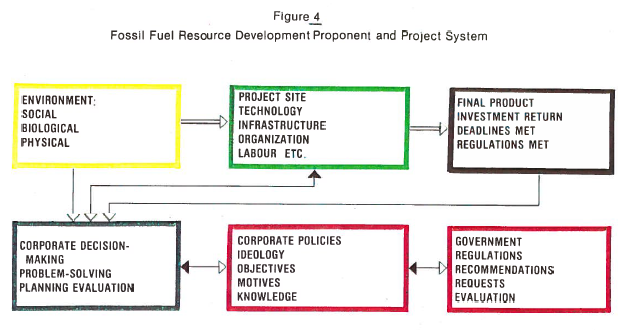
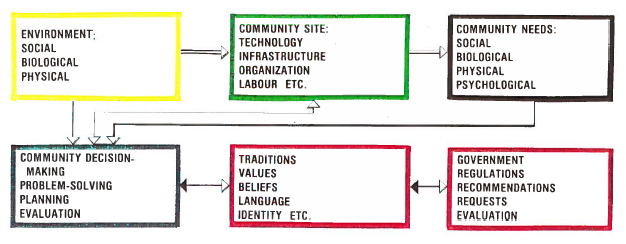
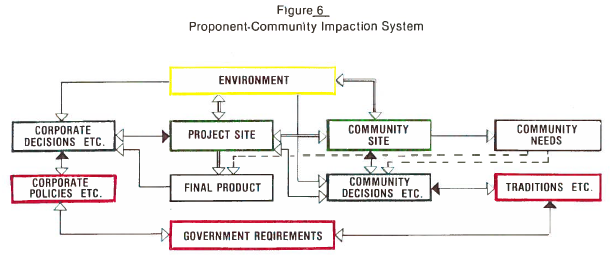
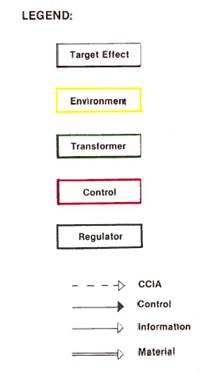
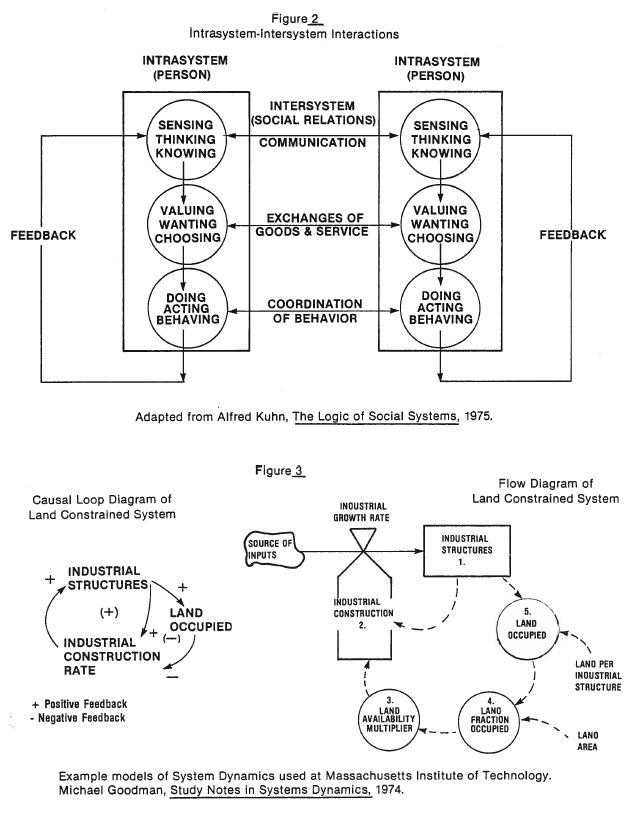
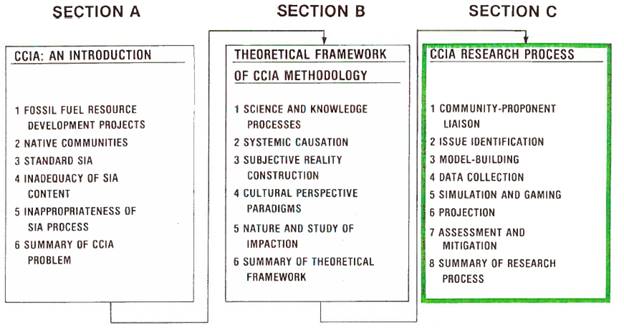
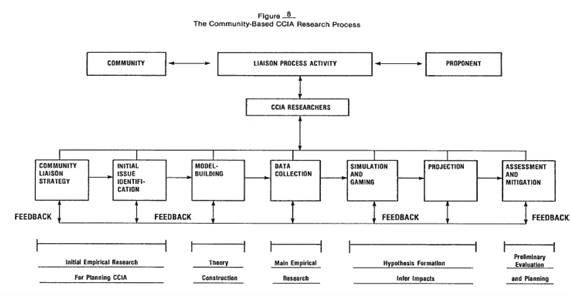
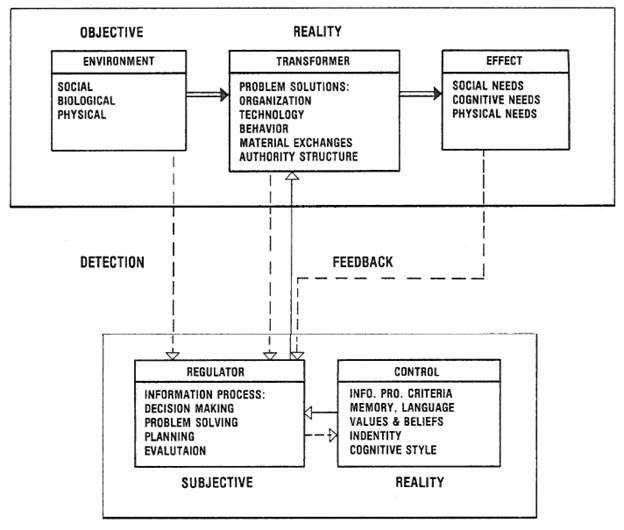
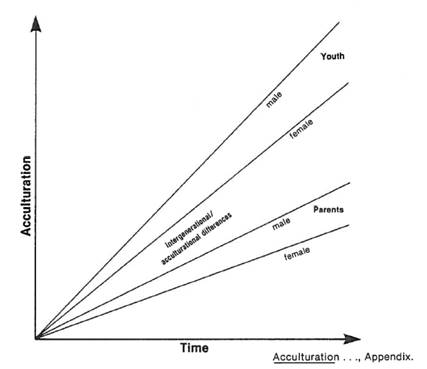
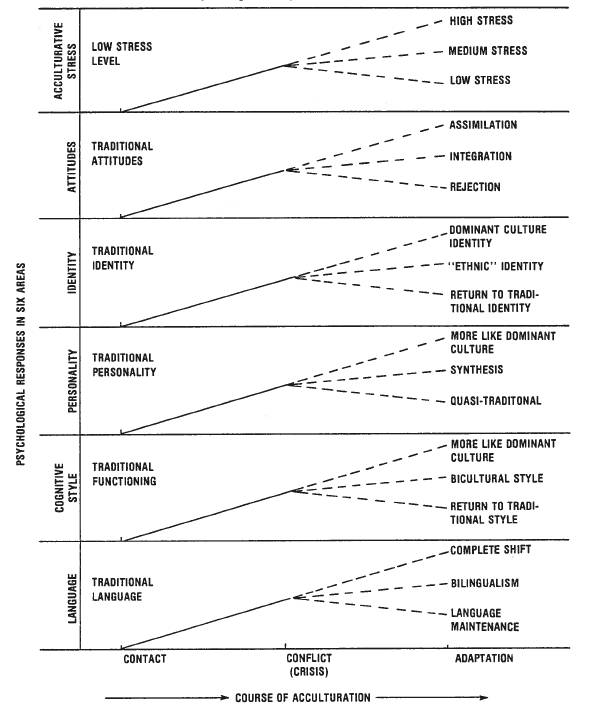
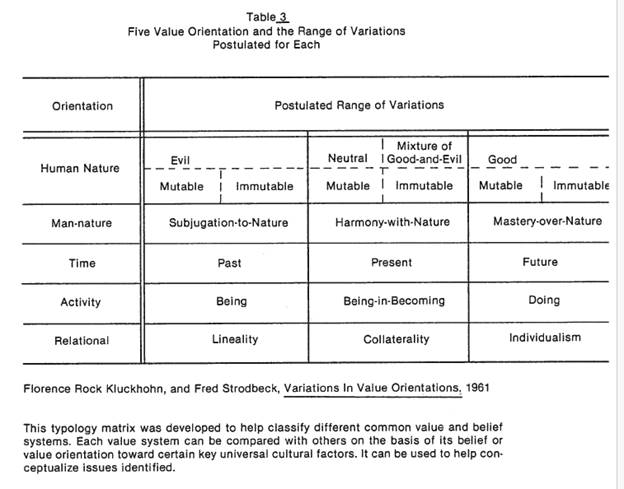









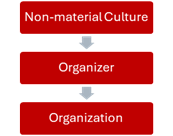

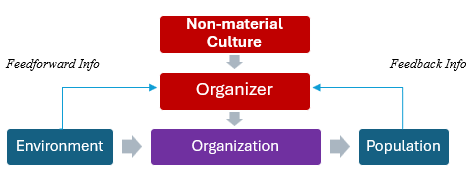
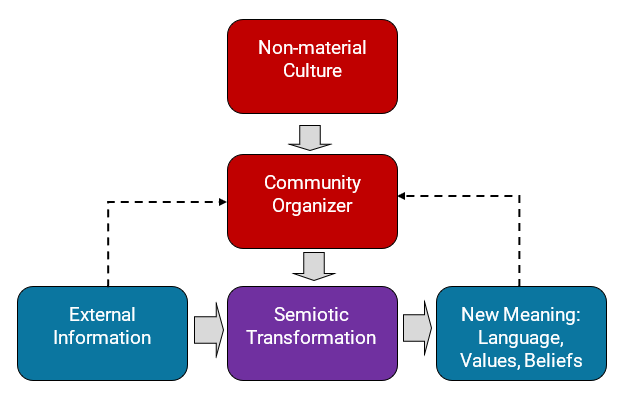
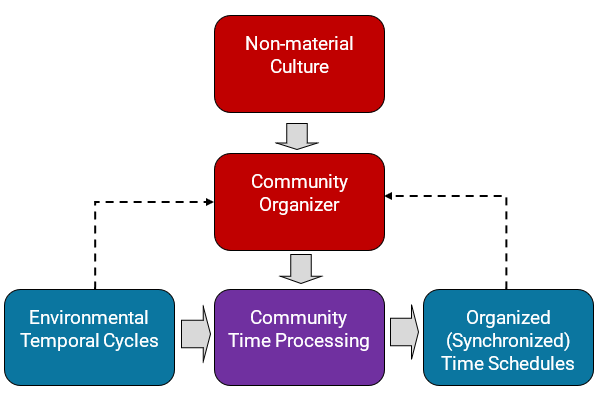
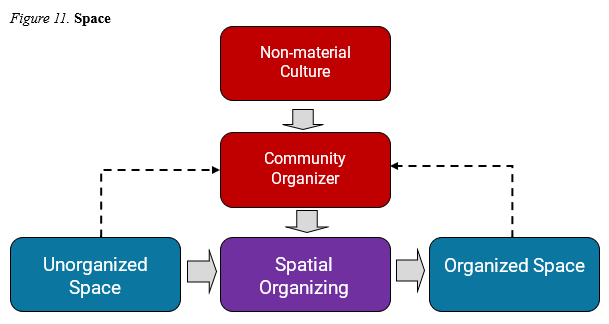
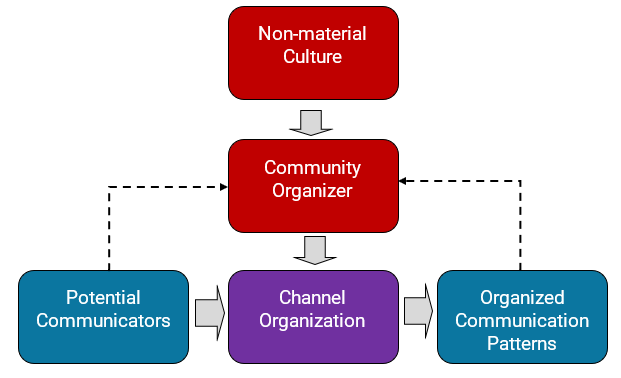
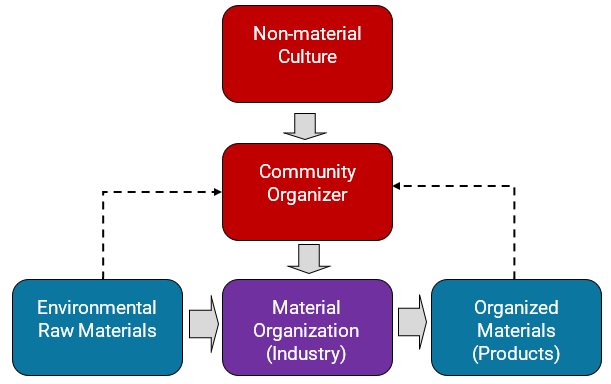
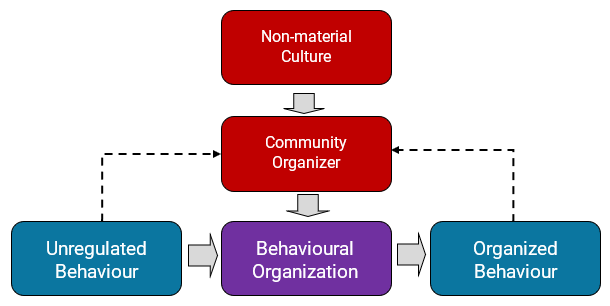
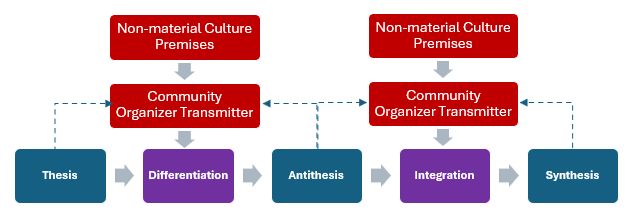
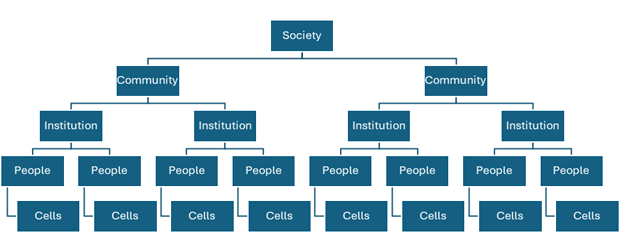

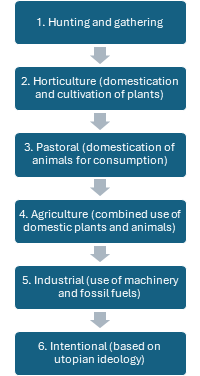

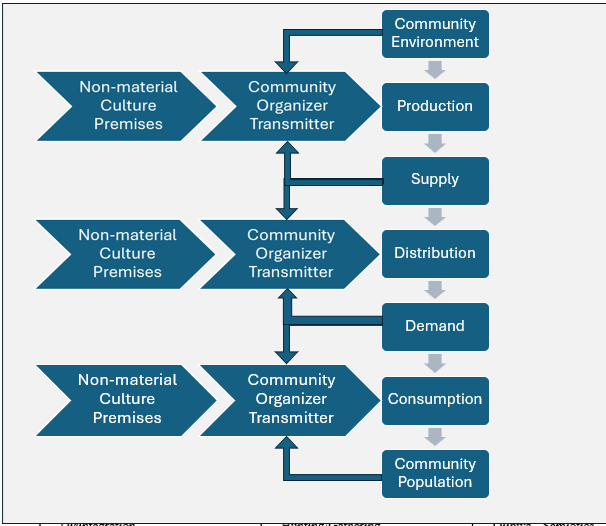
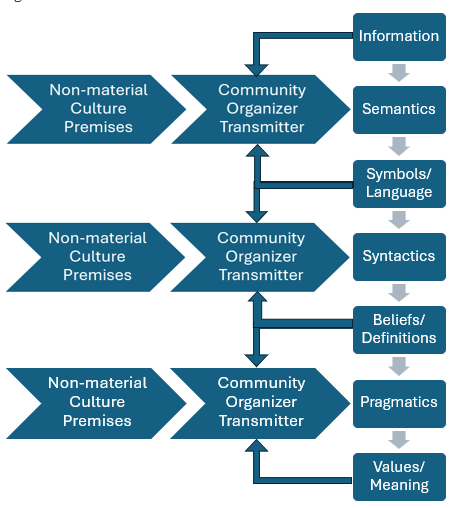
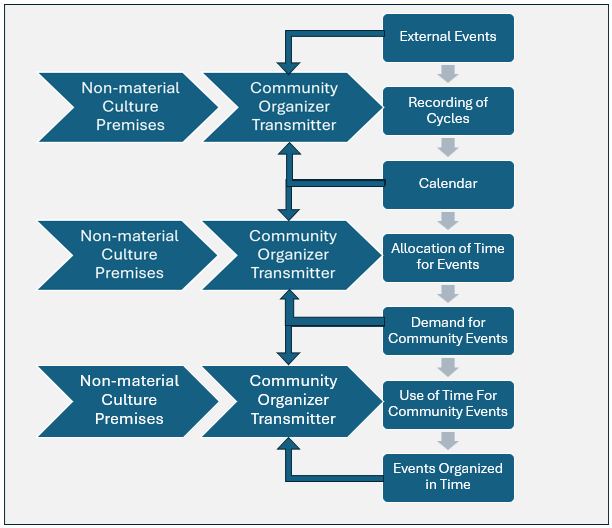
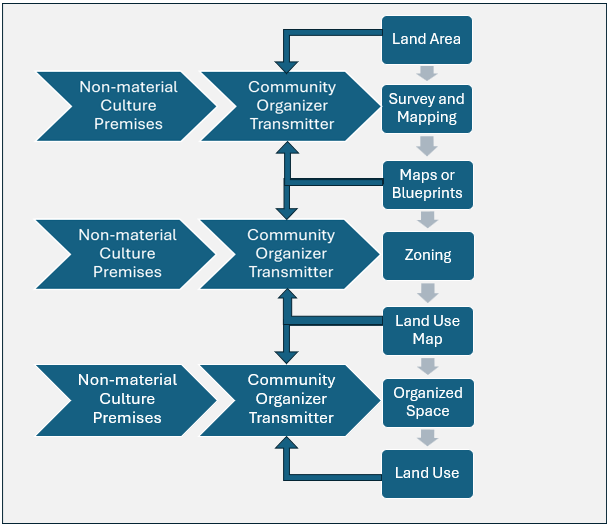

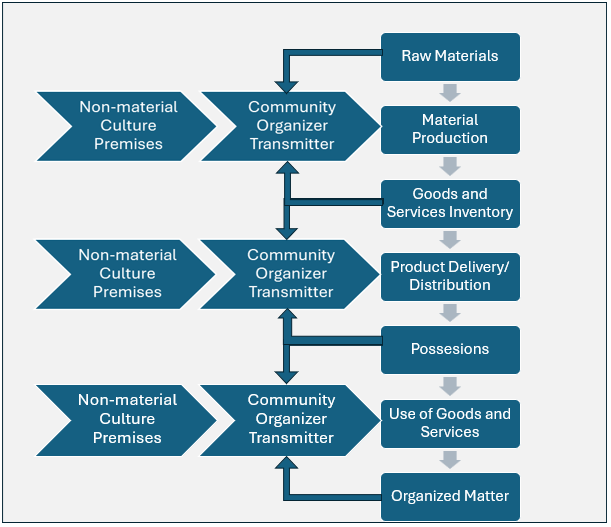
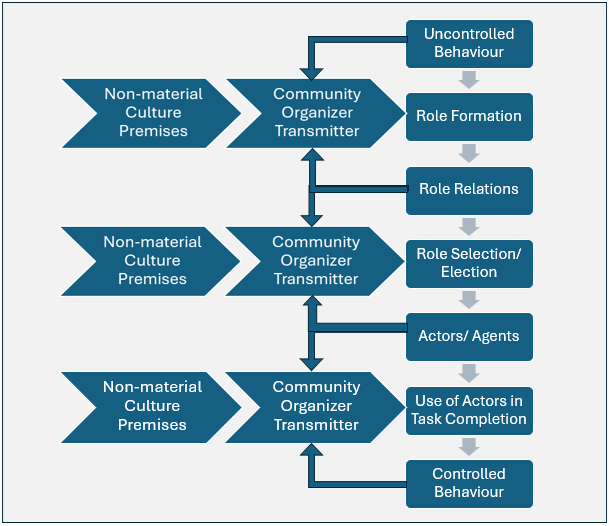

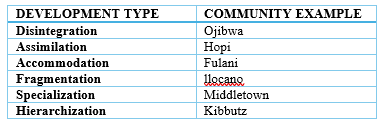

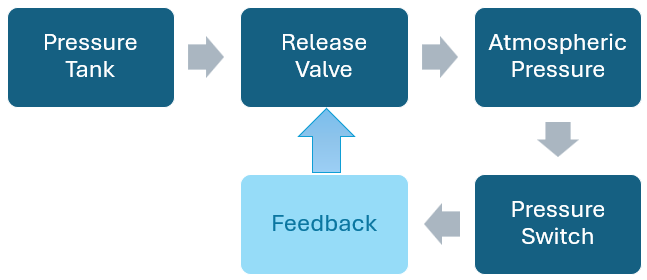
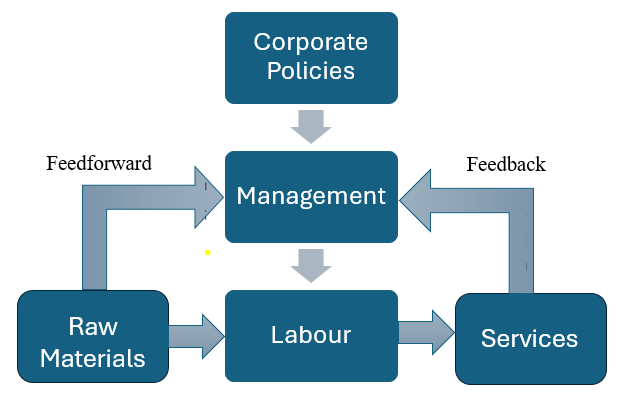
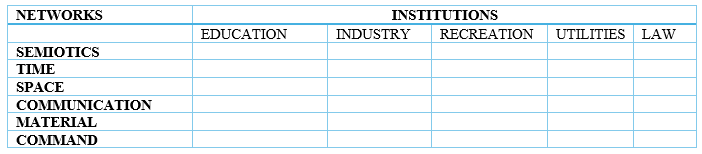



 Randal Adcock