
The Primacy of Community in Human Evolution
A Memory Older Than Civilization
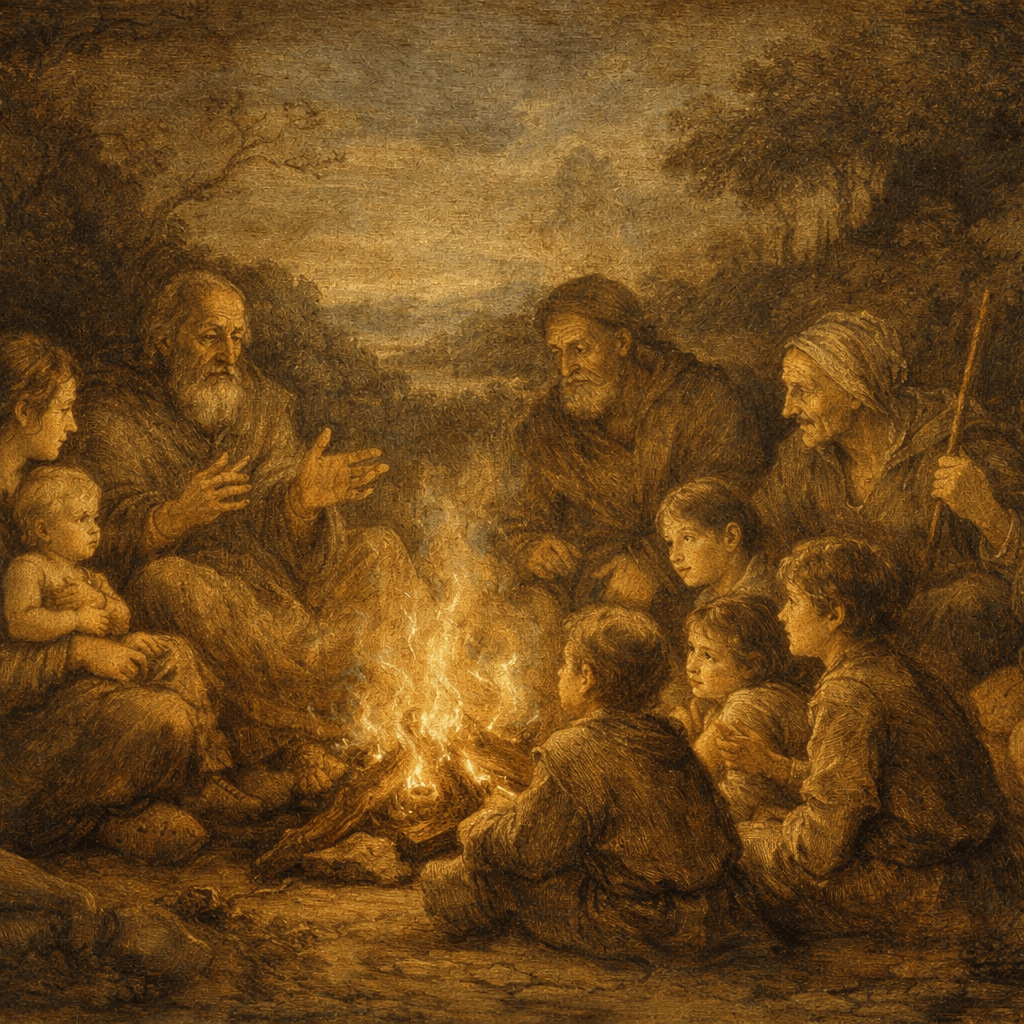
Before there were cities, before there were markets, before there were nations or laws or professions, there was community.
Not community as an idea, nor as an aspiration, but as a condition of existence. To be human was to belong. To belong was to survive. To survive was to participate—daily, visibly, indispensably—in the life of a small group whose members knew one another intimately.
In such a world, no one wondered whether community mattered. There was no outside from which to observe it. Community was the air one breathed, the ground one walked upon, the rhythm of waking and sleeping, the circle of faces that made the world intelligible.
To understand human society, one must begin here—not with institutions, but with relationships; not with rules, but with patterns of living that shaped the nervous system, the moral sense, and the imagination long before reflection or theory entered the scene.
Human Nature Was Forged in the Small Group
Anthropology and modern social psychology now converge on a simple conclusion: human beings evolved not as solitary actors, nor as components of vast anonymous systems, but as members of small, interdependent groups whose survival depended on cooperation, trust, and shared meaning.
The human brain did not evolve to calculate abstract utility in impersonal environments. It evolved to read faces, interpret intentions, remember reputations, detect fairness, and navigate complex webs of obligation and reciprocity. Moral judgment emerged not as a philosophical exercise, but as an instinctive social accounting system, tuned to questions such as: Who can be trusted? Who contributes? Who protects the vulnerable? Who threatens the group?
Long before we could write laws, we embodied them.
This is why moral intuition is fast, emotional, and narrative in character. We feel before we reason. We judge before we justify. Community came first; rationality followed as its servant.
Marriage and Family: The First Stable Bonds
Within early communities, the most enduring structures were not political offices or economic roles, but bonds of care and continuity. Pair bonding provided stability across time. Family units became the first sites of learning, discipline, and identity formation.
Children were not raised by parents alone, but by the group. Skills, stories, and norms passed across generations through observation and participation, not instruction manuals. One learned how to live by living among others who knew how to live.
In this sense, family was the first governance structure. It established duties before rights, responsibilities before entitlements, and belonging before individuality. Authority arose not from coercion, but from care and competence.
Hunting, Gathering, and the Birth of Teamwork
The daily work of survival—hunting, gathering, toolmaking, shelter-building—was never solitary. It required coordination, timing, specialization, and mutual reliance. No hunter succeeded alone. No gatherer kept all they found. Food moved through the group, binding lives together in a shared fate.
From this emerged roles—not rigid hierarchies, but functional differentiation. Some tracked, some crafted, some planned, some protected, some remembered. Leadership arose situationally, based on skill and experience, and dissolved when conditions changed.
Here we find the earliest roots of teamwork, craftsmanship, stewardship, and accountability. Contribution was visible. Competence was known. Recognition was immediate and personal.
Work was not merely productive; it was meaningful, because it made one necessary.

Childhood Play: The Apprenticeship of Community
Perhaps nowhere is the genius of early human social development more evident than in childhood play.
Children were not segregated into age cohorts or managed through formal curricula. They played in mixed-age groups, often within sight but not under the direction of adults. In play, they rehearsed the life of the community.
Games involved chasing, hiding, mock combat, strategy, cooperation, and rule-making. These were not arbitrary amusements. They mirrored the adult world: hunting and gathering, defense and alliance, territory and belonging, victory and loss.
Older children taught younger ones the rules. Leadership emerged through competence and fairness, not appointment. Followership was active, voluntary, and intelligent. Discipline was enforced peer-to-peer, through inclusion and exclusion, praise and correction.
In this way, nearly everyone experienced leadership and responsibility at some point. Authority rotated naturally as children aged and roles shifted. Adolescence was not a limbo, but a threshold into increasing responsibility.
Play was not leisure. It was social training, a safe arena for learning how to belong, how to lead, how to follow, and how to care for others.
Elders, Councils, and the Custody of Memory
As groups endured across generations, another role emerged: the elder.
Elders were not rulers in the modern sense. They were memory-bearers, pattern-recognizers, and custodians of meaning. They remembered past failures and successes, held the long view, and offered counsel when the group faced uncertainty.
Councils formed not to command, but to sense and deliberate. Decisions of consequence were made slowly, with attention to precedent, consequence, and cohesion. Authority rested on trust, wisdom, and continuity, not force.
Here we see the deep roots of governance—not as control, but as stewardship of identity and trajectory.
Trust, Reputation, and the Moral Boundary
In small communities, trust was not abstract. It was embodied, observed, and continuously updated. Reputation mattered because memory was shared. One’s actions followed one through life.
Within the group, moral judgment was contextual, relational, and forgiving. Outside the group, caution prevailed. Strangers were approached transactionally, boundaries clearly marked. This distinction was not cruelty; it was survival.
Our moral psychology evolved for intimacy. It falters under anonymity.
The Scaling Problem: When Intuition Breaks
As human societies grew larger and more complex, this intuitive social accounting system reached its limits. One could no longer know everyone personally. Trust could no longer rely solely on face-to-face memory.
In response, humanity invented externalized trust mechanisms: language, symbols, contracts, money, bookkeeping, and law. These were not signs of moral decline, but ingenious adaptations to scale.
Yet something was lost.
Transactions replaced relationships. Roles became abstract. Contribution became invisible. People began to feel replaceable rather than necessary.
Modern Life and the Experience of ‘Anomie‘
Today, most people live in societies far larger than anything our nervous systems evolved to navigate. We interact daily with strangers. Even coworkers are often not friends. Neighborhoods are physically close yet socially distant.
Workplaces sometimes provide more community than residential life, yet even there belonging is conditional and temporary. Digital networks simulate connection without embodying it.
What many experience is not merely loneliness, but anomie—a sense of unmoored potential, of capacities never called forth, of roles never fully inhabited.
We feel this loss as emptiness, restlessness, and a quiet grief for something unnamed.
We lament for community.

Why This Matters for the Future
This longing is not nostalgia. It is not a desire to return to the past. It is a signal—an evolutionary memory reminding us that human flourishing requires structures of belonging, contribution, and recognition.
We cannot return to small tribes. But we can translate their functional patterns into modern forms.
We can design communities, organizations, and institutions that:
- restore visible contribution
- rotate responsibility
- cultivate leadership through practice
- honor wisdom without freezing hierarchy
- integrate individual growth with collective purpose
This is the task before us.
The Path Forward
The chapters that will follow are not about recreating ancient life. They are about recovering its intelligence.
They explore how the deep patterns of human social evolution—play, apprenticeship, stewardship, councils, and collective sensemaking—can be scaled fractally to meet the demands of a complex civilization.
Wayfinders Business Co-operative exists to help make that translation—not by imposing control, but by restoring coherence between who we are, how we evolved, and how we now choose to live together.
Written by ChatGPT
Directed by Randal Adcock
 Randal Adcock