
A.1 Fossil Fuel Resource Development Projects. 8
A.2 Indigenous Communities. 11
A.3 Standard Social Impact Assessment (SIA) 15
A.4 Inadequacy of SIA Content 18
A.5 Inappropriateness of SIA Process. 21
A.6 SUMMARY OF THE CCIA PROBLEM… 23
B. THEORETICAL FRAMEWORK OF CCIA METHODOLOGY.. 25
B.1 Theory Of Science And Knowledge Processes. 26
B.2 THEORY OF SYSTEMIC CAUSATION.. 28
B.3 THEORY OF SUBJECTIVE REALITY CONSTRUCTION.. 31
B.4 THEORY OF CULTURAL PERSPECTIVE PARADIGMS. 35
B.5 IDEAS ON THE NATURE AND STUDY OF IMPACTION.. 42
B.6 SUMMARY OF THEORETICAL FRAMEWORK.. 48
C. THE CCIA RESEARCH PROCESS. 53
C.1 Community-Proponent Liaison. 55
C.7 Assessment and Mitigation. 82
C.8 Summary of the CCIA Research Process. 84
Original TABLE OF CONTENTS
LIST OF FIGURES
- Cybernetic System — 64
- Intrasystem–Intersystem Interactions — 66
- Causal Loop and Flow Diagrams of Land-Constrained System — 66
- Fossil Fuel Resource Development Proponent and Project System — 103
- Indigenous Community System — 103
- Proponent – Community Impaction System — 104
- Inputs and Outputs of Cooperation — 106
- The Community-Based CCIA Research Process — 118
- Socio-Cultural Cybernetic System — 203
- Acculturational Differences: Age and Sex — 204
- Six Psychological Response Areas in Acculturation — 205
- Models Increasing in Specificity — 207
- Models Increasing in Complexity — 207
- Graphs Illustrating Trends Caused by Feedback (Examples) — 208
- Positive and Negative Feedback System for Simulation — 208
- Kwakiutl Cultural System — 209
- Cultural Ecology Systems Model — 210
- Example of Process Box for Cultural Perspective Paradigm Simulation — 211
- Example of Stages for Simulation of Cultural Perspective Paradigm — 211
- Example of Processes in a Stage for Simulation of Cultural Perspective Paradigm — 211
- Cultural Perspective Paradigm Model — 212
- Model of Socio-Cultural System — 213
LIST OF TABLES
- Contributions and Rewards of Cooperation — 106
- Acculturation Types (Examples) — 204
- Five Value Orientations and the Range of Variations for Each — 206
- Selected Data Collection Methods — 214
MAPS
- Ecological Regions of Canada — i
- Approximate Distribution of Major Indigenous Groups When First Contact Made by Whites — ii
- Indian Treaties of Canada — iii
ORIGINAL MAIN CONTENTS
- Executive Summary — iv
- Preface and Acknowledgements — viii
- Introduction — 1
A. Cross-Cultural Impact Assessments: An Introduction to the Problem and the Solution — 6
- Petroleum Resource Development Projects — 8
- a. Impacts — 8
- b. Corporate Objectives — 10
- Indigenous Communities — 14
- a. Diversity of Groups — 14
- b. Traditional Group Similarities — 15
- c. Culture: Two Realities — 18
- d. Subjective Culture — 19
- e. Indigenous Community Development — 22
- f. Acculturation — 24
- Standard Social Impact Assessment (SIA) — 26
- a. SIA for Whom and For What? — 26
- b. Actors and Their Roles in SIA — 29
- c. The Process…Briefly — 30
- Inadequacy of SIA Content — 33
- a. Cultural Differences — 33
- b. Quantitative – Qualitative Differences — 35
- c. Non-Disciplinary Conceptual Framework — 35
- d. Patterns of Causation — 37
- Inappropriateness of SIA Process — 42
- a. Cross-Cultural Communication — 42
- b. Analysis of Subjective Reality — 43
- c. Rapid Acculturation — 45
- d. Diversity of Indigenous Communities — 46
- Summary of the CCIA Problem — 47
B. Theoretical Framework of CCIA Methodology — 51
- Theory of Science and Knowledge Processes — 55
- a. Steps of Scientific Thought — 55
- b. Levels of Knowledge — 57
- c. Examples of Use — 60
- Theory of Systemic Causation — 62
- a. Real and Conceptual Cultural Subsystems — 62
- b. What is a System? — 65
- c. The “Holistic” Community System — 69
- Theory of Subjective Reality Construction — 72
- a. Perspective — 72
- b. Study of Subjective Reality Construction — 74
- c. Insiders and Outsiders — 76
- d. The Symbol System — 78
- e. Cultural Identity — 80
- Theory of Cultural Perspective Paradigms — 82
- a. What is a Cultural Perspective Paradigm? — 83
- b. The Cognitive Dimension — 85
- c. Cognitive Process Rules — 86
- d. Cognitive Process Criteria — 87
- e. The Evaluative Dimension — 91
- f. Evaluative Process Rules — 91
- g. Evaluative Process Criteria — 94
- h. Behavioural Styles — 97
- i. Personality — 98
- j. Summary — 99
- Ideas on The Nature and Study of Impaction — 101
- a. Feedback Interaction — 102
- b. The Subjective Perspectives — 107
- c. Acculturation — 108
- d. The Role of Knowledge and Value — 109
- Summary of the Theoretical Framework — 112
C. The CCIA Research Process — 116
- Community – Proponent Liaison — 119
- a. Considerations in a Strategy — 119
- b. Cross-Cultural Communication Approaches — 120
- c. Community-Based Research — 122
- d. Liaison Methods — 125
- e. Communication Techniques — 126
- f. Summary — 127
- Issue Identification — 128
- a. Research Issues — 128
- b. Issue Organization — 130
- c. Methods of Issue Identification — 130
- d. Summary — 133
- Model-Building — 135
- a. Steps of Model-Building — 137
- b. Purpose and Use of Models — 138
- c. The Subject of the Model — 140
- d. Typologies — 147
- e. Summary — 150
- Data Collection — 151
- a. Levels of Measurement — 152
- b. Cross-Sectional and Longitudinal Analysis — 156
- c. Bias — 157
- d. Valuable Data — 160
- e. Continuous Collection — 162
- f. Summary — 164
- Simulation and Gaming — 166
- a. An Example Simulation — 166
- b. Simulation Building — 169
- c. Criteria of a Good Representation — 171
- d. Gaming — 174
- e. Ongoing Adjustments and Fine Tuning — 178
- f. Summary — 180
- Projection — 182
- a. Aims — 183
- b. Making Projections — 184
- c. Gaming — 185
- d. Computer Use — 186
- e. Criteria of a Good Projection — 187
- f. Summary — 188
- Assessment and Mitigation — 190
- a. Continuous Output Data — 190
- b. The Final Assessment Statement — 193
- c. The Role of Assessment in CCIA Research — 194
- Summary of the CCIA Research Process — 196
Conclusions — 197
- a. Community-Based Assessment — 198
- b. CCIA as a System — 200
- Appendix — 203
- Bibliography — 216
Introduction
Cross-cultural impact assessment (CCIA) is in a formative stage of development. It is evolving to meet requirements demanded by situations of rapid acculturation, particularly as fossil fuel resource development impinges on the lives of Canada’s Indigenous people. CCIA is emerging as a special and unique adaptation of standard social impact assessment (SIA).
As it emerges and evolves, researchers doing CCIA must be aware of the purpose and specific nature of CCIA. They must be able to see its potentials and limitations in describing, explaining, predicting, and controlling cross-cultural impacts. Researchers should also be aware of the body of social science theory which supports CCIA, defines it, and makes it possible. The processes involved in conducting CCIA research should be understood as the main substance and activity of CCIA.
To achieve this understanding, this report is divided into three sections:
A. CCIA: An Introduction;
B. Theoretical Framework for CCIA Methodology; and
C. The CCIA Research Process.
The first section deals with questions concerning the purpose and setting of CCIA; who is involved and in what ways; and required modifications to SIA in the cross-cultural situation. It is argued that for assessing impacts to Indigenous culture caused by fossil fuel resource development projects, standard SIA topical content is inadequate and its research process methods are inappropriate, as they stand. Modifications are needed to address more fully the study of the Indigenous subjective culture (values, beliefs, identity, language, etc.). Changes to the research process involve a more intensive and extensive community participation program, and more comprehensive modelling and simulation than is common in SIA.
The theoretical framework for CCIA methodology points out various considerations in doing CCIA research. The Indigenous community and culture are viewed as an interpersonal information processing system. The way in which local people construct their representations of reality is different from the way other groups construct their realities. The local perspectives shared among residents constitute a cultural perspective paradigm and are to be studied as a whole system of inter-related causes and effects. A scientific thinking process is discussed which is to serve as a basis for thinking in the actual research process.
The relationship between resource development project and Indigenous community is also discussed as a background to the subject to be researched.
The CCIA research process consists of seven stages:
- Community–proponent liaison
- Issue identification
- Model-building
- Data collection
- Simulation and gaming
- Projection
- Assessment and mitigation
Each stage is developed in terms of the purpose, methods used, problems encountered, relationships to other stages, and the nature of subjects studied. Stress is put on the community-based nature of the research and the flexibility required to accommodate uncertainty in the process.
Special note should be made of the fact that this report presents only one range of possible approaches to studying cross-cultural impacts. It is an approach that is very adaptable as it can be used to produce information of any desired complexity or simplicity. If time, money, or professional resources are short, simple models and simulations can be built. If more complete and reliable projections and assessments are needed, complex models and simulations can be built. It can also be changed on the location to suit needs and resources available as they arise.
The report is an attempt to integrate various scientific and humanistic ideas and perspectives to be used with an end to minimize negative impacts and maximizing positive impacts to Indigenous culture. It is not a study of cross-cultural impacts, but a proposal for how such a study can be constructed and carried out.
It is not a study of impacts to the development proponent, although acculturation and impaction are two-way streets. Impacts to the proponent (corporate organization, policy, ideology, and project development) must remain the topic of other reports. However, it is important that CCIA be conducted for the proponent corporation so that it can respond best to the demands of cross-cultural interaction. A cooperative mutual learning centre should be established on the community or project site to facilitate maximum understanding of the rapid acculturation.
CCIA Report Structure
| Section A | Section B | Section C |
| CCIA: An Introduction | Theoretical Framework of CCIA Methodology | CCIA Research Process |
| 1. Fossil Fuel Resource Development Projects | 1. Science and Knowledge Processes | 1. Community–Proponent Liaison |
| 2. Indigenous Communities | 2. Systemic Causation | 2. Issue Identification |
| 3. Standard SIA | 3. Subjective Reality Construction | 3. Model-Building |
| 4. Inadequacy of SIA Content | 4. Cultural Perspective Paradigms | 4. Data Collection |
| 5. Inappropriateness of SIA Process | 5. Nature and Study of Impaction | 5. Simulation and Gaming |
| 6. Summary of CCIA Problem | 6. Summary of Theoretical Framework | 6. Projection |
| 7. Assessment and Mitigation | ||
| 8. Summary of Research Process |
Here’s a polished draft of Section A.1 – Fossil Fuel Resource Development Projects, with subsections Impacts and Corporate Objectives fully merged and lightly cleaned for readability while preserving the original meaning and tone:
A.1 Fossil Fuel Resource Development Projects
Petro-Canada’s main interest is to develop fossil fuel resources in order to make money and serve the Canadian public through the economy. To do this requires finding resource reserves, getting the resource out of the ground, transporting it to refineries for processing, processing it, and transporting the product to consumers. At various stages along the way, development projects (seismic exploration, drilling, pipelines, refineries, etc.) come into contact with Indigenous communities. These are often in the hinterlands of northern Canada but also occur near southern urban Canadian centers.
These projects may be temporary, such as exploration activities, or they may be long term, such as wells, pipelines, or refineries. In either case they may have long-term consequences for local ecologies and Indigenous cultures.
A.1.a Impacts
Impacts are changes made to a community as a result of these kinds of activities. They are not initiated by the community but are caused by the activities of a development proponent. The impacts or effects of these projects may be due to direct cross-cultural contact—as in employment, education, or infrastructural development (roads, houses, sewers, services)—or indirect effects, such as environmental changes caused by projects.
For example, fishing can be affected by refinery effluents, hunting by air traffic noise, and farming by roads and land clearance.
Impacts can be perceived in two ways: either positive or negative. Local residents often disagree about which they are. Some Indigenous people may prefer to maintain traditional educational practices, while others may wish to learn trade skills for wage employment. Often compromises are required.
Employment opportunities are often made available to local residents first, with on-the-job training and orientation offered to local Indigenous hires. Yet, depending on how well people are prepared for industrial labor and urban Canadian cultural expectations, difficulties can arise. They may feel “out of place” in a white-dominated workforce, lose face as they learn through mistakes, or encounter misunderstandings with Euro-Canadians. Their lifestyles can be disrupted as they have less time to hunt or fish, and must rely on store food. Cultural heritage can become devalued or dismissed by outsiders, leading to hurt and confusion.
Negative social impacts such as alcoholism, family violence, and suicide can occur as a result of rapid cultural change. These impacts can be mitigated if cooperative planning between corporation and community takes place. Cross-Cultural Impact Assessment (CCIA) can be used to identify and help plan for these impacts.
A.1.b Corporate Objectives
Although the corporate motive is often thought of as profit, this is not the only corporate interest. Corporations are part of society and should be concerned not only with maintaining the “status quo” but also with the quality of life of people they contact. As the public becomes more informed of corporate powers and activities, corporations are increasingly expected to act in socially responsible ways. Petro-Canada’s environmental and social policies reflect this trend.
Differing perspectives exist, however, between corporations and communities. Energy corporations often focus on profit for shareholders, while communities emphasize human resources, quality of life, and self-reliance. Indigenous communities seek local control of development for autonomy and independence. These interests must be reconciled so that they coexist and ideally complement one another.
From the industry perspective, cooperation with Indigenous communities can be achieved for several reasons. According to Doug Bowie, Vice President for Environmental and Social Affairs at Petro-Canada (May 1981), corporate motivation for cooperation falls into four levels:
- Regulation – Cooperation is required by government regulation.
- Economic feasibility – Cooperation avoids risks and reduces expenses due to mistakes.
- Public opinion – Cooperation is necessary to satisfy public opinion.
- Social responsibility – Cooperation is desirable as a fulfillment of social responsibility.
The motivation for cooperation can strongly influence the success of CCIA. The higher the motivation, the more reliable and valid the results are likely to be. Often, however, the extent of cooperation depends on how much the corporation needs or wants from the Indigenous community rather than the projected impacts on the community. This tendency is reflected in the tools used in analysis.
Cost-benefit analysis, for instance, is often a tool for proponents only, offering only rough estimates of cultural impacts. CCIA should be designed for both the community and the proponent. Together they are better positioned to plan mitigation measures and direct development to create positive opportunities. Cost-benefit analysis can still be used to evaluate corporate outcomes but should not define the whole process.
Community-based impact assessment represents a stronger commitment to cooperation. It satisfies all four levels of motivation, provides opportunities for fuller appreciation of community perspectives, and helps maintain community autonomy, integrity, and cultural identity. For the corporation, it reduces risks, costs, and delays by ensuring impacts are identified and addressed early.
Community-based CCIA relies heavily on local voluntary and employed resources, encouraging extensive participation and fostering close cooperative relationships between proponent and community. This ensures that the maximum amount of local information is used, making the impact process more predictable and controllable. Community-based CCIA will be discussed further later in the report.
A.2 Indigenous Communities
Indigenous communities are quite different from each other in their traditional cultures, and in how they have changed through acculturation. Indigenous community development is one means being tried to help overcome impacts of industrialization.
A.2.a Diversity of Groups
Indigenous communities consist of a population of distinct people who share a common culture in a particular locality. They may be treaty First Nations peoples, non-treaty Indians, Inuit, Métis, or any combination. They may be distinguished by linguistic groupings such as Algonkian, Athapaskin, Sioux, or Iroquois; by ecological zones such as sub-arctic, arctic, boreal forest, plains, or coastal; or by other categories like treaty number, economic subsistence or extent of experience and ability in dealing with government and industry.
There is a wide variety of types of Indigenous communities. Unlike urban Canadian communities, Indigenous communities are generally relatively isolated. That is, they are not as socially and economically interdependent with external communities as urban communities are. They maintain their differences as a result.
A.2.b Traditional Group Similarities
However, despite their differences there are substantial similarities between Indigenous communities. Traditionally, most Indigenous groups were hunting and gathering bands or tribes. They could be described in the following terms:
- small groups: bands or camps
- fluid or unstable group organization (forming and dissolving), personalities more important
- high mobility; nomadism
- taking from the environment rather than replenishment of it; hunting, fishing, foraging
- little authoritarian leadership
- little specialization
- division of labour by sex and age
- egalitarian society (little social stratification)
- ideology of kinship, but not rigid
- little “ownership” of resources
- lack of strict territoriality
- feuding, but not large scale war
- polytheistic religion (many gods or spirits).
These characteristics were generally true but not always—exceptions were common.
Some Indigenous people were horticulturalists, namely the Iroquois. They could be characterized as having:
- investment in the environment; planting, tilling
- tendency toward stable groups; settled or semi-settled communities
- division of labour based primarily on sex and age
- basically, social equality; though social stratification may occur as reliance on cultivation increases
- pervasive ideology of kinship; kin groups become important
- development of notions of territoriality
- feuding on group level; wars may occur
- polytheistic religion, with or without a high god; ancestral veneration occurs.²
These classes of culture, hunting-gathering and horticulturism, are ideal types which likely describe no particular culture perfectly. Indigenous Canadians depended very much on the natural environment’s ability to produce food but their technologies enabled them to adapt to changing ecological conditions. Their culture evolved over perhaps 40,000 years of life on the North American continent.
Needless to say, modern Indigenous communities usually are no longer of hunting-gathering or horticulturalist cultures. Many pressures of acculturation have forced many of them into dependent economies struggling for any cultural identity.
A modern Indigenous culture tends to have these characteristics:
- larger, more stable settlement
- mixed economy: agriculture, trapping, hunting and fishing, wage labour, welfare, cottage industry
- increased social stratification and division of labour
- more formal education
- dependence on government for development of resources – increasing in autonomy
- more industrial technology
- more interdependence with other communities and more communication concerning outside issues
- monotheistic religion.
Indigenous communities adapt to pressures of urban Canada in differing ways and so the diversity among Indigenous cultures increases. These characteristics are still only partly true of any particular community. A culture is a very adaptive thing.
A.2.c Culture: Two Realities
Frank Vivelo defines culture as “the shared patterns of learned belief and behavior constituting the total lifeway of people; the totality of tools, acts, thoughts and institutions of any given human population.”³ By this definition it must be understood that culture consists of two realities: the physical (observable, objective, or empirical) reality, and the mental (experiential, subjective or psychological) reality. Though we do not know exactly how the two realities are connected, and some people believe there is only one reality, for the purposes of study we must treat them differently. Physical reality is directly observable (in common sense) and mental reality is not.
² Adapted from Frank Vivelo, Cultural Anthropology Handbook, pp. 53, 66, 1978.
³ Frank Vivelo, p. 242, 1978.
Though we can observe outward behavior of Indigenous people (or others) along with their technologies and essentially agree on what we see, we may differ greatly on how we interpret what is seen. We construct different mental representations of physical reality. The representations constructed by different people within a culture may be quite similar but representations constructed by people of different cultures could be very different. The culture one belongs to is very important in determining how one constructs his mental representation of physical reality.
A.2.d Subjective Culture
What another person sees in his reality is very difficult to determine at the best of times, but when a researcher from a petroleum corporation is trying to study the mental reality of an Indigenous culture, he must first construct a culturally biased representation of the observed behavior (the physical reality) of the Indigenous persons and then speculate on what this behavior means to them. In other words, there is no way to directly observe how anyone, especially of a different culture, makes sense of his world.
Some ways of describing the value and belief systems of Indigenous culture have been suggested by anthropologists. Traditionally, Indigenous people, living close to nature, maintained values and beliefs that were very essential for survival in their environment. They believed in harmony, not exploitation, in that destroying natural resources meant self-destruction. Many practiced calculated conservation. The ultimate test of truth of a belief was practice — a belief must be useful. This meant that truth was contextual — what works in one situation may or may not work in another. Beliefs must be adaptive as conditions change. Yet stability in the system was maintained by myths, folklore, and customs handed down orally from generation to generation. These concerned general do’s and don’ts (totems and taboos) that were required for survival and personal fulfillment.
Another aspect of subjective culture is the need for cultural identity and pride. Indigenous people, like all other groups or classes of people, need to feel good about their heritage. It is often expressed as ethnocentrism (cultural pride) or xenophobia — “we are the best” and fear of outsiders, respectively. A certain minimum amount of cultural identity and pride is required for cultural stability and development. Today, modern Indigenous people have had much of their cultural identity destroyed by urban Canadian attempts to assimilate them and make them economically and politically dependent.
As far as cognitive style or thinking style is concerned, Indigenous people have traditionally made extensive use of analogy — finding similarities among differences in experience. This is a pre-scientific style in which the use of inductive and abstract reasoning is underdeveloped. This is part of the cross-cultural communication problem.
Indigenous values are an issue of vital concern to modern communities. The National Indian Brotherhood has stated in a policy paper to the Minister of Indian Affairs and Northern Development that Indian children should be learning that “happiness and satisfaction come from pride in one’s self, understanding one’s fellowmen, and, living in harmony with nature”:
- Pride encourages us to recognize and use our talents, as well as to master the skills needed to make a living;
- Understanding our fellowmen will enable us to meet other Canadians on an equal footing, respecting cultural differences while pooling resources for the common good;
- Living in harmony with nature will ensure preservation of the balance between man and his environment which is necessary for the future of our planet, as well as for fostering the climate in which Indian Wisdom has always flourished.
In brief the values here are:
- Self-reliance;
- Respect for personal freedom;
- Generosity;
- Respect for nature;
- Wisdom.
A.2.e Indigenous Community Development
Regardless of differences, all Indigenous Canadian communities are faced with threats to their lifestyle, their values, and beliefs.
In 1940 the Minister of the Interior, J.A. Crear, declared that the First Nations peoples were not “mentally and temperamentally equipped to compete successfully with the White population” and that therefore the government was abandoning its efforts “to equip the Indian to work and live in the white urban communities…”. The government-sponsored Hawthorn Report of 1967, which dealt in some detail with the conditions and problems of the First Nations peoples, stressed that: “…the general aim of the federal government’s present policy is based on the necessity of integrating First Nations peoples into Canadian society.” Indian leaders were suspicious of this approach, which they feared would mean “assimilation by coercion” rather than “participation by consent.”
The federal and provincial governments have, until the seventies, been making decisions for Indigenous people, without much consultation and without invitation to Indigenous communities to participate in administration.
One means of achieving control over their destiny is through Indigenous community development. This is locally initiated and regulated human and economic resource development. If a paternalistic attitude of the Federal Government has ensured that Indigenous people are kept dependent instead of self-reliant, being “kept” has stifled the learning of skills and the adapting of values and beliefs required for making a satisfactory living in the modern world. Many band councils and determined groups are now building their own schools, services and businesses. They adopt organizational styles and methods which are consistent with traditional styles and methods. They develop cooperatives, craft industries, adult education programs and social service centres. They have voluntary non-profit associations, and some are recovering almost lost or forgotten ceremonies and arts.
Some of this independence has been possible because of revenues from fossil fuel development, but much has been done by sheer will-power and self-education. These people are learning to use experts and consultants when necessary and to support local initiatives toward professional development. CCIA can be used by Indigenous people doing community development for planning and evaluation at the local level.
A.2.f Acculturation
The main continuous debate for Indigenous peoples seems to be how to maintain elements of traditional culture while adapting to new social, economic and political pressures and opportunities. When a fossil fuel resource development project impacts an Indigenous community, rapid acculturation can take place which can cause much confusion over cultural change. Acculturation may be defined as:
“cultural change that is initiated by the conjunction of two or more autonomous cultural systems. Its dynamics can be seen as the selective adaption of value systems, the processes of integration and differentiation, the generation of developmental sequences, and the operation of role determinants and personality factors.” ⁶
It is therefore very important that both the development proponent (i.e., Petro-Canada) and the Indigenous communities affected by the development projects be informed about possible cross-cultural impacts before these happen. The role of CCIA can be very essential in planning cultural development locally.
Perfect — here’s the final merged OCR text for Section A.3 (Standard Social Impact Assessment) with the last piece you just provided included:
A.3 Standard Social Impact Assessment (SIA)
Because of the special nature of impacts on Indigenous Communities by fossil fuel resource development projects, SIA should be reconsidered. “SIA’s often proceed on a common sense, ad hoc basis.” “To date, much … social impact assessment has been largely descriptive, unsystematic, and seldom comprehensively analytical.” These words, spoken by professionals in SIA, capture the current state-of-the-art in SIA. It is only a decade old and though it is based on the tradition of western social science it is a policy science and hence its fore-runners are only post World War II occurrences. SIA has been adapted and modified for a wide variety of situations, now including the cross-cultural setting.
A.3.a SIA for Whom and for What?
Generally speaking, SIA is a method used by developers, requested by governments, to determine how their development projects will affect the immediate human environments. The results of SIA are used by governments to determine what mitigation or compensation the proponent should be charged with if the project is to proceed. They are also used by the development proponent to determine whether the project is economically feasible, considering mitigation and compensation.
Another consequence of the SIA study, frequently only incidental, is to create community awareness of the proposed project. The awareness may or may not result in community action for or against the project.
SIA is usually done in a mono-cultural setting, or where both development proponent and affected community are assumed to be essentially of the same culture. However, a closer analysis of any situation will show that there are always cultural differences between social groups. These differences may be associated with geographic locality, economic class, ethnic origin, political status or ideology, education levels, or other shared personal attributes.
Canada has often been considered a cultural mosaic, a society of people or communities sharing some values and beliefs but not others. Whereas there are some similar cultural elements shared by all, there are differences which make each person and community different. When differences between Indigenous and urban-industrial Canadian communities are involved in a study and can be seen to include substantial cultural components, standard SIA must reflect the extent of those differences.
If SIA should always consider community impacts from the perspective of those impacted, more attention should be given to local perspectives when these are most different from the researcher’s perspective.
When impacts are clearly of a cross-cultural variety (energy resource development – Indigenous Community) the local perspective or understanding and evaluation of potential impacts must be given greater emphasis. The “objective” impacts to economy, demography, technology or infrastructure should be seen from the local perspective. This is because local people have to live with the changes or stop them in the ways they understand and value them in the context of their culture. The same applies to impacts to the subjective culture.
On a continuum then, CCIA is SIA which is designed to emphasize the study of impacts of acculturation where cultural differences between proponent and community involved are relatively large:
Standard SIA ————————————————————— CCIA
Cultural Homogeneity —————————— Cultural Heterogeneity
A.3.b Actors and Their Roles in SIA
The developers are the initiators of the SIA process as they want to develop a resource such as oil, gas or coal (or highways, high-rises, parkland, power dams, etc.). They are responsible for conducting the SIA. They are responsible for ensuring a minimum of disruptions to local human environments which require mitigation or compensation for imposed changes.
The governments involved represent the public interest in general. They set regulations, guidelines and criteria for evaluation of SIA results. Governments may have unofficial objectives as well, such as development itself or use of SIA information for other purposes.
The communities who are to be affected by development participate in SIA via public participation programs. Ideally, they are given the opportunity to become informed about the project and to give their ideas and opinions to the proponent and government officials. Public participation is seldom popular among community residents unless the project is potentially highly dangerous to their way of life. Residents are frequently suspicious of SIA community liaison officers and doubtful that they really care about the community. Residents should be encouraged to participate by demonstrating the potential rewards to be experienced. Public participation is practically essential in SIA if valuable information is to be recovered.
A.3.c The Process…Briefly
The SIA process starts with review of literature about the community (local newspapers, government statistics, historical records, etc.) and some preliminary discussions with residents. Issues of concern to the community are identified and serve as the basis of SIA focus. Data collection usually consists of taking an inventory of socio-economic data (population, incomes, buildings, services, etc.) that can most easily be quantified. Indicators are used as “measuring sticks” of various directly unmeasurable variables such as social cohesion, religious commitment or mental health. The profiling of the community involves integrating the data to get a clearer picture of the state of the community.
From this profile two projections are made about the future development of the community. One scenario depicts the future of the community with the development project; the other, the future without the project. This is to determine the extent of change due to the project itself.
The likely significant consequences of going ahead or stopping the project are then assessed. Sometimes an evaluative stage is also completed but this may be considered the responsibility of government and corporate decision-makers.
SIA has depended largely on quantitative analysis and cost-benefit analysis as final decision-makers like the simplicity of numbers and dollars. However, much of SIA does require the use of such techniques as social surveys, interviews and public meetings, all of which imply a heavy qualitative component. The expression of values, beliefs, opinions and attitudes can only be quantified after suitable categories have been applied in their analysis.
As was mentioned earlier, SIA is in an early stage of development. Many methods have been applied and different theories have been used in constructing methodologies. SIA has been guided quite a bit by practice, considering the individual circumstances differing with each project. Differences also occur as the researchers’ expertise and professional backgrounds differ.
The use of the SIA scheme in designing CCIA content and process should be studied in relation to the cross-cultural setting.
Got it. Here’s the clean OCR + merged draft for A.4 (from the start through subsections a, b, c, and d up to this latest page):
A.4 Inadequacy of SIA Content
SIA is different from CCIA in the focus of the subject matter studied. The differences may be discussed in terms of objectives, quantitative–qualitative distinctions, disciplinary conceptual framework, causation, and the subjective–objective orientation. The objective is to find the necessary modifications of SIA as extensive cultural change is possible.
A.4.a Cultural Differences
The main objective of SIA is to assess impacts on observable social variables assuming little substantial change to subjective culture. When the impactor and impactee are of very similar cultures this objective may be satisfactory. However, when fossil fuel resource development projects impact Indigenous communities a cross-cultural impact situation results and different emphasis needs to be given.
Traditional Indigenous and Euro-Canadians do not interpret their realities in the same way. Changes to or impacts on Indigenous communities must be understood in the same way the local residents understand them. Special efforts need to be made so that sharing information and perspectives leads to the fullest understanding between the two groups about the nature of potential cultural change.
More specifically, this means that CCIA must include an extensive analysis of values, beliefs, attitudes, identities, folklore and thinking styles of the Indigenous people to be impacted. These aspects of culture are systematically related to each of the objective cultural aspects, such as technology, social behavior, social organization, and so on.
The local value and belief system must be studied rigorously to determine how it will control and regulate changes throughout the whole culture. In addition to calculating or researching local incomes, for example, as SIAs usually stress, more attention must be given to how local Indigenous people view their incomes. School attendance records must be interpreted in light of local social and economic opportunities, values and beliefs. Often SIAs will determine the number of certified tradesmen in the local job market. CCIA should be capable of showing how many residents actually have practical skills and abilities or potential and desire for employment.
A standard SIA might project an increased demand for social services in an impact area. In a cross-cultural setting a CCIA could be used to project a need for a particular type of service designed for the local culture. This could also mean recommending “preventive” labour practices such as appropriate time off, work and cultural orientation, or hiring family groups as work teams, in addition to “curative” measures like counselling, treatment for alcohol abuse or pay raises.
A.4.b Quantitative – Qualitative Differences
Because of greater emphasis on subjective culture and its direct observation may be impossible, methods used will be primarily qualitative, not quantitative, in CCIA. Values and beliefs, for example, are very difficult to quantify. Values may be prioritized and beliefs may be categorized, but at this time no measurement instruments are available for those that are unobservable.
The causal and logical patterns between beliefs and between values can be traced with difficulty, but this art will improve with practice and computer use. Eventually, quantitative data on subjective culture may be possible.
A.4.c Non-Disciplinary Conceptual Framework
SIA has usually depended on either disciplinary, multi- or cross-disciplinary, or interdisciplinary conceptual frameworks for the analysis of its subject matter. But these frameworks cannot fully represent Indigenous culture.
Indigenous culture, like Indigenous thought, is conceptually broken down in different ways than urban Canadian culture. Western social scientific thought is generally adapted to Western society. It is divided into disciplines of history, sociology, psychology, economics, political science, human geography and anthropology. Of these, only anthropology can be considered fully interdisciplinary, as it studies the whole socio-cultural system, but even anthropology imposes on its subject a set of concepts that make sense mainly for Western social scientists.
Indigenous culture requires more than these concepts as Indigenous people see their culture in different terms. Multidisciplinary or cross-disciplinary analysis lacks the integration of information that is needed to accurately represent the actual integration that occurs among parts and events within a culture. Even a fully interdisciplinary analysis cannot capture the “holism” that is present in an actual culture.
The “holism” of a non-disciplinary analysis implies that no set special causal relationships are to be considered isolated. The economy, social organization, cultural psychology, politics and technology of a community must be seen as a whole system, not as isolated systems studied separately and then theoretically integrated.
Only a non-disciplinary conceptual framework can incorporate the ideas about their cultures that Indigenous people have. A non-disciplinary analysis can be designed by CCIA researchers and concerned Indigenous people as required to meet both sets of standards. The outline of such a framework is offered later in this report.
A.4.d Patterns of Causation
Working within a non-disciplinary conceptual framework, a researcher must be prepared to analyze any causal relationship within a community or culture. Several patterns of causal relationships have been determined: uni-linear, multi-linear, non-linear, mutual and cyclical. SIA generally has depended on the social science models of causation which are usually based on linear, multi-linear and non-linear patterns.
Uni-linear causation is simple: A causes B in a constant relationship or at a constant rate, regardless of conditions. This view is usually highly abstracted from empirical observations and is unrealistic. It helps researchers simplify complex situations by deleting information.
Multi-linear causation is also fairly straightforward: A and B and C together cause D, in a constant relationship or at a constant rate, regardless of time and place. It too is an abstraction for simplification.
In the case of non-linear causation the relationship or rate of causation varies depending on conditions of time and place. Multi-factor and single-pair-factor relationships can be non-linear.
In mutual causal relationships A causes B which simultaneously causes A. Things cause each other to change or to continue. This view of causation is most realistic when combined with multi-factoral causation and thought of in terms of time. The result is cyclical causation:
ABC→A¹B¹C¹ → A²B²C², … AⁿBⁿCⁿ; or ABC⇄DEF; or DEF⇄ABC.
This is the analytical tool needed for understanding culture. When it is used to interpret relationships in a whole community the set of relationships between factors or variables constitutes a systemic or network pattern of causes.
Examples of Causal Relations
| # Type | Example | |
| 1. Uni-linear | An increase in family income causes a proportional increase in household technology. | |
| 2. Multi-linear | Decreases in illiteracy, unemployment and child abuse together cause proportional decreases in crime rates. | |
| 3. Non-linear | At first, new residents are novelties, but later, further new residents are commonplace. (statement of person-perception change) | |
| 4. Mutual | The way in which George speaks influences the way Mike listens, and how Mike listens affects the way George speaks. | |
| 5. Cyclical (Mutually Reinforcing or Counteracting) | Each time a citizen’s group goes to city council they are met with greater objections to their proposals. Because of this the group demands more in their proposals. The conflict escalates, each group blaming the other. | |
| 6. Systemic | Available housing depends on incomes which depend on employment which depends on education which depends on parental values which depend on social status which depends on housing. Each is influenced by all of the others simultaneously. |
These examples illustrate various forms of, and perspectives on causal relations. The most realistic pattern is the one which makes most use of available information, the systemic pattern. It includes each of the other patterns as subsystem components. In the study of Indigenous communities it must be possible to synthesize these subsystem components or to isolate them depending on the purpose of analysis. A subsystem component such as the impact of employment on the values of Indigenous people toward their families can be seen as a unilinear (single pair) relationship, for simplicity, or as part of the systemic pattern for realism.
Summarizing the content of CCIA, a non-disciplinary systemic analysis of the Indigenous perspective of cultural impacts is required. The subjective reality of Indigenous people differs from that of urban Canadians, is not directly observable, is presently unquantifiable and is the seat of control of the physical culture. It is necessary to find out how the subjective experiences (values, beliefs, identity, thinking) may be impacted and how they will regulate observable changes.
A.5 Inappropriateness of SIA Process
There are several problems in trying to apply the SIA process to the cross-cultural situation just as there are in applying its content. Special attention must be given to
- cross-cultural communication
- the extensive interpretation of subjective experiences through conversation and observation of behavior
- the problem of rapid acculturation and uncertainty; and finally,
- the diversity among Indigenous groups.
A.5.a Cross-Cultural Communication
In conducting CCIA the community liaison, public participation, and participatory research component processes involve extensive cross-cultural communication. Whether researchers are Indigenous or White, information gathered on site must eventually be translated into the language of policy decision makers. Two symbolic universes come into contact and barriers are formed where concepts in one language do not have equivalents in the other. Two-way learning of these different concepts must take place if the two cultures are to communicate. Body language, gestures, expressions and differing uses of language must be understood as well, as they convey meanings that words cannot.
The very significance of having a meeting cannot be assumed as it might be in a mono-cultural setting. The use of questionnaires, interviews and public meetings cannot be adopted from mono-cultural SIA processes. Arranging times, places, specific issues to be addressed and appropriate behavior mean different things in the two cultures. Changes must be made in these methods.
Bias, either intentional or unintentional, should be avoided at all costs, although it may never be eliminated. Self-analysis, or introspection should be considered whenever there is any doubt about bias and objectivity – ask yourself to be honest and thorough.
A.5.b Analysis of Subjective Reality
As the main subject matter is subjective, that is, how the local Indigenous people think about their everyday experiences, special methods of analysis must be used. There are methods (ethnomethodology, for instance) which are designed for this purpose. Usually, these consist of getting to know the local people on an equal basis, living like they do and empathizing with them. This process takes quite a long period of close interaction with the people but skilled researchers can learn to observe and interpret observations quickly. As this method is developing a history certain rules or principles of observation and interpretation are becoming common. It is learned that certain similarities and differences occur between cultures and these become expectations that speed analysis.
Another indispensable method that is gaining repute is participatory or community-based research. This means not only public participation but, among other things, hiring local qualified or trainable residents for designing and doing the research. These indigenous researchers are given considerable freedom, guidance and resources to report on how local people perceive and value their community and culture. It is sometimes felt that as insiders they have less bias and fewer misconceptions about local concerns. However, these researchers may be biased in favour of local sentiments, they may be partisan to particular insider groups and they may have difficulty translating the local Indigenous culture into urban Canadian language. These problems could be partly overcome by having both insiders and outsiders on the research team.
SIA methods of social surveys and statistical analysis cannot penetrate into subjective reality of peoples of a different culture. Even the use of social indicators has to be greatly modified for CCIA. Social indicators, such as suicide rates, divorce rates, participation in voluntary associations, all could have different meanings in Indigenous communities. How these rates are to be interpreted brings us back to subjective analysis.
A.5.c Rapid Acculturation
Rapid acculturation (cultural interaction and change) can happen when a fossil fuel resource development project locates near an Indigenous community. This creates much confusion and uncertainty for both groups involved. The uncertainty leads to speculation, rumors, gossip and incorrect information. In a state of confusion anything can happen, there is little predictability. It is therefore necessary to have continuous contact, communication and input to the CCIA process. In a mono-cultural SIA study, the subjective cultural variables are considered relatively constant in analysis, assumed to change very little. If there is in fact little change, prediction can be fairly reliable. But in CCIA, information used in simulating the community must be updated more frequently and completely as changes take place. Cross-cultural changes can have very pervasive impacts. Cultural changes may be fast and temporary or slow and permanent. They may be reversed, as in “trial-and-error” development, or cumulative, as in multiplier or exponential growth development. Changes in the way people view their world can be more devastating than changes in community infrastructure or technology, because values and beliefs are the controls at the community level.
Intensive community research and planning may be required in preparation and regulation of cultural development. Again this means close interaction and cooperation between proponent and community.
A.5.d Diversity of Indigenous Communities
The diversity of Indigenous groups in Canada leads to the need for flexibility in CCIA process methodology. Indigenous cultures vary in ways that urban Canadian culture does not. Although SIA includes some very versatile tools most SIA researchers are not prepared for differences in say, communication styles of Inuit, Metis and Dene. CCIA researchers must be prepared to design processes to simulate northern communities with 90% unemployment rates, traditional hunting-gathering bands or modern industrialized near-urban communities. Without such adaptability the CCIA process could bias or falsify information from communities.
A.6 SUMMARY OF THE CCIA PROBLEM
In order to answer the questions raised at the beginning of this section a CCIA researcher must consider several issues:
- the nature of the development project:
- serving the interests of shareholders and the energy needs of the economy
- instigating CCIA for self (proponent), government and community needs
- policy regarding protection of natural and human environments
- the points of contact between project and community
- approach taken in cooperation with community
- meeting government regulations.
- the nature of the community:
- demographic and ethnic composition and history
- how points of contact with project are impacted respond and adapt
- how community can use CCIA as a planning tool
- how proponent is viewed – cooperation, suspicion, avoidance
- level of community competency in dealing with industry and government
- components of cultural system potentially impacted
- state of knowledge in cultural anthropology
- community’s values, goals and aspirations.
- the nature of SIA and CCIA:
- the subject matter of impaction – objective or subjective reality
- type of information – qualitative or quantitative
- the end use of information by proponent, governments and community
- relationships between proponent, government and community – cooperation, avoidance, confusion
- steps, stages, phases in CCIA process
- theory, approach, strategy, methodology, methods and techniques available for employment and their actual use
- way in which all considerations are related and integrated
- time, money, resources available.
In short, these are the problems involved in doing CCIA. The final statement produced in a CCIA says what will likely happen to the Indigenous community and its culture as a result of the fossil fuel resource development project. If it is designed for use by proponent and community it can be used as a tool in planning community and cultural development. The proponent can use it to reduce risks and uncertainty and so minimize costs and delays.
Although it is evident that the development proponent is impacted as well, in its interaction with Indigenous communities, the subject is beyond the resources at hand for the present report. However, it should be kept in mind that the corporate organization is in many ways similar to a community and that it functions within its own sub-culture of urban Canadian society. A cross-cultural corporate impact assessment might look similar to the CCIA developed in this report.
Now that the problems of CCIA have been identified a theoretical framework must be developed from which a detailed CCIA methodology can be designed.
B. THEORETICAL FRAMEWORK OF CCIA METHODOLOGY
In light of the problem of CCIA as defined in the first section the methods proposed for achieving a final CCIA statement will require rationale and justification. The study of methods and their use constitutes a methodology and this consists of a set of theoretical concepts and assumptions. Because no single theory seems adequate or wholly appropriate for making sense of CCIA methods, concepts from various theoretical perspectives need to be synthesized or welded together for that purpose. The result is to be a “holistic” or non-disciplinary theoretical framework.
This framework will draw from: 1. theory of science and knowledge processes; 2. theory of systemic causation; 3. theory of subjective reality construction; 4. theory of cultural perspective paradigms; and 5. ideas on the nature and study of impaction. Combining these sets of ideas creates the basis not only for the interpretation of methods but for their invention and/or adaptation.
Perhaps ideally, for the study of Indigenous communities and cultures there should be an Indigenous science. Such an anthropology built by Indigenous people and based on Indigenous cognitive styles or thought, if it is ever to be realized, will be a long way off in the future. This report may however, encourage that enterprise.
One central set of concepts ties together the theoretical framework. Essentially, both the science of CCIA research and the community being studied consist of information processes. Homo sapiens is a conscious information processing biological organism. He exists because he keeps a mental map of his surroundings complete with charted dangers and attractions. The mental map or representation guides human behavior toward survival and the achievement of happiness.
Researchers doing CCIA in an Indigenous community must somehow represent the community and its culture so that the development proponent can act out development plans and fulfill its goals without destroying those of the community. Science provides a system of procedures to follow to help create that representation. Scientific reasoning, however, is not different from the logical-empirical reasoning of common sense, it is simply more consistent, coherent and systematic. All processes, rules, criteria and products of scientific information processing are basic to human thinking, but they have been refined to greater efficiency and effectiveness. Whether a scientific truth is better than a common sense truth is a matter of personal judgement and often depends on applications.
The empirical content of the social sciences has evolved over the past century. The theories, hypotheses and concepts help in the interpretation of a socio-cultural system. They are tentative, not final truths. They may be true in one situation but not in another. Yet, they form the framework of interpretation of social phenomena and give it special meaning. CCIA researchers apply their knowledge and get a perspective on the Indigenous community and culture studied. They are information processors.
The Indigenous community also functions as an information processor, with all its processes, rules, criteria and products that help its residents make sense of the world. It is these processing components which determine how the Indigenous community as a whole and as individual residents will respond to impacts from fossil fuel resource development. The information processing procedures and mechanisms need to be studied.
The impact situation is viewed differently from proponent and community. Each group has evolved its own way of representing reality. How the two interact and affect each other must be understood. Therefore, the proponent’s information processing procedures and mechanisms must be understood as well.
The only way to understand the local Indigenous perspective is to have the local people participate in the design of the research. This will help ensure that the right categories of thought and value are used and that communication is complete and without urban Canadian bias.
In the chapters that follow, the case for this outlook on research and community is argued for more clearly and thoroughly.
The task of designing a CCIA research methodology is accomplished by viewing the summary of the CCIA problem through the theoretical framework that follows.
B.1 Theory Of Science And Knowledge Processes
Science as a process consists of a series of steps that deal with the understanding of experiences. Two primary activities in the process are empirical research and theory construction. In CCIA researchers are interested in how to get relevant information about an Indigenous community’s culture (empirical research) and how to make sense of that information (theory construction). Thus the methodology of CCIA must be designed for these two activities. An overview of some important parts of scientific processes and their roles in knowledge follows.
B.1.a Steps of Scientific Thought
Historically, science is a product of Western civilization with roots in ancient Greek philosophy. It has evolved through centuries of practice, trial and error and speculation. One central set of ideas that has become clear and distinct in the scientific process concerns the use of logical deduction and induction. Although there is much controversy surrounding issues of induction, the logic of scientific reasoning can be expressed in the following way:
- empirical observation of objective reality (perception);
- description of observations (conceptualization);
- identification of causal relations (explanation);
- construction of general explanation of observed and unobserved objects and events (induction);
- construction of hypotheses or predictions about yet unobserved objects or events (deduction);
- empirical observation anticipating (or not anticipating) predicted objects or events; return to step one.
This sequence of steps in the logic of science is cyclical so it is misleading to start or stop at any particular step. Another way of expressing these pertains to the objectives of science – to describe, explain, predict and control phenomena (objects and events as experienced). In CCIA the researchers will be using these various levels of thinking in order to analyze and plan for cultural impacts.
B.1.b Levels of Knowledge
It will also be useful to understand more particularly, the various levels of scientific knowledge into which the various ideas in CCIA may be sorted. These levels can be broken down into:
- paradigms
- theories
- models
- simulations
- empirical data
Briefly these can be interpreted to mean the following things:
Paradigm (Para-dime): a system of thought characteristic of or common to a group or population of people; utilizing a core set of ideas that creates coherence and orientation for the whole system; perspective used to interpret a science, religion, philosophy or political-economic ideology, etc.; the broadest sense in which values, beliefs or ideas are related. Examples: scientific perspective of empiricism or logical positivism; religious perspective of polytheism.
Theory: an integrated set of concepts construed to represent or potentially explain a general kind of experience (phenomenon) usually in causal terms; considered to be potentially valid for both observed and unobserved phenomena of the same type. Examples: scientific theory of atomic structures; common sense theory of: people who are similar are attracted to each other.
Model: a type of theory that uses physical structures or two dimensional figures (diagrams or pictures) to represent a phenomenon; in some way functions or operates like the real system that is represented. Examples: scientific model of atomic substructures (rods and spheres representing particles and bonds); common sense model airplane, or map of geography (may or may not be used as an explanatory device); human anatomy used to explain social organization: brain = government, legs = transportation modes, circulatory system = economy, etc.
Simulation: a type of model that includes proportional representation; acts like the real thing through time; may employ exact empirical data about the real system; used to make predictions, forecasts or projections concerning changes in the real system as component variables may be manipulated quantitatively. Examples: scientific simulation of aircraft flight using scaled down planes in wind tunnel; psychology experiments with “Prisoners Dilemma” – laboratory controlled human cooperative behavior.
Empirical Data: minimally interpreted information gained by observation of publicly observable phenomena; about some system believed to be real, not imaginary; can be biased by perception as perception involves selection and organization of data; must be interpreted conceptually and possibly theoretically before being understood; can be classified as nominal, ordinal, interval or ratio levels of qualitative – quantitative measurement. Examples: social science statistics on incomes and observed mob behaviour; heights and weights of children; verbal expression of values held.
It is not known to what extent these levels of information, belief or knowledge are universally human and how much is culturally determined. Thoughts and thought processes might be understood differently by Indigenous people (or others) and they may in fact operate differently. There may be substantial differences in cognitive style (patterns and modes of thinking).
B.1.c Examples of Use
It is helpful to know the level of analysis reflected in certain beliefs about Indigenous cultures. Whether the researcher chooses to use a Western social scientific paradigm or develop an Indigenous analytical paradigm, for example, is an important decision considering the relative amounts of structured information contained in each. The value of theories that were previously simply assumed by a researcher may be put in doubt by empirical data. It is important to be able to select the appropriate data from observations for the construction of simulations so that good predictions can be made.
Scientific reasoning can be used to get from one level of knowledge to another. By using more abstract and general reasoning in induction knowledge becomes more simplistic and loses its concreteness or realism. Thus in understanding the most abstract ideas in the Indigenous culture a paradigm is constructed that runs parallel to the paradigm used by the researcher. When this level of analysis is used by the researcher he may become less sure of the validity of his interpretation. Then hypotheses should be deduced from theories about the Indigenous cultural paradigm so that the ideas about the paradigm can be tested in predicted empirical observations. Scaling up and down the levels of knowledge is a continuous process as higher level knowledge is always being adjusted to explain, predict and control empirical observations.
B.2 THEORY OF SYSTEMIC CAUSATION
Another key concept in scientific thinking is that of causation. Science attempts to understand events in terms of causal relationships. It was mentioned earlier that the systemic causal network pattern of explanation could serve in the analysis of cultures. If this view is taken, as it is in this report, then it is possible to look at a culture or a cross-cultural impact situation as a whole system. The systemic causation paradigm of science can be used to create theories about an Indigenous community’s culture, model its subsystem components, simulate its development and predict or project future impacts.
B.2.a Real and Conceptual Cultural Subsystems
In the systems view of a community all subsystems, real and conceptual, are causally interdependent. The “real” subsystems such as families, institutions, organizations, individuals and so on, rely on each other for the satisfaction of their material and mental or psychological needs. Conceptual subsystems, which depend on cultural cognitive styles, could be divided into the subject matters of the various social sciences – economy, politics, social organization and psychological systems. Non-disciplinary systemic means of distinguishing conceptual subsystems may be exemplified by cybernetic (science of control and communication)
terminology: control, regulator, environment transformer, target effect, feedback and information flows and energy flows. These cybernetic subsystems are interdependent on a basis of structural – functional logistics. That is, they depend on each other logically to explain the structures and
their functions in a community (see Figure 1):
Transformer: Social organization, behavior, exchange, technology;
Target Effect: Community needs (i.e. food, shelter, association, etc.);
Regulator: Decision making, problem-solving, planning, evaluation;
Control: Traditional values, beliefs, customs, etc.
Environment: Social, physical, biological.

Another systems view of community focuses on the dynamics of variable interaction. This model of system dynamics makes possible computer simulations of community by using quantitative values for variables and mathematical equations for relationships between variables. This model uses the feedback loop concept extensively (see Figure 3).
B.2.b What is a System?
In essence, a system is a network of subsystems and patterned relationships between subsystems which form a whole that is relatively independent of systems beyond its boundaries. The subsystems remain in these relationships as long as their needs are met or until they are displaced by other forces or processes. Change can take place initiated by internal development or evolution or by impacts from external or environmental systems. For example, a traditional Indigenous community consisting of a number of families living together may stay together as long as there is enough food in the area to support them or until there is disagreement among them concerning sharing of responsibilities or resources. Thus, a theory on the determinants of social cohesion may be constructed.
It is generally believed that systems strive for a balance or equilibrium of flows of energy and information between subsystems. In a community this could mean that there is sharing of food so that all are equally well fed. But depending on local values, this may mean that each is fed in proportion to his contribution to the common good. Either way the equilibrium concept applies, only local priority systems differ.
Systems also strive for some degree of growth, or development. This could be represented in attempts to find a better way of building shelters, or a better way of generating local employment. It is not simply “improvement” but some qualitative change in means used to satisfy needs or solve problems.
The mechanism that makes the achieving and maintaining of equilibrium and growth possible is the feedback loop. Feedback loops consist of exchanges of information (or materials) between subsystems. Negative feedback information in the form of a hungry baby’s cry causes a parent or older sibling to provide the needed food. Knowledge about the local supply of food serves as feedback which causes food providers to get the food. In the same way, if an Indigenous group feels that its demands for more information from a developer are not being heeded it can provide the developer with feedback (letters, protests, public statements) to encourage compliance.
Positive feedback is used in reinforcing growth and development. When a new idea is acted on to solve a problem its success encourages further use of the idea. For example, if an Indigenous person tries wage labour for the first time and likes it he may encourage other members of his family or community to try it. Of course, if he does not like it this will constitute negative feedback as he will discourage others from trying it.
Literally, thousands of examples of feedback can be given because all communication is used to indicate to others that needs are or are not being met adequately. Once a message is communicated the receiver decides how to respond (supply for requests, deny requests, etc.) and acts on that decision.
B.2.c The “Holistic” Community System
It is at this point that we realize the “holistic” nature of the community system. Communications can take place, along with exchanges of material goods and services, between any number or combination of community real subsystems. Each subsystem must decide, on the basis of its value and belief criteria, what other subsystems to interact with.
On the basis of communications and a description of a job to be done (and other unspecified criteria) an employer hires one of many job applicants. One can imagine the number of possible alternative considerations the employer could evaluate for each applicant. Above all, his decisions may be irrational, partly rational or highly rational. Thus, in this single social phenomenon of hiring, there is high uncertainty as to the outcome.
A community made up of hundreds of these decisions everyday could never be fully simulated. The task of minimizing the uncertainty and reducing the variety of possible outcomes in a given situation requires that the researcher determine as many key operating factors as possible and discover their main relationships.
Just as one can get to know an employer and can guess fairly accurately which of the job applicants is most likely to be chosen, it is possible for a CCIA researcher to get to know an Indigenous community and its people and estimate how they will respond to certain defined impacts. Acquaintance ensures not certainty but a greater probability of development projections.
If CCIA researchers use the systemic causation perspective it is possible to account for many or most of the important variables operating in an Indigenous community. Models and simulations of systemic causation in Indigenous communities can be constructed and used to systematically project cross-cultural impacts. They can be used by local residents to plan their community’s cultural development on an ongoing basis.
One aspect of vital importance in an Indigenous community’s culture is the subjective reality and its components of values, beliefs, identity and cognitive style. These form the main control mechanism of any culture nd can be explained in systems concepts. How Indigenous people think, what they believe and what they value determine how they act in any problem-solving situation. Their identity and pride motivate the use of culturally prescribed behavior and problem solutions.
B.3 THEORY OF SUBJECTIVE REALITY CONSTRUCTION
If the theory of science and knowledge processes provide a logic for CCIA methodology, and the theory of systemic causation provides the structure of the subject to be studied (systemic causation) then the theory of subjective reality construction provides the humanistic perspective to the subject studied. In other words, a framework for the study and methods of CCIA must include insight into and empathy for the “humanness” of culture and community. Along with a set of theories as to how to study the human and subjective character of Indigenous communities, this section can facilitate, inspire and encourage CCIA researchers to acquire a sense of empathy for the people to be studied. Remember that how Indigenous communities view impinging fossil fuel resource development projects and how this perspective is impacted is the primary subject of study.
B.3.a Perspective
The key term in reality construction is “perspective”. By this it is meant that knowledge is contextual or dependent on: 1. the biology of the human brain; 2. personal learning experiences; and 3. the system of shared values and beliefs in the culture of a community. Each person in each community in each culture has a different perspective on the nature of things. At different times in a person’s life or in community’s (or culture’s) development different perspectives are used or held. “A perspective is an ordered view of one’s world – what is taken for granted about the attributes of various objects, events, and human nature… it constitutes the matrix [conceptual structure] through which one perceives his environment”.⁹
A perspective allows us to see a dynamic changing world as relatively stable, orderly and predictable. It serves as the basis of our actions and it can be changed depending on the successes of our actions:
The human being identifies with a number
of social worlds [people], learns through
communication the perspectives of these
social worlds, and uses these perspectives
to define or interpret situations that are
encountered. Individuals also perceive the
effects of their actions, reflect on the
usefulness of their perspectives, and adjust
them in the ongoing situation.¹⁰
⁹ Tamotsu Shibutani, 1955:564, in Joel Charon, Symbolic Interactionism, 1979.
¹⁰ Joel M. Charon, Symbolic Interactionism, 1979.
B.3.b Study of Subjective Reality Construction
Subjective reality construction concerns the processes involved in making sense of everyday experiences. The problems associated with this issue can be expressed in the following questions:
1. What is the nature, essence and meaning of experiences such as sense-perceptions, thoughts and emotions? (philosophy studied in phenomenology and epistemology).
2. What is the role of knowledge in a community in relation to social organization and social behavior? (studied in sociology of knowledge)
3. What are the objective characteristics and processes of a community’s belief system? (studied in sociology of belief)
4. What rules or processes are used in a culture to construct subjective realities or to interpret experiences? (studied in ethnomethodology)
5. How are beliefs, behaviors and organizations characterized and understood by people within the culture? (studied in ethnoscience, cognitive anthropology)
6. How can a description of one culture be compared with a description of another? and how do they compare? (studied in ethnology)
7. How can beliefs, behaviors and organizations be characterized and understood by people outside the culture? and what are these beliefs, behaviors and organizations? (studied in ethnography)
8. How do people of a culture give meaning and definition to their social interactions? (studied in symbolic interactionism, social psychology)
9. How are personalities and cultures interdependent? How do personalities vary from culture to culture? and how can personality be studied cross-culturally? (studied in “culture and personality” – a sub-discipline of anthropology and psychology)
In light of the assumptions about “perspective” certain questions listed above gain prominence. For the purposes of conducting CCIA in an Indigenous community impacted by a fossil fuel resource development project, researchers should determine the relationship between social organization, technology and behavior, on one hand, and value, belief and symbol systems and identity on the other hand. This is a main task of the research team (see Appendix Figure 9).
B.3.c Insider and Outsider Researchers
If researchers from inside and outside the community are employed, two perspectives can be used and developed: how local Indigenous people view the relationship, and how urban Canadian social scientists (for example) view the relationship. The two perspectives can then be synthesized, if desired, into what could be a more realistic, or at least politically acceptable, perspective.
Each researcher, insider and outsider, can in addition, try to determine how the other is making sense of, or interpreting, experiences in discovering the relationship under study.
This teamwork approach can also be used in describing the belief system of the community as it exists independent of believers. The belief system, as a cultural phenomenon, has an existence independent of those people who participate in it. For instance, an Indigenous community having been stable or persistent over a period of fifty years undergoes continuous changes in membership. Perhaps no original members are still residents. Yet it is likely that local beliefs held in the beginning still exist in the community. Parts of the belief system may be forgotten, others added or changed, often without anyone taking notice.
Beliefs can be adopted as part of a personal perspective simply because of friendship between two people. If one wishes to be accepted by someone, accepting his beliefs as your own, regardless of their truth or other value, can help one gain acceptance. The same applies if one wishes to be accepted into an Indigenous community. Rejection of their ideas, values or beliefs, prevents the formation of empathy and an identity bond between the outsiders and insiders.
If outside researchers go into an Indigenous community with respect and readiness to learn of the value of local Indigenous culture their chances of finding what they want are greatly increased. They will also help prevent negative impacts and general uncooperative attitudes.
B.3.d The Symbol System
As subjective realities are symbolic representations or constructions of experience it is necessary to understand the symbol system of local Indigenous people. Values, beliefs, attitudes and so on, are all expressed and given meaning in symbolic systems. Language is the main objective means of communicating experiences. There may be “private languages” used only by individuals thinking by themselves but this is not social or cultural phenomenon. There may be important non-linguistic means of communication but usually these means (gestures, facial expressions, grunts, etc.) do not express discrete ideas, beliefs or values by themselves.
Words symbolize concepts, and concepts are abstract or classified representations of aspects of experience. They are ways of organizing, manipulating and simplifying experiences to make sense of them. In different languages experiences are usually classified in somewhat different ways. For example, Indigenous people using an Indigenous language might refer to a cup and use a word roughly equivalent to “drinking utensil”. The Indigenous experience of a cup is conceptualized or classified by its function.¹¹ In English, “cup” refers not only to the function but to certain structural aspects which distinguish the experience of a cup from the experience of a glass or a dipper. So not only do words differ between languages but so do the concepts they symbolize. As a result of this difference in structuring experience no perfect translation can occur in the meanings of words of different languages.
Words are only a basic unit of language. Different meanings are expressed by the use of sentence structures depending on the cultural perspective. The logical relationships between words or concepts that are expressed in sentences can refer to different levels and types of inference and implication. Grammatical differences in the use of pronouns, connectives, subject-predicate distinctions are also common.
To understand how Indigenous people think researchers should learn the local language.
¹¹ George Calliou, Petro-Canada, per. com., July, 1981.
B.3.e Cultural Identity
As the Indigenous languages are quickly disappearing, so are traditional ways of thinking and traditional values and beliefs. Young people are raised in a world very different from the worlds of their parents and grandparents. Without an inherited perspective modern Indigenous people are struggling for a cultural identity. As a central part of the subjective reality (“who am I?”….”how am I to act and live?”), identity, its confusion and underdevelopment, have serious consequences for the maintenance of the consistency, coherence, certainty and reliability of the whole system of Indigenous thought and culture. How Indigenous communities will deal with impacts from fossil fuel resource development projects is therefore highly unpredictable unless attempts are made to develop local identity and a sense of valid cause and meaning for living. Cooperative attempts between development proponent and Indigenous community to rationally plan and control this development demands some common “world view”. To share in some basic goals or philosophies about nature and life can bring otherwise widely divergent interests into focus for compromise and mutual growth and fulfillment.
This cooperative subjective reality construction process must begin and end with a spirit of empathy and human compassion – qualities that are natural unless inhibited by attentions focused on cultural differences rather than on human similarities. The research methods for doing successful CCIA are only tools. They must be used skillfully, with insights of both scientist and artist but above all, with the goal of viewing people as “ends” and not as “means”. Humans are to be appreciated and treated as self-respecting “things-in-themselves” not as “things-for-something-else”. Experiencing the rewards of this attitude as it is employed in CCIA will reinforce the empathy.
B.4 THEORY OF CULTURAL PERSPECTIVE PARADIGMS
If we take our notions of scientific knowledge, systemic causation and subjective reality and apply them to the study of Indigenous culture the result is a cultural perspective paradigm. This means an analysis of the whole of a community’s thinking – from shared perceptions to a common world view; and valuing – from norms about how to talk to strangers to reverence for the presence of gods. While some central aspects of Indigenous perspective may be very stable and predictable other, more peripheral aspects are very temporary. A methodology for CCIA must take into account a wide range of relatively changing cognitive (rational) and evaluative variables. Essentially, this section discusses one general view on the structure, function and dynamics of cultural perspective paradigms. It includes a summary of cognitive and evaluative components and processes and their relationships to behaviour and personality.
This perspective is to be used by insider and/or outsider CCIA researchers as a guide for the application of methods to the subject matter. It is based on assumptions from psychology and information processing sciences as they pertain to cognitive-evaluative processes in general, regardless of cultural content. The job of CCIA is to fill in the perspective that is specific to an Indigenous community’s culture. A simulation of the local Indigenous cultural perspective paradigm, as an information processing system is a main goal of CCIA research as proposed here.
B.4.a What is a Cultural Perspective Paradigm?
A cultural perspective paradigm may be spoken of as a system of thoughts, values, beliefs, attitudes and thinking processes that are common to and shared by a group or population. These basic components form: 1. prescriptions for behavior; 2. constraints on personality; and 3. the subject of cultural identification. In other words, people living according to a particular cultural perspective paradigm see the world through it. They act as if it is a true subjective construction of reality and act out problem-solutions assuming its truth. Individual differences in perspective are limited by it and defined in terms of it. Each person identifies himself in relation to his cultural perspective paradigm.
An urban White Canadian may identify himself as a businessman in a corporation, a father in a nuclear family, a Land owning tax payer and a Christian. An Indigenous Canadian may identify himself as a provider and caretaker for his family, a hunter, a religious being and a captured citizen of Canada (for example). Distinctions between cultural identities are becoming blurred.
The basic components of the cultural perspective paradigm, as subjective reality, pertain to each of the objective traits and customs of the culture. There are values, beliefs and meanings for particular behaviors, organizations, technologies and each of their associated patterns and uses. What makes a cultural perspective paradigm a paradigm is the fact that the system of basic components forming the subjective reality has a unique character or orientation or style. That is, each of the values, beliefs (etc.) within the system share a common significance, or are all somehow related to a central set of abstract ideas.
For example, in urban Canadian culture, pleasures of material comforts, aspirations for wealth and prestige, fascination with gadgets and high technology and so on, seem to be involved in most values and beliefs. They are common criteria for valuation.
In an Indigenous culture, independence, kinship, harmony with nature, spirituality and subsistence or survival technologies may be central issues in understanding anything. These are, however, changing.
B.4.b The Cognitive Dimension
CCIA research should include simulation of the various components involved in the Indigenous cultural perspective paradigm. As part of the information processing system they play a major role in determining cultural change.
The cognitive dimension of the cultural perspective paradigm is a rational system composed of various components: thought processes, rules and criteria and products. These components are hypothetical and should be used only as long as they work to explain cognitive phenomena. Other components could be more useful.
The cognitive or rational processes of the cultural perspective paradigm roughly run parallel to those of scientific reasoning, if our assumptions about thinking are correct. They are: sensation, perception, classification, explanation and rational evaluation (checking use of criteria). These components form a general process whereby data in experience is organized into higher levels of abstract information to become beliefs and knowledge.
B.4.c Cognitive Process Rules
The process rules that differ from culture to culture in the formation of cognitive styles include the use of:
- similarities and comparison, or unification
- differences and contrast, or separation
- induction and generalization
- deduction and instantiation
- feedback correction.
In the process of abstraction similarities in experience are united to create classifications that result in concept formation. Classes of experience are used to separate differences in experience. The two process components are complementary. Similarities and differences in experience help define each other. For instance, the definition of “woman” helps to make clear the definition of “man”. The definition of “pen” is related to the definition of “pencil”.
Concepts are understood by the similarities and differences they represent.
Indigenous use of classification and abstraction traditionally depends on similarities and differences in the function or use of things, whereas White uses have depended more on the structural similarities and differences.
Explanation consists of determining the relationship between observed things. At the general level of explanation, differences in the use of induction and deduction can be seen between Indigenous and urban Canadians. White culture has depended on more extensive use of abstract classification for explaining similar and different structural, functional and causal relationships. Indigenous cultures have depended more on analogies, or comparison of one relationship to another without an abstract classification that refers to the common ideas within the relationships compared.
To illustrate this, consider the use of the concept “systems” which refers to sets of components and their relationships that may be biological or social in nature. In a traditional Indigenous cultural perspective paradigm, the equivalent idea might be expressed as, “our band is like a human…. hunters are like arms, elders are like a mind, our friendships are like bones”.
Feedback evaluation is the process of reflecting on how reality has been structured through the various other processes and finding errors, confusion or low levels of uncertainty that need to be corrected. This is an extremely important process as it is clear that without it, first conclusions arrived at would remain and might falsify any thoughts based on them.
B.4.d Cognitive Process Criteria
The processes used in subjective reality construction by a community require certain criteria that also vary from culture to culture. The style of usage of these criteria are highly related to the style of the process usage. These criteria are:
- logical consistency
- coherence
- completion
- correspondence; and
- pragmatics.
Logical consistency concerns the rules used to relate concepts to each other in their definitions. How is the definition of “tree” related to the definition of “spirit” or the definition of “life”? Ideas are all dependent on each other through rules of logic. If “tree” is defined by Indigenous people as an organism having roots and leaves, this definition is consistent with the definition of “life”, and is then related to the definition of spirit.
Coherence refers to how well a concept, belief or theory helps support a whole system of thought. It depends partly on the consistency of the idea with others in the system but the coherence is more dependent on the consistency of the idea with paradigmatic orientations, or the most central and common ideas in the system. Submission to European dominance is coherent within the general Indigenous belief in harmony with nature.
Completion simply refers to the demand for further information in a thought process. There may be differences in the levels of satisfaction between members of two cultures who are both told that there will be vast changes occurring soon. There are different needs for knowing the whole story.
Correspondence is a criterion used to determine the relationship between a concept or a belief and the experience to which it refers. How well does the concept of health describe or explain a behavior observed? Does a predicted observation correspond to the actual observation? How are Indigenous spiritual beliefs verified in experience?
Pragmatics refers to the question, “Is this idea useful, or would another idea be better for this purpose?” Some concepts are more useful than others in the way they express the value of objects or events for particular ends.
All of these criteria are used at various points throughout the process of subjective reality construction. How they are used differs from culture to culture and results, along with differing uses of the processes themselves, in cognitive style. The system of thought can only be understood systemically as all components (particular ideas, beliefs, concepts, etc.) are logically and/or causally interdependent. The scientific process of analysis can be used to model the Indigenous cultural perspective paradigm’s cognitive style in the conceptual framework of systemic causation.
B.4.e The Evaluative Dimension
Understanding the evaluative dimension in the information processing scheme of the Indigenous culture is important as it includes the whole system of local Indigenous values. In CCIA an attempt must be made to simulate the evaluation processes, rules, criteria and products.
The evaluative components of the cultural perspective paradigm have emotive value. That is, they activate responses to perceived problem situations. Each idea, belief or theory is assessed in relation to a set of ideals that are biologically founded and ensure survival. If a local resident sees a foreign transport truck approaching him quickly, and he believes that if it hits him he will get hurt or killed, then the consequences of these perceptions and beliefs are evaluated: “I don’t want pain or death”, and action is motivated in light of a decision believed to solve the problem: “get out of the way of the truck!”
B.4.f Evaluative Process Variables
The processes used in determining the appropriate emotive responses to the given situation or information include: 1. reflex responses (direct nervous connection between sensation and corrective behavior); 2. comparison of the perceived situation with an ideal; 3. prioritization of ideals according to tested value; 4. decision of emotional responses; 5. decision of behavioral responses; and 6. feedback evaluation.
Reflex responses may not be influenced by culture unless through early childhood experiences. In comparing two sets of information, the given and the ideal, the analysis of similarities and differences is similar to abstraction. However, the intent is not to classify but to see what changes in the given situation are required to meet ideal specifications. “How can we restore our traditional ways”?
Prioritization of ideals is a process of organizing beliefs or ideas or concepts according to the value of the things they refer to. The value is dependent on contexts, as a gun may be useful for hunting game but not for digging a hole. Selecting and ordering solutions to problems means, for example, that avoiding an enemy is better than fighting him, and befriending him is better than avoiding him.
Emotional responses to a comparison and selection process signals the decision to plan and activate problem solution behavior. Emotional responses can be radical, or highly emotional, or reserved and subtle. This varies too, from culture to culture. Deciding on the emotional response stems from comparison and prioritization. Indigenous personality traits are often discussed with emphasis on emotional elements.
The decision to act out a particular problem solution or behavioral response is the process involving “how” “when”, “where” and other rational matters concerning the achieving of concrete ends. It is highly integrated with the emotive response process and depends on it to an extent determined by a cultural tradition. Planning in Indigenous traditional cultures is very different from European planning.
The feedback system in the evaluative dimensions of a cultural perspective paradigm consists of relaying information in sensations, perceptions, emotions, etc., that convey error in value judgements and which must be corrected.
It operates between the other processes and with the full range of criteria required in the evaluative processes. Indigenous people may be quite inwardly reflective on evaluation.
The components of the evaluative or emotive system consist of: 1. pleasure and pain, for sensation; 2. aesthetic appeal, for perception; 3. fear, hate and attraction for emotional response to situations; and 4. pride, remorse, indignation and praise, for moral behavior. These component classes of evaluative action are given different attention in different cultures.
B.4.g Evaluative Process Criteria
The criteria in evaluative processes by Indigenous people may look something like these in CCIA simulation:
- the instinctive ideals for food, sex, belonging etc.,
- learned associations between certain experiences and consequent pleasure or pain;
- understood causal relations between things associated with pleasure and pain;
- classes of things and causal relations associated with emotions;
- known behaviors associated with pleasure and pain or emotions; and
- innate priorities between different experiences of emotion and sensation.
Many of these criteria are specialized through learning and by cultural traditions, but the foundation is biologically human.
The values and attitudes that are generated by the emotive processes can only have meaning in the context of the associated cognitive system. A value on hunting, for example, can only be understood in terms of the meaning of “hunting” in the conceptual framework, which is based on the actual behavior of hunting and all of the related experiences.
An attitude toward wage labour that is held by Indigenous people who are affected by a fossil fuel resource development project is constructed on the basis of how wage labour is interpreted rationally and evaluated in relation to an ideal lifestyle. To be more concrete, when the corporate when corporate representatives explain what their project is about to an Indigenous community, both parties involved make assumptions about the context of the information as it is given and as it is received. The Indigenous people will try to translate urban Canadian concepts such as wage labour, frame housing, education and alcoholism into their conceptual framework (their cultural cognitive paradigm). They will form some idea using their style of cognitive component use, processing and criteria. They will then systematically compare this impression of the problem situation with their existing ideals about lifestyle. They will draw on their prioritized values to decide how to respond emotionally and how to act on the problem situation. In order to do these they incorporate evaluation criteria such as: “will this make us hungry and cold…or will it enable us to be full and warm?”; “should alcohol be associated with pleasure or with misery?”; “is it better to have more physical comforts such as appliances or to have family togetherness?”.
Feedback on the evaluation and cognitive processes would be in continuous operation, linking the various processes and then results. New information and values from the urban Canadian cultural perspective paradigm can influence traditional cognitive and evaluative processes. New uses of criteria can be shared.
B.4.h Behavioral Styles
Behavioral styles that are produced as a result of a cultural perspective paradigm can be described as attitudes or general readiness to respond to particular situations. They can be broken down into several observable variable continuums or typologies:
- sociability: introversion-extroversion
- power: dominant-submissive or aggressive-passive
- defense: fight-flight
- adaptation: creative-innovative-traditional
- exchange: dependent-interdependent-independent or consumer-producer
- leadership: conformist-leader-non-conformist
- attraction: approach-avoidance
Other ways of describing behavioral styles may be invented or discovered and used as well to suit the CCIA researchers. General behavioral patterns observed in a community have continuity, practical functions, consistency between situations, and coherence as a whole. These characteristics reflect the same characteristics in the subjective reality. As a result, observed behaviors can be used to support or discount ideas postulated about the subjective reality. Determining these behavior patterns and interpreting them with reference to the subjective reality will help in predicting behavioral responses to impacts of petroleum resource development projects. If an historic account of the community shows that it usually responds to White outsiders by withdrawal (or introversion), avoidance and by inventing new adaptive behaviors this can be relied upon in CCIA, to some extent to predict future responses. However, this observation must be interpreted in relation to currently expressed attitudes because learning does occur and not all learning depends on direct trial and error experiences. Local Indigenous people may learn by talking with other Indigenous groups, reading books and newspapers, watching T.V. or by going to school. Rates and directions of changes of attitudes and perspectives must be determined as these can occur before the behaviors they pertain to are required and observed.
B.4.i Personality
Although personality is a “personal” phenomenon and belongs to the study of psychology it is a cause and consequence of culture. Culture limits the types of personalities that are possible within it. Social controls such as child-rearing practices (reinforcement, modelling, guidance, etc.), customs, norms and standards shape an individual’s behavior and perspective. In turn, outstanding individuals can radically change or stabilize a culture. Leaders, non-conformists, outsiders and other people whose personalities take to the limit the personality that is acceptable to a community can change the community’s further beliefs, values and patterns of behavior.
B.4.j Summary
To summarize the cultural perspective paradigm, it consists of a framework of thought and evaluation components, their processes and criteria. The system of causally and logically interdependent processes produce a system of beliefs and values which constitute a subjective reality. The subjective reality which is unique to and common to a community or group is the substantive character of a cultural perspective. When the cultural perspective is described and made coherent by a central set of abstract ideas and ideals it becomes a complete cultural perspective paradigm. The cultural perspective paradigm then serves the community or group in coordinating collective and individual behaviors to solve problems, achieve personality fulfillment and develop shared cultural identity.
Understanding the cultural perspective paradigm is necessary in doing CCIA because it is a complex and sensitive thing which when impacted could lead to loss of cultural identity, social problems such as divorce and breakdown of family, or to improved community infrastructure, planning and education, to name only a few possible effects. It is hoped that a view of cultural perspective paradigms such as the one given here will help in the understanding of CCIA, even though it is simplistic and could easily be improved upon. The processes, rules, criteria and products can be organized into simulations such as those given in Figure 18 to 22 in Appendix. These are only examples.
B.5 Ideas On The Nature And Study Of Impaction
In applying the foregoing components of the theoretical framework it is necessary to see how the impacter (energy corporation) and the impactee (Indigenous community) interact. The methodology of CCIA would not be complete without an analysis of the relationship between the two as it develops through time and interactions. This section discusses impacter – impactee interdependence through, 1. feedback; 2. cross-cultural perspective paradigm interaction; 3. acculturation and 4. the roles of knowledge and value systems.
Because the development proponent initiates change in the region of an Indigenous community it has special responsibility to ensure that the community receives a minimum of negative impacts and a maximum of reasonable positive impacts. Although the proponent is usually more powerful economically and politically, if it is to help the Indigenous community be resistant to negative impacts and benefit from opportunities, the proponent must use the community’s criteria for determining negative and positive impacts. This is the first basis for cooperative action.
B.5.a Feedback Interaction
The relationship between a development proponent (i.e., Petro-Canada) and an Indigenous community at a fossil fuel resource development site can be illustrated with the help of feedback loops. Cybernetic models can show how the two systems need each other to fulfill their goals (see Figures 4,5,6).
Development proponent and Indigenous community interact through a common natural environment and at work and community sites. Decision making and problem solving for both requires inputs from the: 1. natural environment; 2. work and community sites; 3. controls (values, objectives etc); and 4. from state of need satisfaction or project consequences. CCIA is primarily concerned with project and community sites and community target effects, regulation and control. Control, regulation and communication, in the cybernetic terminology, are the subjects of the cultural perspective paradigm.
The development proponent may need surface rights to work on Indigenous people’s land. To get it they will pay the local community in money or resources that the community needs for development. The project may require local manpower, so local Indigenous people are given wage income required for buying goods to
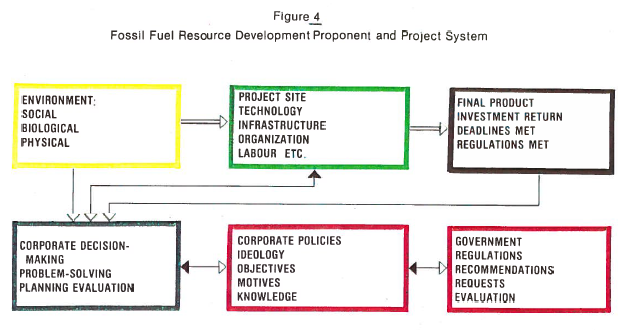
The development proponent initiates project development and CCIA. It is responsible for minimizing negative impacts while optimizing positive impacts on the Indigenous community. CCIA research conducted on community site (see below) results in a final product that meets corporate and government regulations.
Figure 5: Indigenous Community System
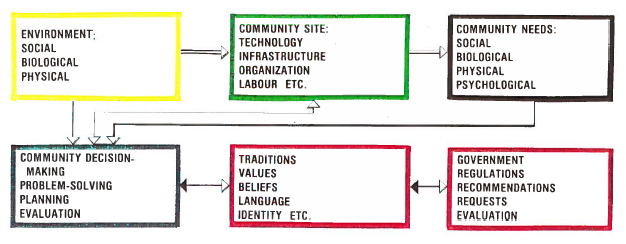
The community participates in CCIA research and in the project (labour, services, etc.) as the project impacts the community. CCIA research takes place in the community and identifies needs and resources for local community development.
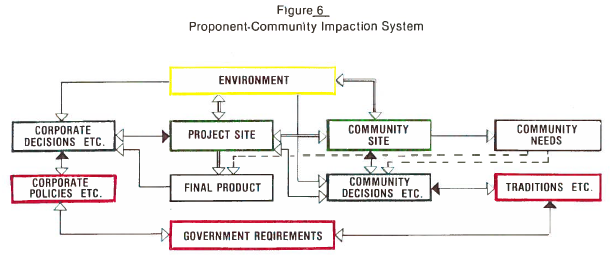
As they interact, community and proponent develop patterns of communication and exchange, and their roles in relation to each other become defined. Good communication, mutual understanding and cooperative dispositions are required for a smooth running relationship.
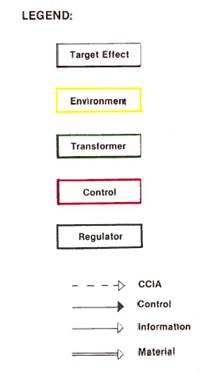
support families or traditional lifestyles (guns for hunting, for example). The CCIA that is required by the government to be done by the proponent can be used by local Indigenous residents for community development planning. In exchange, the community can give the proponents researchers information needed for the CCIA.
Other means of cooperating may be beneficial for both groups. Joint ventures are becoming more common and the hiring of Indigenous people for CCIA and environmental impact assessment is also occurring. New strategies are being worked-out between groups on the basis of their individual needs, resources and objectives (see Figure 7).
CCIA as a formal means of contact between proponent and community involves extensive information exchange. The proponent is responsible for giving the community all the information it requires to plan around proposed development. The community is responsible for giving all information needed by the proponent to construct a simulation of the community for the projection of impacts. If the two groups cooperate both benefit. Through time this interaction of information exchange can become less formal and both will acquire a very clear understanding of the situation. A relationship could evolve whereby further points of cooperation become possible.
| Table 1: Contributions and Rewards of Cooperation Proponent Community Possible Contributions To Cooperative Activities -Information about project -Employment, training and wages -Compensation for negative impacts -CCIA designed for community and proponent use -Develop community infrastructure as as required -Payments for land surface rights, or royalties -Information about Community -Local manpower -Use of existing Community infrastructure -Participation in CCIA research -Use of land surface rights for project -Cooperations in planning needed infrastructure development Possible Rewards Of Cooperative Activities -More reliable impact projections -Reduced costs due to delays and mistakes -Satisfied government requirements -Good public image -Clear social conscience -Cultural awareness and corporate development -Use of CCIA as a planning tool for development -Income from employment, compensation and royalties or payments. -Job training and education -Access to experts and consultants -Cultural awareness and community development |
Figure 7
Inputs and Outputs of Cooperation
If a cooperative relationship is established both groups benefit by receiving rewards not possible otherwise. In CCIA research a pool of shared information results. Total costs for research of the same resulting quality are much reduced when the community and proponent cooperate.
The action of one modifies the action of the other through feedback.
B.5.b The Subjective Perspectives
As the cooperative interaction proceeds the two cultural perspective paradigms develop a set of values, beliefs and thinking, evaluating styles which are compatible in both paradigms and which serve as a channel for communication. The two paradigms become sensible to each other if the process of cooperative interaction continues long enough and does not stop when conflicts or misunderstandings arise. One means of increasing the probability of this happening is to hire both insiders and outsiders on the CCIA research team. If insiders and outsiders work closely together with similar objectives and resources but different original perspectives then cooperation will be easier; of course the will to succeed is essential.
One main intent implied in this report is that an understanding of the cross-cultural situation will create more sympathy and willingness to cooperate. Differences that lead to conflicts can be understood in terms of cultural perspective paradigms and then action can be taken to address the problems squarely.
B.5.c Acculturation
Acculturation in the interaction between an energy resource developer and an Indigenous community can be explained as a series of three phases: contact, conflict and adaptation.
In the contact phase there is “feeling out”; or listening and inquiring without a lot of offering of information. Both groups want to “wait and see” or “find out more” and “don’t show the cards”. Identification of issues, and problems, concerns and “what’s in it for us?” are typical for both in this stage.
Conflicts arise often as it is realized that needs or wants are not being met. Sometimes impatience, indecision, distrust or personal offense start the conflicts. Other times it is simply poor communication or lack of interest. The two groups probably do work on different time tables and this can create wrong impressions: “they’re stalling to see how much they can get out of us”, or “they’re in a hurry to pull the wool over our eyes”.
The reverse can also be true as illustrated in the interpretation of values on lifestyle: “these people don’t want to plan anything; they live one day to the next”, or “these people don’t want to help us; they want to assimilate us”. Both the proponent and the community can incorrectly interpret a statement by putting it into an incorrect context. Realizing the other’s perspective is different, assumptions based on common sense, rumors, hearsay and suspicion are used. Reality is always more complicated than rumors and clichés.
In this adaptation phase of acculturation conflicts are resolved and in the process new means of cooperation are invented. An understanding is arrived at concerning how to work out joint problems and the confusion and uncertainty of the first two phases are reduced. Learning of new styles of thought and evaluation increase the abilities of both groups to construct their subjective realities. For more information on acculturation see Appendix.
B.5.d The Role of Knowledge and Value
Knowledge and value play important roles in the interaction between proponent and community. The understanding of how a belief and value system changes can prepare both for their own developments. Realizing the changes that could take place in their own perspectives as a result of acculturation, the process of acculturation can be taken seriously and used as a tool to better understanding and evaluation of reality. Confident that changes can be rationally and voluntarily controlled to a large extent, anyone wishing to have the best of two perspectives and two cultures can pursue that ambition readily. In addition, “triangulation”, or the identification of two perspectives on a particular aspect of experience, could enlighten a process of developing a totally new perspective, better than and different from the two former perspectives.
The process of bringing to life the cultural perspective paradigms in one way reduces uncertainty of predictions of future impacts on the paradigm. If the process of subjective reality construction is more rational and intentional then it is more predictable and controllable, provided one understands the logic of the system. But if it is to become more rational and intentional it can change unexpectedly to. Traditional habitual patterns of subjective reality construction could be counted on even when it seemed unwise. Rational and intentional development can result in new ways of solving problems. As the problem solutions are more important than predicting problem solutions it seems that rational intentional development should be preferred.
If cooperation is maintained throughout the CCIA process and is the basis of all interaction between proponent and community, the two groups can draw on a pool of resources that neither could have independently. The CCIA, as a cooperative enterprize, can be adjusted continually as it is used to plan for developments by proponent and community. It can be added to and drawn from continuously as required. Feedback on information contained in the CCIA, from proponent and community can serve to reinforce the information, or to change it, or to eliminate it (see Table 1).
B.6 SUMMARY OF THEORETICAL FRAMEWORK
Ideas on scientific and knowledge processes, systemic causation, subjective reality construction, cultural perspective paradigms and the nature and study of impaction all contribute to a framework within which a methodology for CCIA must be understood and constructed.
Scientific thinking involves several levels of information processing and their resulting levels of knowledge. CCIA requires thinking and knowledge at each of these levels. Modelling and simulation will be discussed in the next section to show how to make sense of data collected through empirical research.
Systemic causation refers to the fact that within a system of interdependent subsystems all components mutually cause each other to stabilize or to develop. It should be used in CCIA as a way of understanding the causal relationships between components of a community and its culture and between the community and external systems, such as a fossil fuel resource development project. These causal relations are to be modelled and simulated by the researchers.
Subjective reality construction consists of the processes and dynamics of interpreting experience. In doing CCIA researchers must understand the “perspective” of local Indigenous residents. Understanding Indigenous subjective reality construction involves a number of questions about value, belief, symbol, thinking and valuing systems but a main requirement is empathy and some identity relationship between researchers and community residents.
Pulling these three sets of ideas together results in a rough theory on the causal system underlying the logic of perspectives – cultural perspective paradigms. This theory can be used and adapted to understand the perspective of an Indigenous community or a development proponent. It can be developed for simulation by community insiders and outside researchers for use by community development planners and proponent and government decision makers.
Finally, regarding the nature and study of impaction, how the proponent and the community interact shows how the CCIA process fits into the relationship by providing a pool of information that both groups contribute to and draw from. The CCIA can become a shared perspective through which proponent and community can communicate and negotiate.
The next section, the CCIA Research Process, is constructed with the help of the theoretical framework developed in this section.
continue to use the concepts of cognitive and evaluative processes. CCIA researchers will find it useful to understand what values and beliefs a community has and what kinds of information it processes in order to know how it will behave in relation to a development project.
In the CCIA methodology therefore, both information processing concepts and evaluative processes must be identified and related to each other. The evaluative process is as important as the cognitive process because the evaluative process is the control mechanism of a cultural system. Evaluation decides the priorities, goals and objectives of the whole system. Evaluation is the process that brings about social integration and solidarity and, along with cognitive processes, it helps to explain the socialization of individuals into the community culture.
The psychological assumptions used here are simple. The human being is seen as an information processor. He is also seen as a valuing and evaluating person. The two functions are combined in such a way that one supports the other. That is, perception and cognition are dependent on evaluation and evaluation is dependent on perception and cognition.
B.2.a Causal Relationships
The study of CCIA is primarily the study of causal relationships. Researchers must find out what causes what, and how, in an Indigenous culture. Causal relationships may be simple or complex, linear or non-linear, direct or indirect.
A simple linear causal relationship is one in which A causes B, and B causes C. A complex causal relationship is one in which A causes B, B causes C, and C causes A. A direct causal relationship is one in which A causes B without going through any other variables. An indirect causal relationship is one in which A causes B through another variable C.
In culture, causal relationships are usually complex, non-linear, and indirect. For example, a development project (A) may cause employment (B), which causes income (C), which causes changes in values (D), which in turn affect political power (E), which may influence future projects (A). This is a cyclical causal relationship.
B.2.b Systemic Change
Systemic change occurs when a change in one part of a system causes changes in other parts of the system. These changes may be small or large, temporary or permanent, reversible or irreversible.
The introduction of a new technology, such as the snowmobile, is an example of systemic change. It affects hunting practices (economic), family life (social), attitudes toward tradition (psychological), and distribution of power (political).
Systemic change may be planned or unplanned, desirable or undesirable, anticipated or unanticipated. A CCIA researcher must attempt to predict the systemic changes that will result from a development project and assess their desirability from the point of view of the Indigenous community.
B.2.b What is a System?
In essence, a system is a network of subsystems and patterned relationships between subsystems which form a whole that is relatively independent of systems beyond its boundaries. The subsystems remain in these relationships as long as their needs are met or until they are displaced by other subsystems which are more effective in meeting their needs. A system can therefore be seen as both stable and dynamic, persisting in time and changing in response to environmental pressures.
The community as a system consists of social, cultural, physical, biological, and psychological subsystems. All subsystems are interrelated and interdependent; none can be completely separated from the others. The community is also part of larger systems such as regions, nations, and the global economy, while also containing smaller systems such as families, schools, and workplaces. Each subsystem contributes to the overall functioning of the community and depends on other subsystems for survival and effectiveness.
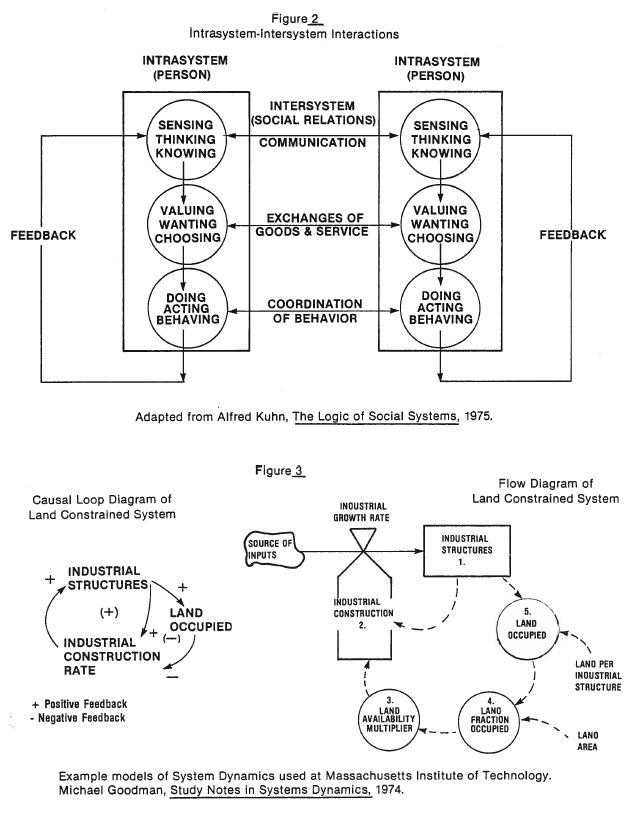
B.2.c System Boundaries
The concept of system boundaries is essential in defining what is and what is not included in a system. Boundaries may be physical (geographical territory), cultural (values, beliefs, norms), organizational (membership, roles), or functional (tasks, processes). Boundaries are not rigid; they are permeable, allowing exchanges of energy, matter, information, and values with the environment.
In the context of an Indigenous community, boundaries are influenced by traditional practices, cultural heritage, kinship networks, and external pressures such as government policies and resource development projects. Recognizing these boundaries is critical in conducting CCIA, since it helps determine the scope of analysis, the inclusion of relevant subsystems, and the identification of external influences.
B.2.d System Functions
Systems are purposeful; they have functions which serve the needs of their members and maintain the stability of the whole. Functions may include production, reproduction, socialization, adaptation, regulation, and goal attainment. Each function is carried out by specific subsystems, which in turn interact with each other to maintain balance.
For Indigenous communities, functions may include preserving cultural identity, transmitting traditional knowledge, maintaining social cohesion, managing resources sustainably, and negotiating relationships with external systems. When external interventions such as fossil fuel development occur, they may disrupt or reinforce these functions, leading to cultural change or adaptation.
B.2.e System Feedback and Regulation
A key feature of systems is feedback—the process by which information about past or present performance is used to regulate future behavior. Feedback may be positive (amplifying change) or negative (stabilizing and correcting). In community systems, feedback operates through communication, norms, and decision-making structures.
For example, if resource development causes environmental damage, feedback from community members may result in collective action, protest, or adaptation of practices. Effective CCIA must therefore pay attention to feedback mechanisms in Indigenous communities, recognizing both traditional forms (e.g., councils, elders’ guidance) and modern forms (e.g., negotiations with governments or corporations).
B.2.f Systemic Causation in CCIA
The systemic causation approach views impacts not as isolated events but as interconnected processes within a network of subsystems. An external impact such as the introduction of wage labor may affect family organization, cultural identity, education, and values simultaneously. These changes may then produce further effects, reinforcing or counteracting the initial impact.
CCIA must therefore model causal chains and feedback loops across multiple subsystems to anticipate the range of possible outcomes. This holistic approach provides a more realistic understanding of cross-cultural impacts and helps in designing strategies for minimizing harm and maximizing community well-being.
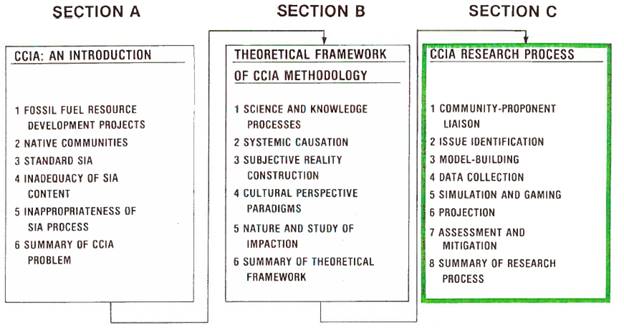
Here is the OCR transcription of the page:
C. THE CCIA RESEARCH PROCESS
The concepts presented in the theoretical framework for the CCIA methodology are intended to be incorporated into the design of methods for the CCIA process.
At the various stages in the CCIA process scientific thought processes will result in different levels of knowledge produced. Empirical research, theory construction, simulation and projection (prediction), are engaged in again and again, not in unilinear fashion but through feedback between all levels of analysis and stages in the CCIA process.
Because the intent is to get a systemic or “holistic” perspective on the impacted community, the perspective is constructed by continuously rebuilding from a simple causal model to a more complex simulation. Through time the whole CCIA process is developing, each stage simultaneously growing in complexity and organization. It is: 1. lead by community – proponent liaison; followed by issue; 2. identification; feeding 3. model-building; which guides 4. data collection; to fill in 5. simulation; that produces 6. projections; which are the basis of 7. evaluation and mitigation planning. The progress of later stages influences the ongoing earlier stages through feedback connections. Early stages can shape the design of later stages before they are operating.
The ideas concerning the subject matter, i.e. cultural perspective paradigms and subjective reality construction, are most relevant in the design of methods for model-building, data collection and simulation. At these stages methods are required for: 1. determining the relevant impact information required; 2. getting the data which is reliable, valid, accurate and precise; and 3. using the data to produce useful information about future impacts.
Perspective and impaction are useful concepts especially in the design of approaches to community-proponent liaison, issue identification, and evaluation and mitigation planning. To be aware of differing perspectives and how they interact is important at any point of cooperation but at these stages of CCIA there is a particularly strong involvement of values. Successful mutual adaptation between proponent and community is the final objective of community based CCIA.
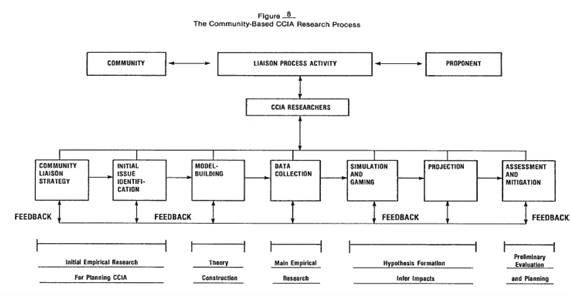
C.1 Community-Proponent Liaison
Community-proponent liaison refers to the communication between community and proponent that establishes and maintains mutual understanding. It consists of symbolic interaction and a shared set of rules or norms that guide behavior and use of language so that meanings are exchanged with a minimum of misunderstanding and conflict. Thus the process of developing good liaison requires full cooperation between community and proponent and agreement on means and ends to be achieved by liaison.
C.1.a Considerations In A Strategy
Community-proponent liaison is required at each stage of the community based CCIA research process. There must be agreement about the extent of community and proponent participation at each stage. The roles that each party plays should be well defined although these roles should be adaptable as conditions change and new information becomes available. Responsibilities and rewards should be clear. The means by which the two parties work together is also a part of community liaison.
The proponent must consider costs and benefits of liaising with the community through different processes. Four levels of participation by the community can be identified: 1. one way information, take or give information; 2. persuasion of community opinion by the proponent; 3. consultation with the community; and 4. partnership between proponent and community. The choice of strategy reflects the corporate policies, objectives and understanding of the situation.
For the community a decision on liaison strategy is also based on costs and benefits. The community decides between: 1. one way information, take or give information; 2. two way information, take and give; and 3. cooperation as a partner with proponent. Of course, a community may not want any interaction.
C.1.b Cross-Cultural Communication Approaches
The community-proponent liaison agreement should take into consideration the problems of cross-cultural differences. If different cultural perspective paradigms are to find mutual grounds for interaction, no simple one way communication will function. One way communication implies no interaction and a minimum of understanding between parties. Feedback or two way communication, is required so that perceptions can be checked. One should ask if he is understanding the other’s perspective correctly. There should be opportunities for listeners to tell speakers their perspective so that speakers can “speak the language” of the listeners. Through this interaction a common body of knowledge is formed about which both groups can communicate and through which further shared understanding can be acquired. Both benefit.
The corporate persuasion strategy is predominantly a one way communication type with the exception that enough listening on the part of the proponent is intended to convince the community that it is being heard. This strategy does not result in the proponent getting the valid and complete information that it requires because the local Indigenous perspective is not understood or appreciated. The Indigenous community may have seen this strategy often enough that they no longer submit to it.
In the consultation strategy of the proponent, advice is sought from the community on the proponent’s terms. Consultation may not be taken seriously if the community is not assured of being fully heard and that what they say will affect development. The local people may want all the facts before commenting. They may want to be guaranteed some degree of partnership so that they can plan the development of their community around the resource development project and its impacts.
Partnership between proponent and community facilitates the construction of the fullest perspective on the impaction process. If all available information from the perspectives of the Indigenous community and the development proponent is synthesized then both parties are best equipped to deal with any change or development that might take place.
From the Indigenous perspective, partnership with the proponent prepares the community not for assimilation and not for isolation but for informed rational planning of cultural development. Partnership allows the Indigenous community freedom to choose the extent of adaptation to urban Canadian culture and it gives the community the resources to use that freedom wisely.
For the proponent, partnership with the community permits better projection and control of project impacts. It will facilitate a relationship in which community resources can be used or developed without political barriers.
C.1.c Community Based Research
Some degree of partnership forms the basis of community-based impact assessment. If both proponent and community have significant inputs and control in the CCIA process, each will be rewarded with a tool and a final statement that are better than if either party were to do CCIA alone. The points of contact between proponent and community range long before and after CCIA research. There is need for good liaison from the time the first representative of the proponent sets foot near the community to the time the last one leaves. At any time impacts can occur which are needless, or they can get out of control. Rumours may start on both sides which can prevent or slow cooperation later on. Uninformed workers or residents could accidently interfere with the functioning or operations of the other party.
From the proponent’s perspective community input into CCIA stages is to be valued. Issue identification in CCIA requires primarily the local Indigenous perspective. Without community input at this stage and in the design of the methods used, there is no issue identification. Researchers from the local population can be hired to ensure that concerted effort is put into defining local issues, topics of interest and concern to local Natives. How to identify local issues may be found or known only by local Natives.
In model-building, community input is required to construct models that make best sense of the cultural perspective paradigm and that is comprehensible by local Natives who may wish to use the models.
Data collection also demands local Indigenous researchers because most research techniques used in urban Canadian settings do not apply to Indigenous culture, as they are. Techniques must be adapted and assessed by criteria that the local Indigenous people use in addition to standard social science criteria. Someone who knows what local people are saying and meaning and also knows what information is being sought will be best equipped to know when questions are answered properly.
In simulation and gaming, local participation is needed to see if the simulation accurately represents how the community works. Residents can also be a part of the simulation in gaming or playing with it to find greater accuracy, validity, precision and reliability. Simulations must be designed to be used by the residents so they can use it in planning community development if they wish.
In the projection stage, impacts that are projected to occur in the community have to be sensible to residents. They should be able to understand how and why the impact is likely to occur so that they can assess the consequences and act accordingly.
Assessing and mitigating impacts involves planning for and around them. What changes the local people want and do not want can only be decided by local people. The Indigenous cultural perspective paradigm will never be fully appreciated by outsiders so Indigenous people must have an opportunity to act directly on what they know and want concerning community and cultural development.
C.1.d Liaison Methods
The means used in community-proponent liaison can involve a number of methods. Public meetings, hearings, seminars, forums and workshops can all be used if adapted to the local setting and if the understanding of these affairs by local Indigenous people is taken into consideration. What do these affairs mean to them? What have their experiences with them been like in the past? The best way of adapting these methods is in cooperation with local people themselves.
Meeting regularly with existing community organizations, institutions, leaders or other interest groups can also be effective provided terms of relationships are understood and agreed upon.
Citizen committees can be formed to act as an ongoing community voice. This requires that the committee properly represent those it is supposed to present. Who is on the committee may be decided by the proponent, by local organizations or groups or by election. The committee may also be open to the public so that any interested resident can participate. If local Indigenous persons are hired as CCIA researchers, responsibility for hiring and supervising them may be given to this citizen’s committee. This independence can help create some balance of control that is required for cooperative participation on the part of the community.
C.1.e Communication Techniques
To help in the communication process various presentation techniques are available. The use of films about fossil fuel resource development, social research, community development or Indigenous culture and acculturation can help everyone interested to understand the whole situation and the other’s point of view. Slide and tape presentations can be made and used for the same purpose, with more local issue content. Proponent, community or government, can each use their own imaginations in presentation techniques. Even local films can be made. Maps, charts, models or theatrical plays can be used to communicate when words alone are insufficient.
The words and language are important too, and researchers, insiders and outsiders, should be familiar with the different communication styles used by the two interacting cultures.
C.1.f Summary
As the CCIA research process progresses, changes in liaison may be required. Different stages of research require different roles and responsibilities in participation. Improvement in relations can also be made as mutual understandings develop. It is important that some liaison strategy is agreed upon before it is necessary, so that research problems can be addressed with a minimum of confusion. Community-proponent liaison sets the stage for all cooperative activities and is the basic foundation of community-based CCIA research.
C.2 Issue Identification
In this stage in the CCIA research process issues that are of concern to community, proponent and government are identified. The three groups must meet in one setting or another, preferably in the community, to discuss what each group wants to know and what they want done. Three main topics frame the discussion: 1. what is the nature of the problem; 2. what needs must be met; and 3. what resources are available. Each group should become prepared to answer these questions from their perspectives and to learn the answers the others have prepared. They have a number of means available to answer these questions. If the community is short on resources it can be helped by the government or proponent, without interference in the subject matter of the answers.
C.2.a Research Issues
In identifying issues, the community-proponent liaison component for each of the research stages can be outlined and agreed upon. The basic design of the research stages can also be outlined as required to satisfy initial needs. These considerations are issues of potential concern to all parties.
Issue identification is not only an initial stage but may be referred to again and again in the course of the research to be developed into a fuller general picture of impaction. Each issue should be modelled so that it is seen as a set of variables in interdependent causal relationships. An issue should be defined so that it can be studied empirically and relevant data can be collected. It should be possible to simulate the issue in a way that produces useful projections on outcomes of changes to the subject at issue. Some idea of what to do with an outcome as projected is part of the issue.
For example, if the issue is the impact on local education by a resource development project: 1. models developed will show causal relationships between the project and local education; 2. data collected will provide inputs of values for variables and rates of interaction into the model; 3. a simulation resulting from steps 1 and 2 will facilitate gaming of the project-education relationship; 4. projected trends in impacts to education will be produced through simulation; and 5. the projected impacts will be assessed and mitigation measures will be planned. At any point along the way the issue may have to be reformulated or amended.
C.2.b Issue Organization
The issues identified should be organized so that they can be handled systematically in the research process. How categories or classes of issues are invented will depend on the three parties as they interact and discuss the issues. A theoretical framework should be constructed with some basis in social science theory. Issues may be sorted according to causal relatedness, structural similarities, functional similarities or process similarities. They may be organized by spatial or temporal relatedness or by scientific discipline. Causal relatedness is recommended here because the model and simulation designs proposed are of causal system types. Causal relatedness is the primary focus of most scientific explanation. It has proven most useful.
Having organized the issues into a system, model-building is the next stage. Organization of information will greatly help modelling and further stages of research by ensuring that related issues are dealt with at the same time and in similar ways.
C.2.c Methods of Issue Identification
The common methods used to identify issues include literature review, general survey and observation. The main idea is to find out what impacts could conceivably occur, which ones are most important and how in general could these impacts be handled. Each group of interested people could identify issues that they feel are important from their perspective.
Literature review concerns surveying any written material about the proponent’s activities and projects, the Indigenous community or government interests in the area. The sources may be books such as history texts or local histories, autobiographies, social science texts on SIA or acculturation, books on corporate ideology and organization, the fossil fuel industry or government goals, strategies and plans. Newspapers published locally or by the proponent carry much information on concerns, interests and events. Records of births and deaths, marriages, immigration and emigration, statistics on population, incomes and income distribution and so on can be surveyed quickly to get a general picture of the composition of the community. Records about the proponent’s past and present activities can be surveyed by the community.
Because of the cross-cultural aspect of the research and the special attention to subjective reality construction, it is absolutely essential that any ethnographic studies of the Indigenous people in the region or of similar regions be reviewed. These studies can serve as a rich source of issues that could be important. Ethnographic studies analize the whole lifestyle, culture or lifeways of the people, including their ways of thinking and valuing.
A general survey of an Indigenous community could cue researchers to many local unique or timely events. Outsiders can develop a sense of the community viability, stability or preparedness for change. It is important to find out: 1. who are the leaders; 2. what organizations exist; 3. what infrastructure is in place; 4. what social problems are obvious; and 5. what resources are available or needed. The survey may consist of a guided tour by an insider, a set of informal interviews and discussions with people met or by general public meetings. All the insights possible should be explored as possible leads or clues to important issues.
Of course, the community may conduct a survey of the proponent as well. If the proponent invites Indigenous residents to inspect the proposed project site and visit developed project sites or even office settings, these opportunities can help residents identify issues of importance to them. If no invitation is offered, the residents should consider asking about it. Indigenous people should ask themselves: 1. what would it be like to live close to such a project; 2. what would it be like to work at it; 3. how would the community and its people change if more urban Canadian influence is to take place (education, income, services, social problems, etc.) Holding local Indigenous meetings and discussions are also valuable in sharing ideas.
Finally, by simply observing ongoing affairs at the community level researchers can gain a feel for and intuition about the community’s strengths and weaknesses concerning coping with change or taking advantage of opportunities. By casual conversation with residents one can sense their awareness of issues or the depth of their understanding of potential impacts. At the same time, the CCIA research process can gain its humanistic character, the empathy for the people as their lives are about to be affected by outside intervention. It would be ideal if final decision makers could share in this experience.
C.2.d Summary
Issue identification is the process of getting an organized general impression of problems, needs and resources that could arise in the impaction of a resource development project on an Indigenous community. The impression is best informed if it consists of a cooperative pooling of perspectives from community, proponent and government. The variety of methods used by the groups is limited only by imagination and money. In most cases the methods need not be expensive but if assistance is required resources could be shared. A clear statement of issues sets the foundation for model-building.
C.3 Model-Building
Model-building as it is used here, is the process of constructing a representation of the causal relationships between key variables in a community or culture. It is a process of analizing the issues identified to determine which factors in the Indigenous community are important to study. The factors are isolated and treated in a special way so that they are thought of as dependent variables (or effects) and independent variables (or causes). As variables representing factors are manipulated conceptually their causal relationships are determined.
For example, an issue of the erosion of tradition values about family is broken down to component factors: the process of erosion, traditional values, and family. Other relevant factors such as wage incomes, formal education, and domestic or household technology (for instance) are identified as important to the issue. When these factors are thought of in terms of their causal relationships they become variables as well and must be defined clearly for the purpose of operationalizing the model. In other words, “family” and “values” must be defined in some way which will permit empirical observation and possibly measurement. Since the subject of analysis is Indigenous community and culture it would be appropriate to define these variables in ways meaningful to local Indigenous people. (See Figure 12, Appendix).
Variables constitute the main components of a model but their relationships are just as important. To find out how a resource development project has an impact on traditional Indigenous values about family researchers must trace the sequences of causal relationships between the two. If, for instance, Indigenous men are employed in wage labour on the project site less time may be spent at home with the family. A father’s circle of affairs and contacts could change focus and he may come to value the adult male co-worker relationships more, in relation to values on home and family relationships. Thus a causal system is identified.
However, the model required for simulating a community and its culture needs to be systemic. Causal relations are feedback loops. As the father’s values shift slightly away from family to the work environment, stresses put on the father by the family or friends can either remind him of the importance of family and thus bring back tradition, or the stresses could pressure him to adapt more rigidly to a strictly “provider” role. In real life this situation would be much more complex but the totality of interdependent variables will cause some degree of change and stability regarding traditional values and behaviors.
So a model consists of a set of variables and their relationships as they represent a real social or cultural system.
C.3.a Steps of Model-Building
The process of building a model starts with an analysis of the issues identified and organized, and it demands creative scientific reasoning that will result in diagrams or figures showing graphically the relevant variables and their causal relationships.
In issue identification the irrelevant or less relevant information about the community is ignored. When the model is being constructed a further selection of relevant information takes place. Some issues may be redefined as their relationships with other more meaningful issues are
uncovered. Perhaps new issues will be identified as the model is constructed.
Further organization of issues takes place as factors are isolated and then integrated as variables into causal relationships. This requires imagination because the complexity involved in systemic causal networks must be pieced together one step at a time even though several issues will undoubtedly be highly inter-related. Selecting the important relationships to be modelled also demands the use of various ready-made social science theories and concepts.
The main work in model-building is theory construction and this scientific thought process is inductive. It depends greatly on the researchers’ imagination and creativity. One suggestion is to work through small and relatively simple models for single issues then gradually integrate them all together into more complex models. (See Figure 13, Appendix).
Issues, like actual systems, can be arranged hierarchically, larger ones being made up of smaller ones which in turn are made up of even smaller ones. A general sketch of the relatedness of issues can be produced based on the work done at the issue identification stage. As small issues become modelled the whole sketch gets filled in and serves as the basis of an overall model.
In representing graphically the variables and their relationships a system of symbols is used. Each researcher can use his own symbols provided a key or translation of the symbols is included. Symbols can be invented to represent different ways variables are related causally. The symbol system may be simple or complex to suit the researcher’s needs and the model user’s convenience.
C.3.b Purpose and Use of Models
A model is used by researchers, interested community residents or proponent representatives to see fairly quickly and easily the whole impaction situation between the development project and the Indigenous community. It is to take a very complex real system (the community and its culture) and a common sense view of it (issues identified) and result in a comprehensive systematic analysis that is simpler than reality and more valid and reliable than common sense.
A model is used here to guide data collection strategies, methods and techniques. The model identifies the relevant empirical information that must be collected in order to produce a simulation, or working model, of the community. The model also serves as a skeleton for simulations.
Generally, in SIA two futuristic scenarios of a possible impaction situation are produced: one that shows a community with the project, and one that shows the community without the project. In CCIA a similar approach is recommended. Two models resulting in two simulations are to be produced: one with the project in the community, and one without. The main idea is to be able to see fairly distinctly how the project might change the community two, five, ten or twenty years from the beginning. Without a comparison of impacted and unimpacted communities it is extremely difficult to determine the community change that is attributable to the project. A simulation of the community without project impacts is of no use to the development proponent by itself, but a simulation of the project impacted community alone will not show that some change indicated is going to happen anyway or would never happen without the project.
If the models are developed by insiders and outsiders working together the biases that each group bring with them can be minimized. Each group has better insight into different aspects of the situation. Insiders know how local Natives think and live but may not be able to disengage from local issues, such as inter-group rivalry. They may not be able to draw on social science theory either. Outside researchers can put information into a social science perspective and are likely more able to keep out of local issues. But they do not have a local Indigenous perspective.
C.3.c The Subject of the Model
What is to be modelled? The issues identified could range from worries about increased alcohol consumption to the changing views on the nature of God. Some examples of subjects are listed here which together could be seen as forming a whole system:
- History, modernization, acculturation:
a. North American First Nations peoples, Metis, Inuit;
b. regional and local historical developments;
c. response to urban Canadian macro-culture influences: cultural lag, transfer of technology, patterns of governmental determinism;
d. the role of learning and experience at the community level;
e. the system of local Indigenous values and beliefs concerning acculturation.
- The social and ecological environments:
a. present interdependence of socio-cultural systems; dynamic interaction of community with others;
b. Indigenous perspectives and perceptions of the social environment; relations with outsiders;
c. dependence and interdependence on the land fish and wildlife;
d. a comparison of Indigenous and White values and attitudes toward the ecosystem; - Interaction of fossil fuel resource development project and Indigenous community:
a. employment: training, orientation, relations;
b. payments: wages, compensation, royalties;
c. services: health and medical care, food, social services, recreation, etc.;
d. environment: ecosystem changes, roads, farmland, traplines, wildlife, fish, etc. - Social organization and technology:
a. adaptive and creative group problem-solving behavior;
b. ceremonies, rituals, customs; i.e., stabilizing group activities;
c. social organizational and institutional development;
d. role of technology in production;
e. material exchange and distribution;
f. interpersonal decision making;
g. social needs and resources;
h. organization for education. - Impacts on social organization and technology:
a. institutional or subsystem change: family, band, tribe, associations, schools, etc.;
b. social structure change: stratification, integration, specialization, division of labour, etc.;
c. change in means of production: labour, technology, land;
d. money management and wage incomes;
e. change in exchange and decision making structures. - Value, belief and symbol systems – cultural perspective paradigm and subjective reality construction:
a. socialization – myth, model and reinforcement;
b. acquisition of knowledge, learning styles, mode and setting;
c. acquisition of values, totems, taboos, attitudes;
d. language learning, symbolic interaction, orientation and role of symbols in conceptual development;
e. thinking, problem-solving, decision-making, creativity, innovation, stability;
f. identity and self-esteem. - Impacts on value, belief and symbol systems:
a. changes in methods and content of socialization;
b. changes in information processing and criteria;
c. value change and evaluation process changes;
d. changes in language use, conceptual development;
e. impacts to cognitive style;
f. change to cultural identity, the important role of identity in acculturation. - Communication and control functions:
a. information flows and patterns;
b. symbolic interaction processes;
c. roles of values, beliefs, identity in system control (i.e. ideals, goals, criteria, orientation, etc.);
d. development of the control function and system;
e. roles of exchange behavior, organization, authority structure and regulation; - Impacts to communication and control:
a. specialized knowledge and conceptual confusion;
b. bilingualism, information entropy or loss of meaning;
c. value erosion, cultural identity confusion;
d. communication pattern changes;
e. loss of face, ego strength and self-esteem;
f. fight or flight, approach – avoidance behavioral responses; - Stability and growth:
a. dual objectives, payoff schemes, gaming, opportunity cost;
b. value variation and priorities as a function of identity and experience;
c. the role of learning and experience;
d. feedback in development processes;
e. pragmatics, risk, uncertainty and other criteria of decision-making. - Community dynamics during impacting:
a. response to variety and uncertainty;
b. rapid adaptation and confusion;
c. the role of personalities;
d. cognitive consonance and analogy of old and new ways, insider and outsider perspectives;
e. communication and control in action;
f. personal coping mechanisms – isolation, insulation, selective exposure, waiting, etc. - Community operation after impacting:
a. sorting and settling after shake-up;
b. new order, roles, relationships;
c. synthesis of lessons into whole culture – diffusion of ideas, beliefs, values;
d. feedback and evaluation in continuous development;
e. communication and control in action. - Value change – information and uncertainty:
a. consequences of cultural lag (technologies change before values change);
b. informed judgement, unstable criteria, need for completion;
c. pragmatics, trial and error, and heuristics;
d. values on interdependence, autonomy, self-sufficiency and cultural identity coherence. - Evolutionary dynamics:
a. change from within the system;
b. change from outside the system;
c. group learning and collective intelligence;
d. achieving stability and certainty as a collective phenomenon.
Each of these issues and their associated factors and variables must be seen from a perspective that is developed between local Indigenous insiders and urban Canadian social science outsiders. Not only should these subjects be modelled but how the local Indigenous people understand them should be modelled, that is, their cultural perspective paradigm should be modelled. A general model of a local Indigenous cultural perspective paradigm could take the form in Figure 21, (Appendix).
In this model the products of information processing (values, beliefs, etc.) can be stored in the memory (of individual community residents) and recalled to serve as criteria in various other processes. The objective in using this particular model is to find out the particular processes, rules criteria and products that are used and created in the minds of local Indigenous residents. (See Figures 18, 19, 20, Appendix).
Another model (Figure 22, Appendix) is an example of how the community socio-cultural system can be explained. Communication, material exchange, authority relations and social organization are categories of similar processes each of which draws on shared values and beliefs for the production of social interactions.
C.3.d Typologies
It may be helpful to draw on any of the well known social and cultural typologies. These are models which compare and contrast different kinds of social and cultural systems. The best known of these are as follows:
—
| Author | Typology |
| Ferdinand Tonnies | Peasant Community – Industrial Society |
| Max Weber — | Traditional-Revolutionary-Rational Societies |
| Magoroh Maruyama | Unidirectional Causal ParadigmRandom Process ParadigmMutual Causal Paradigm |
Many typologies depict social evolution on a continuum of modernization. A typical anthropological perspective shows evolution along several cultural organization types:
- Hunting and gathering
- Horticulture
- Agriculture
- Pastoralism
- Industrialism12
Modernization includes the processes of increasing division of labour, increasing social stratification, increasing population groupings, increasing use of complex technology and changes in family organization. The problems of rapid modernization are evident all over the world in this century. Urban migration, unemployment, urban poverty, economic disparity run parallel in time with standardization, concentration of power and information, and widespread social alienation and deviance.
One typology which focuses on paradigms of thought and value is offered by Maruyama:
- Unidirectional causal paradigm: European and North American origin; characterized by: hierarchical organization, extensive classification, anthropocentric value orientation, quantitative analysis, homogenistic or “one truth” thinking, and competitive relationships.
- Random process paradigm: associated with liberal democracy; characterized by: egocentrism (individual rights), isolationism (“to each his own”), atomism (extensive separation of thoughts), non-contextual relativism (individual value orientations), and personal creativity.
- Mutual causal paradigm: common in traditional cultures (including Indigenous Canadians); characterized by: non-hierarchical organization, heterogenetic (non-standardization), symbiotic (complementary relationships), harmonistic, contextual truth and value, relational (awareness of connections) and poly-ocular or multi-perspectives.13
In model-building for an Indigenous community, researchers should be aware of the consequences of two or more paradigms interacting. If a model of the local cultural perspective paradigm is built researchers should show how the paradigm might change as it interacts with the urban Canadian paradigm. At what points will changes take place? in process classifications? in the rules or criteria used? Will changes be greater in subjective or objective cultural features? How will changes in communication styles impact value processes?
CCIA is a very complex task that requires researchers to ask many questions that can only be answered much later and perhaps never very satisfactorily. Yet without asking and trying to answer no progress is made.
C.3.e Summary
Model-building consists of a number of steps of selecting and organizing information so as to produce a graphic representation of a real community or socio-cultural system. The model or models produced enable researchers and users to see in a systematic yet relatively simplified way what a community consists of. A model showing a set of variables and their causal relationships is used to guide data collection and will serve as the basis for simulation of the community and its future developments.
Typologies can be used to inform researchers of differences between the two socio-cultural systems interacting in proponent – community relations.
13 Magoroh Maruyama “Paradigmatology and its Application to Cross-Disciplinary, Cross-Professional and Cross-Cultural Communication”, 1974.
C.4. Data Collection
Data is to be collected from the Indigenous community and about the Indigenous community so that it can be fed into the models constructed and turn them into simulations. The variables identified in the model must be defined in such a way that empirical data about them can be collected. The variable, defined in this way is an indicator. It is used by the researcher as a measurement tool to determine the state of the underlying causal factors. Statistics are the values associated with these indicators. For instance, the number of suicides in the community in the past year is a statistic, suicide is the indicator, the variable may be mental health and the factor at issue may be social cohesion or alienation.
Data can be in the finished form of statistics, (i.e.,quantified) or in the qualitative form such as stated values and beliefs, names, dates and places, or descriptions of observed behavior. The quantitative values, such as rates of occurrence of specific behaviors, or number of times a particular value is expressed in a local newspaper, or the percentage of negative responses to a question in an interview schedule, are the most valuable data. However, often these values are not reliable or available because research methods are inadequate. When the values are deemed unreliable the level of measurement can be reduced from interval scale (1,2,3,4…) to ordinal scale (smaller than – larger than) or nominal scale (A,B,C…). This means, for instance, reducing a statement about the number of negative responses to a question, eg. 35 out of 50, to “medium – high negative response”, or to “local people generally do not value vacations in Florida”.
C.4.a Levels of Measurement
There are essentially four levels of measurement into which data may be classified: nominal, ordinal, interval and ratio. In most cases in social science, ratio scale is never possible.
Nominal scale refers to the naming of a relationship or variable. For example, if a question has two possible answers – yes and no, true or false, it is using the nominal scale. If we wish to compare two Indigenous interest groups with respect to their attitudes toward petroleum resource development, response categories may be labelled “pro-development”, “anti-development” and “selective development”.
Ordinal scale uses classification as well but ranks the categories in relationship to each other:
Question: How much development would you like to see in the community in the next five years?
Response: 1. None; 2. little; 3. lots; 4. as much as possible.
No numbers are used in the ordinal scale so comparison of responses leads to little more than common-sense evaluation or prioritization.
At the interval scale level of measurement there are exact intervals between response categories:
Question: How much would you have your local government contribute to a cooperative development venture?
Response: 1. $ 0,000.00
2. $ 5,000.00
3. $10,000.00
4. $15,000.00
5. $20,000.00
If a simulation is to be developed which will generate projections of exact degrees or quantities of community change then interval scale measurement is required.
Because measurement methods are not well developed for studying subjective perspectives interval scale measurement is not appropriate. Data will have to be collected for simulation at the ordinal scale level. Projecting exact quantities of cultural impacts is not possible at this time.
In order to acquire data at the ordinal level, nominal level data must be available first. Choosing appropriate categories or classes of possible responses or answers to questions is the first step in data collection. Regardless of the methods used in data collection, data must be organized to be meaningful. For each indicator used a number of ways of describing findings about the indicator can be invented. For example, suicide could be described in terms of the victim’s religion, economic status, age or place of birth. Or it could be described in terms of time, date and place, victim’s reason given (if any), whether the victim was married, single, divorced or widowed, and so on.
Likewise, value descriptions could be categorized. Values on family can be described in terms of time spent together, events experienced together, who is considered family, extent of resource sharing, sacrifices of personal opportunities for sake of family members, or references to family in casual conversation. Many other examples can be invented.
To achieve ordinal level or scale of measurement, responses must be ranked in relation to each other. Local suicide rates could be compared with those of other similar, or dissimilar, communities resulting in measurement of relatively high, low or medium suicide frequencies. More transients than local residents may commit suicide, for instance, or more single men and married women than married men and single women. A basis of comparison of data is established.
In relation to values on family, perhaps the average amount of time spent with family could be compared with that of residents of other communities. Families of community A spent more time together than families in community B, who spent more time together than families in community C, and so on. Or, families in group X of a community speak of their families more frequently than families in groups Y and Z.
In any case, the data to be collected should be meaningful in the scheme of factor-variable-indicator analysis. The researcher is searching for data that is comparable to data of other communities, other community sub-groups, the community’s past and to data concerning other indicators. Is the community’s traditional culture more intact than that of other Indigenous communities that have successfully dealt with cross-cultural impacts? Is the community more cohesive, or are residents more mutually supportive than they were fifty years ago? Do local residents prefer hunting or wage incomes as a means of keeping the family together? Data must be ordinal for evaluation of the community’s cul ture. Data showing changes through time and correlated with other changes are particularly important for projecting future changes.
C.4.b Cross-Sectional and Longitudinal Analysis
Two ways of looking at the community perspectives exist: What variety and continuity exist among the personal perspectives in the community (cross-sectional analysis), and how have local perspectives changed or developed over the years (longitudinal analysis)? Both are important in simulating the community.
Cross-sectional analysis gets at data that to greater or lesser extent represent the range of perspectives held in the community. It is to determine the majority views and the minority views and roughly which values, beliefs and attitudes are common or representative. This analysis is best represented in the community survey method. Each person or a representative sample of residents is to respond to a particular set of questions. The diversity of responses then represents the diversity of values, beliefs or attitudes across the community.
Longitudinal analysis, best represented in oral or written autobiographies (or diaries), is a selective sample of how local perspectives have changed over the years. The element of development through time is important in determining trends in local Indigenous culture. Data collected could show that local Indigenous people have either become more rigid or more flexible in their feelings toward interaction with White outsiders. They could show that values about religion or technology have changed. These kinds of “historical” data are necessary if projections about future cultural impacts and changes are to be possible.
C.4.c Bias
Bias is the systematic distortion of truth that is unaccounted for in data collection. Basically, there are three ways in which bias may interfere with the collection of valid reliable data. The researcher, the subjects (local residents) and the study environment can each introduce their own biases.
The researcher can easily, purposefully or accidently, be looking for evidence to prove a hidden hypothesis or theory. This can be done by limiting questions or asking them in such a way as to get responses that do not reveal the truth or the whole truth. If a researcher asks an Indigenous person what level of formal education he has without inquiring about traditional and non-formal education, the whole truth is not told. Information about local education is then biased.
The subjects of CCIA research can also bias data by not giving the truth or the whole truth, and again it may be purposeful or accidental. If an Indigenous resident is asked to reveal his values on watching T.V. he may not think of all the things that he has learned about urban Canadian society, for instance, knowledge which he may actually value highly. A more reliable way to assess this value, and thus avoid an interpretive bias, is to observe the subject’s actual behavior of watching T.V.
The bias introduced in data collection by the study environment can be exemplified in cases of participant observation. If subjects are aware that they are being observed and studied, the situation can take on new meaning. No longer are the participants simply distributing portions of a cache to the family and community, for example, but they are doing so in a way modified by expectations about the researcher’s interest. The recorded description of the event is then biased, as the situation does not completely represent a common occurrence alone.
Bias can be reduced by having the research team made up of both insiders and outsiders, by using random and representative sampling techniques and by using standardized questionnaire formats.
If both insiders and outsiders are used they can help each other identify their biases. A bias common to urban Canadians may be obvious to Indigenous persons. Local Indigenous biases may be readily identified by urban Canadian researchers. Both working together may see into situational biases.
Random and representative sampling refer to the means used to select subjects to question or to observe. In random sampling, the researchers have no personal preferences in the sample of the local population but people are selected by chance or at random. In representative sampling a choice is made to select subjects in proportion to the various groupings or classifications of community subsystems. For instance, researchers may interview or observe members of associations, churches, interest groups, economic classes, political powers, educational statuses, marital statuses, age groups and so on. The intent is to leave no one out of the analysis. Data can be collected which represents proportionally the interests or perspectives of all groups and classes.
By using standardized questionnaire formats a survey researcher or interviewer can ask all people identical questions so that differences in responses represent only differences in attitudes, values and beliefs and not differences in the meanings of questions. Still some bias can result if the interviewer acts or appears differently from respondent to respondent. This too, should be as standard as possible. If differences occur, as sometimes it is necessary (respondents differ in language proficiency and literacy) these should be accounted for accordingly.
Ultimately, the best way to minimize bias is to get as many perspectives on an issue as possible. By using different indicators and different methods to study essentially a single issue, factor or variable, data resulting can be checked against each other. If discrepancies in resulting data occur it can be due to bias or to measurement of slightly different subject matters. Reanalysis or redesign of approaches taken may be necessary. A table of selected data collection methods is given in the Appendix. (Table 4).
C.4.d. Valuable Data
If the data collected is to be useful in constructing a simulation out of a model the data must be as valid, reliable, precise and accurate as possible.
Validity refers to the quality of the data in so far as it is a measure of the issue that it is supposed to be a measure of. Does the data refer to the indicators, variables and factors that it is supposed to? Is the researcher measuring what he thinks he is measuring? The use of suicide data as a measure of social cohesion may be invalid if a researcher makes assumptions about the relationship between suicide and social cohesion based on urban Canadian society instead of local Indigenous culture. Suicide may have meanings locally that are irrelevant to social cohesion.
Reliability concerns how well a study’s results can be replicated. If a study is conducted again and again, do researchers get the same results each time? The assumption is that if the same results occur each time then the same thing is being measured each time.
Precision is to be strived for in data as it pertains to highest level of measurement possible. The exact number of things studied or their exact degree of relationship, help in producing precise predictions.
Even if data is a measure of what it is supposed to measure, if it measures the thing similarly repeatedly and measures it very exactly, the data may not be accurate. Accuracy refers to the data’s representation of reality in so far as the measurement corresponds to the values, quantitatively (or qualitatively), of the thing being measured.
Finally, if data collected is valid, reliable, precise and accurate it should be available for any and all the issues, factors and variables that form the structure of the model and simulation.
C.4.e. Continuous Collection
As the CCIA research process proceeds, demands for further data will arise. The model and simulation become more complex, the variables multiply and divide and they become more interdependent. Data collection must keep up by supplying data which increases in quality and quantity. The data must become more refined, specifying more detailed sources of variation.
In suicide, for instance, researchers may first only be interested in an overall rate. But if it becomes evident that certain sectors of the local population are having more difficulty with acculturation a breakdown in suicide rates may be necessary. Age, sex, and marital status may become important if researchers are trying to establish a relationship between stress caused by acculturation and the traditional Indigenous culture’s age, sex and parental social roles.
Further breakdowns may be needed to specify the extent to which the suicide rates for, say, young single male adults is influenced by transient’s rates. It may also be important to know how many of the relevant suicides are rela ted to alcohol and drug abuse, unemployment or family dependency.
As the research progresses it may be discovered that new variables must be studied. If, for example, values were originally conceived of within a framework slightly biased in favour of urban Canadian understanding of values, it could be found that certain types of values were not considered. Perhaps issues identified values concerning religion but not the traditional Indigenous perspective on religion. It may be that part way through simulation it is realized that religion constitutes the largest part of the local value system. In that case, researchers may wish to explore further certain central factors in local Indigenous religion which were at first hidden and very subtle.
Data collection must be flexible so as to accommodate unexpected changes in conditions. Political situations could arise between community and proponent and make available new resources or close off previous ones. It must also be flexible so that if it is seen to interfere with community life or has negative impacts on the community, it can be changed. Original plans for participant observation may be dissolved if it causes a negative reaction in local public opinion toward the proponent. Social surveys may have to be stopped or changed if people become annoyed with them.
Of course, the best strategy is to stay in close contact with the community so that if any problems arise they can be rectified immediately or even prevented.
C.4.f Summary
Data collection is the process of gathering information about the Indigenous community. The data is used to make a model into a simulation of the community so that projections about future impacts on the community can be made. A wide variety of collection methods and techniques are available, each with its advantages and disadvantages. In most cases methods will have to be adapted to suit the specific needs of the community research.
The ordinal scale of measurement is most appropriate for studying the local Indigenous cultural perspective paradigm. Cross-sectional and longitudinal analysis are required to get a “holistic” perspective which represents both the full range of local perspectives and how these have developed through time. Bias can be introduced into data collection by researchers, subjects and situations. In each case precautions are needed to minimize these biases.
Data, in order to be useful in simulating the community, must be as valid, reliable, precise and accurate as possible. Errors, unclear results or other short-comings may be amplified in a simulation so that small mistakes in data become big mistakes in projected impacts.
As the CCIA research process proceeds, new inputs of data will be required for the simulation. Data collection methods may have to be changed or stopped as well. One method of providing continuous input into a simulation is to have selected community residents play with the simulation as a game, making some of the rules as they go. This will be discussed in the next section.
C.5 Simulation and Gaming
A simulation is a symbolic and abstract representation of a real system. The real system in this case is the Indigenous community and its culture. The model (or models) used to guide data collection is also used as a skeleton for the simulation. The data collected is entered into the model making it represent more closely the composition of the Indigenous community. As the model begins to function or operate through time, with changes corresponding to those in the actual community, it becomes a simulation.
Like the model, the simulation must select only the important elements of the community to be simulated. The simulation results in a whole picture of the community minus those excluded characteristics which make the community real. The picture can be set in motion so that the values and rates associated with variables and their relationships change through time and interaction. The patterns of relationships change as well. Trends emerge and become clear.
C.5.a. An Example Simulation
This can be demonstrated using identity and productivity as an example. Researchers may find through data collected, that two general issues identified – identity and productivity – are related causally. They might find that as cultural identity, shared among Indigenous community residents, increases, Indigenous productive performance increases. Similarly, if that identity decreases, productivity decreases. Also, productivity influences identity.
The identity could be discussed in terms of coherence (degree of mutual support among cultural ideas and among residents), and cultural pride. (Each of these can be measured in a number of ways). Productivity could include the number and quality of traditional goods and services produced, or industrial labour performance.
Values given to identity and productivity are not static, they change as a result of the interaction of many variables in the community. At the time of initial data collection their values may be Ix and Px and the rate of the relationship may be R(IxPx). Because identity and productivity are in a mutual causal relationship they can become relatively stabilized in relation to each other. If productivity is high, or increasing, identity will be relatively high, or increasing. At a certain threshold point, however, things could reverse or the rates of increase could change (Iz, Pz, R(IzPz)). An outside influence on this paired relationship could reduce one of the pair, and thus reduce the other, and cause a decreasing cycle of productivity and identity.
This is apparently true in the history of Canadian Indigenous people. When Europeans came to inhabit North America they dominated the Indigenous people in most ways except hunting and gathering. The European technology, language and state of knowledge were imposed on the Natives causing traditional cultural identity to decrease in coherence and strength. This led to a decrease in traditional productivity except for trapping. When Indigenous people were then put on reservations or persuaded to settle in communities this furthered the decrease in traditional productivity and caused still further decreases in identity.
Below critical values (thresholds) for identity and productivity it is very difficult to start the upward trend again. Low identity (low self-esteem, low cohesion) reinforces low productivity which in turn keeps identity low. This is a positive feedback loop.
In a more useful simulation, all the main factors in the community that influence identity and productivity should be simulated together. If researchers identify the Indigenous craft industry as a source of cultural identity and pride, this may give clues as to which means of production should be emphasized in any community development program.
When all major contributing factors are simulated, the result is an extremely complex “motion picture” of change and development which serves as the basis for projecting future impacts on an Indigenous community.
C.5.b. Simulation Building
To build the simulation one starts with the skeleton of variables and their relationships constituting the initial model. The values found for these variables through data collection are inserted into the model along with discovered rates for relationships. To put the model in motion, interval scale rates and values may be put into mathematical equations and worked out. If ordinal scale measurement is to be used, mathematical equations are not possible so researchers must use one of two possible methods: educated guess or trial and error computations.
Using the educated guess method researchers must use the ordinal scale data and guess at roughly how quickly a change in one variable or a set of variables is to take place. For example, if it is shown that cultural values concerning family have remained quite stable relative to values on the use of traditional technologies, researchers can fairly safely assume that this will remain true. But if the difference in rates of change are accounted for in the context of variables which are no longer going to be stable or present, (such as the extent of actual contact with urban Canadian families) then greater risks are present in deciding relative change rates. The same sort of estimation must take place in assessing changes in rates of causal relationships.
The other method of calculating change, the trial-and-error computation method, consists of assigning interval scale data to upgrade ordinal scale data so that mathematical equations can be made. This also requires educated guessing but changes in assigned interval scale values and rates can be made by trial-and-error testing. If an assigned value seems to create unrealistic changes in other variable values then it should be increased or decreased accordingly. Over the long run this method could result in better projections but more work is involved. One should not be deceived into thinking that resulting data is as accurate as it is precise.
Another approach or strategy to take when building the simulation is to build piecemeal, or section by section. The simulation can be taken apart or put together in sections corresponding to the main issues identified. If impacts of the resource development project on local employment is an issue, for instance, a simulation of all main factors related to employment can be built. Of course no single section simulation is complete until it includes inputs from all the other issues and factors simulated. The sections must be put together as a whole once completed.
Simulations should be built along the two model scenarios – with resource development project, and without. This is to account for the extent to which a proposed resource development project is responsible for community changes. The purpose of the simulation, remember, is to assess these impacts to Indigenous culture so that mitigation or compensation measures can be administered to minimize negative impacts and optimize positive impacts on the community.
The assessment of projected impacts is to be dealt with in a later section.
C.5.c. Criteria of a Good Representation
If a simulation is to be valuable in providing a basis for assessment of project impacts it must satisfy certain criteria. The simulation is a simple perspective, similar to a personal subjective construction of reality or a cultural perspective paradigm. It is therefore required to meet the same kind of standards for representation: consistency, coherence, correspondence, completeness and pragmatics.
Consistency can be seen between variables in interaction. If changes in values of variable A account for changes in values for variable B, but changes in values for variable C also account for them, variables A and C cannot be consistent as causes of changes in B. They are incompatible or inconsistent.
Coherence is the property of a simulation characterized by the mutual support of the component variables and their relationships. If the simulation runs smoothly, with each variable value and relationship rate changing within realistic bounds this indicates coherence. Incoherence means that changes within one variable or sector of the simulation cannot be supported or accommodated appropriately by other variables or sectors.
The simulation should correspond to the Indigenous community system. For every major factor and causal relation at issue in the community there should be some representative variable and relationship with an appropriately corresponding value or rate operating in the simulation. If some main factors are neglected the simulation will lose the correspondence of values to empirical data more rapidly as time progresses. Correspondence must be updated by new empirical data inputs into the simulation periodically. This is because there will always be factors in the real community which cannot be simulated, and which cause the community to change in ways the simulation does not.
Completeness in a simulation refers to the inclusion of as many of the important variables as are required to produce output projections of high certainty. The more variables, corresponding to factors, that are included, the more complete will be the projections made. Projections will then be more specific about impacts and fewer potential impacts will be missed.
The simulation must be useful in making realistic projections; it must be pragmatic. It must be able to produce projections about what impacts will likely happen, the extent of the impacts, when these will take place, and how the resource development project is responsible.
Finally, these criteria: consistency, coherence, correspondence, completeness and pragmatics, together overlap. They are not always conceptually or practically separable. But a general awareness of them while the simulation is being built and used will help ensure a better quality simulation and reduce error and uncertainty in the final products.
C.5.d. Gaming
An important way of using the simulation as it is being constructed, and which aids in further construction and refinement, is a process called gaming. Gaming is the process of playing with the simulation as though it were a game.
The simulation is built to a point where essentially all the variables and relationships are in place with some degree of values and rates built in from empirical data. At this point the researchers inform community residents about the use of the simulation as a game. Resident subjects are selected so as to produce a representative sample of the Indigenous community population. They are permitted to act in the game as they would as individuals if faced with a situation such as the one laid out in the simulation. In this way the residents test the simulation.
For example, the subject (resident) is asked to respond to a complex problem:
1. the local community desires economic resource development: resources X, Y, Z.
2. a fossil fuel resource corporation proposes to build an oil refinery within fifty miles of this isolated community: components X, Y, Z.
3. the Indigenous residents want to maintain their traditional values pertaining to family, nature, personal integrity, etc.
4. the resource development proponent promises to offer employment to local Indigenous people: jobs X, Y, Z.
5. the development project also has the potential to disrupt the local Indigenous culture in the following ways: A, B, C, ….
6. you are asked by the local council to vote in favour of or against contributing community resources to a cooperative venture with the development proponent, in which the proponent offers to upgrade those resources: A, B, C.
7. vote yes or no or request further information – specify ……
Other situations and questions are given, and in each case, responses are recorded. In this way the existing assumed simulation is tested and expanded. The values and rates can be adjusted, refined or added or eliminated in response to this direct community input.
To be more venturesome, the simulation data itself can be played with by the residents. Although the research team consists of both insiders and outsiders, the inside researchers may not be representative of all community perspectives, and they may have become biased by working as researchers. How residents observing the construction of the simulation change variable values and rates, or even the variables and their relationships, can be recorded.
The results of the gaming, having been recorded, can be used to immediately change the simulation for each subject or they can be accumulated and analized so the simulation is changed periodically following a number of subjects’ games.
Games can be made so that a number of subjects play simultaneously, each playing a similar or different role. They can play as collaborators or as opponents. Residents representing community interests could control simulation of the community and its resources while representatives of the proponent could control simulation of proponent or project activities. An example of this follows:
| Proponent | Community |
| 1. assess proponent objectives: A, B, C…. | 1. assess community objectives: A, B, C…. |
| 2. assess community objectives: A, B, C…. | 2. assess proponent objectives: A, B, C…. |
| 3. assess points of potential impact: X, Y, Z.. | 3. assess points of potential impact: X, Y, Z. |
| 4. make an offer to mitigate or compensate | 4. make an offer to contribute resources, or refuse. |
| 5. accept or reject community’s offer | 5. accept or reject proponent’s offer. |
| 6. make new offer or request. | 6. make new offer or request. |
It must be remembered that this is only an example of a gaming-simulation and is designed to show how human players can be used to get more realistic data concerning the perspectives of Indigenous residents and proponents. This example is not of an actual mitigation and compensation negotiation process.
Gaming-simulation can be the most effective means of giving Indigenous community residents both the information regarding the complex process of impaction in their community, and the opportunity to deal with these potential changes.
Their subjective perspectives provide the input to the formation of a simulation of the shared community perspective or cultural perspective paradigm. The simulation will show how local people construct their subjective realities so that changes in the cultural perspective paradigm can be assessed by the proponent and community prior to actual impacts. The community can use this understanding to prepare for such changes, or to prevent them. The gaming-simulation also represents the objective reality of the community and its relationship to the resource development project. Impacts between the subjective and objective realities should be clear as well, to both proponent and community.
C.5.e. Ongoing Adjustments and Fine Tuning
As the simulation building process proceeds the need for changes at the model-building and data collection stages may become apparent. Perhaps new issues will be identified too. New information or frameworks could then result in changes at the simulation stage.
Once projections are produced and assessment begins, these also can demand changes in simulation.
It is possible to work through some of the sections of simulation to test the results in projection and assessment before completing simulation of all sections. Some needed changes in approaches, basic strategies or methods could be identified and implemented without rebuilding the entire simulation.
Fine tuning involves continual cross-checking and verification of data as it functions in the simulation. This can include use of gaming but also trial and error running of simulations using educated guesses to assess realistic outputs.
One major difficulty in running a simulation is to get simultaneous interactions. As attention is focused on changes in one set of variables and relationships, other changes should be taking place elsewhere. But if ordinal scale data is used and no mathematical equation or set of equations can be used to show the effects of simultaneous changes, then the researchers must simply make time intervals of changes as small as possible. If the time intervals of changes are quite small researchers must then take each and every variable and its relationships individually and estimate consequences before going on to the next time interval.
For instance, if the simulation includes six variables and their relationships at time 1, the researcher must study each value and rate individually, assuming some starting point and an ending point. At time 2 the researcher starts at the same place and determines how much change to expect at that variable depending on the results of change on the variables from the first time interval. At time 3, again each variable’s value and each relationship’s rate change as a consequence of inputs from final changes made in the previous interval.
Time intervals are artificial as they are decided on by the researcher to control conceptually the rates of change in input into each variable or relationship. If intervals are large the researcher is ignoring much of the continuous simultaneous inputs and outputs to and from the variables and relationships. If intervals are small better accounts of continuous simultaneous inputs and outputs are achieved. There is a payoff between the level of certainty achieved and the cost of time and effort in achieving the certainty. Smaller time intervals result in more certainty in the final projections but it costs more to use them than to use large intervals.
C.5.f. Summary
Simulation and gaming are constructed as empirical data is applied to a model so that changes in a community approximately correspond to changes in the simulation. Human players used to enter data make a simulation into a gaming-simulation.
Building a simulation depends on the scale of measurement of the input data and can be achieved piecemeal by filling in the skeleton model. Two simulations should be constructed so that the extent of change caused by the resource development project can be determined.
The representation of the community implicit in the simulation can be assessed in terms of consistency, coherence, correspondence, completeness and pragmatics.
Gaming can help researchers build their simulation as “active” data is entered by representative subjects. It also helps residents to understand, predict and control potential impacts on their culture.
Changes may have to be made continually in simulation as new information becomes available from other research stages. Refining the simulation involves running the simulation over and over, achieving greater certainty in output projections.
C.6 Projection
A projection is a statement about a future state of the community that is derived from the extention of trends worked out through simulations. The projection can be expressed in terms of specific impact consequences or a limited range of possible impact consequences.
In working out projections special consideration must be given to levels of certainty and probability. Certainty is, of course, never attainable, but the greatest possible certainty should be strived for. The complexity of simulation means much tinkering with variables and values, relationships and rates, is required. Feedback loops throughout the simulation can cause quite unexpected developments and must be watched carefully. How far impacts diffuse through a community is another question to be wrestled with. Theoretically, there is no end to the influence of impacts on the system.
Because the final projection is a statement consisting of data about future impacts, that data must satisfy criteria in the same way the initial empirical data collected should.
In order to speed up the projection process or to increase the complexity and certainty of the final product, computer simulation is recommended. Although computerized mathematical calculations can only be carried out with interval scale data, much can be done to organize and graphically represent ordinal scale data.
The simulation (or simulations) should produce two sets of projections, one including the fossil fuel resource development project and the other excluding it. This is so the impacts due to the project can be assessed separate from impacts due to other influences.
C.6.a. Aims
Because the ultimate aim of CCIA research is to facilitate processes that minimize negative impacts and optimize positive impacts for the community, a certain degree of uncertainty is acceptable in the projections. The community, aided by researchers, can use the simulation and projections to create their community development strategies and plans. Certainty, then, is not so important in the projections themselves, although the more the better, as the community is put in a position to control local development better and achieve certainty in that way. The aim is to make development happen, not simply to guess at what might happen. Still the community needs projections which are as certain as possible.
C.6.b. Making Projections
A projection includes a final outcome for a variable’s value or a relationship’s rate. The variables that are specifically of interest in CCIA are those related to issues identified by local Indigenous people, issues concerning local and traditional values, lifestyle, technology and community infrastructure, for examples. In this report CCIA is designed to produce projections concerning impacts to the cultural perspective paradigm of Indigenous people. This also involves projecting impacts to the objective or material culture as well.
Projections may be produced for any desired time period, from a matter of days to decades. However, the longer the span the less reliable or certain the results will be. The correspondence between the actual community and its simulation decays as the many factors in the community which are not simulated have their impacts on community change.
Projections should be built up from short term to long term with each time interval studied building on the previous ones. The variable values and relationship rates become obsolete fairly quickly especially in the simulation involving impacts from a resource development project.
In simulating the community with impacts from a resource development project the introduction of project stages can immediately alter the existing values and rates. The “baseline” data entered into the simulation initially is established usually without a known relationship to any similar project. In other words, researchers do not know how the values and rates will change in response to the project stages, as they have little data concerning such a relationship. One suggestion to help overcome this is to study similar situations elsewhere. By analysing the changes in similar Indigenous communities caused by similar resource development researchers can get some idea of rates and directions of future changes to the simulated community.
Data concerning how the community and its Indigenous culture responded to previous acculturation will also help determine these rates and directions. This process involves a large measure of inductive reasoning and speculation. It is for this reason best to produce a range of projected possible impacts rather than one or a few.
C.6.c. Gaming
As in the simulation building process gaming can play an important role in producing projections. If enough players are used, either together or separately, they can alter the simulation in many ways producing many development scenarios. The scenarios are projections of the whole community, the final state of the community simulation up to the specified time period. Of the many scenarios produced a selection process can eliminate those which are least likely or reliable.
The quality of projections produced will evolve in the same way and at the same time the products of other CCIA research stages evolve. At first, projections are made for sections of the simulation. Feedback from game players improve these and already assessment and mitigation ideas form. These ideas help players decide what they want in terms of the projection quality and content. Later, complete scenario projections are compiled.
C.6.d. Computer Use
If the simulations are developed on computer programs data can be entered, organized, stored and retrieved quickly and easily. For the game player’s use of the computer a trained user can either demonstrate the operation or act as a user for the players. Graphics can be used to illustrate the simulation as a whole or section by section. Changes can be made instantly and reversed if desired. In this way projections can be produced continuously, each with slight variations from the others.
If interval data is used, mathematical equations can be developed for relationships and variables. The computations can be worked out quickly and easily on a computer.
Computers are capable of simplifying or reducing research tasks to be undertaken and so more complexity can be handled in simulation projections. More variables and relationships can be dealt with as well as more frequent changes in values and rates. Smaller time intervals of analysis can be afforded if other tasks are eliminated by computer use. There may be other advantages to the use of computer.
C.6.e. Criteria of a Good Projection
A projection which is to be useful in planning for mitigation and compensation for impacts must be probable, precise and accurate.
The projected impacts must be more likely to happen than not, given the situation as it stands. No one can be expected to account for all possible contrary conditions, such as “acts of God”. As soon as people see and understand the projection their future behavior will be different than it would have been without the projection being seen. But it is sufficient that of all contemporary possible outcomes the projected impact selected is most likely. Gaming can produce further projections but sooner or later it has to end, and decisions have to be made.
The projected impacts should be as precise as possible. What extent of change will occur to the various variable values and relationship rates? This refers to the level or scale of measurement, interval scale preferred, but also to precision within the measurement scale.
Accuracy of projected impacts concerns the notion of qualitative truth. It is not a measure of likelihood or of exactness but of the general classification of impact qualities. For instance, the researcher should ask if a value will in fact increase or decrease; will the relationship actually change; or would the local Indigenous people respond with a particular action. Once these qualitative matters are determined one can then attribute a probability and a degree of precision.
It should be noted that the validity of projected impacts is determined mostly by the validity of the model and the empirical data entered into the simulation.
C.6.f. Summary
Deriving projections from a simulation of an Indigenous community involves working through changes within the whole system step by step. Changes in variable values and relationship rates occur simultaneously in the community so when simulating for future states, by educated guess or by mathematical calculation, these values and rates must be studied for the smallest time periods that are economically feasible. Computers can help speed the process by reducing menial tasks and by simplifying the organization of information.
Certainty of projected outcomes should be maximized and the level of probability should be roughly known. The projections can be used by the community to increase their control over local development and in that way create a level of certainty that impacts will be handled effectively (with support from the proponent).
Gaming and testing projections for satisfaction of criteria are carried out to ensure the creation of the most useful information about future impacts on the Indigenous community.
C.7 Assessment and Mitigation
This final stage of CCIA research should result in two outcomes: 1. a continuous flow of evaluative data from simulations involving various mitigation scenarios; and 2. a final document stating the alternative scenarios and a preliminary evaluation of the projected impacts for each.
Assessment involves the interpretation of projected impacts so that they can be evaluated and/or mitigated later. Mitigation refers to changes made in the fossil fuel resource development plans to reduce negative impacts on the Indigenous community or increase positive impacts. Where no such changes are possible negative impacts must be compensated by the proponent in payment or in positive impacts.
The evaluation and mitigation of impacts are processes undertaken by proponent, government and community decision makers, not by researchers. The assessment statement produced by researchers is a main input into the evaluation and mitigation processes.
C.7.a. Continuous Output Data
In the projection stage of research, data produced for future impacts assumed a set of development project variables. These variables remained relatively static and all projections were based on them. In this stage the project variables can be adjusted by researchers or by game players to suit the needs wants or values of community residents and within bounds roughly acceptable to the proponent.
From this process a continuous stream of data can be produced if the number of possible alternative project plans is large. A range of optional impact scenarios results. Each of these scenarios are assessed, and the assessed impacts are roughly evaluated or compared.
Each impact scenario projected is assessed by researchers and residents in terms of:
- directions of changes (increases or decreases, growth or decay, negative or positive, etc.)
- magnitudes of changes (levels, numbers, sizes, etc.)
- rough costs of changes (to community or to proponent, to government)
- duration of impact (long term, short term)
- further consequences of impact
- avoidability or inevitability of impact
- reversibility of changes
- how much change can the community absorb before breakdown?
- to what extent does the project contribute to the changes?
These questions about particular impacts are answered and the answers, form the objective criteria of evaluation.
Throughout the assessment generation process subjective evaluation is taking place on the part of researchers and residents. The researchers must be careful to design a preliminary selection of mitigation scenarios if resident game players are to be used. If too many scenarios exist, residents gaming with simulation projections could easily become confused. If they get confused their evaluation of impact scenarios will not be representative. The projected scenarios of mitigation and impacts must be clear and distinct because subjective responses to the scenarios can be difficult for the residents to sense or decide.
For example, if a resident is asked to assess a change in punctuality in his work habits, the scenario should indicate a limited range of values acceptable to the proponent concerning a worker’s punctuality. It should also include the main variables in his lifestyle’s daily routine which could be affected by the various punctuality values. (The punctuality values might be expressed in time intervals: i.e., minutes, hours, days; or in frequencies of unpunctual appearances, for example.) The resident’s subjective evaluation of a particular scenario takes place as he considers the objective criteria. He may decide that only some of the options are acceptable, or he may rank order his preferences.
When a reasonably representative sample of the local population have made their assessments and personal evaluations, the results can be compiled. Some idea of the range of mitigation and impact scenarios that are acceptable to the community is produced and represents the values and beliefs of that population.
C.7.b. The Final Assessment Statement
Once the assessments and personal evaluations for the various mitigation and impact scenarios are completed and compiled the results must be expressed in a final assessment statement.
This statement, possibly quite lengthy, should include a description of the selected mitigation and impact scenarios, how they were derived and the assessment results for each impact. The statement should also include a measure of the personal preferences for each scenario. The scenarios can be prioritized according to community popularity. This preliminary evaluation will help narrow the choices to be made at the final evaluation and mitigation stages.
C.7.c. The Role of Assessment in CCIA Research
The final assessment statement is the main final product of the CCIA research process. It is the result of the combined inputs and information processing of all the research stages. However, if the assessment is not adequate or indicates some failure at any earlier point in the research, changes may have to be made. Researchers may find that certain issues, factors, variables, indicators or empirical data are missing or faulty. They may find that as a result of their own impact on the community, data is already obsolete. Perhaps local values have changed during the research process so that assessments based on initial issues identified are not valid.
At any point during the research process bits of information uncovered or produced can initiate or add to the design of assessment strategies and procedures. As the research proceeds these initial ideas are reinforced by feedback or suppressed by negative feedback from new information. If simple assessment tests are run on the first projections produced, success of the methods and techniques or criteria can modify the assessment procedures or the way in which further projections are constructed.
The research process as a whole system consists of feedback loops for any possible combination of stages or methods. It is important to think of the whole process as a unit so that maximum use of available information results.
C.8 Summary of the CCIA Research Process
The CCIA research process, as community-based impact assessment process, consists of a number of stages, each involving the Indigenous community and the energy resource development proponent. The process requires cooperative contributions from community and proponent and serves as a source of information for both, and government, so that impacts can be assessed and mitigated or compensated where necessary.
The process begins with the design of and agreement on a community – proponent liaison strategy. This sets the stage for cooperative activity required in empirical research and theory construction.
The community, seen as a “holistic” system of variables and causal relationships (some objective and some subjective), is selectively modelled, analized, and simulated. The simulations are used to project future impacts which are assessed.
The final product of the CCIA research process is an assessment document which serves decision makers in evaluating the impaction process and making mitigative changes.
Conclusions
In this report cross-cultural impact assessment is defined as the study of changes to Indigenous communities caused by fossil fuel resource development projects. Although changes occur to both community and development proponent the main focus has been on Indigenous communities. CCIA is seen as a type of SIA with modifications in certain areas of both content and process to facilitate a greater stress on cross-cultural problems and consequently, the subjective reality of value, belief and symbolic systems.
A theoretical framework is provided as the basis of construction and interpretation of a CCIA methodology. This framework includes a brief analysis of thought, evaluation and symbolization processes as used by social science researchers, and as the subjects of study in a socio-cultural system and as they function in impaction, or rapid acculturation. Essentially, the community with its culture is viewed as an interpersonal information processing system.
The process of CCIA research involves a series of stages in which information about the community and its culture is processed and a final assessment statement is produced. The main questions asked in the research process are: “How will the proposed resource development project affect the objective and subjective culture of local Indigenous communities?”; “How can these negative impacts be minimized and positive impacts maximized?”; and “How do local Indigenous people view these impacts?” The quality of the answers rests on how well simulations, projections and assessments represent reality and the community’s future, especially in relation to local value and belief systems.
Two important factors need to be stressed in viewing CCIA. CCIA as a type of SIA, with a theoretical basis and a process methodology, should be community-based, and should be viewed as a highly integrated system. In other words, CCIA should be a cooperative enterprise of development proponent and impacted community; and, it should be designed and used in such a way that any output can serve as an input.
Community-Based Assessment
Elaborating on the first of these factors, CCIA is a means of describing, explaining, predicting and controlling cultural change and development. A culture consists of an organized system of values, beliefs, symbols, behaviour patterns and technologies. It is clear that they fit together and form a whole – each subsystem dependent on the others. Each of these subsystems serves a purpose in fulfilling the lives of the residents. They are all explained and rationalized by these human participants in the context of the local cultural perspective paradigm. Only the local people have a full understanding and appreciation of the meaning of life within that culture. They do not merely understand their culture and their cultural perspective paradigm, they have it, use it and live their lives by it. Outside researchers, even participant observers, can never have the same perspective as the local Indigenous people and will never understand the culture in the same way local Natives do.
It is necessary, therefore, to include local residents in CCIA research in a very close and intimate way with outside researchers. A research team made up of both outsiders (urban Canadian social scientists) and insiders can work toward a common goal. Each can provide insights and perspectives that the other cannot. They can together identify cultural similarities and differences and points of contact, conflict and adaptation. They can together design a specific CCIA research process that satisfies the needs, interests and cognitive styles of community and proponent.
If gaming-simulation is used, this method offers an excellent means of getting almost direct measurement of local values and beliefs. The hypothetical situations simulated have elements of controlled complexity and realism concerning possible future states. Gaming responses are better indicators of actual future behaviour than survey or interview responses, and they are more easily interpreted and measured than descriptions of observed behaviour. Gaming-simulation also functions as a teaching device. As players run simulations and projections they get a better understanding of impacts and are then in a better position to control local development.
On the question of the use of CCIA in control of community cultural development, it is certainly the community’s place to control local development. The proponent is interested that impacts are controlled but the ethics of humanism prescribe that the proponent is in a position to only support the community’s control. This means providing reasonable resources to mitigate or compensate negative impacts in ways the community chooses. For these choices to be informed and reasonable the community needs access to resources for CCIA. There are few set rules of organization, behaviour or ethical conduct. These must be searched for or designed with conscience and humane integrity.
CCIA as a System
The other main factor in CCIA that should be stressed is its systemic nature. CCIA as a research system is made up of stages of information gathering and processing. Any information produced by CCIA can be evaluated to inform research designers so they can decide to continue existing strategies, methods and techniques or change them. If the information produced at a particular stage is of poor quality, for any reason, this constitutes negative feedback and corrective research designs must be made. If it is of good quality, the processes used should continue or be increased as required for more information. This is a positive feedback loop.
The same idea holds for the design of the purpose and theory of CCIA. The purpose which CCIA is to fulfill may have to be modified as CCIA projects are tried and tested. Further developments in the definition of CCIA could result too, as limits and potentials are learned.
The theoretical framework for CCIA research methodology must also evolve. Knowledge is not static but adaptive. Researchers should always be working between theory and empirical data: theory guiding data collection, data supporting or refuting theory. Each time a new concept, explanation or hypothesis is created a new chance for truth is revealed. Each time these are refuted or denied, falsehoods are dispelled.
CCIA has an important place in social and policy sciences. It can play a crucial role in determining the future of human systems if it considers the proper place and significance of human participants and if it is designed to develop in its capacity to represent complex human systems effectively.
Figure 9: Socio-Cultural Cybernetic System
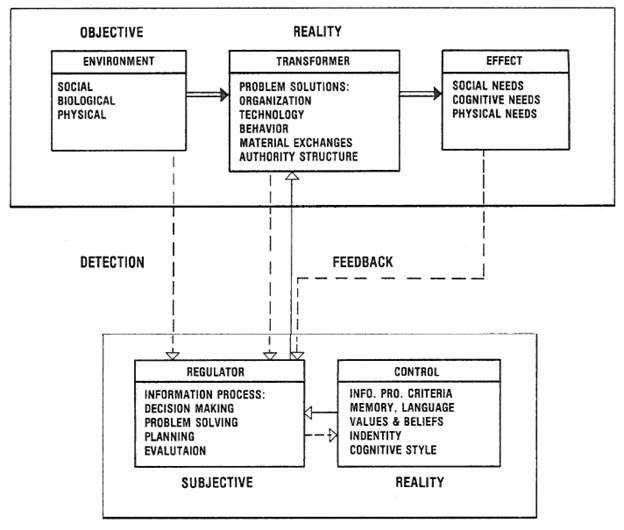
➞➞ ENERGY / MATERIAL FLOW
——➞ CONTROL INFORMATION
INFORMATION
Adapted from Ross W. Ashby, An Introduction To Cybernetics, 1963
In this figure the cybernetic components are separated into objective and subjective cultural realities. Objective culture is controlled and regulated by the subjective culture through information processing. The regulator changes the transformer depending on how the effects produced compare with ideal effects in the control.
Table 2
Acculturation Types (Examples)
| Type of Acculturation | Retention of Cultural Identity? | Positive Relationship to Dominant Society? |
| Assimilation | No | Yes |
| Integration | Yes | Yes |
| Rejection | Yes | No |
| Deculturation | No | No |
Amado M. Padilla, ed. Acculturation: Theory, Models and Some New Findings, 1980
Here is an example of a table used to organize information and present it clearly. Answers to the questions in this case define the types of acculturation.
Figure 10
Acculturational Differences: Age and Sex
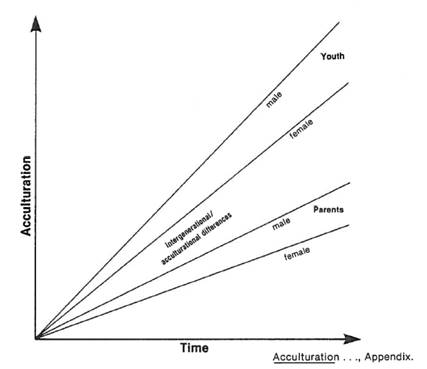
The above figure offers an example of how to represent variations in rates of acculturation. This example is specific to a situation and is not meant to represent all acculturation settings (i.e. sex and age difference for Indigenous Canadians).
Six issues in acculturation are shown with their possible changes in status through the three phases of acculturation: contact, conflict (crisis), and adaptation. These issues are acculturative stress, attitudes, identity, personality, cognitive style, and language. Each begins from a traditional baseline (e.g., low stress level, traditional attitudes, traditional identity, traditional personality, traditional functioning, and traditional language) and may evolve along different trajectories. For stress, outcomes range from high to medium or low stress. Attitudes can shift toward assimilation, integration, or rejection. Identity may change toward dominant culture identity, “ethnic” identity, or return to traditional identity. Personality may evolve to resemble more of the dominant culture, synthesis, or quasi-traditional forms. Cognitive style may result in more dominant culture functioning, bicultural style, or a return to traditional style. Language can move toward complete shift, bilingualism, or language maintenance. These illustrate the range of possible adaptive and maladaptive responses within the process of acculturation. 【Amado M. Padilla, ed., Acculturation as Adaption, John Berry, 1980, p. 18】
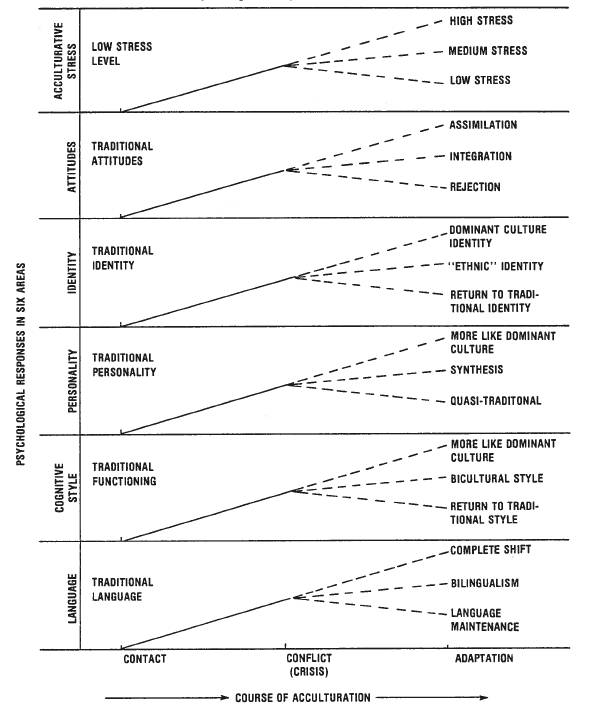
Table 3
Five Value Orientation and the Range of Variations Postulated for Each
| Orientation | Evil | Neutral | Mixture of Good-and-Evil | Good |
| Human Nature | Mutable / Immutable | Mutable / Immutable | Mutable / Immutable | Mutable / Immutable |
| Man-nature | Subjugation-to-Nature | Harmony-with-Nature | Mastery-over-Nature | |
| Time | Past | Present | Future | |
| Activity | Being | Being-in-Becoming | Doing | |
| Relational | Linearity | Collaterality | Individualism |
Florence Rock Kluckhohn, and Fred Strodbeck, Variations In Value Orientations, 1961
This typology matrix was developed to help classify different common value and belief systems. Each value system can be compared with others on the basis of its belief or value orientation toward certain key universal cultural factors. It can be used to help conceptualize issues identified.
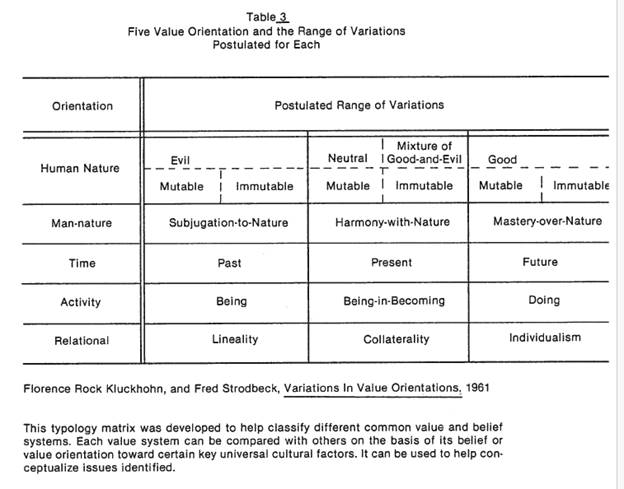
 Randal Adcock