

Abstract
“Community Systems Science: A Paradigm For Development” introduces a framework for applying general systems science to human communities, divided into three main parts: Theory, Analysis, and Synthesis. Part One explores the essence of community and its evolution, presenting the idea of communities as self-sustaining systems rooted in human nature and survival instincts. Part Two dissects community structure and function, comparing communities across an evolutionary continuum and highlighting elements like networks and development processes. Part Three illustrates how communities can be designed and managed using system principles, with examples such as space colony design and cross-cultural development. While successful in its aim, the document acknowledges potential alternative approaches and unresolved issues in community systems science.
- Abstract
- 1.1 Community Universals
- 1.2 Community Evolution
- 2.1 Community Networks
- 2.2 Community Development
- 3.1 Community Systems Engineering
- 3.2 Community Systems Management
- 3.3 Conclusion
Preface
Community Systems Science: A Paradigm For Development was undertaken as a result of the author’s felt need to understand and to help others understand the complete human community. This task has involved four major objectives. The first set of objectives, and most general, are taken from the group of objectives often attributed to science in general: to identify, describe, explain, predict, and control community. The second is to integrate the perspectives of the traditional social sciences – history, human geography, economics, political science, sociology, social psychology and anthropology.
The third objective is to provide a means by which one can view community as a whole, not merely as a sum of parts. The last objective is to be able to represent and control the processes of dynamic change in community behavior. Each of these objectives, if achieved, would allow one to understand the complete community in some way.
The rationale for choosing the particular divisions found here among parts and chapters is the author’s- belief that human reason functions to produce a theory or model of reality through the processes of taking things apart and putting them together (analysis and synthesis). Also, it was felt that there are basically two ways of viewing anything: cross-sectional and longitudinal perspectives. That is, in terms of a cross-section of organization and a longitudinal record of change. The result, of course, is theory, analysis, and synthesis viewed in terms of organization and change.
The development orientation for this scientific paradigm was chosen because the only real reason to understand anything is to finally be able to control phenomena for one’s advantage. Understanding community may be interesting in itself, but without leading to community development control such understanding is left wanting. An effort was made to make the examples of communities used representative of the wide spectrum of known varieties. This was done to reinforce the claim that communities have universal similarities and that development principles can be applied anywhere at any time.
Much literature research and creative critical thinking was done in the preparation of this work. Because it covers so many topics the thesis could not be fairly expected to deal with each topic as well as some readers would desire. The main task was to bring together in a coherent fashion information from many different disciplines and case studies. Many of the ideas researched are on the cutting edge of science. They may be controversial or disputable, but they are usually very thought-provoking. After well over a century of analytical positivism in science it is time to bring old ideas together with the help of new ones.
Systems science is one relatively new way of -integrating diverse sciences and enabling holistic perspectives. But because it dares to challenge and alter the scientific status quo it is open to many criticisms for not complying with established criteria in scientific methodology. For one thing, in emphasizing integration, process, and synthesis, systems science tends to demand extensive creative induction. It cannot, by its very nature, always comply with the demand for deductive logical certainty. Scientists must begin to realize that endless reduction of reality into its atoms leads to a body of knowledge and people who are isolated from one another. In their isolation, by specialization, members of a scientific community become disintegrated, and the community becomes a mere fluid sum of parts. Knowledge must grow by integration as well as differentiation if it is to represent reality. The relations between entities must be studied as well as the entities themselves.
It may fairly be said that the role of science is to reduce uncertainty and irrationality; science never succeeds in eliminating either of these. Knowledge will always be finite while ignorance eternally infinite. Man’s ignorance begins in his essence, the irrational and unknowable value-laden foundations of thought. To introspect is to proceed in a seemingly infinite regression of more subtle assumptions, yet one must accept some initial assumptions if one is to get anywhere. Once thought is in action ideas can be selected on the basis of their fruitfulness. The ideas composing the main body of systems science seem to this author to offer the best currently available set of operational assumptions for scientific reasoning. The fruitfulness of these systems ideas is to be demonstrated in this thesis. These ideas do not replace or try to influence value judgements in any predetermined way, they are instruments that help make value judgements easier and more successful in determining the user’s desired outcomes.
Many different approaches and applications of system science are now available. They are not all consistent with one another on all issues. Control, communication, information and game theories, cybernetics, artificial intelligence, and operations research are some of the special areas within systems science. Applications to social science by Talcott Parsons, Walter Buckley, Alfred Kuhn, and others are all very different from each other, even though the same central concepts and principles are used. There seems to be little consensus on any single social systems theory. After reading their works and others I have acquired more or less an intuition concerning the application of systems theory to social theory. I have made no attempt to deal with mathematical questions in this thesis.
The application of mathematics will, however, be the next step in the development of community systems science. The main systems model used here is based on Ashby’s cybernetic model. Other ideas presented are synthesized from various sources.
In the social sciences the systems approach to analysis has often been contrasted to the “conflict” model of analysis. The position presented here is that social conflict can be treated as a type of functional differentiation — functional, provided that it is accompanied by enough integration so that underlying conflict social groups can still maintain a sense of common humanity and purpose. In this way I have tried to show that systems theory is capable of answering questions the conflict model is supposed to answer. The conflict approach pays too much attention to the antithesis phase of dialectics and not enough attention to synthesis. Theoretically, the systems approach will include explanations of any social phenomena, and do so with a minimum of instrumental bias. Only the reader can judge how valuable a contribution Community Systems Science: A Paradigm for Development is to the growing body of systems science literature.
Acknowledgements
I would like to thank Dr. Richard Jung for his valuable contribution to my understanding of systems applications to social theory. Dr. Richard Jung, of the Department of Sociology and the Centre for Advanced Study In Theoretical Psychology, was not able to help me complete the thesis as committee chairperson.
I would like to thank Dr. David Wangler, of the Division of Community Development and the Department of Education Foundations, for his intellectual stimulation and constructive criticism throughout the thesis preparation.
Thanks also go to Dr. Ray Rink, of the Department of Electrical Engineering, for valuable guidance and feedback concerning my use of systems theory. My committee chairperson.
Dr. Regna Darnell, of the Department of Anthropology, deserves special thanks for her painstaking reviews and editing assistance. Dr. Darnell has been a source of continuous support and guidance.
I would also like to thank the staff of Petro-Canada’s Department of Environmental and Social Affairs. They provided for me a much-needed opportunity to apply systems theory to real life problems. During the summer of 1981, I wrote a report on cross cultural impact assessment for Petro-Canada. The results have been incorporated throughout this thesis and particularly in Chapter 3.2.
Very special thanks go to my wife, Lori Bissell, for her patience in seeing me through the preparation of this thesis.
0.1 Introduction
The following parts and chapters constitute an attempt to show how systems science can be applied to the study and development of human communities. By covering issues of universal, evolution, networks, development, engineering, and management, the thesis should provide new and useful insights into the nature of communities.
Community systems theory is to offer a general conceptual framework for the interpretation of any empirical observations of communities. Outlines of community universals and evolution are to guide thinking about organization and change in general. They set the stage for the application of theory in community analysis and synthesis.
In Community Systems Analysis the general theoretical framework is used to show how particular communities can be taken apart conceptually for study. In Community Systems Synthesis, the last part, the framework is used to show how communities can be created and controlled.
No definition of community is presupposed, it is argued for throughout the thesis. Using this approach, the thesis tries to convince the reader that if he/she thinks of community as an organization of various resources standing between a population and its environment, and which is changed according to the felt needs and values of the population, he/she will have a clear, distinct, and useful understanding of human community. This basic proposal is elaborated on in the second and third parts where community is the subject of analysis and synthesis. It is also argued that if one understands the nature of community organization and change, then there is a strong foundation established for community development practice. The inherent principles in communities can be exploited for intentional and rational control of development.
The six cases of communities taken from anthropological literature and used as examples for analysis were chosen to represent human communities across the globe and at different places in cultural development. They are also selected to be paired with particular networks, so in each case, the network analyzed is of some anthropological significance.
In Chapter 3.1 the design of a space colony is used to exemplify systems engineering. It is chosen because of the important role systems engineering will play in the actual design and construction of space colonies. It is also an interesting prospect as it includes such issues as the future of human community, complete design for self-sufficiency, and the use of creative imagination in community design.
In Chapter 3.2, an example of cross-cultural development between Canadian native people and fossil fuel resource development proponents is used to illustrate systems management of communities. This choice was made because of the growing frequency of cross-cultural encounters around the world. Rapid acculturation is going to continue to increase as the world’s population and communication systems increase.
1. Community Systems Theory
Community systems theory is presented here as an organized set of ideas concerning the nature and evolution of community. These ideas are abstract representations of reality, beginning with substance and form and ending with networks and development. Human community may be studied in terms of universal characteristics and their genesis in human nature. In this way community development practice may be guided by an understanding of the inherent limitations and potentialities of people vis-a-vis organizations. In other words, we should only expect people to be able to engage in a specific range of social behaviours. General systems theory will be used to enlighten traditional social theory, and this will result in a community systems theory. General systems theory is a growing body of ideas which try to explain how things, particularly living things, are organized to achieve specific organizational goals through self-regulation. Human community is like a life form in its organizational behaviour and can, therefore, be understood in terms of the concepts and principles of general systems theory. Systems theory can be used to explain universals of community organization and the principles of change involved in community evolution. When this task has been achieved, community systems theory will be applied to the analysis and synthesis of communities.
1.1 Community Universals
Community universals are those characteristics of human communities which are common to all, regardless of time or place. Communities may be understood to have causal and logical structures that function in maintaining human populations within a range of satisfactory living standards. Causal and logical processes joined together in a special way create a self-sustaining system. This system is a pattern of organization that can be seen in six different ways in any community. Semiotic, time, space, communication, material, and command networks combine to produce the substance and form in communities. It is important to identify these networks and their relationships so that balanced development takes place in a controlled manner.
1.1.1 General Universals
To speak of universals, or of elementary particles, is to speak metaphysically. There is no empirical basis for these ideas, only intuition or perhaps logic. The ideas that follow in this section may be metaphysical ideas, but they may be useful in organizing ideas which have empirical bases. If there are unchanging laws governing all behaviour and processes in the universe then it is with these laws that we should start in our pursuit of understanding of human communities.
Let us suppose that the universe consists of two things only: substance and form, and that these are embedded in time and space. Substance may be equated with energy, and form with patterned relations. In other words, form is the ordered pattern of causal influences between instances of substance. Mental information consists of representations of these patterns. With complete information all changes in pattern are fully explainable and predictable. Further, particular instances of substance may be referred to as entities, while particular instances of form will be called relationships.
Substance and form are abstract concepts which in reality are never isolated. They are always found together in organization. By definition, then, organization is a set of entities and their relationships. Organization is located in space. In the temporal dimension, entities and their relationships exhibit change. Together, organization and change create system.
As substance and form, in all their potentially infinite manifest organizations, change, it becomes evident that there are unchanging laws of change. There are essentially two kinds of change in the universe: change of substance and change of form.
The first kind of change is described by the laws of logical inference, the second, by the laws of thermodynamics, or of general causation. By the logical laws, information is transmitted. By the causal laws, energy is transformed.
There are also two general kinds of organization: organizations that control themselves, and organizations that do not. In organizations that control themselves relationships are such that they are not affected by a change in substance. The laws of logic govern the application of the laws of causation, in uncontrolled organizations, the laws of causation govern the application of the laws of logic.
Controlled organizations, governed by the laws of logic, are called open systems. This is because they are open to energy inputs from outside their bounds but are closed to information inputs. They change in substance, not in form. Uncontrolled organizations, governed by the laws of causation, are called dosed systems. They are closed to energy inputs, and they change in form, not substance. The universe as a whole is a closed system. There are apparently no inputs of energy from elsewhere. There is no empirical evidence of any god who controls the whole thing with an end to create order.
According to physical observations, (as opposed to spiritual revelations) the universe as a whole is approaching a state of maximum disorder. That is, a state in which all causal relations are equal in information — all events are destined to become randomly distributed.
Human community is a temporary isolated instance of a reversal of this trend. Like life forms, communities are open systems. In communities, causal relations become more organized and each relationship contains increasing amounts of information, provided, of course, that the community is viable. The next section will attempt to make more clear how communities are organized in relation to other open systems in general.
1.1.2 General Systems Theory
The universal characteristics of human community can be best explained by reference to those concepts and principles which have been identified as common to all open systems. General systems theory provides such a set of ideas as it defines systems as collections of inter dependent entities in a patterned formation (von Bertalanffy, 1 968). This means that a system, such as a community, consists of entities (energy) and patterned relationships (information). An open system, as mentioned earlier, is a system with inputs from its environment. It is a synthesis of two processes of change: causation and logical inference. Structure and process are two concepts that help reveal the nature of causation and logical inference and their functions in systems.
1.1. 2.1 Structure
Structure, in the sense used here, refers to the structure of change in organizations. It consists of an antecedent and a consequent, or input and output. It describes two states of an organization separated in time, in the case of causation, or separated in space, in the case of logical inference. The two constant structures in terms of which systems can be understood are the causal structure and the logical structure.
Processes governed by the laws of causation or logical inference make the changes between antecedent and consequent in a system’s structure.
All systems consist of structured change. Communities consist of energy in many forms. People, human behaviour, capital and technology, food and vegetation all contain energy. Community is a system of informed energy. One useful way of thinking about energy in all its diverse forms is through its behavioural structure. All things in the physical universe can be described in terms of energy and its alternate state, mass.
Motion, force, and electro-magnetic waves, for example, obey the law of conservation of energy. This first law of thermodynamics states that energy cannot be created or destroyed but only transformed.
All energy changes from one state to another, from an antecedent, cause, to a consequent, effect (See Figure 1). A universal condition stated in the second law of thermodynamics exists for closed systems whereby causes are more organized than effects. This is the tendency for all energy to become random , to end in a state of maximum entropy. Entropy is a measure of disorganization. As entropy (or disorganization) increases, the causal influences among entities become equal, in other words, a state of equilibrium is approached in which the information needed to predict behaviour becomes so diffusely distributed as to be practically lost. It means that there is lower probability of any particular event occurring as entropy increases.
Figure 1.
Causal Structure

If an environment of a community is considered a cause , and its population an effect, the population would die without a continuous input of energy from the environment. But a community is more than a collection of energies. It is capable of maintaining a particular formation in spite of a change in energy. A community can remain essentially the same even with a complete turnover in its population. The energy that passes through the community becomes more disorganized as its information is used to support community organization. This issue concerns the need for information in the control of systems. In order to achieve and maintain its desired level of organization, a system must consume the effects of input entities by filtering them out and rearranging them to suit its needs. Once removed from the input organization, the special characteristics of these entities leave the remainder of the input less organized.
Let us assume that the universe is deterministic, but also, that we lack complete information about any particular causal event. The amount of information in any organization is at any time, constant It is a record of all simultaneous causal relationships, and must, therefore, always sum to certainty — a perfect explanation of organizational behaviour. Only incomplete knowledge of this information leads to predictions with probability of less than 1. However, when a system is highly organized, the causal relationships are controlled so that little interference occurs among entities. Highly organized systems, such as open systems, exhibit regular, or repetitive, behaviour patterns. Information needed to predict changes in behaviour is therefore more easily acquired. As systems become disorganized it becomes more difficult to get this information. Events appear to become more random or controlled by chance. Acquired information reduces our cognitive uncertainty about any organization (Orians, 1 973,349).
Where fewer causal relations are involved, more information is contained in each causal relationship. As the number of entities in an organization increases, so do the number of relationships. The total information involved is then increased, even if the individual behaviours of entities are relatively understood. In very complex organizations, where there are a large number of entities, general systems theory and simulations are needed to acquire the information required for explanation, prediction, and control. This is the case for human communities.
Human communities are complex systems. They can be more or less organized, goal-seeking, and self-regulating. An understanding of how a community works involves the identification of causal relationships. A community has its own information processing capacity which makes possible self-control, and which permits the community as whole to avoid the general trend toward increasing entropy. This information processing capacity can be explained with reference to the structure of logical inference.
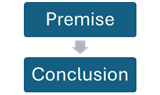
The simple logical structure of information behaviour runs parallel, conceptually, to the simple causal structure of energy behaviour. Information in an antecedent, premise, is imposed on a consequent, conclusion (Figure 2). The pattern forming the premise is duplicated in the form of a conclusion. The first law of logical inference is that patterns of relationships are maintained between premise and conclusion when transferred. There is no loss of information in either premise or conclusion if there is no interference from outside the simple structure. The information need not be contained in language as it is in symbolic logic. It can be the pattern of relationships in any organization.
Figure 2.
Logical Structure
This logical inference structure and its associated law underlie all living forms of energy. It is required for any achievement or maintenance of higher levels of organization. However, it does not defy the second law of thermodynamics because the net effect in the structure is increased entropy. Imagine a gasoline engine burning gases to maintain its rotary pattern of output. The heat produced by combustion is only partly used to turn the engine crank. Likewise free energy flowing through a community is only partly preserved in the organization of the community. This is the second law of logical inference: logical activities create waste energy.
In a human community this logical structure exists between the minds and the physical resources and behaviours of the population. It is -essentially the same type of structure present in cell development and division. The pattern for cell development is kept in a premise known as the DNA code. It is used as the basis of the conclusion, the body of the cell. In communities and cells alike, conclusions are consistent with premises and energy is used to make the pattern transmission. The specific operations contained in
the causal and logical structures make limited and regular changes to inputs. These operations, or processes, perform organized change.
1.1. 2.2 Process
The structures of causation and logical inference contain processes best described as transducers (Ashby, 1958, 44) Transducers alter inputs according to certain laws or principles to create outputs. In the causal structure transducers, located between cause and effect, will be referred to as transformers. They change the pattern of relationships in the input energy according to the laws of causation (Figure 3).
Figure 3.
Causal Process

In logical structures transducers will be called transmitters, as they are located between premise and conclusion to duplicate information. They do this according to the laws of logic. Transformers lose information and conserve energy, while transmitters conserve information and lose energy (Figure 4).
Community transformers consist of all the materials and behaviours used to
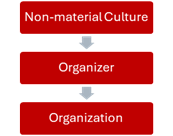
convert energy into useful forms for the population’s needs (Figure 5). Transmitters are collective decision-making and problem-solving activities carried out by the population to make ideals and traditions become actual behaviours and materials (Figure 6).
The specific activities of the transformer and transmitter are parallel in that, if considered separately, both are only capable of making one kind of change, reduction. Either information is lost or energy is lost. However, if considered in combination these two structures are able to increase both energy and information within their bounds. Such a combination results in an open system.
Figure 4.
Logical Process
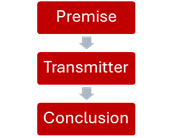
Figure 5.
Community Causal Process

Figure 6.
Community Logical Process
1.1. 2.3 System
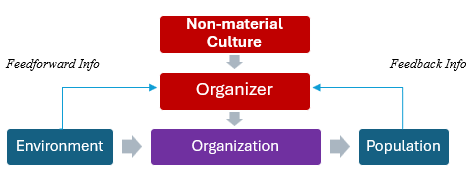
If a transformer of a causal structure is operated on by the transmitter of a logical structure, an open system is created (Figure 7). The information transmitted to the transformer from the premise makes the transformer a primary conclusion. When it transforms energy from cause to effect, the effect becomes a secondary conclusion. The premise provides information which causation has lost and the cause provides energy which logical inference uses. The two structures support each other.
An open system is one that has an environmental source of energy (von Bertalanffy, 1 968,75). In this case the environment is the cause. By definition, a system has no control over its cause. It is a given. The environment of a community is defined as any arrangement of physical, biological, or social entities which have not been organized or altered by the community. The boundaries between community and environment in any particular case are difficult to define because there are degrees of control by the community. Domestic plants and animals can be considered a part of a community, whereas wild ones may not be so considered. Of course, residents are a part of it, but visitors from elsewhere are not so likely to be. The criteria used to make this distinction vary from community to community.
The result of the union of causal and logical structures is that the causal effect becomes isomorphic to the premise as the pattern originally in the cause is partially replaced by the transformer. If the information in the effect is greater than that in the cause then, except for the energy lost in the transmission, entropy has been reversed.
This means that the transformer can perform the opposite to information reduction. It acquires this ability from the logical inference structure. This new process may be called equifinality. Equifinality is the tendency to achieve a particular high level of organization regardless of initial causal conditions (von Bertalanffy, 1968,74). Such a tendency is a highly improbable one, and of course requires input energy in order to occur.
The logical inference structure also becomes capable of an opposite process as it can begin to grow in energy content. The amount of energy in the structure is not continually reduced but can accumulate because of its connection with a source. The open system is governed by the first laws of logic and causation.
Together the two structures forming a whole system have a new pair of properties which distinguish them from their isolated states. These are equifinality and growth. But an additional process can also be created. If information can be relayed from both the causal and effect states to the transmitter, then inductive inferences can be carried out. Feedback, information from the effect to the transmitter, tells the transmitter if its message to the transformer was successful in creating a reproduction of the ideal state defined by the premise. Any discrepancy between the two results in the transmission of new information to the transformer. Thus, feedback provides a variable minor premise which alters the primary and secondary conclusions (transformer and effect).
Feedforward from the cause to the transmitter also serves as a minor premise that can alter conclusions. This feedforward makes changes in the transformer possible before changes in causal conditions effects it. It is the combined information from cause and premise, either in the effect first or directly in the transmitter, which creates mutated information that can be selected for survival. Any of this new information that becomes independent of the original premise and is embodied in an effect is a candidate for evolutionary progress. The information from original premise and cause, however combined, can become a new premise in a new system. If the combination has the ability to generate more certainty in its effects, that is, reproduce itself more reliably with the same variety of causal inputs, then the synthesis of original cause and premise will have been inductive.
This synthesis could take place between premise and cause alone. It may have happened in the most rudimentary of early systems, such as in the formation of proteins. Feedback and feedforward make this synthesis more likely and more successful because they enable a transmitter to complete the synthesis according to certain rules and criteria that may exist in the premise for such processes. The transmitter, in addition to being able to discriminate between ideal and non-ideal, is capable of analogizing. In this way the similarities between premise and feedback/ feedforward inputs can be used to create more general or abstract information. Not mere combinations of information, but higher levels of it can be formed according to certain rules called heuristics. Heuristic rules of induction are functionally similar but opposite to algorithms (logical rules) of deduction.
Heuristics are rules learned through experience of similarities among differences. They are like statistical hypotheses in that they are arrived at through induction and do not offer certainty, only probability.
As these systems have become better organized through mutation, combination and induction, they have acquired the ability to learn from information processing. They no longer depend entirely on generational changes to improve information processing abilities. By learning a system can use the minor premises taken from feedback and feedforward and use these not only in the immediate situation but store them for future use as major premises. For animals such as primates, instincts (major premises) are not used for completely determined behaviour sets but for more general types of behaviour that need to be detailed in light of what may best be described as heuristics.
In human communities learned information can be shared so that the total information available to an individual is greater than that which is instinctive or personally acquired. Induction can also be expanded even further than at the individual level, and the total environmental variety that can be reduced by the community is greatly increased (Figure 8). The non-material culture of a community consists of shared language, beliefs, and values — meaning that is derived from experience through induction guided by heuristics.
Underlying the preceding discussion is another statement of law. There has been a law of requisite variety identified to explain the success of systems. According to this law a premise and transmitter must be able to provide requisite appropriate variety to the transformer to counter any and all of the variety in the cause (Ashby, 1958, 206). The transformer must be designed by the transmitter and premise to handle the causal input variety with alterations that result in the desired effect. Informational disturbance from the cause must be minimized or eliminated if there is to be successful embodiment of ideals in the effect. In a sense then, two conclusions follow from the premises, the transformer design and the ideal effect. Each is a synthesis of energy from the cause and information from the premise. Enough energy from the cause is also needed to feed the system. Thinking and doing use energy or create waste energy.
Now these general systems concepts and principles must be applied to social systems. The following discussion will help show how general systems theory can be used to identify, describe, explain, predict, and control social phenomena.
Figure 7. General System

Figure 8. Community System
1.1.3 General Social Theory
In order to find suitable subject matter for a theory of community systems, a look at the traditional breakdown of social science theory is needed.
General systems theory can be applied to the study of social science matters just as it can be applied to cells, organisms, and computers. In each case a logical structure imposes organization on a causal process and results in an effect which is relatively isomorphic to the original premise.
Traditionally the study of society, civilization, culture and institutions has been broken down into conceptual networks. Cultural ecology and economics study the flow of energy matter and money through a community or society. Human and cultural geography study the organization of people and institutions in space. Sociology studies patterns of social interaction, particularly symbolic interaction. Political science and law study the system of roles, rights and responsibilities in a community or society, particularly as these effect control of social interaction.
Anthropology is generally thought to cover all matters in a culture, however, perhaps the most significant contribution this social science has made is in the area of cognitive style or cognitive paradigms. It is in the empirical study of subjective culture that psychology has been shown by anthropology to have an important relationship to social organization. Cross-cultural psychology, as a discipline of anthropology and cognitive psychology, has begun to determine the nature of this fundamental relationship. Sociology of knowledge has also approached this issue, but primarily from a theoretical viewpoint.
Finally, history, long considered a mere record-keeping descriptive science of the past, holds the key to the study of the organization of time in a society. This view of socially organized time has yet to be accepted but the growth of futurology may provide a catalyst in the reconstruction of the traditional view of history. Futurology is the science which studies the possible sequence of events following trends shown to be developing in the present.
If we take the essential subject matter of these disciplines of social science a new conceptual framework can be devised which is most amenable to a community Systems theory. The following table pairs science and subject of science:
Table 1. Community Networks
| COGNITIVE ANTHROPOLOGY | SEMIOTICS |
| HISTORY | TIME |
| HUMAN GEOGRAPHY | SPACE |
| SOCIOLOGY | COMMUNICATION |
| ECONOMICS | MATTER |
| POLITICAL SCIENCE | COMMAND |
The list on the right constitutes the set of community networks. These networks can be studied in terms of the concepts and principles of general systems theory. The following sections will attempt to make clear how each network consists of processes which impose information on energy.
1.1. 3.1 Semiotics
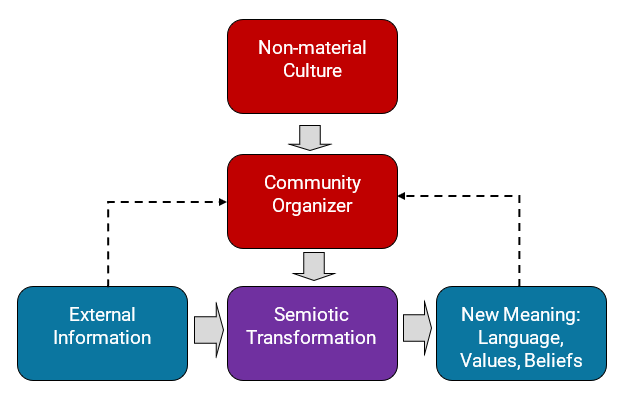
The semiotic network of a community is the set of values, beliefs and symbols that are held in common by a population (Figure 9). It is also the relationships between these ideas, and the means by which they are created, altered and used. It is the collective thought, mind and identity of a population. It is a shared model of reality. Although not all ideas are equally shared, there is a coherence among ideas which unifies them. In the terminology of systems used previously, the information network makes up both premise and transmitter for each of the other networks and their integration. In this way the semiotic network is special, but it is also to be viewed as a peer or sibling to the others.
This is so because it too is partially dependent on new inputs from the community’s environment and serves personal needs inherent in the population. Computer simulations of the information networks of a community may be capable of giving an adequate representation of the complex values, beliefs, and symbols (See Chapter 3.2).
Figure 9. Semiotics
1.1. 3.2 Time
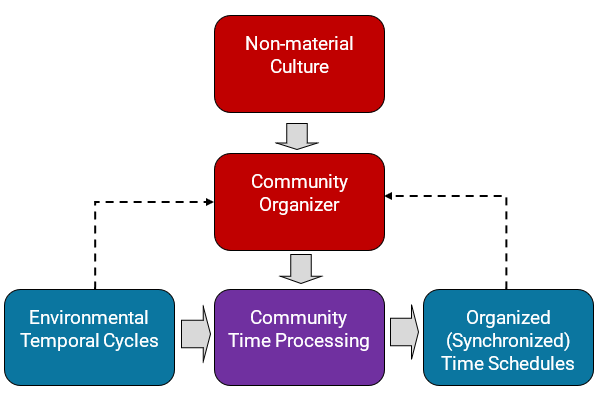
The temporal network organizes community events in a time sequence (Figure 10). It does this for the past, present and future. In each community there is some standard or set of standard units of time which are used to relate events to one another. The standard may be natural, like the positions of the sun during the day, or artificial, like the minutes and hours on a clock. In either case unscheduled time is environmental to the community, a cause which is to be given order in terms of community affairs. Organized time is necessary to satisfy human needs for predictability and regularity and for some degree of variety. Calendars and timetables are common means used to represent organized time.
Figure 10. Time
1.1. 3. 3 Space
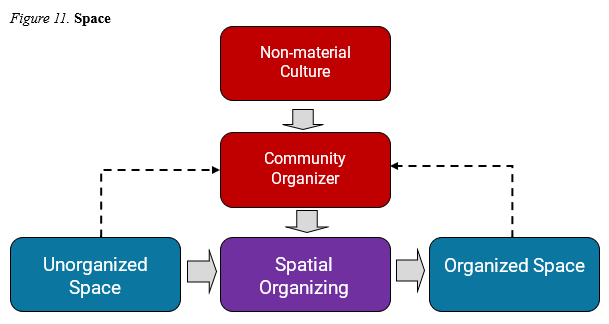
Spatial networks deal with the organization of people and things in space (Figure 11). They determine who and what goes where. The area to be occupied is the environment for the community and it must be transformed into a pattern of subspaces designated for special purposes. Transportation routes, residential, commercial, agricultural, and industrial areas (or zones), are common categories of organized space which meet the needs of a community population. These divisions are often represented on maps and blueprints.
Figure 11. Space
1.1. 3. 4 Communication
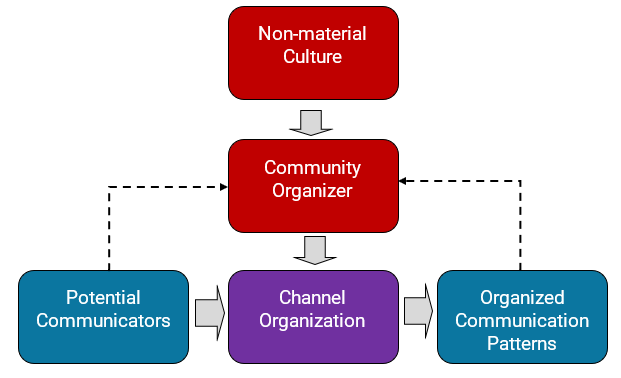
Communities include patterns of symbolic interaction. There is an opportunity for communication at every interpersonal contact, or among any members of the population. Only some of these possible relationships are used for this purpose. The complete set of possibilities is the environment of the communication network, and the organized pattern of symbolic interactions are selected from this set according to the needs and desires felt by the population (Figure 12). These needs and desires may be personal or institutional, informal or formal, but the means of selecting and using channels for communication are at least partly culturally determined. Sociograms, statistics and sociometrics may be used to represent the general patterns of symbolic interaction.
Figure 12. Communication
1.1.3.5 Material
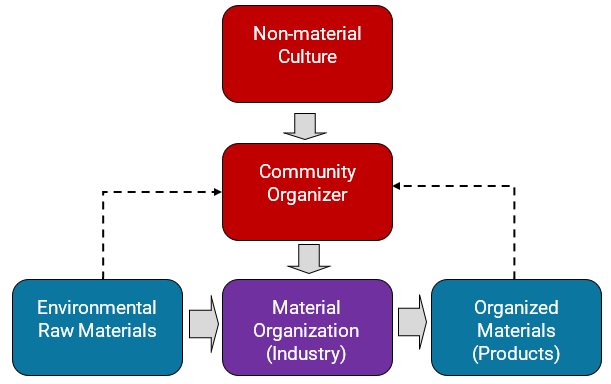
The material network of a community most resembles the general model in systems theory. Although other networks operate on the same laws and principles, they modify a pre-existing pattern of energy on a different scale (Figure 13). The material network is defined in this context as the system that organizes things, not in space or time, or with respect to symbols, but concrete things- in-themselves. It transforms matter that is not useful, or is harmful to the population, and makes it useful and harmless. The material environment of this network is all things that have not previously been altered by the population. The creation and use of tools are an important part of the transformation process. Solar collectors, for example, represent a major kind of transformation. Econometrics and certain ethnographic techniques can be used to illustrate the flow of matter through a community.
Figure 13. Material Culture
1.1. 3.6 Command
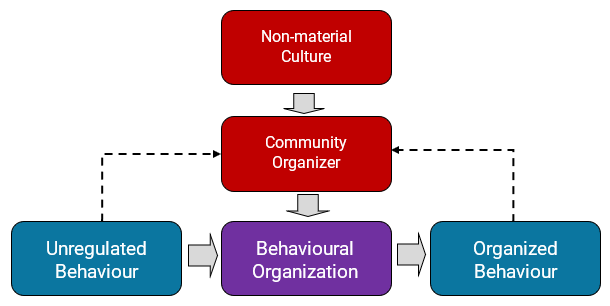
In every community there are many kinds of decisions to be made concerning how people are to behave. To ensure that these decisions are made effectively for the population, a special network is required (Figure 14). The command network takes as its environment the set of all possible functional behaviours and organizes these into sets of roles to be performed by certain people. Each role with its associated rights and responsibilities is given a status in an organization of roles. Behaviour is then relatively coordinated and regular. Each person is given a set of roles and knows what to do in particular situations. At the same time each learns that the behaviour of others can be reasonably predictable. The different roles should be designed to be complementary, so that behaviours are at a minimum of conflict Hierarchical structural charts can be used to show the overall organization of roles.
If these community networks are integrated conceptually as they are concretely, a coherent theory of community systems organization results. It is important to see how the networks combine to produce a coherent goal-oriented and self-regulating community system. A discussion of this now follows.
Figure 14. Command
1.1.4 Community Systems Organization
To summarize the last few sections, a community can be thought of as a system of six networks. Semiotics, time, space, communication, matter and command are the basic parameters of any social phenomenon. In each case there is information (organization) imposed on some environmental source of energy. The result is, in most cases, a satisfaction of human needs in the population according to criteria maintained in the minds of that population.
A complete definition of the general systems model in light of general social theory is now needed (Review Figure 8). The causal structure of a community system shall consist of environment (cause), community organization (transformer), and population (effect). The logical structure shall include non-material culture (premise), community organizer (transmitter), and feedforward and feedback (minor premises). The environment is the source of energy resources and disturbances which are modified by the community organization to achieve ideal population states. The ideal population states and the rules and criteria for organization are represented in non-material culture. The community organizer is informed by feedback and feedforward about the present states of the population and environment. It uses this information in combination with that from non-material culture to change the community organization until the desired feedback is received.
Since no community event, activity, or thing can exist without some consequences for each network, any community phenomenon must be defined in terms of its relationships to other phenomena in these six ‘dimensions’ of networks.
For example, a man’s behaviour while working in his yard may have consequences for each network. The semiotic network may be altered by the impact of his artistic expression conveyed in the floral arrangements. The time he spends in the yard effects the time he spends with his family and at work. The use of his yard for gardens may be against local zoning bylaws. His relationship with his wife could be strained if he does not talk with her enough. Harvesting a few vegetables could alter the local food market by changing the family buying habits. Finally, his friends may consider him with more or less respect as he becomes known as a ‘gardener’ in the status structure.
These are but an insignificant fraction of the possible consequences of such a mundane cultural activity. Yet it serves to demonstrate the interdependence of all behaviour in a community. There may be other networks as well as these six, but they are based on subjects identified by social scientists over the past couple of hundred years and seem to be very useful. Together, these six networks roughly define the scope of social science.
1.1. 4.1 Network Integration
It has been argued that community phenomena can be described in terms of their status across six dimensions. This implies that in order to create ideal phenomena in the population state the information concerning those phenomena in relation to the six networks has to be integrated. The status of a phenomenon in one network can limit its possible status in another network. Just as a full description of an object in space requires a specification of status on three dimensions, community phenomena require specification on six. Such a phenomenon could be unsatisfactory for reasons corresponding to the six networks.
The problem of integrating information about these networks is solved by either personal or interpersonal thought in the semiotic network. It is accomplished in the language and with values and beliefs that are common to all or most of the members of the population. Of course, there is also input from individuals which is not culturally determined, but the extent and style of this input are influenced by community information.
Once information about phenomena, defined in terms of the networks, is integrated, it becomes a pattern which can be implemented in community organization. In other words, the six networks composing the community organization become related to one another in a way prescribed by the non-material culture and the community organizer.
An instance of this integration is shown in the relocation of a Kung Bushmen camp. The hunters of the camp decide among themselves to move to a better location when local herds become scarce. It is the hunters who decide to move, where and when to move. Whose decisions these are is largely culturally determined for the command network. The decision to move is itself a direct involvement of the semiotic network.
Where to move and when are problems of the space and time networks. The decision is also based on the relative scarcity and abundance of energy resources, a material network concern. Finally, moving will be discussed between those who are affected by it, which involves communication. In this way a major decision is broken down to minor decisions that are to some extent predetermined by the traditions of the community.
Six different types of organizational patterns must be made to fit together without inconsistency and without conflict. Yet at the same time they must accomplish their joint tasks of making environmental inputs into ideal conditions for the population.
Usually, this process of integration is not without many initial inconsistencies and conflicts. The Bushmen, for instance, in relocating, sometimes have to decide to move before there is agreement on where to move to. Such pay-off’ decisions are by far the rule rather than the exception in network integration. They result in suboptimization of network requirements but optimization of overall community performance. This means that instead of the best solution being arrived at for each individual network, sacrifices have to be made.
Generally, decisions are made to favour those networks in which the population is approaching some critical threshold. The threshold is simply a level (or value) of development, or resources, that is either too great or too little to maintain the population. The Kung Bushmen may have to move because a lower threshold has been reached in their food supply. This would take precedence over the desire to wait until consensus has been reached on where to move to. In that case suboptimization has occurred. The fluctuating relative values could be expressed using supply and demand graphs. These graphs, established through trend analysis, show how the various network thresholds compare.
1.1. 4.2 Balanced Development
Over several generations a stable community develops fairly regular rules and criteria for meeting needs and maintaining satisfaction. As new members become a part of the population, by birth and immigration, they are taught these rules and criteria so their behaviour is fairly predictable and controllable. These rules and criteria (algorithms and heuristics) change gradually as new situations are encountered. They maintain a certain resemblance to the original and the more elementary ones. The body of information evolves so that useful values, beliefs and symbols are kept while those that are not are rejected and forgotten.
Continually the body of information grows. The rate of growth may be generally low, as in hunting and gathering communities, or great, as in industrial communities. But in order to satisfy all the needs of the population, the rate of growth should be roughly equal among the networks in the long run.
Unbalanced development can result in failure to satisfy human needs. If a very well developed network coexists with a poorly developed one, network integration can become very difficult to manage. The community as a whole has certain thresholds just as the networks have. The important thresholds for the whole community concern attention to the network thresholds. As unbalanced development increases, and becomes more complex, it becomes more difficult for residents to be sensitive to, or aware of, network thresholds. Short term attention to underdeveloped networks may be necessary.
In advanced industrial societies, communities have well developed material networks. However, their semiotic networks have not progressed at the same rate. Information has proliferated but no equally major change has occurred in information organization. Perhaps the use of advanced computers and telecommunications can help rectify the problem to some extent, but a new way of thinking is needed. General systems thinking can play an important role in organizing information, as it is interdisciplinary and is capable of integrating the progressively more specialized information caused by the industrial revolution.
In the long run, cultural evolution can resolve these kinds of imbalances. But, if communities are sufficiently understood, balanced development can be built in and continually managed. This does, however, require some holistic perspective such as use of general systems theory. Using community systems theory, community development practitioners can gain some rational control over cultural evolution and use the inherent principles of change to control development.
1.1. 4.3 Summary
In summarizing this first chapter, communities consist of a causal structure and a logical structure in an interdependent relationship. This system structure can be seen in six different ways in a community; in semiotics, time, space, communication, material, and command. It is important that one or more of these networks do not get overdeveloped while others are underdeveloped, as this leads to the failure of the community to meet human needs. To understand how evolution has managed the development of communities, an investigation of theory on the psychological, social, and ecological foundations of community is in order.
1.2 Community Evolution
If community development practitioners are to help communities acquire self-control, it is important that they understand why communities exist and how they have evolved. Community development may be thought of as the ‘fine tuning’ of community evolution. The principles of change inherent in evolution are to be applied in development
The theory of evolution of human community concerns the progressive selection of life forms that are able to handle greater variety and complexity in their environments while maintaining adequate levels of need satisfaction and reproduction. Evolution is the result of the law of requisite variety. Life forms with greater capacity to respond to environmental variety, in relation to their variety of needs, survive those with less capacity. Each progressive level of organization of life forms, from amoeba to man, represents an improvement in the ability of individual ”species” to identify and adapt to its environment for self-preservation and reproduction. The information capacities of life forms increases through evolution. Human community, like a life form, is built upon the abilities of its constituent subsystems. In communities, the subsystems are people and institutions. Their abilities are used to preserve the community and its population. Human populations making up communities consist of the collective needs and abilities of individual persons. Inherent in these persons are the capacity and preference for social interaction. This makes community organization possible. The shape of community as it has evolved is also dependent on the ecosystems in which human populations exist. In brief, community has evolved as an intermediary device of human populations for protection from and exploitation of their environments.
1.2.1 Information
Human communities are made up of subsystems which are in some ways similar and in some ways different. How these similarities and differences are organized will determine the information capacity of the community. In other words, how the similar and different needs and resources of a population are ordered determines the success of community resources in turning useless and harmful environmental elements into useful and harmless factors for need satisfaction. The ability of a community to identify and use valuable naturally occurring elements also rests on this information capacity. Over tens of thousands of years of evolution, human communities have improved in their capacities of identification and adaptation. This evolution is partly genetic and partly cultural.
Essentially, what the community must be able to do is determine if a particular environmental element is directly useful to its population. If it is identified as useful, then it is used as is’, when and where it is needed. If the element is not useful “as is”, the community must be able to adapt either the element or its population’s need so that the element becomes useful, or at least harmless. Information processing required in this task is done by the community organizer. The organizer must be able to compare environmental and populations states, and, using value criteria provided by non-material culture, decide what to do. It must be able to apply the laws of logic to organizational information.
1. 2.1.1 Differentiation
According to the law of requisite variety, the greater the number of things a system can identify and adapt to, the greater is its chance of survival and reproduction. It takes a lot of variety in a system to properly deal with the vast information in an ecosystem. Micro-organisms and insects, for instance, are relatively simple life forms, yet they thrive just about anywhere on earth. They do this for essentially two reasons: they mutate easily and they are very prolific. The information needed to reduce the variety of destructive things and events in the environment is contained not in individuals but in the population. The population generates enough different kinds of individuals that surely some of them will be properly designed to survive the conditions and reproduce their own strain.
Human beings, however different they may be from one another, are capable of acquiring a vast amount of information and skill from experience. In fact, they have to learn in order to survive; there are few built-in detailed programs for survival. In addition, the reproductive rate for humans is very low compared to other species. Instead of proliferating, people have very general programs built in genetically which cause relatively extensive dependence on learning about environmental conditions, identifying objects and events and responding appropriately for survival.
Whether insects or human are considered matters little when referring to evolutionary principles. Natural selection favours those life forms which have more information appropriate to their needs in relation to their environments. Reproductive and mutation rates and individual learning are two means of acquiring and using the needed information. Another means is cooperative interaction. Individuals who separately do not have the requisite variety of abilities can pool their resources to meet their needs. The most elementary of these cooperative interactions is sexual intercourse for reproduction. Reproduction is a mutual need for both sexes which can only be achieved, in most life forms, by cooperative interaction. Information from both parents is synthesized to form new original offspring. In human communities, personal interactions have become differentiated into the six networks outlined in the first chapter. These networks become further differentiated culturally into institutional subsystems. Each network and each institution serves a special function in the community. This is how communities increase their information capacities.
1. 2.1.2 Integration
The fundamental pattern underlying these different ways of getting and using requisite information is the integration of differentiated units. In each case different abilities are united and coordinated by a common body. In insects the variety provided by mutation is controlled by genetic structures themselves, which in essence are similar between individuals of a species. In sexual reproduction, different sets of genes are united according to the common basic structure of each. Learning processes, including identification and adaptation, involve the use of basic mental faculties and behavioural potentials to integrate different ideas and behaviours. In other words, differences are managed by similarities.
The function of integration is not to reduce the negative impacts of environmental influences or to increase positive impacts, but to control the different activities that fulfill these tasks. It performs conflict-resolution through self-regulation and goal-orientation. Because of this, the system that integrates differences has less information than is contained in those differences, but more information that is common to them. It only needs to be able to identify and adapt to the similarities among the differences. It has a general overview of network and institutional subsystem relations ■ 31 and their overall goals.
In order to coordinate the actions of the differentiated subsystems and to fulfill their individual and common needs with their individual and common resources, the integrating system must weigh the costs and benefits of the various ways of combining subsystem actions in achieving the goals. On the one hand there is a common goal to be optimal, and on the other, competing needs of complementary subsystems.
This task of integrating different complementary subsystems is needed anywhere there are substantial conflicts operating. While one integrator works to coordinate its subsystems, other integrators do likewise. Then these different integrating systems performing different integrations need to be integrated. Systems performing integration at this level also need integrating. A hierarchy of systems controlling other subsystems emerges, with the end result being an extremely complex system of subsystems integrating different subsystems (Parsons, 1977). Conflicts at one level are resolved at the next higher level. If the hierarchy is relatively flat, with a higher degree of differentiation than integration, it is relatively flexible and effective in meeting various needs. If it is relatively high and narrow, in other words, has relatively greater integration in relation to differentiation, then it is more stable and efficient in the use of resources.
1.2.1. 3 Process of Community Organization
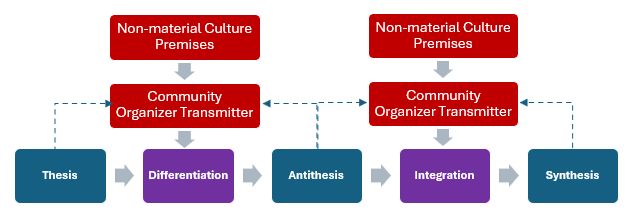
In summary of the last three sections, it may be said that the process of community organization consists of two sub-processes: differentiation and integration. These two processes are common to all evolved organization. The increase in complexity is one measure of evolutionary advancement. That is, the more complex the organization, the further it is down the road of evolution. Using the language of dialectics, an organizational scheme may be offered to show the relationship of differentiation and integration to change (Figure 15.).
In this figure, an original state, thesis, is differentiated into separate antitheses which are in some way functionally complementary but also in conflict or competition. The antitheses are then integrated so that a synthesis results, which has the advantages of specialization but not the problems.
Community organization has evolved as networks and institutions have become more differentiated and integrated through time. Human community emerges out of patterned interactions in which human resources (abilities) are coordinated to satisfy human needs.
Figure 15. Community Dialectics
In terms of conflict analysis, social conflict may be considered a process of differentiation.
1.2.1. 4 Community in the Chain of Being
The hierarchy of systems which results from continuous evolution and increasing organized complexity can be described as a chain of being (Lovejoy, 1960). This chain appears as a static structure at any given time (Figure 16). Communities are subsystems of societies, while institutions are subsystems of communities. Institutions are made up of people, Between cells and people lies a whole range of organizations, such as organs and tissues.
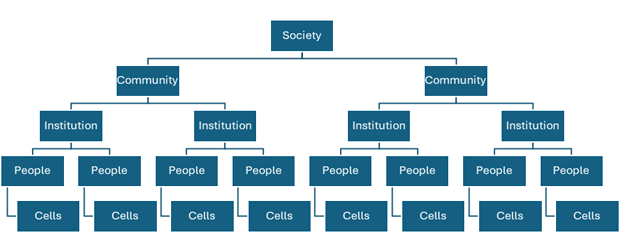
Figure 16. Chain Of Being Community
On the scale of life forms there is also an organized chain of being. Some of the distinguishing landmarks of evolutionary development along this chain are as follows:
| 1 | cell reproduction |
| 2 | photosynthesis |
| 3 | herbivores |
| 4 | mobility |
| 5 | locomotion and ingestion |
| 6 | sensory systems |
| 7 | predation |
| 8 | remote senses |
| 9 | internal senses |
| 10 | central nervous system |
| 11 | land adaptations |
| 12 | learning and memory |
| 13 | mental mapping and modeling |
| 14 | abstract reasoning |
| 15 | family bonding and interdependence |
| 16 | imitative behaviour |
| 17 | cross modal transfer of learning (sensory motor) |
| 18 | symbolic communication |
These steps of development identified by Hagman (1982) do not necessarily follow the order given. The list does, however, roughly describe the sequence of developments leading to homo sapiens as he exists today. The increasing specialization of cells for specific purposes is a kind of defined differentiation while their coexistence in single organisms constitutes an instance of integration. With each newly acquired ability, previous abilities may remain but are adapted to the newcomer through the process of integration. Humans have reduced sense of smell as sight has improved. Some abilities are lost as others become more useful. Animals cannot photosynthesize. Land animals cannot take oxygen from water.
One important shift in importance is that learning and memory have replaced many functions previously performed by instinct. As a result of this and the supplementing of personal experience with cultural information (made possible by communication), cultural evolution may begin to supplant biological evolution. Survival depends more and more on acquisition and application of cultural values and beliefs rather than on inherent sensory-motor patterns. These inherent sensory-motor patterns in man are sufficiently general as to apply to the learning of any insights or skills needed for survival in any environment. What we lack in biological inheritance can be made up for by technology. In fact there is concern in some quarters that this trend will facilitate artificial support for a decaying human gene pool. More and more people are reproducing who would not normally survive under purely biological natural selection processes. This means that culture must compensate for these possible biological changes. People must become more cooperative.
1.2.2 Individual Organization
Human communities are made up of sets of individual persons and their relationships. The set of individuals, population, includes people with many similarities and differences. These individual differences and similarities are partly genetically and partly environmentally determined. Either way these can be used to define the potentials and limitations of community. Two important types of ability are important to both individual and community survival: identification and adaptation. Needs are represented between identification and adaptation and serve essentially a goal-orientation function for the individual.
1.2.2.1 Individual Abilities
Identification and adaptation are complementary. They enable a person to construct a model of reality, decide what appropriate action to take, and then act out the prescribed behaviour. The mental faculties composing the identifying system are sensory-perception, cognition, memory, and motivation. They interact to produce a model of reality and to prescribe action (Heimstra and Ellingstad, 1972). The model is a pattern contained in the central nervous system. The pattern is relatively isomorphic to reality. The behavioural capacities making up the adaptive system include reflex, instinctive, conditioned and intentional patterns. These combined behavioural patterns can be used to generate a wide range of appropriate responses to environmental stimuli and inner drives.
Together these two systems in an environment form a special feedback loop. An empirical modification cycle exists whereby information from the environment (empirical knowledge) is organized into a model of reality which is used to determine behaviour and change the environment (Laughlin and d’Aquili, 1974, 84). New information acquired as a result of the behaviour modifies the model. This new information is feedback. If it reinforces the original model the feedback is negative, because it inhibits change. If it alters the model, it is positive, because it promotes directed change (Figure 17).

Figure 17. Empirical Modification Cycle
This process is important for human communities because it is a process that people must do together to coordinate community organization. People must have a certain degree of agreement among their models of reality if they are to agree on how to use environmental and human resources to satisfy population needs. Consequently, it is important to understand the rules and criteria used in the cycle of empirical modification.
1. 2.2.2 Individual Needs
Once a model of reality is established, emotive responses to it determine what adaptive action will take place. The emotive responses are based on human needs. These needs are, categorically, for physical, cognitive, and social fulfillment. They are instinctive, fundamentally, but each person defines his needs in terms of his model of reality, and that is influenced by culture.
If individuals are to coordinate their interactions in community organization, they must be able to agree on common needs. They must, therefore, have a similar understanding of reality and be able to communicate that similarity. Felt needs among individuals is the driving force of adaptive community behaviour. The need to achieve and maintain a certain level of basic satisfaction motivates the empirical modification cycle. Needs and abilities are components in a process for turning information in an individual’s environment into a meaningful mental model. Then the model is used to change the information contained in the environment.
1. 2.2.3 Information Processing
It has been suggested that the human mind thinks empirically in terms of space-time and causality. Information received from the environment is given meaning in terms of two innate templates (Stich, 1975). The first template organizes the information into a coherent space-time model. Spatio-temporal relations are identified so that discrete objects and events can be isolated perceptually and conceptually. The second template organizes these objects and events in terms of their causal relationships. It identifies causes and their effects (Laughlin and d’Aquili, 1974). Although this question of innate templates has not been solved, it is difficult to imagine how a new born baby would begin to make sense of anything unless he were born with some similar presumption or predisposition.
Through a hierarchy of integrating subsystems such relationships are abstracted to higher and higher levels, from pure perception to pure conception. Each time information is abstracted from perception, the original images diminish, and they are eventually lost from consciousness. In order to keep these abstractions an artificial pattern must be imposed on new perceptual substance. These new creations are symbols. They may be auditory, visual or tactile, even olfactory. The original information, however, is some how maintained in and between symbols. The process of symbolizing is called semantics. Spatio-temporal and causal relationships become represented by grammar and syntax.
The result is a continuous deep structure underlying perception and language which is common to all people, and a surface structure for each person which depends on how deep structure is applied to experience.1 When symbolic information contained in the model of reality is evaluated in relation to felt needs, and for prescription of behaviour, p rag mat i c processing has taken place. This means that the information processing function of an individual consists of semantics, syntactics, and pragmatics. More about this will be explained in the next chapter under Semiotic Network.
1.2. 2. 4 Individuals in Community
The sharing of a set of symbols and their use in language is a fundamental necessity for human community. Communication by use of gesture is not adequate for abstract thought. Without agreement on some of the more meaningful ideas about reality community populations could only organize for simple tasks.
Another characteristic of human ability with consequences for community is sheer mental capacity. The amount of information an individual can process and organize certainly defines the range of his abilities in social interaction. The limitations and potentials of identification and adaptation suggest certain natural social role capacities in community organization. For example, there is likely some optimal range of integration functions that a manager can handle. Outside of this range, dissonance, in the forms of anxiety, depression, or hostility, may be experienced, and community integration is then poorly performed.
Individual differences in abilities also play an important role in community. It is the populations’ set of individual differences that adds to the information capacity of a community. The collective variety of identification and adaptation abilities makes community a much more viable form of existence than isolation.
Genetic differences in individual abilities, if properly integrated, may be very complementary and mutually beneficial for interacting participants. Genetic similarities, represented by the universal components of mental faculties and behavioural patterns, become differentiated through individual applications to experience. So, whether abilities in mechanics, language, arithmetic or interpersonal relations are involved, or knowledge and skills in general problem-solving, people who participate in community are better able to satisfy their needs. They can draw on the resources of others as well as their own.
Community is more than the sum of the needs and resources of its population. Organized patterns of relationships among individuals are also crucial. These relationships ensure that shared resources are used effectively and efficiently to satisfy common needs. Also, the knowledge and skills which are at the base of abilities, can be transferred to other individuals without much loss. Simultaneously, community provides specialized services and goods as well as the knowledge and skills to perform and create them. That is, both energy and information are shared.
There are, of course, limits and potentials of individuals to participate in social interaction. These again are founded in biological human nature.
1.2.3 The Social Nature of Humanity
If man was not inherently a social animal it is not likely that he would learn to become one. Competition is the first rule of natural selection in evolution. Life forms which are best suited to their environment survive those which are less appropriate. A basic strategy for survival such as community or isolation could not be left up to individuals to decide after experience had shown them the costs and benefits of each. This is particularly true of man as the period of childhood dependency is so long that some instinctive drive for child care is necessary. It is also likely that because of intergroup competition, the capacity and even preference for association with groups larger than families became a part of human nature. Language learning, which seems to be an innate potential for man, serves as a vital group support mechanism, facilitating the exchange of information and meaning. Social man is superior to asocial man because of his ability to draw on the resources of others. He has, therefore been selected by nature through competition (Wilson, 1978).
Inherent potentials and limitations for social interdependence rest on these three evolutionary developments: family bonds, cooperation and reciprocal altruism, and language. They have evolved because they serve the human community in defense, offense, and territoriality (Lorenz, in Caplan, 1978). These latter three functions were the grounds on which natural selection took its toll. Groups can defend themselves against attacks and predators better than individuals can. They are also more successful at attacking and hunting. Because ecological niches are only capable of supporting a certain density of population, competition for territory will likely favour larger groups against smaller ones in expansionist feuds and wars.
1.2.3.1 Family Bonds
As organisms evolved greater capacity to learn individually, a simultaneous need for teachers and protector-providers evolved. The long period of human infant dependency needed for learning all the things for which other animals depend on instinct. 40 reflex and conditioning, demands not only a mother s presence but a father s. Mother and child must be naturally compelled to be together. Mothers inclined to neglect their babies could not reproduce their kind. But because the young require so much attention, a father must also be present to protect and provide for both mother and children. Not only this, but siblings must have some potential to learn to stop short of killing each other, because any sibling inclined to seriously injure or “kill another essentially threatens his own gene pool.
Experiments in social psychology have shown that people are attracted to others who are similar to themselves (Baron, Byrne and Griffitt, 1971, 40). They also show that eye contact and smiling are correlated with development or enhancement of attraction. Parent-child bonds and marriage bonds seem to depend on eye contact and smiling, or other perceptual cues for reinforcement. It could be that personal identity is extended to others through these gestures, and that the identification is based on perceived similarity. It is likely that a modified process of imprinting, such as that which occurs in birds, occurs also in humans. There is a predisposition to identify with parts of one’s experience which have certain characteristics common to human appearance and action.
It is a tendency to extend the self to others of a similar nature. This disposition would constitute inborn knowledge inherited along with all the other mental and physical abilities that make survival easier (Laughlin and d’Aquili, 1974, 79).
The opposite effect would be considering those things which are different from oneself as separate. This is also reinforced by experiments (Baron, Byrne and Griffitt, 1974,48). Similarities support identification; differences support separation. The exceptions to this rule are of course along certain functional lines. Attraction of opposites in heterosexual relations is one case in point. Economic division of labour by specialization is another. In this case, differences are a basis of attraction because of complementarity. However, underlying successful personal relationships is a sense of identity that is based on similarities. For example, spouses seem to choose each other by compatibility which is made possible by similarities. It is the drive for completion which attract opposites. Realizing one is not whole, that one cannot be everything, there is a need to supplement oneself by affiliation with those elements of ones experience which are in some preconceived way both compatible and complementary. This seems to be a dual disposition designed to acquaint a person with his environment as soon as he arrives.
A child is brought into a world in which he identifies with those he perceives as similar and to complement himself with those he perceives as different. Until one can identify strangers as one or the other there is fear and curiosity to motivate avoidance of danger and approach for understanding.
Once the needs for identification and completion in personal bonds are met, the likelihood of further pursuits diminishes. The search for and attention to critical similarities and differences dies so that existing bonds are not disturbed. After the needs are satisfied further similarities and differences become the basis for competition instead of cooperation. Each person has a limited capacity for simultaneous personal relationships.
1.2.3. 2 Reciprocal Altruism and Cooperation
The moral commandments “Love thy neighbour as thyself” and “Do unto others as you would have them do unto you”, are simple statements of clarification of man’s natural place in his community. If people do in fact extend their identities to include others simply by virtue of their common humanity, though this commonality is often forgotten, there must be a reason for it. In the previous section it was pointed out that such natural bonds have their advantages for family units. But for non-family units the same principles apply.
We can view social interdependence on a continuum with altruism on one end and cooperation on the other. In the first case, no rewards or benefits are calculated against risks or costs. Action is taken to help someone in need as a matter of empathy for the victim’s suffering. In the second case, an exchange is made between cooperators, supposedly for mutual benefit. Altruism results from identification and cooperation from completion. Both behaviours, and all combinations, have survival value.
Altruism, because it involves greater risks for the helper, tends to have long-run rather than short-run payoffs. Outside of the possible immediate show of gratitude by a saved victim, the gene pool of those inclined to altruism is more likely to survive than that of non-altruistic types (Trivers, in Caplan, 1978, 213). Cooperation has immediate payoffs, and unlike true altruism, is a continuous activity in a community. It also increases the survival rate of its participants by increasing their general standard of living.
The motivation for cooperative and altruistic behaviours is derived from the combination of genetic dispositions and early childhood experiences. The process is similar to imprinting and the development of sensory— motor abilities. The maturation of the human nervous system is not possible without some environmental inputs to guide development. The genes depend on the fact that the family and community environments will be present in order to provide these stimuli (Hayes, 1978, 77). Lorenz (1963) noted that mans whole system of innate activities and reactions is phylogenetically so constructed, so calculated’ by evolution, as to need to be complemented by cultural tradition.” Those people who successfully provide the social conditions for completion survive and reproduce their own kind. Others do not.
1.2.3. 3 Language
One of the clearest indications of man’s biologically determined social character is his apparently innate capacity for language learning and use. The manipulation of symbols may be a part of the subjective life of pre-social animals, but only man has the ability to systematically exchange and share symbolic information within a community setting. The best evidence of the innateness of language learning and use is that there appears to be a universal deep structure in all languages (Chomsky, 1968). The basic rules and procedures of grammar are the same in all languages. They are not culturally determined as are the ways in which these rules and procedures are applied.
The obvious advantage of language learning which would justify its innateness is its contribution to the expansion of information in terms of cultural knowledge and values. Groups with better genetically evolved language learning capacity will tend to be able to identify and adapt to a wider variety of environmental conditions. They would be more likely to survive any competition against other groups, other factors being equal.
Language probably evolved out of the combination of the child’s tendency to mimic adult behaviours (internalizing and identifying) and the adult need to extend abstract thinking by use of symbols (Hagman, 1982). So, when some rudimentary words, little more than grunts, were used to elicit certain responses from others, and to refer to certain things or events, they were repeated and became established with meaning. People could then learn from each other’s experiences and acquire a larger range of abilities for survival. Again, through competition, the most advanced cultures will replace less advanced ones. But, as cultures advance, competition becomes less a matter of genetics and more a matter of learning.
The changes in social existence that were brought about by the evolution of language cannot be overemphasized. Communication does for a community what a nervous system does for an individual. The transmission of information means that culture can evolve. Accumulated knowledge, wisdom, and skills over the generations has made possible civilization itself. It has encouraged progressively more specialized and more abstract thought, making possible ever more complete and accurate conceptual models of reality.
1.2.4 Ecological Influences
The evolution of community has been shaped by social human nature, but community has also taken a form compatible with the physical, and biological, and social environments. Population sizes are controlled by resource supplies available in the ecosystem. Cognitive styles of various community cultures are shaped by their ecosystems. Material technologies of communities are also influenced by the demands and resources of the ecosystem. In each case, man is set up in some relationship with nature, as slave, master, or peer. It must not be forgotten that community is primarily an intermediary mechanism between a human population and its environment.
1. 2.4.1 Population Size
Although organization and social behaviour are necessary for community, they are not sufficient. Community, in the biological and ordinary senses, implies a certain small size of population. There are natural limits and potentials to the size of community populations.
Because most of man’s evolution occurred while the dominant unit of social organization was the family and pack, his ability to relate to no more than a few people intimately was predetermined. The environment determined that people should know and trust their partners so that bonds were strong and behaviours could be reliable and coordinated. Only a few such close relationships could be formed given the capacity of the human brain. Alternatively, a minimum number of these relationships is also needed to cope with environmental phenomena. Therefore evolution has endowed man with needs for association and intimacy. Without these, there is loneliness, alienation and despair.
Because of the limited resources in an ecosystem only a certain density of population is supportable. This is most obvious in hunting and gathering communities which represent the dominant type of community through man’s social evolution. When food gets scarce or populations get too large, people either disperse, expand their territory, or starve. Some communities regulate their growth at appropriate levels for survival. In others the population fluctuates in response to changing resources. Either way a maximum limit gets established. The minimum level is determined by competition for territory and resources. A community with too small a population cannot defend itself against attacks by larger expanding groups.
Another factor regulating population size and density is breeding. A population must be large enough to supply a variety of potential mates. Incest taboos prevent inbreeding, and undoubtedly they have survival value for that reason. Large populations may have no disadvantages for mating, but as the population grows the personal similarities between people are likely to diminish and reduce interpersonal attractions. High density populations of other species have been shown to reduce reproduction rates in spite of sufficient food and supplies.
Without putting exact numbers on it, there does seem to be a natural range of population sizes for communities based on face-to-face interactions. This is evident in the neighbourhoods of cities, rural communities, and communes. These community populations range from about 200 to 10,000.
1. 2.4.2 The Evolutionary Continuum
Cultural anthropology has organized a typology of communities which roughly represent major changes in level of cultural evolution (Plog and Bates, 1980). The main classes are:
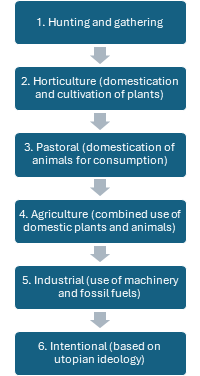
This typology emphasizes the role of ecological-technological adaptation as a main determinant of community organization. In each type attention is drawn to the means by which the community population makes a living. These types represent common plateaus of development, or cultural paradigms, evident around the world. In this context, paradigm refers to the set of characteristic cultural factors which create community coherence. Each paradigm builds on the previous ones although variations and combinations do occur.
The typology suggests that the process of organization, differentiation and integration, sometimes progresses in leaps rather than continuously (Kuhn, 1970). These leaps may be called paradigm shifts. Certain plateaus are reached as these basic changes can only be achieved after long periods of accumulated minor changes. It implies some degree of material determinism, meaning that production methods strongly influence social organization. At the same time it reflects why non-material culture (values, beliefs, and ideas) changes more slowly than material culture. Differentiation, which readily occurs among tools and implements, needs integration by thought. But thought is more complex and subjective, and therefore has more inertia or resistance to change. Thus major technological progress is usually held at certain levels of development while social organization and non-material culture develop (Appelbaum, 1 970).
New communities occasionally appear when population sectors become dissatisfied with the dominant social order. These ”intentional” communities, often led by charismatic leaders, are not characterized by a level of technological development but by ideology. This ideology usually contains some new combination of existing ideas, values, and beliefs. It is emotionally inspired and may be rationally pursued. The intentional community, with its “utopian” ideology, is like a mutation. It strives for some alternate and ideal state. Its success serves as a prototype for others to duplicate. Its failure is a signal and lesson that its organization was inappropriate.
This intentional community type may be added to the typology given earlier. It has occasionally played a role in the history of community evolution. It may yet play an important role in helping industrial communities regain some of their lost network balance.
1.2.5 Summary
Community systems theory explained in Chapter 1.1 and elaborated on in terms of community genesis and evolution in Chapter 1.2, contains the essential concepts and principles needed to understand community as a system. However, theory cannot stand alone and should not remain static. Theory must be applied in analysis and synthesis of real communities. It must also develop and grow as new information about community is acquired through these applications. There must be feedback between theory and application.
In the following two parts, the theory of community systems discussed here will be applied to community analysis and synthesis. Only then can it be said that a community systems science has been fully outlined.
2. Community Systems Analysis
In the first part of the thesis, a theory of community systems was outlined. In this part, networks and institutions are studied as major organizational divisions of communities. Institutions are developments within and between networks. They have specialized functions to serve and are relatively self-contained subsystems. The examples used are intended to provide a representative sample of human communities. They are taken from various parts of the globe, and they represent all levels of cultural evolution. Only one network is discussed in each case, as a complete analysis is not possible for all networks in each case. The particular cases were selected on the basis of their abilities to illustrate the principles of organization and change in a particular network. The following list shows the relationships between network, community, and cultural paradigm:
Table 2. Organization Of Part Two

2.1 Community Networks
The six networks outlined in Chapter 1.1 form a convenient framework for the analysis of human community. These networks are in some ways similar to and in some ways different from each other. They perform different functions and when operating together they satisfy the needs of a population as no single network can. When studied together in a single community, these networks form a perspective which resembles the wholistic approach of anthropology. This perspective is particularly advantageous in community development practice because in reality the cross-network interactions cannot be studied in isolation with much success.
2.1.1 Network Similarities
Like the general systems model each of the six network models consists of two structures, the logical and causal structures. In each case information is imposed on the causal structure by the logical structure. An ideal set of relationships imposed on energy components transforms environmental inputs into outputs for population needs.
The networks, semiotic, temporal, spatial, communication, material and command, are each composed of three processes. These three new network processes are: production, distribution, and consumption. These are the transformation processes operating.
The production process transforms environmental resources and disturbances into a supply of products useful to the population. Distribution takes this supply and distributes it to meet identified demands. The demand is created as a result of consumption, where possessions are put to use in satisfying the needs of the community population. In each of these networks human resources produced by the population are organized and used according to the common identification system of the community, non-material culture and the community organizer. But these human resources are only possible if the population needs are being met properly. Hence, a complete feedback loop is formed between needs and resources. Each depends on the other.
Every one of the six networks of a community consists of organized human resources forming a patterned set of needs out of environmental inputs. The main terms used in the analysis of these systems are as follows:
1. Environment: patterns of energy not regulated by the community; the source of raw inputs.
2. Population: collection of individuals with needs for regulation and resources for regulating.
3. Resources: human abilities to identify and adapt energy patterns.
4. Needs: states of energy patterns required for human happiness and survival.
5. Production: process using organized resources to transform environmental energy patterns into a supply of product energy patterns.
6. Supply: an inventory of goods, services, products, commodities or other useful energy patterns.
7. Distribution: process using organized resources to transform a supply into a demand pattern of energy (i.e. supplies arranged according to demand).
8. Demand: an inventory of possessions (patterned energy) ready for use.
9. Consumption: process using organized resources to transform demand possessions into final energy patterns used by the population of humans.
The basic causal structure of a community network takes an environmental pattern of energy and produces a supply which is distributed to demand and consumed by the population (Figure 18). The basic logical structure, which is discussed later in fuller detail as the semiotic network, consists of non-material culture, serving as a collective memory of the community, and the community organizer divided into three information processing functions: semantics, syntactics, and pragmatics.
Production, distribution, and consumption, representing essentially the adaptive abilities in the causal structure are regulated and controlled by the logical structure which is now referred to as the semiotic network of human communities. The semiotic network carries out the identification function of human abilities which informs the transformers (production, distribution and consumption) how to organize and operate. It uses information from inputs and outputs of each process, feedforward and feedback.
Now it is possible to describe each of the six networks making up human communities. Examples will be given to illustrate the analysis of the systems. These examples are taken from the evolutionary continuum presented in the last chapter. It is hoped that their inclusion will support the claim to universality of the concepts and principles of community systems theory.
Figure 18. Community Network Structure
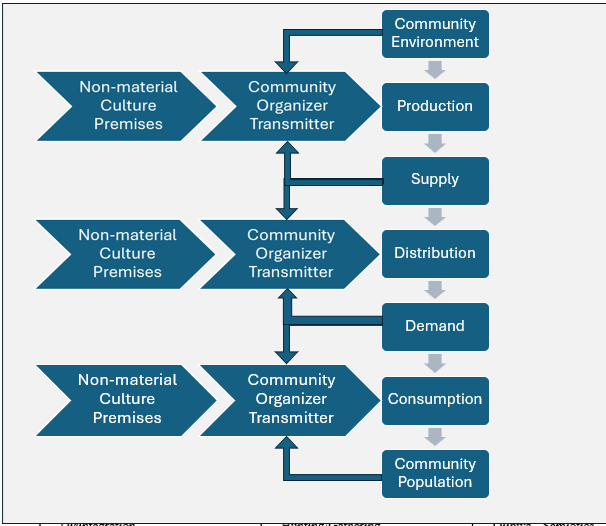
2.1.2 The Semiotic Network
A community’s semiotic network transforms information into meaning. Information is here to mean any pattern of relationships among energy or matter components which is not contained within the minds of the community population. This is the environment of the semiotic network. Meaning refers to the sense or significance of this information in relationship to human needs and disposition for adaptation, and which is contained in a mental model of reality (Fodor and Katz, 1964),
Runes’ Dictionary of Philosophy (1975) defines semiotics as “a general theory of signs and their applications,… pragmatics, semantics, syntactics” (288). It defines sign as “that which represents anything to the cognitive faculty; that which signifies or has significance” (292). It goes on to say that logic is sometimes called the “science of signs”. With some imagination, semiotics may be construed as a community network (Figure 19).
Semantics, syntactics, and pragmatics may be used to discuss production, distribution, and consumption in the semiotic network. If information that is not yet regulated by the community mind is the environment, and the final population need is for meaning, then the semiotic network employs human resources in the processes of semantics, syntactics, and pragmatics in order to create meaning out of information.
The patterns imposed on information in the three systems depends on the innate human abilities to identify and adapt information. This means the selection of information appropriate for human needs and changing information to suit these needs. In this way the semiotic network is apparently reflexive, that is, it operates on itself as well as on the other networks. The semiotic network transforms information from the other networks into a common language so that patterns of relationships in different kinds of organizations can be dealt with together. One information pattern is created to represent the information in all the networks. This information pattern forms a model of reality.
The “production” system of the semiotic network, semantics, generates signs and symbols to refer to information in the environment. Sensory stimulation, the components of perception, and words exemplify cognitive signs. Their presence and absence represent the presence and absence of corresponding “things” beyond cognition.
Figure 19. Semiotic Network
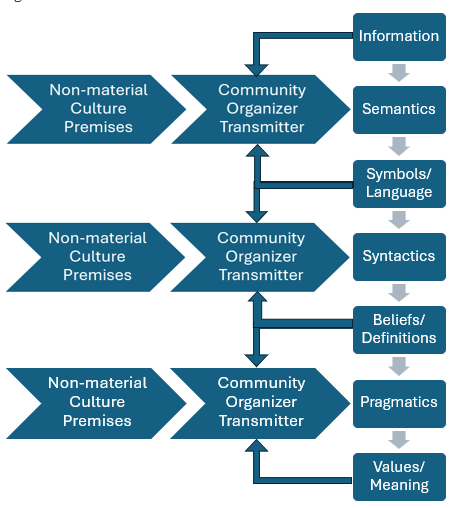
The supply of these denotative products is “distributed” through the syntactic system. Here the signs are related to one another according to their similarities and differences, their contiguities in time and space and their causal connectedness. They are distributed in this way because these are the relationships demanded by the pursuit of happiness and survival. Without such relationships no model of reality, no reconstruction of information, would be possible. The result of this syntactic transformation is a set of beliefs and definitions about reality which are important for the survival of the population.
These beliefs are “consumed” in the pragmatic system. It uses them to prepare and motivate behaviour. It is this final outcome of attitudes and values that constitutes the meaning that the population needs to organize and use adaptive abilities (or behaviour) in the other five community networks .
It is important in a community that semantics (symbols), syntactics (beliefs), and pragmatics (values) be shared in common. If there is to be coherent interaction and organization people must agree on how to talk about reality, what exists, and how to respond to one’s cognitive environment. It is this agreement which also helps create the cultural identity and social cohesion that is needed in a human population. An example of a semiotic network will help make these points clear.
2.1.2.1 Ojibwa Semiotics
The semiotic network of the Ojibwa Indians demonstrates ail of the main features of any semiotic network. The Ojibwa Indians of central North America (west of the Great Lakes) are a hunting and gathering tribe. A traditional Ojibwa community consisted of a band, a small group who occupied a hunting territory. During summers they lived together because resources were plentiful, but in the winters they broke up into smaller units and dispersed. Ojibwa Indians and early European settlers had some difficulty communicating their different ideas and traditions. They had very different cultural perspectives on reality. The Ojibwa spoke the Algonkian language. They had an extensive taxonomy for natural vegetation and wildlife. Usually, the names for things were determined by their use or appearance. Cup in English, for instance, would be understood as drinking utensil in Algonkian. The language also distinguishes between animate and inanimate things. However, the Ojibwa considered many things animate which those of European ancestry would not. For instance, trees, the sun, thunder, some rocks, kettles and pipes were designated animate implicitly in the language. This is believed to be because these things appear to have independent action at least occasionally (Hallowell, 1976, 357).
The Ojibwa made sense of their symbolic world, and indirectly their corporeal reality, by defining the relationships between words and between the referents of words. For example, they defined persons to include humans and other-than- humans. Many animals were known to be persons, and grand fathers, who were powerful spiritual beings, ancestors of the Ojibwa, were also persons. They do not define a difference between natural and super— natural as other people, notably of European heritage, do. To the Ojibwa everything is natural, even though anything can happen. Sorcery and action at a distance may be performed by all persons, but especially grandfathers are important in giving humans strengths and abilities or causing and curing illness. Everything is accounted for in terms of cause and effect, whether there is empirical evidence of the sort people of industrial communities would require.
Values are associated with many beliefs as these have bearing on the pursuit of happiness and survival. Because Ojibwa traditionally believed that powers over people were held by others, many central values to the culture concerned keeping grandfathers and potential enemies satisfied. To avoid illness the Ojibwa would not break rules such as incest taboos, commit murder, or trespass on another man’s trapping territory. They would not show their displeasures publicly for fear of revenge (Barnow, 1950, 19), and they would keep their promises to their grandfathers. If a law was transgressed, one would get sick. The only sure cure was public confession of the crime (Hallowell, 1976, 391).
These values, based on beliefs and the symbol system, completed the need for meaning in Ojibwa communities. Having identified what exists, what relationships exist between things, and what significance these have for people, the Ojibwa semiotic network prepared people for adaptive action in their environment.
2.1.3 The Temporal Network
In a temporal network environmental time consists of cycles of events which are not regulated by the population. The population is the set of time-keepers and time-users. The temporal pattern of environmental events and changes is used to regulate the occurrence of community events and changes. The human population of a community needs to meet various other needs. It does this by using its time-keeping abilities to transform environmental schedules into community schedules (Figure 20).
Environmental time is transformed into a record such as a calendar, timetable or even simply a memory. This represents the production process. The result is a supply of significant dates or periods such as days (formed by oscillating light and dark), moons (lunar cycles), seasons, hours or minutes.
The “supply” of recorded times (calendar) are used to organize community events through the process of distributing the time periods in the record to the events in demand. The temporal pattern supplied is imposed on the events demanded so that the community can coordinate its many activities in an organized way.
Finally, time is consumed by the passing of events according to the schedule. Consequently, the need for an ordered sequence of events is fulfilled. The population uses time efficiently and effectively by increasing temporal organization. An example of temporal organization can be taken from the Hopi Indians.
2.1. 3.1 Hopi Time
The temporal network of the Hopi Indians is of special interest because the Hopi put extra emphasis on temporal cycles. They also have very different ideas about the nature of time (Whorf , 1 964). Functionally, however, Hopi time is quite similar to that of other horticultural communities. Environmental cycles, external to the community, such as lunar and seasonal cycles, are important in keeping crops. Hopi communities of New Mexico were settled and horticultural. They are known for growing com. It was important for the Hopi to keep track of time for the planting of their crops. Each year a person designated to watch the position of the setting sun would keep track of the approaching winter solstice. This naturally occurring solar cycle was used to start each year’s festivities. The solstice ceremony was to celebrate the return of the sun to bring forth the new growing season and to call on the kachinas to come into the communities. The kachinas were great beneficent beings who brought rain and helped the crops (Parsons, 1933, 40).
Throughout the year, as the seasons developed, certain other ceremonies were held to help bring about the right weather conditions for the crops, or for other purposes, such as initiation rights. Ceremonies were planned several days or weeks ahead of time, and days were counted down to the occasion. The celebrations often lasted several days with different events happening daily:
Figure 20. Temporal Network
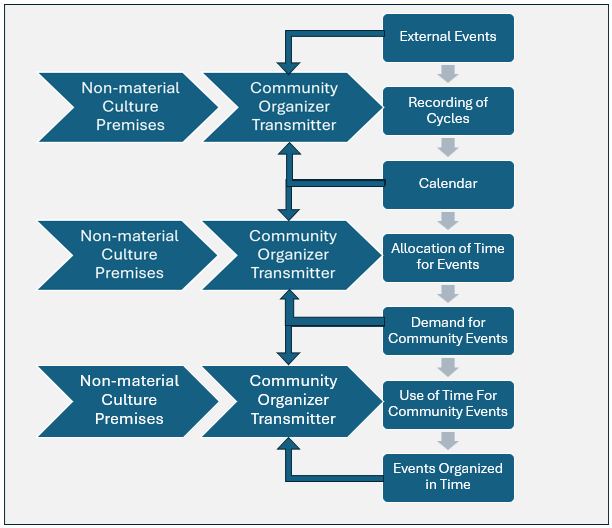
The Hopi also celebrated the summer solstice and watched the lunar cycle to determine other occasions. According to their traditions, certain critical times were best for such things as planting. Different kinds of seeds were planted at different times depending on weather conditions common to the various lunar and solar positions. While keeping track of time, the Hopi were able to get the most out of their crops. They avoided late spring frosts, drought periods, and early fall frosts. They were also able to achieve a sense of control over their destinies by holding ceremonies at the right times so as to bring the best weather (Parsons, 1 928, 1 6).
2.1.4 The Spatial Network
The environment of a spatial network is that area occupied by and surrounding a community settlement that is not regulated by the community. The population is the set of individual space organizers and users. Space is the land area of a community which is accessible, complete with its terrain and physical features.
In the spatial network resources include the abilities to organize space in ways that satisfy the population’s need for land and personal space. As people need to occupy space, by virtue of their existence, they have the abilities to identify and adapt to a wide variety of types of space. They do this by surveying and map-making, zoning, and land use (Figure 21).
The production phase in the spatial network involves the survey of land that is to be occupied. A record is made of the natural features of the terrain, such as a map can illustrate. Hills, valleys, rivers, bushes and soils can all be indicated, among other distinctions.
The supply of mapped features are then distributed or designated for certain functions in demand. A land use zoning map results, corresponding to the future uses to be made of the land.
The land is consumed, or used, in the manner specified by distribution. It is used for such things as residence, transportation, agriculture, industry, commerce, recreation, and so on. The need for space for various community activities is then satisfied. Nomadic peoples, such as the pastoral Fulani, provide an excellent example of community spatial organization.
Figure 21. Spatial Network
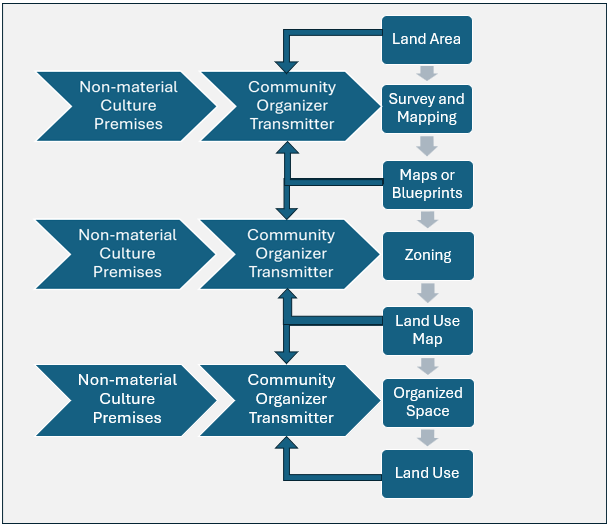
2.1. 4.1 Fulani Space
The pastoral Fulani of West Africa have developed their ability to organize space to meet their nomadic needs. They are herders of cattle who move continuously to . various grazing grounds to make use of the best available pastures. Many related families group together to share cattle and protect themselves. They move usually in a geographically cyclical pattern called transhumance. The land is divided into relatively dry and wet areas so that the Fulani would occupy drier areas in the wet seasons and wetter areas in the dry seasons. In general, the wet seasons saw the Fulani congregate in larger groups, while drier months encouraged dispersal.
Traditionally, a yearly orbit of transhumance could involve approximately a sixty-mile direct distance between extreme wet and dry season camps (Stenning, in Ottenberg, 1 960, 1 46). Daily movements and trips between staggered pastures and water holes also could involve several miles. Camps would have to be made along the journey so the shelters were mobile, packed on ox-back. However, the camps were always organized in the same spatial pattern. The homes of male heads of families, usually brothers, were aligned so that older heads were south of younger ones. Those who were brothers were arranged so that in addition to the north-south line, homes with older offspring were west of those with younger ones. In addition, each home was arranged facing the west and divided between domestic and cattle corral sides, with a fire in each and a calf rope separating them (Stenning, 1959, 39, 106).
The movement of the camps and cattle from one pasture to another was guided by the herdowners’ knowledge of the land, its residents, and the routes of other herdsmen. They may have wanted to stop to trade or visit with people along the way, but the water holes and good grasslands were priority locations. From year to year the routes taken vary. Over the long run there is migratory drift. Eventually the pattern changes entirely so that totally new territory is used. This is a result of changing environmental conditions and population trends. The use of space is organized around needs for pasture and water, and around known available landscapes (Stenning, in Ottenberg, 1960, 152). The pastoral Fulani organize space to meet their needs for new pastures. Their transhumance cyclical path is surveyed, zoned, and used according to local traditions. The paths are adjusted to changing conditions.
2.1.5 The Communication Network
The communication network transforms a set of potential symbolic interactions into a patterned set of actual symbolic interactions. In this case the environment is the collection of all possible communication channels between members’ positions in the community. That is, the environment includes all relationships which have not yet been used for communication. The population includes all members of the community in their capacities as communicators.
The resources, or abilities to communicate, are used to produce, distribute and consume patterns of symbolic interaction. In the end the needs for communication are fulfilled (Figure 22).
Patterns of symbolic interaction are produced by associating social positions with types of information. Each social position in a community is an information or semiotic position. It is the transmitter and receiver of certain specialized information. Even in the simplest communities there are age and sex determined positions, each with some degree of special knowledge and values. So the environment of all possible relationships is narrowed down to specific relationships for specific purposes.
Next, these positions and their relationships are distributed for various functions in demand. Channels of communication are made as easily as calling out the name of a neighbour or dialing the doctor’s phone number. The general pattern of actual channels selected repeatedly in a community constitutes a large sociogram.
This pattern of communication is used to achieve the goals of information exchange and the sharing of meaning that are needed in organizing all community activities. It is in this consumption of symbolic interactions that culture is transmitted. The meaning given one’s personal model of reality is quite largely acquired by communication. Few personal activities escape the influence of culture where communication is freely engaged in. An example will now show the important role of communication in community.
2.1.5.1 llocano Communication
In an llocano community, the communication network is important in agriculture, economics, politics, and in the family. The llocano are rice farmers of northern Luzon in the Philippines. Because they use animal power, systematically work the land, and develop domestic strains of crops they are considered agriculturalists. Social positions in an llocano community, or barrio, fall into several categories: “the bilateral kin groups, affines, age-mates and friends, neighbours, work-mates, and ritual or fictive kinsmen” (Lewis, 1971, 83). Social relationships between members in these positions have distinctly different characteristics. The reasons for which communications take place, the frequency, and the style of symbolic interactions all differ depending on the relationships.
Figure 22. Communication Network

The basic units of association are the bilaterial kin group (relatives of both parents), the nuclear family, and the “alliance”. One is born into the bilateral kin group and a nuclear family and has no control over who one’s relatives are. But the important communicative relationships one chooses are based on geographic proximity and perceived personal need. Neighbours are like family. Of course, closeness in kin relations, age, sex and social status also influence who one’s neighbours will be and of the neighbours, who one will associate with. The alliance group is made up of close friends, neighbours and relatives who trust and depend on one another for mutual aid and information.
Landlord and tenant relationships are quite different. Likewise, whether one works one’s own land or works as a labourer is significant. Four levels of social class depending on land-labour status exist which partially determine symbolic interactions. The landlord— tenant relationship is asymmetrical because of class difference. The landlord, having greater resources, determines whether a contract is to be made with a tenant. Because of the abundance of labour and increasing shortage of land the landlord has greater ability to determine the nature of the relationship. Thus, communication is essentially a top-down flow in the landlord— tenant relationship. Landlords form their own alliance groups of tenants and labourers for political support.
The irrigation societies formed to control water in rice paddies do not correspond to community populations but rather to people using land fed by a common water supply. These societies, like alliances and landlord tenant relationships, are essentially economic in nature. However, they are one of the most common types of situations involving communication. The irrigation society is basically like the economic alliance in that it is reciprocal, but it is like the landlord-tenant relationship because it is kept rather formal and not too personal.
Overall, the patterns of communication in an llocano barrio tend to be quite well established and related to various pragmatic matters. The need for sharing meaning and exchanging information is met by following traditional paths for creating, selecting, and using channels of communication.
2.1.6 The Material Network
As energy organized into discrete objects, matter plays an important role in the way a population satisfies its physical needs. Matter in the environment of a community is that which has not yet been transformed by the community. It is either in forms created by nature or by other communities. The population, those who transform and need particular materials, produce, distribute and consume these materials in many ways. Agriculture produces food, building construction results in shelter, and tanning and weaving provide clothing (Figure 23).
In the production stage of the material network, environmental inputs are transformed into a supply of goods and services, or commodities. The matter may be taken apart and rearranged, or simply arranged in some new way with other materials. Hunters producing food and hides have to produce weapons first, kill the animals, and then prepare the carcass for storage or eating.
The supply of products is distributed throughout the many demands expressed in the population. Who gets what is one major concern, but there may be restrictions on what kinds of demands have priority for supplies. The market exchange, barter, and “first come — first served” systems of distribution are examples of material distribution. In each case some pattern of flow from supply to demand is established.
The use of matter to satisfy a population’s material needs for food, shelter, clothing, and other things is also established as a pattern. In a community the way in which food is eaten, how people dress, and what they live in are largely determined by tradition. Some materials, such as food, are consumed quickly, while others such as homes may last for generations. The ways materials are used depend on the human needs of a population. If a community cannot satisfy its population’s material needs, it will not last long. The development of the material network is no where more clear or advanced than it is in industrial communities.
Figure 23. Material Network
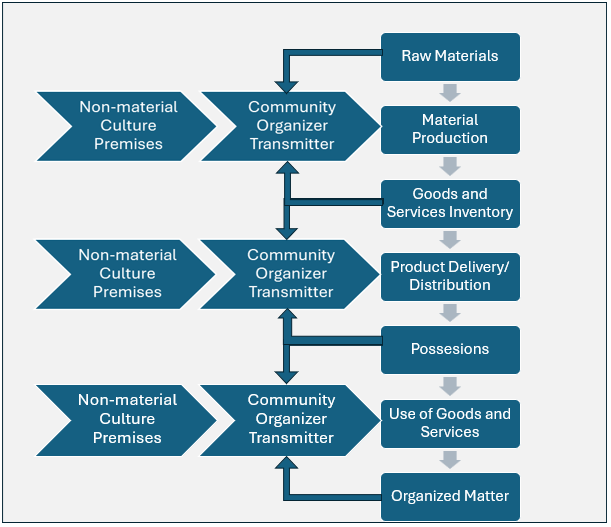
2.1. 6.1 Middletown Material
The American city of Middletown (Muncie, Indiana) falls into the category of industrial communities. As such it is characterized by the extensive use of complex material technology, use of fossil fuels, and a high concentration of population. It is also relatively interdependent with other communities as each specializes in producing certain goods. Middletown depends on a complex system of material production, distribution, and consumption to meet the material needs of its population.
In 1886 natural gas was struck in the city. In the following twenty to forty years Middletown boomed. The natural material resource, gas, was piped to homes for heating and cooking. It was piped to factories for making glass bottles, rubber, iron for nails and bridges, and for heating in other factories and businesses. “Two and one-half years ago when natural gas was first discovered, Middletown was a county-seat of 7,000 inhabitants … It has grown since that time to a busy manufacturing city of 12,000 …. Over forty factories have located here during that time…” (Lynd and Lynd, 1929, 16).
The gas was distributed in a market economy, users paying at first by the fixture rather than amount used. Its availability spurred the production of various goods locally and the consumption of such things as stores, furnaces and cars from abroad. It also had consequences for the social aspects of the economy. The owners of the means of production became rich and accumulated a large portion of the material goods and services available. Labourers, many of whom were formerly land— owning farmers, became a more clear and distinct class relative to the capitalists. Production and consumption became more distinctly different activities, with distribution through a market exchange becoming an opportunity for systematic profit-taking. The nuclear family became not a producer-consumer unit but only a consumer unit.
The natural gas boom plus the influx of new technologies into Middletown resulted in a raised general material standard of living and increased disparity of material wealth between rich and poor. Material resources were used more efficiently as machinery replaced labour. Socially, the head of the family was the only “producer”. The young were required to get greater education as production would become more specialized.
In Middletown material inputs from the environment are greatly transformed by technology and the marketplace. Gas is turned into warmth, sand is turned into glass, iron ore into steel, and tree gum into car tires. In each way naturally occurring matter is organized to satisfy the human needs of the population.
2.1.7 The Command Network
Production, distribution, and consumption systems of the command network transform the rights and responsibilities associated with tasks into organized social behaviour. This achieves social control of social interaction. An environment of functions and tasks defined by the other networks is the input. These socially unregulated jobs need to be controlled by a population so that their completion can be attained in an orderly fashion efficiently and effectively. The result is a chain or hierarchy of command (Figure 24).
The tasks are given definition by the population of role-makers for people of various social positions. Rights and responsibilities are stated for each position required in accomplishing a common goal. A role structure is produced, each role described in relation to the others. How people in different positions and playing different roles are to behave toward one another is answered in this production phase. How one role affects another is decided here.
The supply of roles in a role structure is distributed to people who suit the roles, actors. The rights and responsibilities associated with the roles are given to the actors. They perform the appropriate social behaviours and receive the corresponding rewards. Thus, a social structure shapes social interaction and contains it.
As actors are demanded for the completion of tasks they are used (consumed) to keep the flow of interactions relatively smooth, cooperative, and coordinated. If everyone acts according to the roles they are given, tasks are accomplished with great efficiency and effectiveness. It may also be appropriate to consider material technological entities as actors in the roles they play in achieving human goals. In intentional communities, special attention is often given to issues of command. A look at one of these types of communities could illuminate the command network.
Figure 24. Command Network
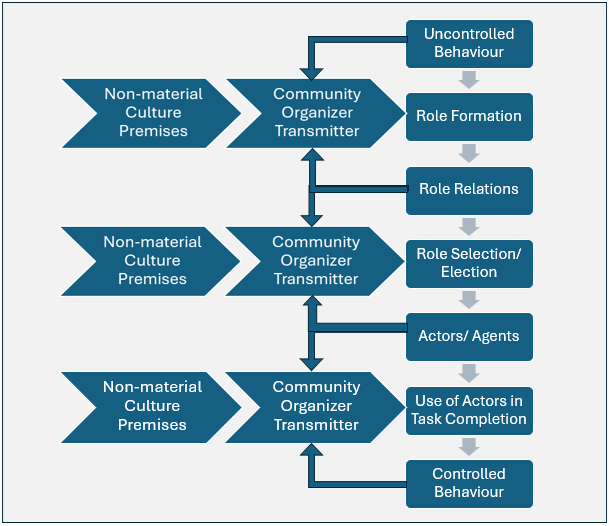
2. 1.7.1 Kibbutz Command
The Israeli kibbutz is an intentional community formed to satisfy the members’ felt need for social justice and equality — factors they feel cannot exist in a capitalist society. There is a strong work ethic which dictates each individual’s relationship to the community and its agricultural base. There is also a Zionist ideology which motivates strong social bonds for some within the kibbutz.
In the kibbutz ideally the rule is “from each according to his ability, to each according to his need”. Each member is expected to work as hard and carefully as he can for his community and receive no more or less than anyone else. Town meetings, held regularly, are used to debate and decide any significant issues facing the kibbutz. It is fully democratic and bureaucracy is kept to a minimum. All people are to be equal; an absolute minimum of formal specialized positions are created as this would set people apart from one another. Even children were raised collectively in many kibbutzim because it was thought possessive to make certain relationships exclusive. Many functions usually performed by families in other communities, are taken over by the whole community in the kibbutz. Commitment to community objectives is placed above commitment to family objectives.
Although men and women are treated as equals formally, there is some sexual division of labour based on personal preference and ability. The hardest work is done by males, especially young men, and these jobs at least implicitly provide the greatest social prestige. Older people are less able to live up to the farm work ethic and receive low social prestige. So although material needs are treated equally, there is certainly differential social treatment through a prestige structure.
The distribution of roles to actors is informal provided the actor is qualified for the specific task responsibilities. However, elected committees were formed to deal with certain central common tasks. For instance, one kibbutz had eight committees: secretariat, nominations, education, high school, culture, welfare, security, and landscape (Spiro, 1956,94). The nominations committee nominated members to stand for the committee positions each year. A general secretary played a central role in coordinating overall kibbutz affairs including chairing town meetings. All positions are filled by election.
Because the kibbutz is an intentional type of community it is experimental. Many types of role relations have been tried and accepted or rejected. There is also a wide variety of arrangements throughout the many kibbutzim. These relationships are changed depending on the satisfaction felt by the population with particular arrangements. With a flexible attitude, ideal patterns of social interaction can eventually be found that will result in optimal social command.
2.1.8 Network Differences
In summary of the preceding sections, it should now be evident that in each network environmental elements are transformed through production, distribution, and consumption to satisfy a population’s human needs. Of the six community networks, semiotic, time, space, communication, matter and command, there are three main different kinds of networks. These may be called macro-, social- and micro-networks. The macro-networks are time and space. The social networks are command and communication. Finally, micro-networks are the material and semiotic networks. They serve three different levels of function in community.
The macro-networks, time and space, are dimensions in the ordinary sense. That is, they are parameters used to measure virtually any physical objects either in themselves or in relation to other physical objects. Everything and every activity in a community is contained within and is measurable in terms of time and space.
Social-networks, or communication and command, refer to types of social interaction or social behaviour and their patterns formed in time and space. These systems determine how people interact in the course of satisfying needs. The coordination of behaviour and the sharing of meaning amplify and multiply individual abilities of identification and adaptation. By coordinating behaviour, individual adaptability is increased. Communication extends the individual’s ability to identify reality.
At the micro-networks level, semiosis and matter consist of self-contained units of organization. Semiotic networks are networks of symbols contained within individuals, not in personal interactive relationships, but united by similar organization. Likewise, material networks are discrete entities or objects, whose significance lies in their similar organizations rather than their interdependent relations. They are community networks because their similar constructions, resulting from community production, distribution, and consumption, identify them as unique and necessary cultural phenomena.
Macro-networks are a background to all phenomena. Social-networks describe patterns of interaction between people. Micro-networks consist of self-contained organized subunits of community. Together the three levels of networks are complementary and mutually exclusive. They are three separate and distinct perspectives on community. In order to understand any community event fully, one should understand its spatio-temporal status, the communication and command which are involved in the event’s social presence, and finally, the cultural embodiment of the event in matter and mind.
The first half of Community Systems Analysis has now been covered. Comparative Network Analysis has shown how the six community networks are in some ways similar and in some ways different. It has explained how each network is made up of three processes: production, distribution, and consumption. It also discussed how the networks can be divided into groups of micro-, social-, and macro-networks. The use of a diverse selection of community cases as examples has lent support for the claim that community systems theory can be applied universally.
Now it is necessary to show how community systems change in response to various influences.
Table 3. Network Types

2.2 Community Development
The development of individual human communities is similar to the evolution of communities in general. The expression— ontogeny recapitulates phylogeny — captures the sense of this argument. In development, mutation, diffusion, drift, and selection are influenced by shared and learned human values and beliefs. In evolution these processes are controlled by genetics and other biological factors. Development is generally conceived to be change plus improvement or progress. It is the improvement of the ability of a community to satisfy the needs of the population. A community in development increases its information capacity. It does this by increasing in complexity of organization. Complexity, then, is a measure of cultural evolution in a community (White, 1 959). Cultural evolution at the community level is the basis of community development. However, in community development practice, the principles of cultural evolution are applied rationally and systematically.
An improvement in the ability to satisfy population needs can come about in two ways, by differentiation or by integration. By differentiating, a community improves its ability to deal with a variety of environmental inputs and population needs. It improves flexibility in responses and effectiveness in meeting needs. Integration improves a community’s ability to coordinate and use resources (Blakely, 1 977). It creates organizational stability and efficient use of resources to fulfill overall system goals.
Development can be essentially qualitative or quantitative in nature. If qualitative, the processes of differentiation and integration are changed in new ways. That is, there are new kinds of changes taking place. If it is quantitative development, there are simply more or less of the same old kinds of changes. Development does not imply increases in change, qualitatively or quantitatively. Sometimes reductions in differentiation or integration leads to improvement. If development is unbalanced, and growth in one network cannot grow at the rate of another, then a reduction in the overdeveloped network could help the situation. Likewise, development should be seen paired with undevelopment. In other words, conceptually, positive and negative development are similar but opposite processes. Often it is impossible to find agreement on whether development is positive or negative in any given situation. It depends on how one views the outcome in terms of values on needs satisfied. Sometimes there is disagreement within a community, but sometimes the disagreement is between insiders and outsiders.
It is important to distinguish community development from population development. In the case of community development changes are made in the ways in which resources are differentiated and integrated in the production, distribution and consumption processes. Population development refers to the way in which these transformers differentiate and integrate environmental inputs and satisfy population needs.
In this chapter, six examples of community development will be compared and contrasted. The six examples are not intended to be mutually exclusive or collectively exhaustive. They may in reality be combined and there may be other ways of describing development. The six cases of communities used in the previous chapter will be used here as well, to create continuity. The examples of development are paired with communities in the following way:
Table 4. Community Development Examples
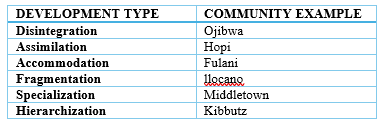
2.2.1 Development Similarities
Disintegration, assimilation, accommodation, fragmentation, specialization and hierarchization are six possible ways of classifying community development. In each case there is some positive or negative, qualitative or- quantitative change in the way in which institutions are organized. Transformers, i.e., production, distribution, and consumption, are altered in each of the six community networks by the semiotic network. The semiotic network, which functions as the logical structure in each community subsystem, transmits instructions maintained in a model of reality, non- material culture, to the transformers. The instructions, selected with the help of feedback from outputs, and feedforward from inputs, regulate the organization and use of resources to transform environmental inputs into population needs (outputs).
It is in the semiotic network that decisions are made on haw to alter the levels of differentiation and integration in the institutions (Figure 15). The non— material culture which makes up the premises of the logical structure is the community memory of ideal states of population satisfaction and the balance of effectiveness and efficiency needed to achieve these states by institutional organization. The transmitter of the logical structure of a community corresponds to the semiotic transformers: semantics, syntactics and pragmatics. It is in these transformers that information from feedforward, feedback, and non-material culture are processed into meaningful community organization instructions together the five systems and the central semiotic network improve in efficiency and effectiveness and result in better population development This is community development
2.2.2 Disintegration
Community disintegration is the process in which a community is culturally and socially destroyed. This is usually the case when one dominant community or society takes control over a subordinate one and tries to rapidly assimilate its population. The community loses its cultural identity and social cohesion. Institutions collapse under these pressures. Its people become demoralized and psychologically disoriented and defeated. The rules and criteria used previously in organizing community resources are lost and forgotten. Even the culture of the dominant community is not adopted so residents either leave or live a marginal social and cultural existence. There is neither internal nor external integration. As a result of disintegration functional differentiation is also lost
2.2.2.1 Ojibwa Disintegration
Ojibwa communities of the last century suffered a great cultural shock as they learned that their traditional coping and adapting mechanisms did not work when confronted with the continually growing force of European settlement Their way of integrating differences with foreigners was to present a public image of acceptance of foreign culture (Shrimpo and Williamson, 1965,103). Usually such acceptance would need to be only temporary as previous to the white invasion, visitors were either passers-by or, if they remained, became Ojibwa. Even in the face of inter — tribal feuds a change in territory would permit community preservation. Other tribes were not so different from themselves anyway.
The double-standard defense mechanism used by the Ojibwa operated so that while white people were present the community would try to act and think white. But when alone among themselves they preserved their own way of life as best they could. This reaction seems to be based on the Ojibwa belief that people have powers of sorcery and may also have very powerful grandfathers protecting them. They were fearful of exposing their resentment of white domination, believing that there would be retaliation.
When children were sent to school to appease white administrators, parents would privately teach traditional knowledge and values to counter the white influences. Children were pulled between two opposing forces. Neither parents nor white teachers tried very hard to integrate Ojibwa and European meanings of reality. With the passing of each consecutive generation of school-goers traditional ways were lost Yet white ways were irrelevant on reservations. Those who assimilated white ways left home for urban centres. Those who did not stayed home hanging on to a diminishing Ojibwa life.
Hunting and gathering on a reserve were not sufficient for existence because of the small area. Farming was introduced but was not successful in most cases. Transfer payments from governments provided existence without incentive to find a better way. Without a sense of self-esteem, cultural identity and social cohesion there was little basis on which motivation could arise and drive development for self-reliance. Ojibwa institutions of geriocracy and polytheism, and their oral traditions, continue to be lost and forgotten.
2.2.3 Assimilation
Assimilation is the process of making people of one culture become more like people of another culture. It is asymmetrical integration between communities or societies. It is institutional development by transfer, or drift, between communities. The subordinate community may retain some of its original character but far less than the dominant one retains of its character. Development is seen by some as positive and by others as negative. These opinions may change with time.
2.2. 3.1 Hopi Assimilation
Hopi communities have experienced considerable pressures to assimilate into American society. However, the Hopi are among the most successful Amerindian tribes in maintaining traditions. Their Kachina dance ceremonies have been largely forgotten or changed since the last quarter of the last century (Dockstader, 1954, 125). Much of the culture was forcibly suppressed, but particularly those ceremonies which celebrated fertility and germination were banned by the American government. These dances were considered abhorrent by whites, as they involved sexual actions and dress. As a result dances became less frequent, some extinct, some conducted in private quarters. Much of the knowledge required to perform the ceremonies has been buried with their performers as the aged often do not pass it on to youth.
In their temporal network, the Hopi wear watches now, keep American calendars and work or study regular hours per day and days per week. It is no longer necessary to have a sun watcher for the winter or summer solstices. Because so many people either work eight hour days or go to school it is not possible to hold ceremonies during week days. Weekends are used instead. Fewer people have spare time to learn and practice dances, so there are fewer performers. Sometimes, to the disdain of some, ceremonies become commercial events. Kachina dolls and other arts and crafts are sold to tourists.
Rain-making ceremonies have declined as new “rain-making” and storing technologies have been introduced. But the yearly cycle of ceremonies has remained in tact. Time has become differentiated into smaller units such as weeks and months. The value of Kachina rituals in promoting unity, cooperation, pure thinking, happiness and socialization of children still remains. Indeed, it may be because of these ceremonies that Hopi communities have been preserved as well as they have in the face of such great pressures to assimilate. Hopi institutions such as their ceremonies are gradually being functionally replaced, but they may be kept in some diminished form for symbolic value in Hopi culture.
2.2.4 Accommodation
When a community acquires a trait or quality from a different community it must make some internal changes to adjust. The process of changing for an acquired development is accommodation. It is likely to be a smaller change than that experienced in disintegration or assimilation. The new quality is integrated into the community and is itself an additional differentiation. Accommodation is quite common for changes in the material subsystem of a community, as changes there have fewer impacts on central integrating factors such as cultural identity. Spatial organization may also change through accommodation.
2. 2.4.1 Fulani Accommodation
Many pastoral Fulani have converted to Islam in the past century or two. For those who have, much status is given to the ones who have been to Mecca, the holy capital of all Muslims. The opportunity to pay homage and share in Islamic ritual is highly valued. Every year many of these Fulani families form communities to become pilgrims. Starting in Nigeria and travelling through Cameroun, Chad, and Sudan, these nomadic communities travel sometimes over 3,500 kilometers and take from two years to as many as thirty-five (Birks, 1977, 47).
They herd their cattle north during the wet season and south during the dry, all the while making eastward progress. Some of these large family groupings will stay with other local Fulani for periods along the way to make money, socialize and find out about the territory. They may even go through a yearly transhumance cycle with local people before continuing on eastward.
It is important that the pilgrims learn about the local geography that lies ahead of them. They find out from locals where the pastures and wells are, and where bandits and government patrols are located (migration across boards, especially with cattle, is illegal). Varying conditions such as climate will also effect the routes taken. Cattle must be given priority because their value and health depend on a regular supply of water and pasture land. Stops are also made occasionally for trade with local farmers. They avoid large settlements and undesirable areas. On the return trip from Mecca, the pilgrims either hurry home with their remaining herds or sell the cattle and ride home by truck. Some settle in Sudan.
The chance to integrate some of the Islamic culture into their communities is highly valued. The pilgrimage requires some accommodation to their spatial network, but no great difficulty is experienced. The development is one of quantity. The amount of area transversed is expanded, and the knowledge of the territory enhanced. It is merely an exercise in learning about new land from new people. Previously local lands of home were known by tradition. All in all, accommodation was possible perhaps mainly because not much change in lifestyle was required to become Muslim. Acquiring Islam as a religious institution did not seriously effect the institution of transhumance.
2.2.5 Fragmentation
In the process of fragmentation antithetical forces within a community become so clear and distinct that separate groups or classes form. The mounting tensions reach a point where separation leads to open conflict or other tension reduction mechanisms. In other words, differentiation is created and each group or class integrates separately. Then action takes place. It is similar to cell division in that two (or more) communities arise, essentially the same, but in some special way different from each other. Depending on the extent of the differences, “mutation” might be considered to have taken place. Fragmentation is not the cause or consequence of conflict, it is a process of conflict creation and resolution.
2.2.5. 1 llocano Fragmentation
In established llocano barrios there is often much congestion. Through generations of families living in the same area population densities and division of inherited plots of land are so great that much social conflict builds up. Landlord and tenant relationships in particular are a problem. A tenant may work land for several landlords each of which expects tenant allegiance in community affairs. In addition, there is generally high competition for land among landlords, for tenantship among tenants, and among labours for work. The need for economic cooperation between friends and neighbours is great and strains social relationships. There are many quarrels over land boundaries (Lewis, 1971). Traditional institutions, such as associations, divide.
Under these conditions many tenants and dissatisfied landowners will look for better opportunities elsewhere. Given the opportunity to start new communities there has been a pioneering movement in northern Luzon by the llocano. Land in the province of Isabela, for example, was made available by the Philippine government as early as 1920. Over the following fifty years many settlers moved in from the established llocos Norte region bringing with them a culture based on wet rice farming. Plots were larger and populations less dense than in the old barrios. Competition for land and work were greatly reduced and pressure on cooperative networks * reduced. The kinds of relationships formed were different as well. There was a shift away from interdependence among neighbours toward friends. Irrigation societies in the new communities were the basis of social relationships and were celebrated with fiestas. In the old barrios irrigation societies became political tools of landlords and were used to gather support for elite political alliances. Whereas the homeland barrios depended more on hired help on the farms, peer cooperation groups which exchange labour were more common in the new land.
Community development here meant integration of social interactions, or patterns of communication, simultaneous to sector differentiation, as well as reorganization of types of relationships. Fragmentation, or sector differentiation in this case, provided greater opportunity for informal social institutions, relatively free of political and economic obligations and competition.
2.2.6 Specialization
The process of making units or components of transformation fit more exactly the functions served is the process of specialization. It is primarily a differentiating process as units previously used for general purposes are redesigned to serve different more limited purposes. As a result each more specialized unit becomes individually more efficient in its specific task but less generally effective. This is because the number of things accomplished by the unit is necessarily reduced so that better things can be done with less effort. For example, assembly-line production operations are very restricted and repetitive but fast and economical in use of energy. Collectively, many specialized units can be effective, as each need or purpose is addressed individually, but less efficient if not well integrated. If each need is filled by a dissimilar transformation more energy is needed to integrate these transformations making the overall process less efficient Development by specialization can result in over-differentiation if not accompanied by corresponding generalization by integration.
2.2.6. 1 Middletown Specialization
In Middletown the industrial revolution brought a plethora of new material technologies (Lynd, 1937). Factories specialized in producing particular commodities, stores retained limited lines of goods, and in the home new appliances performed individual domestic chores. Tasks were achieved with greater certainty, reliability, accuracy and precision. Initial costs per unit were great but long run costs for use were low. Specialization in Middletown had consequences for all institutions.
Because of increased specialization on the assembly line, goods were mass produced quickly and easily. The products being standardized made specialized production even more economical. Specialized retail meant easier product marketing and more consumer convenience. Special home appliances reduced housework time and effort. This kind of development by differentiation was accompanied by increased management functions, generalists and consumer education. But frequently special technologies arose quickly while the means of integrating them into community institutions lagged considerably. A single type of unit is easily produced and produced quickly but the complex system of relationships which each unit would have in a community is difficult to manage and slow to react to change.
Overdevelopment in Middletown, due to the rapidly increasing standard of living, was reduced by the Depression years of the 1930’s. People who were riding high on the spirit of material development were forced back to the harsh realities of survival. They reflected on the relationship between material wealth and such nebulous things as family solidarity and cooperation — the kinds of things needed to integrate material specialization into society.
2.2.7 Hierarchization
When communities become differentiated to the extent that they are so flexible that they are unstable they need to be integrated. A hierarchy is a pattern of organization in which a large number of specialized tasks or functions are coordinated by a smaller number at a higher level. Information about these lower order transformers is used to control and regulate their interactions. Units making the decisions concerning interactions are specialized and they too may be regulated and controlled by still higher order . integrators. The process of creating higher order transformers to coordinate others is hierarchization. As hierarchization increases stability in the organization increases. Too much stability, however, can lead to inflexibility, so an optimum balance of specialization and hierarchization is desirable.
2.2.7. 1 Kibbutz Hierarchization
When the Israeli Kibbutz movement began early in this century, it began with an ideology combining an agricultural work ethic, Zionism and communism (Spiro, 1970). Control in the communities was based on town meetings where everyone could vote on all issues concerning the community. However, over the years many differentiations have occurred as deemed necessary. Factories and industrialization have occurred, sexual and age divisions of labour have evolved, and the shear number of issues confronting the kibbutz (Zionism, Marxism. Etc.) have made committees necessary. The town meetings became inadequate to deal with the growing differentiations. Committees were set up to address special issues, and the general secretariat to coordinate decision-making affairs. In this way, the governmental institution became hierarchical. These positions were filled democratically annually and in accordance with communist principles no extra rewards were given even though extra responsibilities were undertaken. The positions were hard to fill because of this, but sense of duty ensured occupation. The secretariat and special committees took information and opinions from all diverse sources throughout the kibbutz and integrated it into decisions or proposals for town meeting democracy. A hierarchy of decision making control developed to maintain community stability. Integration through hierarchization in the command network depends on the willingness of people to allocate different levels of control in the community. As institutions become more complex increasing hierarchization is inevitable if a community is to remain integrated.
2.2.8 Development Differences
Two ways of contrasting community development types are by source and by proportionate differentiation and integration. The first main difference among cases of development concerns whether the source of development pressure or incentive is exogenous or endogenous. Disintegration, assimilation and accommodation are forms of acculturation (change resulting from interactions of two or more cultures) and therefore are of the exogenous type. Fragmentation, specialization and hierarchization are inherent processes resulting from endogenous community forces.
Exogenous influences on community development have usually been considered as acculturation, or between different cultures, but this need not be the case. They may be between communities of one culture or between subcultures. Integration and differentiation both operate between different communities and depend on how the communities see each other — as relatively similar or different, as potentially complementary and cooperative or in conflict and competitive. There must be a good understanding of each other if accommodation is to result instead of disintegration. This is possible only if there is the will and time available to develop a sense of common identity, purpose, and respect.
Endogenous sources of development often are composed of antithetical forces. There are usually liberals and conservatives in any community on any issue, and polarization can be useful to achieve the balance of flexibility and stability needed in development Integration and differentiation are continually at work if there is good feedback on development. All people seek some degree of progress and novelty on one hand and security and familiarity on the other. Feedback on these changes throughout a community enables the various opinions to keep in check and resolve hopefully in favour of most needs being met
If we consider the varying degrees of balance between development by differentiation and by integration each community development case must be considered individually. While it seems fairly clear that Middletown focused on differentiation (specialization), llocano on a balance (fragmentation), and the kibbutz on integration (hierarchization), the others are less obvious. The Ojibwa communities apparently disintegrated but they also lost differentiation as a result. The Hopi communities experienced increased differentiation by assimilation at the expense of some of their original differentiation. In the case of the Fulani, communities developed in a fairly balanced way, accommodating culture change by integrating new spatial patterns into their system and differentiating more land condition types.
One might generalize to say that the likelihood of success of any two groups’ interaction is dependent on three things: First, it helps if the groups are relatively similar. Second, if much change is required between them, chances of success are reduced. Third, success depends on the willingness of the two to see the benefits of cooperation and compromise.
Comparative community development is an analytical approach to understanding the processes of differentiation and integration at the community level. Community development differs from community evolution as it concerns individual communities and the role of individual human contributions of thought and value. Development can be positive or negative, qualitative or quantitative, based on external or internal forces, and can stress differentiation, integration or a balance of each. In any case community development is the process of altering the way in which community resources are organized to transform environmental inputs into population needs. This process operates in a community as a whole or in particular community subsystems. Development is to close the gap between a community now and some future ideal community.
A scientific paradigm of community would not be complete without a means of analysis of communities, but science and analysis are useless without application in community synthesis. The final part which follows deals with a systems approach to community engineering and management — community systems synthesis.
Table 5. Development Types

3. Community Systems Synthesis
In this part systems engineering and systems management are used to show how communities can be created and controlled. Systems engineering shows how to design a new community while systems management shows how to control development processes. The engineering of new communities differs from the management of existing communities in that it involves completely hypothetical modelling. In existing communities, such as the ones in the previous part, engineering would only apply to major redevelopment projects. Except, perhaps, for the kibbutz, community systems management would be the most likely approach used in these cases.
3.1 Community Systems Engineering
Community systems engineering is the activity of designing and constructing new communities or major innovations to existing communities. This activity is primarily concerned with the use of models of community systems. If future residents are used in designing the community, construction can slowly evolve out of their interactions. Construction then is not included as a subject in this chapter. A better introduction to construction activities is offered in the last chapter, Community Systems Management.
This chapter includes explanations of the use of systems design models, and systemic variables and relations. It is intended to be a brief introductory proposal of an approach to the application of systems engineering to the design of human communities.
3.1.1 Systems Design Models
Models are descriptive and explanatory devices which represent the important component details of real things. There are basically three kinds of models: iconic, graphic and symbolic. Iconic models are three-dimensional scaled-down representations of physical things (model airplanes, cars, houses, etc.). Graphic models are two-dimensional representations (pictures, diagrams, blueprints, etc.). The models we are interested in are symbolic. Verbal and mathematical representations do not physically resemble reality at all, but symbolize it. Words, numbers, logic and mathematics are used in these models to recreate the essence of the real objects.
3. 1.1.1 Community Models
The main objective of community systems engineering is to end up with a new real community that uses available resources to optimally satisfy the population’s needs. In order to accomplish this complex and enormous task, however, it is much easier to start with a model than with reality (See Appendix for examples). Using a symbolic model of a community it is possible to identify and solve problems long before they actually arise. Using a systems design model, a special kind of symbolic model, engineers can recreate all of the major elements of a future community and manipulate them without actually having a community (Goodman, 1 974). By testing the model continually it is possible to get some idea whether the community that the model represents will function properly.
The first task of the community systems design engineers will be to identify all the important needs and resources in any human community. These factors include population and environmental conditions and basic organizational requirements. These community factors or elements will be represented by variables in the systems design model. Then the transducers which occur between community factors must be identified. These are to be represented by relations in the model. The model consists of a set of variables and their relations. It can, alternatively, be viewed as a matrix of networks, on the one hand, and institutional subsystems on the other. Each variable is related to other variables within the same network and to others of different networks but within the same institution.
3. 1.1. 2 Scientific Methodology
Every rational endeavor requires some overall approach or strategy to make the various tasks involved coherent and complementary. A set of fundamental objectives and activities that serve this function is a methodology. It is a general rationale for the use of trouble-shooting, problem-solving and decision-making procedures. The use of models in the design of communities has a methodology derived from the tenets of scientific reasoning (Stogdill, 1 970).
The scientific methodology of community systems modelling consists of a cycle of inductive and deductive reasoning. Induction, the process of hypothesizing, theorizing or conjecturing, leads to new ideas about the existence of community factors (or variables) and transducers (or relations). In deduction, these new ideas are tested empirically against evidence from the senses, or objective reality. Once these new hypotheses, theories or conjectures are corroborated by substantial testing they become the basis of further induction and deduction. In model-building, community systems engineers must continually search for new and significant variables and relations to get the best possible design for a community. They do this by differentiating variables and integrating them with relations. Those changes which empirically are shown to improve the design are kept in place. In this way the cycle of induction and deduction continues until the desired levels of design performance and refinement are achieved.
3. 1.1. 3 Space Colonies
In order to illustrate some of the principles of systems engineering in community design, examples of applications will be given for a proposed space colony. Island One is a hypothetical space colony designed by a team of physicists and space scientists (O’Neill, 1 976; Heppenheimer, 1 977). So far, most designs for Island One are for its physical structure. However, there has been much speculation on lifestyle and culture in space colonies (Maruyama, 1 976). Space colonies are technologically possible now (1982), but the financial investments and risks required to undertake such an enormous programme are great. Although in the long run space colonies may prove both profitable and necessary for human survival, it is not likely that any will be built before 2000. Yet a comprehensive interdisciplinary approach to the wholistic design of a space community will be eventually necessary. It will also provide a a useful exercise for the design of any future human community.
3.1.2 Systemic Variables
As mentioned earlier, variables in the systems design model represent factors in a real or future real community. These variables can be classified according to two basic criteria; they can be qualitative or quantitative, controlled or uncontrolled. They may also be classified according to whether they correspond to population needs or abilities, environmental resources or disturbances, or organizational intermediary factors. Variables initially should be general and few. They should be able to represent all of the essential factors relevant in a community but not so many as to confuse the designers. The process of making the model more complex for more precise representation is made possible by gradually differentiating the basic variables. This will help ensure the effectiveness of the community in satisfying diverse needs. Finally, values must be associated with variables so that ideal states can be achieved. The model must be designed to show how well the potential community will function under various uncontrolled conditions. Values measure performance.
3. 1.2.1 Characteristics
Variables may represent factors qualitatively or quantitatively. If they are qualitative in nature the symbols used are words. Each qualitatively defined variable is capable of being in at least two states. For example, if applications for residency or employment in a space colony specify sex, the two possible states of that variable are male and female. If it also specifies occupation as a variable, the qualitative possible states may be scientist , administrator, technician, educator, doctor, and so on.
If a variable’s states can be quantified it is better to use quantification. A quantitatively defined variable gives more information than qualitatively defined ones. The states of a quantitatively defined variable can be measured on a continuous scale of uniform intervals. For example, if the space colony is to have a balanced normal age distribution, the variable age can be measured from zero to ninety or more. Each person will have an average caloric intake, and these can be compared on a quantitative basis. The number of people per family is also measurable.
Variables can be distinguished according to whether they are controlled or uncontrolled. The amount of solar radiation contacting the outer surface of a space colony is uncontrollable. The amount reaching the interior is controlled by the construction of the outer shell. If engineers can, in the real community, influence the range of possible states a variable is in then it is a controlled variable. Otherwise it is uncontrolled. Atmospheric pressure, humidity and gravity in a space colony are controlled variables. On earth, of course, they are not. The need of people for social interaction is genetically and biologically controlled. Therefore, unless space colonizers are genetically engineered this factor and others like it are not controlled. Because space is not man’s natural habitat it is important to anticipate all areas of needed control.
Factors may belong to any of the six community networks. Space, time, matter, communication, control and semiotics are all defined in terms of their component variables in the model. Some variables are part of the production processes, others are part of the distribution and consumption processes. Some are supplies or demands, others may be resources or needs. Sometimes it may not be clear whether a factor belongs to one network or another. In those cases, as it will be shown later, it may be necessary to differentiate a factor, or variable, into its smaller component factors or variables. It is also desirable sometimes to group variables from different networks into community subsystems, or institutions.
3. 1.2.2 Factors
The factors to be represented by variables fall into three main groups: environmental, organizational and population. In each case there are two conceptually distinguishable subgroups. The environmental factors can be seen as either resources or disturbances. Organizational and population factors can be seen as needs or resources. An environmental factor such as meteorite bombardment can be a source of new materials or of damage to the outer shell. Organization of work groups could be a source of increased productivity, but if the groups become too isolated and self-interested they could become a disruptive influence in need of special attention. For the population too, a human need for understanding is also a most important resource in trouble-shooting, problem-solving and decision-making. Each of these double-sided factors can be represented as a variable in the design model. Certain relations of these variables correspond to a factor’s designation as need, resource or disturbance.
3. 1.2.3 Environmental Factors
By definition the environment of a community is that set of external factors which are not yet controlled by the community. The states of these factors as represented in the design model are to be empirically determined. There is usually very little choice in these variables. In a space colony system engineers must list such factors as solar radiation, gravitational pulls of the earth and moon, impacts of meteors, and the vacuum of space. For each of these factors there must be some corresponding attribute about the colony which is controllable. The location of the colony in a stable gravitational zone or Lagrangian liberation point (between the earth and moon) for example, is important. Building shields of solid matter to protect the colony from the intense sun’s rays is important. But at the same time the colony should be able to use the sun’s rays as an energy supplement.
Other environmental factors of a man-made nature include the transportation of goods, materials and people between communities and communication with outsiders. Possibly some control of the community’s affairs also comes from elsewhere. These linkages are only partially controlled by the community. News from earth to a space colony cannot be predetermined. Some characteristics of immigrants can be predetermined, but not all characteristics. The frequency of visits and the amounts of goods and materials transported to the colony are mutually determined between the colony and the other parties concerned.
3.1.2. 4 Population Factors
Factors concerning the population of a community can be grouped according to physiological and psychological needs or resources. Physiological factors include physical safety and biological process factors. Physical safety refers to protection from harm or damage to persons caused by extreme temperatures, pressures or vacuum, radiation, contamination or other things. Injuries can include anything resembling mutilation, fractures, dismemberment or others, and can of course lead to death These factors can be controlled by such other factors as reflex responses to pain, evasive action, preventive foresight and medical treatment. People have evolved physical responses to physical harm. Eyes blink to flashes of light. People either fight or take flight when presented with an enemy. They shiver when cold and then find a source of warmth. In space, threats to human life will be of a new order. Man is not naturally physiologically designed for weightlessness or the vast void of vacuous space. Man will have to create an artificial environment which as closely as possible resembles his natural habitat. Physical safety will depend more than ever on ingenuity rather than reflex and instinct.
Biological process factors include air, food, water, sleep, excretion, sex and activity or motion. Each is obviously a need and a resource. Interruption of these factors will results in discomfort and in some cases death. Cessation of sexual intercourse may be discomforting for the individual but it could mean death of a genetic inheritance. A space community must be able to supply its population with regular periods of sleep and properly balanced diets. The air must contain the correct proportion of oxygen. There must be adequate facilities for excretion. Activity can be encouraged through recreation and sufficient work and living spaces.
Psychological factors of the population can be separated into personal and social categories. These are needs and resources that have evolved as refined ways of expressing and meeting more basic physiological needs. Personal factors are perception, cognition, memory, motivation, and their manifestations in curiosity, exploration, discovery, invention, and so on. Self-esteem, self-actualization, and mastery are also important personal factors to include. People seem to need and use opportunities to engage in a challenge and its contrary, control.
Social psychological factors involve social recognition, acceptance, belonging, communication and love. These may be considered third level factors on a par with self-esteem, self-actualization and mastery. This is because they are designed by nature to enhance more basic factors. In particular, social interaction can be useful in the acquisition of knowledge and resources for physiological survival and comfort. The need and capacity for social interdependence must be accounted for in the design of a community. In a space colony social conflicts should be minimized because of captivity. It is very important to identify and resolve conflicts early.
3. 1.2.5 Organizational Factors
These factors have been hinted at throughout the discussion of environmental and population factors. Organization lies between environment and population. These factors are most controlled by systems engineers as they are most artificial. Man creates organization while environments and population characteristics are largely given and uncontrolled. Organizational factors are discovered, invented or otherwise created in response to the needs of the population and the disturbances caused by the environment. They are constructed by the synthesis of human and environmental resources. For example, in order to be self-sustaining a space colony must have its own sources of food and oxygen. Plants can be used as food and to produce oxygen. In’ fact they form a symbiotic relationship with humans. Human respiration produces carbon dioxide for the plants, and sewage wastes from human digestion serve as fertilizer for them. People and plants are interdependent. The organization of plants into farms, with highly controlled growing conditions, constitutes an organization factor. It may be subdivided into other factors depending on criteria of plant type, food type, growing conditions, or location, for examples.
Other organizational factors to be modelled include institutions of education, industry, commerce, government, utilities, research and development, fine arts, recreation, religion, medical care, media, transportation, libraries, law and enforcement, social services, defense, finance, and family and marriage. These are not exhaustive or mutually exclusive categories. Others can be invented and most overlap each other. They can be reorganized as well, with factors moved from one institution to another. In space it will be very important to be able to create and use organizational factors rationally. New and different circumstances may arise which demand wholly new ways of organizing.
Whether environmental, population or organizational factors are being considered it is important to be able to distinguish essential from non-essential factors. Variables chosen to represent these factors should not be so numerous as to present problems for complex computations. At the same time to leave out influential variables can lead to seriously inaccurate projections of the community’s performance. Systems engineers must be very careful to stay within boundaries set by confusion, on one hand, and catastrophe, on the other.
3.1. 2.6 Differentiation of Variables
Once the essential factors have been selected as variables for the systems design model, it may be necessary to differentiate variables into smaller components. Variables whose states cannot be easily determined must be decomposed conceptually. This will enable the designers to find out how the variable’s states are arrived at and thus increase certainty and clarity in the definition of the variable. Once relations between a variable’s ”subvariables” are also determined it will become easier to control the variable’s outcomes. Greater control in the model means that greater control in the actual community will be possible.
If the six networks identified in Chapter 2. 1 were left individually undifferentiated to satisfy their respective needs in a population they would not perform properly. Networks need to be differentiated in terms of their component variables. Production, distribution and consumption are mere abstractions unless there are concrete variables identified in these processes. For instance, in organizing events in time, a space community must have some units of time, states that can be universally measured and kept track of. Since the colony will likely rotate on its axis to create artificial gravity, the period of one complete rotation could become significant. The period of twenty-four hours is significant on earth because of earth’s rotation cycle, but this period could be completely irrelevant in space. The period of rotation then could be a factor in the production of organized time.
Differentiation of temporal variables in the model corresponds to institutionalization. Institutions are groups of factors which are differentiated to serve special functions in the community. A particular institution will have its own time table of events. At the same time that it organizes its own activities in time it must be able to coordinate this schedule in relation to other institutions. Employees in an industry need to work simultaneously with their co-workers. They have to meet and discuss mutual concerns, or coordinate physical actions. But they must also live their non-working hours according to the schedules of other institutions such as recreation facilities, church, or the market place. So there are general variables regarding interinstitutional or community-wide temporal organization – such as general hours of operation, and nodes or isolated groupings of temporal patterns within institutions.
Differentiation ensures that all important needs in a community are taken care of. It increases the effectiveness of the community as a whole. At the same time it gives the community more flexibility as it produces a greater number of possible states of being. These are both highly desirable qualitites in a space colony which is forced by its harsh environment to be very self-sufficient.
In the design model of a community differentiation is a method of experimentation. The systems engineers can try various combinations of variables to see what level of differentiation produces the best community performance. Community performance is measured by the proportion of total variables, particularly population variables, which are in ideal or desirable states. Performance rating is similar in spirit to the utilitarian principle that moral goodness is that which “produces the greatest happiness for the greatest number” (Mill, 1861). A community in which some members must die to minimally increase the happiness of others would not be acceptable to most (unless those members were sentenced to die for their crimes of murder). Only the residents themselves can decide what behaviour or performance is desirable. Outside of moral issues, however, the subordination of some variables will always be needed for the elaboration of others. This is because there are limited resources to serve potentially limitless needs and wants. Unless a space colony is to be governed by something other than democratic principles it will be necessary to have input from future residents at the design stage of development The residents of the community, according to democracy, are responsible for value judgements about community design. Differentiation of variables, as it has been established already, clearly involves value judgements. Differentiation implies discrimination between what is valuable and what is not.
3.1.2.7 Values
Each variable can assume at least two different states, often these states are infinitely continuous. These states can be defined as values. That is, they can be defined in terms of their potential utility and they can be compared on this basis. For instance, if the variable is “sex” and its state either “male” or “female”, the values, “male” or “female” imply the use of this information for some purpose. A space colony should have an approximately balanced sex ratio. Frontier boom towns with high male-to-female ratios are often plagued with social problems. The value “male” in response to the variable “sex” on an application is to be weighed in light of the current sex ratio of the community.
For each significant variable or set of variable states in the design model, residents, with the assistance of systems engineers, must determine two types of values. First, they must decide an opt/mum value, that value which is believed to be the ideal state of the variable, the one toward which the community should strive. Secondly, the residents must decide on thresholds. Thresholds are the upper and lower extremes beyond which values become unacceptable and dysfunctional. These values cannot be decided in isolation. They must be decided in relation to one another because values are based on the relationships between variables’ states. The following example illustrates these values.
The population of a space colony is a variable. It is capable of a range of values, say, from zero to 10,000. The space colony can support up to 10,000 people, so this is the upper threshold. Conditions such as personal space, agricultural produce, wastes treatment, and oxygen determine this level to be the maximum possible. For comforts sake, however, the residents may choose to impose their own upper limit perhaps at 8,000. The lower threshold, the number required to keep the colony alive may be 200. But again, the residents may decide that 500 is a safer and more comfortable minimum.
With considerable difficulty in deciding the colony residents might set 4,500 as an optimum population size. They could arrive at this after considering such things as profit levels from industrial exports (satellite manufacturing, telescopic lens production, etc.), safety margins for utilities, emergency measures requirements, and justification for keeping specialist medial staff.
Other common sense examples of values that need to be specified are for employment incomes for different services, home floor areas, educational facilities, pollution rates, and personal water consumption. In each case residents can establish upper and lower thresholds as well as optimum values. Many variables have input into the values of other variables. They are interdependent. The relations between variables will be discussed under Systemic Relations, but first it is important to know how value criteria set for each variable are represented in the model.
Values, as felt by residents, belong to the semiotic network of a community. Threshold and optimum values of variables correspond to these ”sentient” values. They are the criteria used to determine whether variables are performing satisfactorily. As criteria they are premises in the logical structure of the community. They are located in what has become known in anthropology as the non-material culture, the collective memory and storehouse of traditions, customs, and folkways. As premises they control the interactions between variables through a transmitter and may change as a result of feedback. The transmitter, or community organizer, compares the criteria with information from variables and alters variable interactions so as to make the variable values the same as the criteria optimum values. This is how the semiotic network, consisting of the premise, transmitter feedback and feedforward of the community logical structure, integrates variables from different networks. The values which represent the thresholds and optimum states in the community’s variables are contained within corresponding variables of the semiotic network.
3.1.3 Systemic Relations
Systemic relations in a design model represent interactions between factors in a community. They express the directions, amounts and rates of exchange and transformation of matter and of information transmission. In the model relations tie variables together so that changes in one variable lead to changes in others. Relations may be characterized as logical or mathematical and as controlled or uncontrolled. They are found or constructed between variables of the same network or across networks in institutions. Relations provide integration among variables to coordinate them in achieving overall objectives of the community and its institutions. They create system stability and efficiency. Relations function in controlling variable states in relation to one another through feedback, feedforward, and the regulation of transformation activities of the community organization.
3. 1.3.1 Characteristics
Just as variables may be qualitatively or quantitatively valued, relations may be logically or mathematically defined. The design model, being primarily symbolic in nature, is constructed of words and numbers. Relations in the model are expressed in either verbal sentences with logical syntax or numerical equations with mathematical syntax. Logical relations are given in the form: If … then …. If variable X is in state a, then variable Y is in state b. For instance, if a lecturer (variable) is a space biologist (value) his audience (variable) will be largely space scientists and biologists (values). If resident theists (variable) worship the Christian God (value) they will keep Sunday (variable) as a day of rest (value). These statements of relation may be quite complex involving values of several variables in the outcome of one, or several outcomes from one variable. Moreover, these relations change through time as a result of variable changes and interactions. The rates of interaction change.
Quantitatively defined relations show how much change in one variable is needed to change another a given amount. Alternatively, they also show how much change in a variable results from a given change in another. These relations are given in the form: x units of change in variable A corresponds to y units of change in variable B. When there is a one-to-one correspondence between values of two or more variables the relation is called a function. If we introduce to this the idea of probability then for every change in one variable there is a corresponding probability of a certain change in the other. For instance, without considering probability, an increase in population by 100 results in a reduction in the food supply by x number of caloric bushels of vegetable matter. However, not ail people eat the same amount, so based on average food consumption per person a probability factor should be introduced. One hundred more people will probably reduce the food supply by x units.
Another example of mathematical relations is that between education and income. The first variable, x, years of formal education, has values, say, zero to thirty. The second variable, y, annual dollar income from employment, has values of perhaps $5,000.00 to $95,000.00. A possible equation representing the relation between these two might be this: Y = 100X2 + 5,000. This is a non-linear function indicating not only that more years of education results in more annual income but that as education increases a greater increase in income results. Between ten and twelve years of education there is a difference of $4,400.00. Between twenty and twenty-two years there is a difference of $8,400.00. As a matter of fact, however, there may be a point at which in the upper end of the education range the trend changes. That is, further increases in education beyond that point do not result in greater increases in income. Equations must represent reality. In order to represent reality accurately equations for relations can be extremely complex. Several variables may be involved simultaneously.
Relations can be controlled or uncontrolled for the same reasons variables can be. Wherever environmental or population factors are concerned relations can be greatly determined by uncontrolled factors. Relations between environmental factors are by definition uncontrolled. No one can control the relation between the gravitational forces of earth and the moon. No one can control the relation between the sun’s radiation and its impact on the outer surface of the space colony. Population variables may be partially controllable. Medical treatment can cure some physical and psychological disorders between parts of a personal constitution. Other human factors, such as instincts, the circulatory and respiratory systems, cell structures, and the ability to speak and think symbolically, cannot be related in controlled ways without altering the human constitution itself. Community systems engineers are not biogenetic engineers.
The whole area of organizational factors is tied together by controlled relations. The influence of one variable in the model on another can be specified by the designers. The influence of distributed computer terminals on the frequency of worker social interaction can be controlled by placements of terminals together or apart or by the provision of specisi opportunities for meetings. The relation is altered physically in the community but in the model the alteration is represented symbolically.
3.1. 3.2 Transducers
Transducers were defined in Chapter 1.1 as mechanisms which alter inputs to produce outputs according to certain rules. They were called transformers in the causal structure because they transform information in energy. In the logical structure they were called transmitters^ because they transmit information between bodies of energy. The same distinctions apply in the design model of a community. Relations represent either transformers or transmitters. Transformations can be measured as rates of exchange or flow rates of energy. Transmitters send signals which can be measured most easily only in terms of their consequences.
3. 1.3. 3 Transformers
Transformations which may be production, distribution, or consumption, within community networks are often composed of interrelated variables. A transformation is made up of a set of smaller transformations. A factory can turn steel, rubber, and glass into transportation vehicles. But it does this through a number of departments specializing in certain tasks. If these smaller transformations are summed systematically one large transformation results. Fifteen ball bearings and a coupler are transformed into a bearing cluster. Four bearing clusters with four wheels and four spindles are transformed into a set of low resistance rotating locomotive supports. Put these on a frame and a chassis results. A chassis with an engine, drive train and a body are transformed into an automobile. In a space colony instead of cars there may be conveyors inside and small shuttle-craft outside. But the same principles apply in the assembly of these. A supply of metal becomes a supply of vehicles. The transformation may be something like: 300 pounds of aluminum, 80 pounds of silicon, 50 pounds of synthetic fiber, and 45 pounds of assorted metals are synthesized under the skilled hands of 30 workmen and 15 special instruments for two weeks to produce one small two-person construction space craft. This is obviously completely fictitious, but it illustrates the complexity of transformations and of relations needed to model them. The patterns of energy are transformed in a series of steps. In a sense, energy flows from one state to another, from one variable or factor to another.
3. 1.3. 4 Transmitters
The actual means by which energy is transformed from one pattern into another is controlled and regulated by a logical structure. The transmitter of a logical structure, which is coupled with a causal structure, sends information about what transformation is required in order to result in the output variable values which best agree with the criteria in premises of the logical structure. Also in the transmitter are rules about how the transformer should operate to achieve its desired output It is a memory of how previous transformations effected output variable values. Information feedback from the output variable’s value to the transmitter is compared with criteria in the premise. The result of the comparison causes a signal to be relayed from the transmitter to the transformer. The signal instructs the transformer to alter its activity so as to make the difference between output variable values and premise criteria as small as possible. If the output variable values are near thresholds the transformer is instructed to make relatively large corrective changes. If they are near optimal values, small corrective changes are needed.
If over time the rate of change increases as a result of feedback, then feedback is positive. This means that each time the output changes, the amount of change is greater than the previous. This happens when input resources are abundant but the difference between criteria and feedback values are great. When each consecutive change is smaller, feedback is negative. This happens when variable values approach the optimum as defined in the premise criteria.
An example of this is the information control of the atmospheric pressure of the space colony (Figure 25). If the air pressure were to fall to a dangerous lower threshold, perhaps because of meteor penetration of the shell, a pressure switch would signal a control valve to open pressurized air tanks. The pressure switch represents three things. Its ability to measure air pressure makes it a feedback mechanism. Its ability to be set to trigger at certain pressure values makes it a premise with criteria. Its ability to compare feedback and criteria and to signal a valve accordingly makes it a transmitter. The control value on the pressurized air tanks is a transformer. It transforms air in the tanks into air in the colony’s atmosphere merely by releasing it at a determined rate. If the atmospheric pressure is very low, the release rate, determined by the transmitter’s signals, will increase at first possibly exponentially. As the atmospheric pressure approaches normal negative feedback reduces the release rate gradually. In positive feedback change builds on change. In negative feedback change reduces itself.
Now in a model of such a system, transmission of information is represented by a relation. A variable in the semiotic network represents the premise whose criteria are the optimum and threshold values for the system’s output (variable’s) values. There is a functional relationship between these two variables just as there is between the input and output variables of causal transformations. The system’s output is a function of a logical input (transmission) and a causal input (transformation). The transmission relation is secondary, however, as it influences output by influencing the transformation relation. So the transformation relation is a function of the premise variable and the output variable. More precisely, it is a function of the difference between the two, between actual and ideal outputs.
The systems design model of a community must include how the community is to be controlled and regulated. This is the role of the semiotic network. It contains premise and transmitter (non-material culture and community organizer). An example of the relations formed by transmissions in the semiotic network can be taken from a case of administration (Figure 26). The work force producing solar power satellites, and the equipment it uses in production, form a transformer which can be expressed as a relation in a design model (see example in Transformers). The management of this organization can be represented by a transmission relation in the semiotic network. Managers regulate worker and equipment activities so as to get the desired productivity. Productivity is the output variable of the transformation while the ideal is a criterion value. The criterion value is defined by the administration’s policy. This policy is determined by desired levels of profits, government standards and regulations, and public opinion. It is set by company share holders and other owners with voting rights, or by a board of directors.
Another example could be the administration of community social services. Managers are required by government policy and funding bodies to ensure that service delivery satisfies the public demand for social services. The managers must gain feedback through programme evaluation, client satisfaction and in-house or consultant evaluations. They then reorganize their programs appropriately.
Figure 25. Atmospheric Pressure System
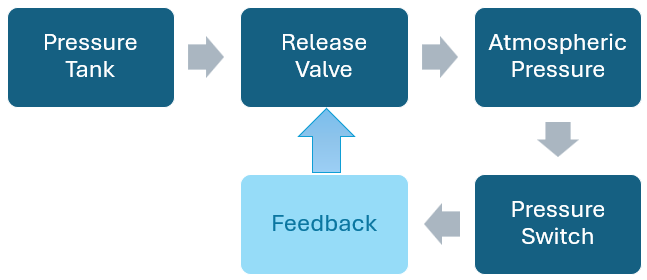
Feedback informs a transmitter of the results of transformer activity. Continuously the output varies because of changing input variable values. If the transmitter receives feedforward from these varying input values it can prevent output changes. By comparing input values from feedforward with a second premise criterion a transmitter can signal changes in transformer activity before input changes cause output changes. This second premise -criterion. Like that for the output variable, defines the optimum values for the input variable. This optimum value criterion is determined by its relation to the output optimum value.
For instance, in the case of the administration of social services, managers should assess their “raw material inputs”. In the social services the “raw materials” are social problems. If the managers foresee major project developments in the community, they should do a social impact assessment. In this way they will be able to prepare for any increase in social pressures. Discrepancies between criteria and input variable values will trigger signals from managers to line workers which may result in new or modified programmes or delivery.
Figure 16. Service Management
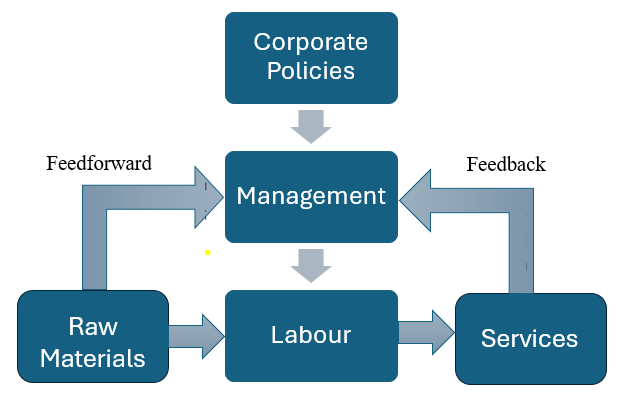
3. 1.3. 5 Systemic Integration
Transmission relations in the design model should be carefully chosen so that variables are maintained near their optimal values. Everywhere there is a transformer there must be some transmission relation specified to control and regulate that transformer. There are also transmission relations between variables of different networks. Within institutions coordination of activities is needed for variables across networks. If a meeting is called it is set for a specific time, at a certain place, for particular people to discuss maters of a given topic; perhaps the topic is the production of a new material item. Knowledge of these different factors are maintained in the semiotic network of those people concerned. The time of the meeting is a factor belonging to the temporal network. The place belongs to the spatial network. The communication network contributes the participant variables while the control network specifies the chairperson and executive positions. The subject matter is composed of language, beliefs and values which belong to the semiotic network. As a result of the meeting a new product line may be accepted or rejected, with obvious consequences for the material network. In each case variables are joined by transformation relations. The semiotic network ensures that these relations take into consideration transformations of the other networks. The time of the meeting can affect the quality of decisions made. Who is in control of the meeting may influence who will show up to participate. The meeting location may alter visitors’ dispositions to accept hosts’ ideas. The meeting’s planners should consider these inter-network factors in addition to the more obvious factors like agenda and objectives. These complex details would require a lot of thought and evaluation if the meeting’s outcome is very important. A meeting, as an example of several transformations occurring simultaneously, is a common and trivial example. But it illustrates how the semiotic network plays a major role in integrating transformations in different networks.
Relations between variables of the same and different networks integrates the variables so that to some extent the needs of individual variables are sacrificed for the good of the whole. It is like taxation. Every factor in the community must contribute some of its potential so that the whole community can survive. This is a system of continuous payoffs between variables or factors so that optimum states or values are seldom achieved. Each variable’s value in the design model should be expected to be suboptima/ rather than optimal. The logics and mathematics involved in keeping the many variables in satisfactory states is extremely complex, but the end result for the whole system is a state of dynamic equilibrium. The competing demands of variables on one another should be relatively stable. The “taxation” should not be so heavy that variables are forced to threshold levels.
If in a space community education is sacrificed for increases in production of satellites, long-term problems could arise. Students who grow up in the community, and on completion of high school go to work, will not be able to fill the shoes of their specialist parents who founded the colony. A population of less than 10,000 people will have difficulty supporting a university. Extra expenses of sending the students to earth for advanced education may deter the acceptance of this alternative. One feasible alternative is to combine distance education with community education. Under correspondence instruction through telecommunication with earthside institutions students could make use of community facilities such as local theatres, research labs and libraries. Local specialists and professionals could serve as tutors. In brief, a space colony would have to be quite innovative in order to achieve both long and short term equilibrium.
To complement the effectiveness of variable differentiation, integration of variables through relations creates efficiency. Integration ensures that resources get used where they are most needed. In the definition of each relation in the design model is the implication that as threshold values are approached greater pressure is exerted by the transmission relations (via feedback) on transformation relations to rectify the situation. Collectively then, variables tend to find suboptimum equilibrium values. If the model is unstable new relations and/or variables must be inserted into the design until stability is achieved. Stability may be defined as the condition in which all variables are kept within threshold values.
3.1.4 Summary
The task of designing any community is an enormous and complex one. Community systems engineering outlines the basis of an approach to such a task. It depends on the use of a symbolic model of the future community. The model consists of variables and their relations. The variables, representing factors in the institutions and networks of an actual community, are given optimum and threshold values. Relations represent transformations and transmissions between factors in the community and, along with variables, can be given precise logical and mathematical meaning. The task of the systems engineer is to first identify the appropriate variables that correspond to factors crucial in ensuring the satisfaction of population needs. Second, the engineer must find relations between variables that correspond to the transducers in the community which maintain an overall dynamic equilibrium.
Space colonies may be realizable by the late 1990’s. Their design for and construction in the barren environment of space need to include every possible and conceivable factor in the support of human life. It will be necessary to consider a wide variety of designs before the best available is created. Experimentation after construction may lead to further changes in later designs. Because of the complexity and subjectivity involved, the modelling of the semiotic network may be a most difficult task and may be best approached using qualitative and logical information first rather than quantitative and mathematical information. However, the central role of the semiotic network is a most critical one. The first step in the construction of a space colony is to develop agreement on essential principles used in trouble-shooting, problem-solving and decision-making. The design model is only useful if it can be implemented and managed properly.
Table 6. Network/Institution Matrix
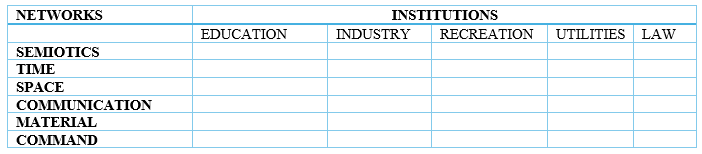
3.2 Community Systems Management
Like community systems engineering, community systems management is an applied science. Unlike engineering, which is the design and construction of new communities, management is the control of ongoing community development activities. These community development activities involve changes to organizational structure and behaviour. Between the uncontrolled conditions of the environment and the uncontrolled needs of the population, organizational structure lies controlled by the semiotic network of a community. Premises and transmitters of the semiotic network process input information and generate sets of instructions that guide organizational factors and transformations in keeping population needs satisfied throughout changes in the environment. In order to ensure that management is conducted efficiently and effectively, it should proceed through a sequence of stages and it should be done by the community itself.
3.2.1 Systems Process Model
The management of a community system has inputs and outputs. Input to management is feedforward from the environment, feedback from the population and criteria from non-material cultural premises. The output is a set of instructions for organization. Transmitters responsible for integrating input information can be seen as a matrix of the semiotic processes with a series of steps of thought. The semiotic processes, semantics, syntactics and pragmatics, are used to organize information in each of these steps. Language, beliefs and values are determined for all significant factors and transformations in the environment and the population. The result is a mental simulation of the community. Organizational factors and transformations are recorded after each instruction is transmitted.
The steps of thought through which the semiotic control proceeds establish goal-orientation and self -regulation. If management is defined as semiotic control, then semiotic control may be further defined as goal -oriented self-regulation in the community. Goal-orientation means that the community strives toward some ends. These ends are the community’s interpretation of population needs, and they are maintained conceptually in the minds of the community residents and managers. Goals are acquired and used in separate steps – goal -setting and decision-making. Goal-setting may be approached with the help of research in the social sciences for the purposes of this chapter (an explanation will be forthcoming). Decision-making may be loosely identified with execution. Goal-setting is the first step in the management process model. Decision-making is the last.
Self-regulation is the community’s means of achieving its goals. It is the activity of creatively, critically, rationally and empirically trouble-shooting and problem-solving. Trouble-shooting and problem-solving follow goal— setting and precede decision-making. Trouble-shooting may be approached by exploratory planning, and problem-solving by development planning. Together the four steps in systems management are:
1. Goal-setting (Research)
2. Trouble-shooting (Exploratory Planning)
3. Problem-solving (Development Planning)
4. Decision-making (Execution)
Through research processes of issue identification, model building and data collection, local goals for development are uncovered or chosen and then stored as criteria for later decision-making. In exploratory planning the information compiled in the first step is used in simulating the community, and gaming and projecting future scenarios. Development planning builds solutions for development problems identified in the previous step. It includes design, assessment and mitigation of community development plans. Finally, the plans are evaluated, a decision arrived at and a set of instructions sent to the community organization. These comprise the execution stage. These four steps in the management systems process form a model. (See Hall, 1962, for other models.) The steps of management are used to control the community development process. Community development is the set of activities that transform the present community into a future community. In the management model, the entire system is represented in terms of scenarios — present and future scenarios (Figure 27).
I .
3. 2.1.1 Community Based Development
It is now generally accepted in community development studies that the more community participation in the development process the greater are the chances of successful goal attainment (Cary, 1970, 144). People need to identify with a cause. They need to feel included and to feel that they have some control over their destinies. When they feel in control they feel committed to a purpose in living. This is a seat of strength and pride which drive people to use their resources to the best of their abilities. People prefer to work toward their own goals and regulate their own activities in goal achievement. Community based development depends on this principle of human nature. People will invest their resources when they can determine how they will benefit from the investment. In other words, a community is a goal-oriented system; output determines input. It is self-regulating, or adapting, in that it changes its organization in response to inputs and outputs. It is in community based development when local human resources are the main inputs and outputs of development (Blakely, 1 979).
As an input-output machine, a community can be an amplifier (Figure 28). Local resources put into the organization are increased or improved upon. When outputs are recycled as new inputs a community development cycle evolves which is a positive feedback loop. Development can proceed exponentially if properly managed, if development goals are to increase the material standard of living, social cohesion, cultural identity, and self-determinism then the successful achievement of these can mean the community will be able to put more back into the development process. There will be more resources for training and education, more general enthusiasm, and more understanding of the control or management process itself.
Cooperation is needed if any satisfactory goals are to be met. This cooperation can generally be defined along network lines. There must be agreement in the semiotic network first Language, beliefs and values must be held in common if there is to be any further cooperation on more concrete goals and means. In the command network there must be cooperation in sharing responsibilities and rights. There must be cooperation in communication so that no barriers to liaison occur. Materially, people should be ready to make contributions in proportion to their ability and expectations of a return on investment (personal or communal). There must be agreement on where development is
Figure 27. Community Development Management System
Figure 28. Community Resource Amplifier
to take place so that all people participating benefit from its location. Finally, the timing of development should be such that people can make their participation most effective. The management of community based development .demands that each participant contribute in a way that benefits the whole community as well as himself. Without such cooperation at the local level development can be expected to be chaotic and frequently self-defeating.
Participants must understand clearly how community organizational development can act as an amplifier. The complex interactive feedback loops should be explained in simple terms so that community management, like business management, is not a magic or mysterious enterprise. The better an organization is understood, the better it will work. Without the shared responsibility in making the development programme work local resources will not grow as quickly or completely. Responsibility for control ensures that control processes will be better understood and consequently more effective and efficient in achieving common goals. Control from outside the community (not community based) tends to promote dependency and exploitation rather than cooperative responsibility.
3. 2. 1.2 Cross Cultural Development
In cross-cultural development it can be very difficult to get cooperation. Often only one party in the situation is an established community, the other being an outside development proponent To avoid cultural disintegration or assimilation both parties involved must agree above all that they each have a right to development. Co-existence of fundamentally opposed groups is rarely possible and it is usually destructive. Beyond this elementary agreement there must be some means of managing any interaction. Although both groups may pursue their own development goals using their own resources, there should be at least agreement on non-interference between them. There may be some joint projects that they can share in for mutual benefit. At any rate, autonomy must be respected if development is to succeed (Petro— Canada, 1978).
Co-existence, non-interference and joint project strategies in cross-cultural development each demand special attention to the nature of semiotic differences and similarities. There may be countless problems arising from language differences. Cooperation is difficult to manage without proper communication. Beliefs are important too, as ideas as contrary as fatalism and self-determinism are very difficult to compromise for cooperative development. Differences in formal education or knowledge of local ecosystems could give one group or the other a distinct advantage in the control of development. However, such differences could also be the basis of cooperation, each providing knowledge resources the other cannot. In terms of values, some may be incompatible while others complementary. Vegetarians and meat-eaters would find it difficult to develop farms together. However, if in a different case, one culture is horticultural and the other a hunting group their valued ways of life could result in trade of vegetables and meat. This would be mutually beneficial.
The management of cross-cultural development would require that similar and different ideas be sorted out before and throughout development. One way of doing this is to have both groups do their own development research and planning independently first, then select joint projects for cooperative development. Each party (community, corporation, government, etc.) should determine its own goals and means through its own control and then negotiate with the other on possible common goals and means. Each retains its community based development status but selectively cooperates when and wherever it can so benefit. The joint projects must be clearly defined in terms agreeable and comprehensible to all participants. This will require the establishment of a common sub-culture, a semiotic network that links the two cultures by shared language, beliefs and values. A semiotic synthesis of this sort would provide both cultures with greater variety of responses to environmental conditions. Each would be better able to maintain and develop its level of population need satisfaction. Failure to take advantage of cross-cultural semiotic synthesis would be a great misfortune for those participants. It would not require the sacrifice of culture, only addition to it. A management team composed of representatives of both parties would control these joint projects. They would take the projects through research, exploratory and development planning, and execution to achieve goals shared by all participants.
The remaining sections of this chapter outline the steps and methods involved in the management of cross-cultural development programmes. More specifically, examples will be taken from the case of cross-cultural development involving Canadian native communities and fossil fuel resource development proponents. This particular case is of interest because it is becoming more common as energy is in greater demand and as native communities are becoming more vocal on issues of their cultural disintegration. Little theoretical work has been done to approach the problems of rapid acculturation which arise in these cases. Common social impact assessments assume a relatively mono-cultural urban development setting and are not directed primarily to development planning pursuits of the indigenous community. The community systems management approach presented here is addressed to participants in cross-cultural development who wish not only to assess and mitigate impacts of change but wish to gain complete control over the development process. It assumes that all parties concerned want some development and are ready to engage in cross-cultural cooperation.
3.2.2 Research
Research is the process of finding out the composition of the community and how the population would like the community to be composed. In ordinary language researchers find out where it’s at and where it wants to be. Primarily at this stage in the management process, however, the objective for the community is goal-setting, that is, where do we want to be. The process of determining the present status of the community is to be more fully carried out in exploratory planning. In research information is received from the environment via feedforward and from the population via feedback. Information about organization is also gathered. This information is simply compiled into lists of factors and relationships to be used in a community simulation in the next stage. Goals that are identified by the population are stored as premise criteria for later decision-making. Two kinds of information then, result: knowledge or beliefs about the community to be used in planning, and values or goals about the community and its future to be used in execution.
The research process is made up of three steps – issue identification, model building and data collection (Figure 29). In each case researchers in cross-cultural development programmes should represent both parties’ interests. They should be cautious in avoiding bias and misconceptions. It is certainly recommended that the two participating groups research their own communities (corporations) before attacking the challenge of cooperative research. However, it is possible that cross-cultural development research could be more successful than the separate studies since there is semiotic synthesis. The combined best of two cultures could be very successful if the participants are willing to explore their similarities and differences. This could be a long term goal.
Figure 29. Research
3. 2.2.1 Issue Identification
Identifying issues in a community involves listing concerns voiced by residents. These may be stated negatively or positively depending on whether the concern is a fear or a hope. The issues may be about the community’s independent development or about impacts from outside developments. Inputs to issue identifiction should be representative of all community interests. Each interest group should be approached for input. In a native communty there may be Metis, status and non-status Indians. There may be Inuit and Indians or Inuit and Whites. Men and women may have different concerns just as the young and old have. Businessmen, labourers, civic employees, farmers, fishermen, craftsmen, and professionals should all be represented too. Research in a fossil fuel resource development project could include such issues as location, manpower sources and needs, access and development timeline.
The outputs of issue identification, essentially a list of priorized concerns, forms the basis of a framework for model building. The output statements of a cross-cultural development programme might include a general lineup of potential impacts of native employment in the fossil fuel resource development project. Some impacts might be increased income for native people and special work arrangements on the job. There could be reduced construction costs due to labour availability and improved local road systems. These are, however, only tentative estimates of future developments. They are issues identified.
A large number of methods are available to research issues. Some common ones include public meetings, casual random survey interviews, meeting prominent citizens, and local media monitoring. Many of these methods which were originally designed for urban Canadian research, as well as others listed later, must be adapted to cross-cultural use. Rural native people may respond quite differently to questioning than urban Canadians Urban Canadian researchers should make an effort to understand native culture. Improper procedures could even spoil development prospects. No rigorous quantification is needed in identifying issues. Reseachers may want to count response types to priorize issues though.
3. 2.2.2 Model Building
In model building researchers must use some social science theory (or theories) to tie together the issues identified. It is the process of finding casual relationships among factors and of representing these factors and relationships in a model such as the one outlined in chapter 3.1. The model need not be quantitative at this time as it is to serve only as a theoretical framework for data collection and simulation. But with these processes following model building it must be kept in mind that the model will eventually be quantified. The process of model building may reveal issues which were not identified earlier. In this case researchers should check out these leads with feedback from the population.
Models may be iconic, graphic or symbolic. The symbolic models are capable of being most useful in representing the complex interactions of organizational factors. Model building draws on social science literature, so literature reviews will be necessary. Computers can be used to contain and display models. This is particularly helpful when model building becomes complex. If inexperienced computer users are to serve as model builders, which may be the case with rural native people, training sessions will be necessary. If cross-cultural development is to be successful in the long run it will be necessary to use the most advanced technologies available. To be competitive in an industrial or post-industrial society, native communities should be able to use computers to model their organizations. Energy development proponents use computers regularly in their projects and management.
3. 2.2.3 Data Collection
Once the model of the community is constructed it is then necessary to gather more concrete empirical data. Issues were identified by self-report essentially. Now to make the model more realistic each variable or issue and relation must be given some value or equation which corresponds to the real thing in the community. Researchers design and construct surveys which are more concise, comprehensive and reliable than issue identification techniques. They gather statistics from previous studies, the census,
■
government records and so on. They stage numerous interviews and meetings and record various observations about the community. All the time the researchers are guided by the model components to ensure their data will be relevant. They cross check results between participants and between test types. Two basic approaches are used, cross-sectional analysis and longitudinal analysis. The first depicts the community composition in its entirety at present. The second depicts certain aspects of the community through time. Data may be gathered through goal-directed questioning or by passive participant observation. In a native community it may be best to try a number of data collection methods to avoid bias. Correlating results will help build a more dependable representation. It is definitely important to have indigenous residents particpate in research, particularly in data collection. It helps make sure that the results are acceptable and trustworthy. This involvement should last throughout management. Research design, construction, supervision, and data collection and interpretation are all important activities which require both logical perspectives and social science expertise. Data about goals are simply stored for control of planning and execution.
3.2.3 Exploratory Planning
The main objective of this stage in community systems management is trouble-shooting. With data and a model it is now possible to find out what the community will likely be like in the near future. As the future unfolds in simulated scenarios of the community it will be possible to determine how changes will be necessary in order to achieve goals specified in research. Any barriers to development will be identified for development planning. Data and a model are inputs, and future scenarios are outputs. The exploratory planning step includes simulation, gaming and projection (Figure 30).
3. 2.3.1 Simulation
Simulation is the process of making a model of the community behave like the community. Ideally, for every community change there will be a corresponding model change. Conversely, for every change in the simulation model planners can expect a change in the real community. By gaming and projecting with the simulation it is possible to generate alternative possible scenarios of the community s future.
Figure 30. Exploratory Planning
The first thing to do in simulation is to enter the empirical data collected into the model. If this is done with a computer, the model is contained in a programme. Data entry is simple enough using the appropriate codes and commands. Running the programme results in a display of new data for any specified time period – six months, two years or ten years, for example. The basic simulation of the present can also be produced. It will show, for example, how income average is related to demand on social assistance, or how acculturation is related to crime statistics. It could show that family size is dependent on economic stability and perceived control of one’s destiny.
Simulation may turn up errors in model assumptions or data inconsistencies. It must be realized that any major mistake in the simulation will automatically result in inaccurate projections of future states. The simulation must not leave out important variables or overemphasize minor ones. Acting out simulations as a drama may reveal problems in it and at the same time make its significance better known. Participants can take on roles of community leaders or characters and play out their parts as defined in the simulation model. They may in the process realize that they are faced with decision factors not present or not properly represented in the model. In this way the simulation may be tested and corrected.
3. 2.3. 2 Gaming
Once the simulation is tested and corrected for representativeness it can be used as a game. Gaming is the process of altering the simulation so as to get more or less desirable outcomes. It is a way of finding out what will have to be changed in the community if it is to proceed in its present course successfully. After development planning has generated some development designs for the community these will be simulated and used as a game also. The output of gaming is a better estimate of how the community would respond to change and how it will develop without a development programme. This result is used then as the basis for further projections of scenarios for the community.
Methods of simulation gaming can involve varying degrees of citizen participation. If, for example, a computer simulation is used, several participants (planners and/or citizens) may be allowed to interact with one another and the computer. They can do this individually, in pairs or in groups. They may be in competitive relations or cooperative ones. They may even form teams. The rules of the game can be varied. Participants may have varying degrees of control over the simulation game. They could perhaps vary values for certain community institutions, relations between certain institutions or equations for relations within certain networks. The options seem nearly endless. In cross-cultural development projects it would be possible to use gaming as a means to exploring negotiations to settlements of conflicts. It could be an instrument of cooperation.
An alternative method of gaming would be using board games. Games similar to Monopoly or Risk could be constructed to simulate the community. This would be simpler but less complete than computer gaming. Such a game could be used as a preparation for use of the computer. Although high technology may seem to some to be misplaced in a native community ultimately development will be benefited from the use of any instruments or methods which allow greater control over one’s destiny. Gaming makes the simulation more accurate, valid and reliable.
3. 2. 3. 3 Projection
In making projections about future states of community organization planners must build on the results of gaming. One, or a selected few, base simulation scenarios (of the present community) are used to forecast, predict or prophesy future scenarios. Calculation of equations relating variables are made periodically or continuously to create change over time. The calculations are simultaneous or sequential depending on the structure of the model. A series of scenarios can be produced for the community at any interval. Six month intervals might be best to show change in some variables, while six weeks or six years may be needed for others. As the projected future becomes more distant the scenarios become less reliable. This is because there are factors in the community which are not represented in the model or cannot be anticipated, but which have influence on community behaviour. Individually they may be insignificant but because a real community is so much more complex than any model can be, collectively these factors can be very significant in determining community change.
Projected scenarios are used to determine where troubles lie in development. As projection is the final process in trouble-shooting, or exploratory planning, it must produce a set of statements about what difficulties will arise in the normal development of the community. What barriers or interferences will prevent the community from achieving its goals? In cross-cultural development scenarios produced by both the native community and the energy corporation (for its development project) must be combined if there is to be a realistic account of cross-cultural impacts. How will the two development programmes impact each other if trends remain as experienced for each? A clear and distinct statement is necessary if development planning is to be successful in problem-solving.
3.2.4 Development Planning
In the community systems management process development planning is the stage in which problems identified in exploratory planning are solved. Projections for the future of the community are used as the basis of plans for development. The simulation model or initial community scenario is modified so that problems first projected do not arise and so that goals set in the beginning are met satisfactorily. The result of development planning is a new community design and a plan time table for implementation of the design into the community. The development planning stage of management is composed of three steps – design, assessment and mitigation (Figure 31). Cross-cultural impacts between a native community and a fossil fuel resource development project are to be planned in such a way that negative impacts are minimized and positive impacts maximized.
3. 2.4.1 Design
Design is essentially the activity described in Community Systems Engineering. However it need not involve the design of an entirely new community. Design can also be a piecemeal continuous activity which responds to demands as they arise. It is the process of selecting variables and relations, values and equations which keep a model in a stable dynamic equilibrium. It is a means of finding out the best balance of differentiation and integration or effectiveness and efficiency in a community. Unlike exploratory planning it is not descriptive or predictive so much as creative and control oriented. How can the community be changed so that it meets its goals and satisfies its needs?
Figure 31. Development Planning
.
The methods used in designing development include modelling, brain storming, force-field analysis and projection. Modelling is begun with the existing model of the community. By brain storming, a group of participants and planners can list all possible options available to solve problems found in the model. Force-field analysis is a means of evaluating the various options generated by weighing the pros and cons of each (Lewin, 1 95 1 ). To find out how the chosen changes alter the behaviour of the community projections are made in the same way they were for the existing community.
In cross-cultural development programmes it is important to include full scenarios of both the native community and the resource development project. Planners should be chosen from each group as well as to ensure that both perspectives are represented. Without participation at this critical stage it will be impossible to make cross-cultural projects successful. With values and beliefs as divergent as these two groups it is unrealistic for one to represent or make fair assumptions about the other’s perspective. Independent development planning should be done first by each group so they are well prepared for negotiating and joint planning. Also at the design stage it is important to review and even amend the original goals set for development. These can be used as criteria in the selection of changes, but these goals may have to be changed in light of new information.
3. 2. 4.2 Assessment
Assessment in development planning is to determine what impacts development changes will have on the existing composition of the community. In other words, it must identify problems in the implementation of design changes. The input to assessment is the development design and the simulation produced in exploratory planning The output is a list of points of impact between the two models (Torgerson, 1 980).
The assessment should include the following characteristics of impacts:
1. Direction of change of variable or reaction (increases or decreases, growth or decay, negative or positive)
2. Magnitude of changes (value levels, numbers, equation rates)
3. Rough costs of changes to development proponent (for implementing and covering impacts)
4. Duration of impact (long or short term)
5. Further consequences of impact
6. Avoidability or inevitability of impact
7. Reversibility of changes
8. Ability of community (corporation) to absorb impacts without breakdown
9. Extent to which development contributes to the impact
There are of course other informal criteria of assessment which may not be predetermined. Native people or corporate policy makers may have their own concerns in cross-cultural development programmes. For instance, native people might be concerned about measurement of psychological costs of rapid acculturation, or the rate of change that they can best control. Corporate executives could be concerned with the suitability of compensation methods for specific impacts. Assessment is important because development can be destructive if not implemented properly. Planners must know how their plans will change the existing community or their development designs could actually create more problems than they were to solve.
3. 2.4. 3 Mitigation
Once the assessment has determined what impacts will result from implementing the development designs it is necessary to amend the designs or its implementation schedule to make transitions smooth. This is done through basically the same processes used in design. The list of impacts and their characteristics define the problem. Modelling, brainstorming, force-field analysis and projection provide the solutions. The result is a new design and implementation schedule that is ready for approval or rejection.
Mitigation of impacts in cross-cultural projects can be difficult if there is no agreement on the values of changes. Native people and corporate planners could disagree on the importance of impacts to local roads due to increased use. In this case some rigorous negotiating would be needed supported by documented reports of the present conditions and of similar impacts in other project areas. It could be useful to use the computer simulation gaming method to come to agreement. Undoubtedly there will be disagreement on many issues and for the sake of efficiency and time constraints, diplomatic concessions probably will be made before consensus is arrived at.
3.2.5 Execution
Execution is the stage in community systems management in which a course of action is chosen and implemented. The final draft development plan is evaluated, a decision is made to go ahead or not, and the plan is put into action (Figure 32). Execution draws on the goals set in the beginning as criteria in this decision-making process. Once the action step is underway the complete management cycle may be repeated for further refinement or additional development programmes.
3. 2.5.1 Evaluation
Evaluation is the process of critically reviewing the creative products of development planning. Goals identified in the community through research are reviewed. The plan is evaluated using cost-benefit or cost-effectiveness analysis and the result is a rating, or a measure of how profitable the development would be for its participants. If more than one plan was prepared each is evaluated similarly so that their ratings can be compared. The main idea is to determine the extent to which a plan is more effective or beneficial than costly. Other methods of achieving the same results may also be used. Any plan which is not feasible is rejected.
It is important in cross-cultural development evaluation that the goals of community and corporation be given proportional weight. Either the party with the most potential gain or loss, or the party with most invested, should have greater control in evaluating the profitability of the project. Profit should not be considered only in dollars and cents. Money is easy to count, so it is often used as a universal measure. But many factors which cannot be bought or sold cannot be so measured. Native cultural heritage or local social cohesion are two examples. The value of public image for a corporation is not easily priced either. These factors nevertheless are important and cannot be left out. They may be listed in addition to financial analyses. Ultimately, these factors may be decided quite subjectively even though they are extremely important.
3. 2.5. 2 Decision
Once evaluations have summarized the development plans a decision is made on what to do with the plans. If there is only one plan prepared or evaluated as feasible the decision is to accept the plan as it is, accept the plan with minor changes, or reject the plan. If there is more than one plan decision-makers can either choose by elimination, priorization, or by amalgamation. Amalgamation means that certain characteristics of different plans are synthesized. This should be done by going through the development planning process again as unanticipated consequences could occur from such a synthesis.
Figure 32. Execution
Decisions should be made by representatives from all participant groups. In the case of cross-cultural development native people and corporate executives must decide cooperatively. Both must consent to the plan if it is to go ahead. Rejection by either kills the plan. If decision-makers have had much feedback or input into the management process there should be no serious problems in getting plans accepted.
3. 2.5. 3 Action
Action is the final step in the community systems management process. It is the goal of the process since without action the process is unsuccessful. The implementation of development plans begins when the decision to go ahead is given. Preparation for action, however, should have been included in the planning stages. The implementation time table, for instance, should provide a basic framework for the coordination of activities. Action involves the purchase and acquisition of materials, equipment, land and labour. It involves assigning tasks and responsibilities, communication of construction instructions, and feedback on progress. In essence it is the sending of instructions from transmitter to transformer as well as transformer response itself. It also includes the establishment and use of monitoring procedures which feedback information from organizational states in the community after construction is complete. Monitoring community organization permits the management to control operations and do fine tuning after plans have been implemented.
The action stage of the management of cross-cultural development would entail, for instance, detailing action along the six networks. First, a time table is developed in adequate detail. The location of activities, events and things in space should be mapped or blueprinted. Then materials such as building materials, tools, manpower, and so on should be acquired and organized. A chain of command for supervising development should be established along with channels of communication. Finally, in the semiotic network each person involved should have a clear picture in mind of what he is to achieve in relation to others, in relation to the whole programme, and in terms of his own needs and resources. Because of the cross-cultural nature of this programme a synthesis of ideas and of actions between cultures may present difficulties. The plan of action or implementation should try to anticipate these difficulties long before they actually arise so that conflicts can be prevented. For example, managers should prepare convenient work schedules for native employees. The schedule should make possible the preservation of periodic hunting or fishing traditions if desired. On the other hand, native people should be prepared to accept some of the responsibilities of regular industrial employment. Compromises are needed on the part of both groups.
3.2.6 Summary
Management is control. Control is exercised primarily in the semiotic network of a community and especially by the transmitter or community organizers. Successful community development is usually community based, that is, control is local and favours local human resource development, social cohesion, cultural identity and so on. Cross-cultural development occurs when two or more groups of different cultural background, such as Canadian native people and energy corporations, come into contact and interact to achieve common or complementary goals.
The process of community systems management is made up of four stages or steps each of which is composed of three sub-stages. Research processes including issue identification, model building and data collection, set goals for community development and prepare information about the community for planning. Exploratory planning is the trouble-shooting stage. Composed of simulation, gaming and projection it supplies the management process with scenarios of the community’s future in relation to community goals. Problem-solving is conducted in the development planning stage where design, assessment and mitigation are done to come up with a development plan. In execution the development plans are evaluated, a decision is made on whether to proceed and action may then be taken to implement the plan.
Throughout the management process new information becomes available which can have impact on earlier or later stages. Opportunities should be made to incorporate this new information as it occurs.
‘
_
127
Table 7. Cooperative Development Management
STAGE
CORPORATION
COMMUNITY
CROSS CULTURE
MANAGEMENT
Production
Council
Mixed
Staff
Representatives
OBJECTIVES
Fossil Fuel
Living
Manpower/
Profits
Standards
Employment
RESEARCH
Project Needs/
Community
Cross Cultural
Resources
Issues
Impacts
EXPLORATORY
Project
Community
Joint Futures
PLANNING
Futures
Futures
DEVELOPMENT
Final Project
Final Com¬
Final Cross
PLANNING
Plan
munity Plan
Cultural Plan
EXECUTION
Project
Community
Cross Cultural
Operation
Development
Development
.
3.3 Conclusion
Community Systems Science: A Paradigm For Development shows how systems science can be applied to the study and development of human communities. It provides not the only possible application but one set of examples of application. As a science it approaches community from the angles of theory, analysis, and synthesis, and it covers issues of organization and change. As a paradigm for development, it provides a model of control by showing the relationship between causation and logic, between energy and information in the community. An emphasis has been placed on the role of the semiotic network as part of the rationale of the control model. In terms of organization, communities are shown to have universal structure – causal and logical system – with six functional networks. These can be organized intentionally using design modelling techniques. In terms of change, communities are shown to have evolved out of man’s social nature, they develop through differentiation and integration, and they can be rationally controlled by the use of process modelling techniques. It has also been illustrated how community systems ideas can be applied to a wide variety of communities. It is hoped that this scientific paradigm will help community development practitioners in their capacities as organizational change agents.
Addendum 2024: A 42 Year Update
The world population in 1982 was approximately 4.6 billion people. With the current population around 8 billion, it has increased by approximately 3.4 billion people.
Bibliography
Appelbaum, Richard. Theories Of Social Change. Chicago: Markham Publishing Company, 1970.
Ashby, Ross. W. An Introduction to Cybernetics. London: Chapman and Hall Ltd., 1956.
Azarya, Victor. Aristocrats Facing Change. Chicago: University of Chicago Press, 1978.
Barnouw, Victor. Acculturation and Personality Among the Wisconsin Chippewa. American Anthropological Association, 1950.
Bateson, Gregory. Mind And Nature. New York: E. P. Dutton, 1979.
Berger, Peter and Luckmann, Thomas. The Social Construction of Reality. Garden City, New York: Doubleday and Company, Inc., 1967.
Berry, John W. Human Ecology and Cognitive Style. New York: John Wiley and Sons, 1976.
Berry, John and Dasen, P. R„ Eds. Culture and Cognition: Readings in Cross-Cultural
Psychology. London: Methuen and Co. Ltd., 1974.
Bertalanffy, Ludwig von. Robots , Men And Minds. New York: George Braziller, Inc., 1967.
Birks, J.S. “The Mecca Pilgrimage By West African Pastoral Nomads” Journal Of Modern African Studies Ab, 1,47-58, 1977.
Blakely, Edward I. Community Development Research. New York: Human Sciences Press, 1979.
Buckley, Walter. Sociology and Modern Systems Theory. Englewood Cliffs: Prentice-Hall,
Inc., 1967.
Caplan, Arthur, Ed. The Sociobiology Debate. New York: Harper and Row, Publishers, 1978.
Cary, Lee J., Ed. Community Development As A Process. Columbia, Missouri: University of Missouri Press, 1970.
Chestnut, Harold.Sysfe/ns Engi neeri ng Methods. New York: Wiley & Son, Inc., 1967.
Chomsky, Noam. “The Formal Nature Of Language.” In E. H. Lenneberg. The Biological Foundation Of Language. f> New York: Wi ley, 7967.
Cleland, David and King, William R. Management: A Systems Approach. New York: McGraw-Hill Book Company, 1972.
Cortes, Fernando; Przeworski Adam; and Sprague, John. Systems Analysis For Social Scientists. New York: John Wiley & Sons, Inc., 1974.
Cox, Bruce, Ed. Cultural Ecology . Toronto: McClelland and Stewart, 1973.
Dockstader, Frederick. The Kachina and The White Man. Bloomfield Hills, Michigan: Cranbrook Institute of Science, 1954.
Doreian, Patrick and Hummon, Norman. Modeling Social Processes. New York: Elsevier, 1976.
Dow, James. “A Systems Model of Cultural Ecology.” Social Science I nformation, 15 (6), 953-976 (1974).
Etzioni, Amitai, Ed. Complex Organizations. New York: Holt, Rinehart and Winston, 1961.
Finsterbusch, Kurt and Wolf, Charles P., Eds. Methodology of Social / m pact Assessment. Stroudsburg, Pennsylvania: Dowden, Hutchinson and Ross, Inc., 1977.
Fodor, Jerry and Katz, Jerrold, Eds. The Structure Of Language. Englewood Cliffs, N.J.: Prentice-Hall, Inc., 1964.
Forrester, Jay W. Industrial Dynamics. Cambridge, Massachusetts: The M.l.T. Press, 1961.
Goode, Harry H. and Machol, Robert E. System Engineering. New York: McGraw-Hill Book Company, 1957.
Goodman, Michael. Study Notes in Systems Dynamics. Cambridge, Massachusetts: Wright-Alien Press, Inc., 1974.
Greenblat, Cathy S. and Duke, Richard D., Eds. Garni ng-Si mu/ation: Rationale , Design and Applications. Toronto: John Wiley and Sons, 1975.
Hagman, Roy S. Culture and the Genesis of Language. Edmonton: Linguistic Research Inc., 1982.
Hall, Arthur D. A Methodology For Systems Engineering. New York: D. Van Nostrand Company, Inc., 1962.
Hallowell, Irving A. Culture and Experience. University of Pennsylvania Press, 1955.
Hallowell, Irving A. Contributions to Anthropology. Chicago: University of Chicago Press, 1976.
Hare, Van Court, Jr. Systems Analysis: A Diagnostic Approach. New York: Harcourt, Brace and World, Inc., 1967.
Heimstra, Norman and Ellinstad, Vernon. Human Behavior: A Systems Approach. Monterey, Caiif.: Brooks/Cole Publishing Company, 1972.
Heppenheimer, T. A. Colonies in Space. New York: Warner Communications Company, 1978.
Holzner, Burkart. Reality Construction in Society. Cambridge, Massachusetts: Schenkman Publishing Company, 1968.
Kahn, Alfred J. Theory and Practice of Social Planning. New York: Russell Sage Foundation, 1969.
Krauskopf, Konrad and Beiser, Arthur. The Physical Universe. New York: McGraw-Hill Book Company, 1973.
Kuhn, Thomas S. The Structure of Scientific Revolutions. Chicago: The University of Chicago Press, 1970.
Lauffer, Armand. Social Planning at the Community Level. Englewood Cliffs: Prentice-Hall, Inc., 1978.
Laughlin, Charles D„ Jr., and d’Aquili, Eugene G. Biogenetic Structural ism. New York: Columbia University Press, 1974.
Lewin, Kurt. Field Theory In Social Science. Edited by Darwin Cartwright. New York: Harper & Row, Publishers, 1951.
Lewis, Henry T. l/ocano Rice Farmers. Honolulu: University of Hawaii Press, 1971.
Lovejoy, Aurthur O. The Great Chain Of Being. New York: Harper & Brothers, 1960.
Lynd, R. S. and Lynd, H. M. Middletown. New York: Harcourt, Brace and Company, 1929.
Lynd, R. S. and Lynd, H. M. Middletown in Transition. New York: Harcourt, Brace and Company, 1937.
Marshall, Lorna. “IKung Bushman Bands.” Africa, 30, No. 4, 325-355 (1960).
Maruyama, Magorah. “Designing A Space Colony”. The Futurist. October, 273-281, 1976.
Maruyama, Magorah and Harkins, Arthur, Ed. Cultures Beyond The Earth. New York: Vintage Books, 1975.
Maruyama, Magorah. “Paradigmatology and Its Application to Cross-Disciplinary, Cross-Professional and Cross-Cultural Communication.” Cybernetica 17, 18 (1974).
Meehan, Eugene. Explanation in Social Science: A System Paradigm. Homewood, Illinois: The Dorsey Press, 1968.
Mill, John Stuart. Utilitarianism (1861). New York: Bobbs-Merriil Company, Inc., 1957.
Nagata, Shuichi. Modern Transformations of Moenkopi Pueblo. Chicago: University of Illinois Press, 1970.
Nagel, Ernest. The Structure of Science. New York: Harcourt, Brace and World, Inc., 1961.
National Indian Brotherhood. Indian Control of Indian Education. Policy Paper presented to Minister of Indian Affairs and Northern Development, Ottawa, 1976.
Olsen, Marvin E. The Process of Social Organization. New York: Holt, Rinehart and Winston, 1968.
O’Neill, Gerard. The High Frontier. New York: Bantam Books, 1977.
Orians, Gordon H. The Study of Life. Boston: Allyn and Bacon, Inc., 1973.
Ottenberg, Simon and Ottenberg, Phoebe, Eds. Cultures And Societies Of Africa. New York: Random House, Inc., 1960.
Padilla, Amado, Ed. Acculturation: Theory, Models and Some A lew Findings. Boulder, Colorado: Westview Press, 1980.
Parsons, Elsie Clews. Hopi and Zuni Ceremonialism. New York: The American Anthropological Association, 1933.
Parsons, Tacott. The Evolution of Societies. Englewood Cliffs: Prentice-Hall, 1977.
Petro-Canada. “Socio-Economic Statement: The Arctic Pilot Project and Its Effect on Selected Arctic Communities.” Unpublished Report, Calgary, 1978.
Poplin, Dennis E. Communities. New York: Macmillan Publishing Co., Inc., 1979.
Raser, John. Simulation and Society. Boston: Allyn and Bacon, Inc., 1969.
Runes, Dagobert D. Dictionary Of Phi losophy. Totowa, N.J.: Littlefield, Adams & Co., 1975.
Shimpo, Mitsuru and Williamson, Robert. Socio-cu/tural Disintegration Among the Fringe Sau/teaux. Saskatoon, Saskatchewan: Extension Division, University of Saskatchewan, 1965.
Sage, Andrew P. Methodology For Large Scale Systems. New York: McGraw-Hill Book Co., 1977.
Spiro, Melford. Kibbutz: Venture in Utopia. New York: Schocken Books, 1970.
Spradlin, W. W. and Porterfield, P.B. Human Biosociology. New York: Springer-Verlag, New York, Inc., 1979.
Stenning, Derrick J. Savannah Nomads. London: Oxford University Press, 1959.
Stich, Stephen, Ed. Innate Ideas. Berkeley, Calif.: University of California Press, 1975.
Stogdill, Ralph M., Ed. The Process of Model -Bui Id i ng in the Behavioral Sciences, Ohio State University Press, 1970.
Torgerson, Douglas. Industrial ization And Assessment. Toronto: York University Publications In Northern Studies, 1980.
Van Gigch, John P. Applied Systems Theory. New York: Harper and Row Publishers, 1974.
Vivelo, Frank R. Cultural Anthropology Handbook. Toronto: McGraw-Hill Book Company, 1978.
Wallace, Anthony, F. C. Culture and Personality. New York: Random House Inc., 1970.
Warfield, John. Societal Systems. New York: John Wiley & Sons, Inc., 1976.
White, Leslie A. The Evolution of Culture. Toronto: McGraw-Hill Book Company, Inc., 1959.
Whorf, Benjamin Lee. Language, Thought, And Reality. Edited by John B. Carroll. Cambridge, Mass.: Massachusetts Institute Of Technology, 1964.
Wilson, Edward 0. On Human Nature. Cambridge, Mass.: Harvard University Press, 1978.
Wilson, James. Canada’s Indians. London, England: Minority Rights Group, 1977.
 Randal Adcock