

In a far-off age, nestled between two great mountain ranges, lay the Clockwork City of Cogmere. The city sprawled over rolling hills blanketed with patches of iron-capped trees, their metallic leaves glistening under the sun. A network of gleaming brass aqueducts crisscrossed through the landscape, feeding into the central clock tower that loomed like a sentinel, its gears perpetually turning against the backdrop of snow-capped peaks.
A marvel of gears, pulleys, and intricate mechanisms, Cogmere was the envy of the world. People of different backgrounds came and added to the rich diversity of talents and interests. Its citizens boasted of the city’s unmatched intelligence and ingenuity, attributing their prosperity to an endless stream of new inventions and layers of administration that promised to streamline life. Yet for all its brilliance, there was an undercurrent of exhaustion. Minds were dulled, tempers frayed, and people shuffled through streets lined with ever-ticking devices that seemed to run their lives.
The city had grown so vast and complex that the Council of Mechanists, a group of esteemed officials, spent their days examining scrolls of data, arguing over minute discrepancies, and proposing layer upon layer of new solutions to fix the fraying system. Each month, a new sub-council was born—the Subcommittee of Lamp-Lighting Efficiency, the Bureau for Trolley Whistle Regulation, and the Advisory on Synchronizing Rooster Crows, to name a few. And yet, despite the mountain of parchment decrees and buzzing devices, the citizens grew weary, their spirits burdened by the ceaseless ticking that never allowed a moment’s peace.
Among the bustling throngs, hidden on the fringes of society, was a small, ragged group who gathered in the Whispering Grove. They were thinkers and dreamers, known dismissively as the Parsimonists. The Council derided them for their simplicity and scoffed at their mantra, “Hail Parsimony,” which championed reducing the world’s apparent complexity by seeing it through a lens of elegant simplicity.
Led by an old scholar named Elias Vine, who once held a seat in the Council but was cast out for his ‘radical’ views, the Parsimonists met under the rustling trees and spoke not of gears, but of flows—the way water ran through a brook, the way leaves fluttered in the wind, and the way stars, distant and patient, mirrored the unfathomable yet harmonious patterns of life. Elias would remind them, “Nature scales as it wills; it does not layer itself in labyrinths of needless rules. Understand the root, and the branches will not lead you astray.”
As the years passed, Cogmere teetered on the edge of breakdown. Clockwork systems misfired, data became too dense to interpret, and the citizens’ minds, tangled in information webs, grew fogged with fatigue. Chaos seeped in; the harmonious ticking that had once defined the city was now a cacophony of discordant clanging and sputtering. The Council, in a desperate attempt to restore order, issued edicts to address the symptoms—more committees, more inspections, more gears layered onto the sputtering engines.

Then, one fateful night, a great firestorm swept down from the mountains, ignited by an errant spark from the overloaded systems of the city’s central clock tower. Flames burst into the sky, crackling like a thousand whispering demons as the acrid scent of burning metal and wood filled the air. The citizens’ eyes widened in terror, their shouts rising in a chorus of panic that echoed through the narrow streets. Some clutched their loved ones, others darted aimlessly, their faces etched with confusion and fear as the fire’s heat pressed against them like a suffocating shroud. The fire danced and roared, consuming the outer districts before the eyes of terrified citizens.
It was then that Elias and the Parsimonists moved swiftly. They did not rush to dampen the fire with isolated buckets of water as the panicked townsfolk did, but instead, they led a line to clear paths through the city, allowing for controlled burns that redirected the flames and saved the heart of Cogmere.
In the stunned silence that followed the storm, the Council, now haggard and humbled, invited Elias to speak. “You sought to solve what was plain to see,” Elias began, “but you were blinded by the glitter of details, unable to grasp the roots beneath.” He traced his finger through the ash and drew the fractal shapes of branches, veins, and rivers. “Life follows these paths because they balance order and chaos. Your machines did not, for they knew not how to scale with purpose nor align with Nature’s law.”
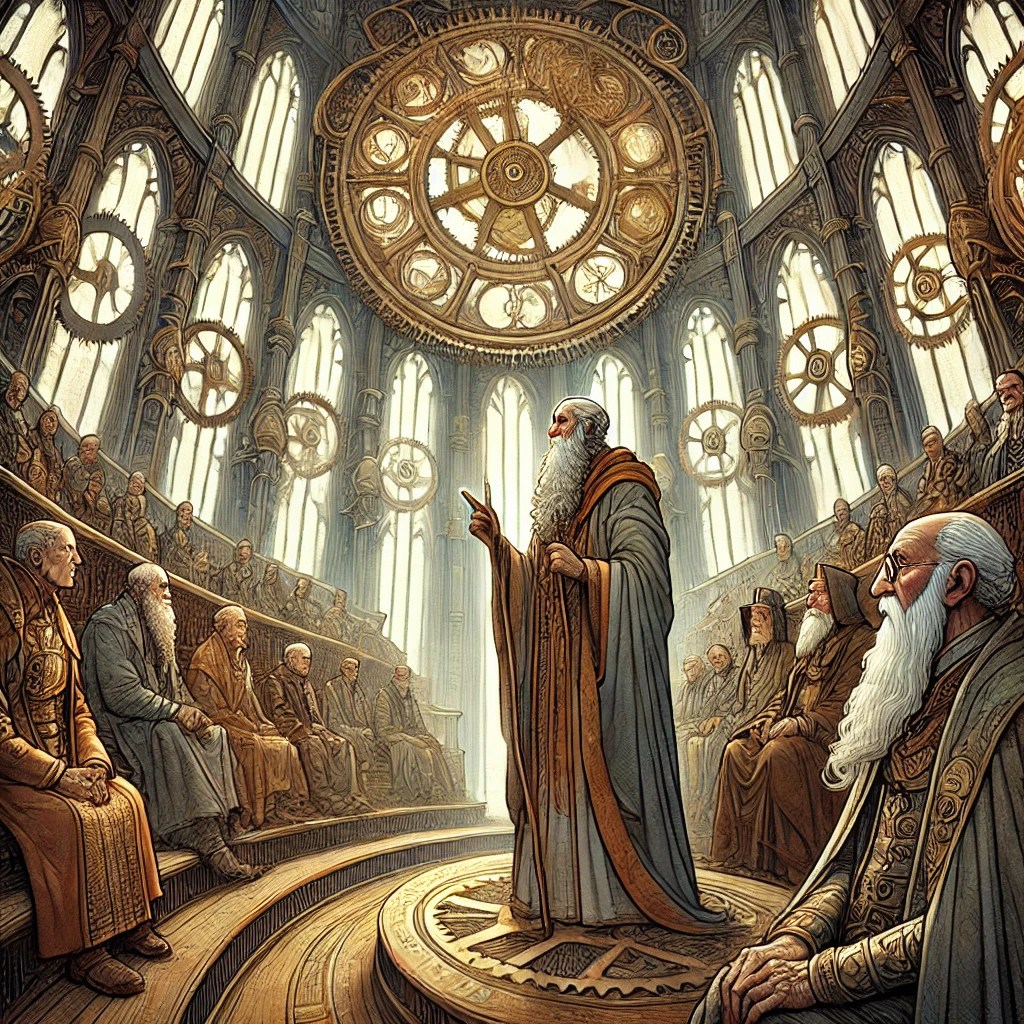
Thus, a paradigm shift was born. Cogmere slowly dismantled its extraneous subcommittees, casting away the gears that added only noise. The city embraced a holistic, fractal systems worldview, recognizing the scaling laws that guided forests, seas, and stars. The concept of requisite variety took root, as they learned that only by matching the complexity of life with adaptive, natural frameworks could they thrive. The Council established the Office of Harmonious Systems, which focused on maintaining balance by studying natural patterns and applying them to city planning. They redesigned the water distribution system to mirror river networks, simplified governance to prioritize essential functions, and created community spaces where citizens could reflect and recharge amidst nature.
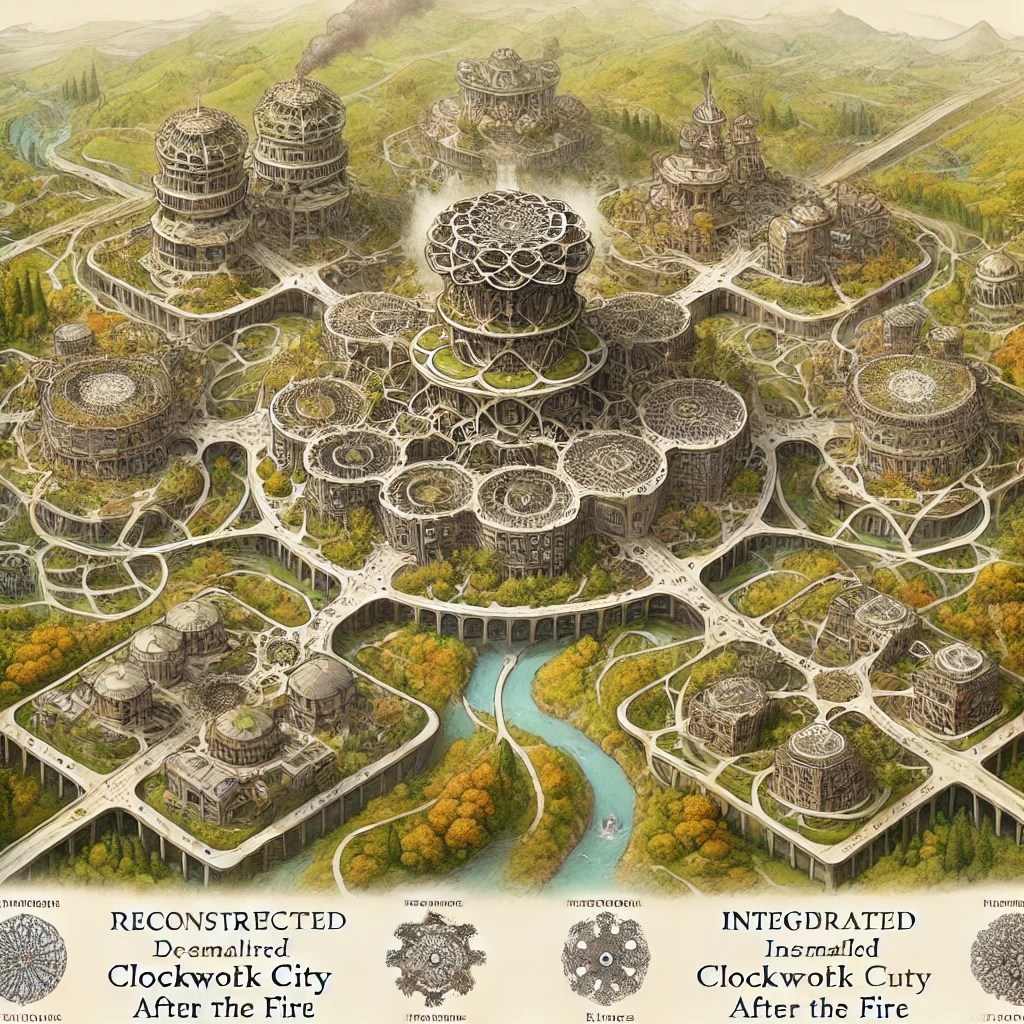
Elias’s teaching, once relegated to whispers, became the guiding light for a rebuilt Cogmere, one not driven by the endless tick of gears, but like a Phoenix from ashes, rekindled by the living hum of understanding.
And so, Cogmere found peace in its simplicity, aligning its civilization with the fractal order of nature. It had learned that true wisdom lay not in counting the ticks, but in heeding the flow.
Moral: When a civilization is overwhelmed by the symptoms of its own complexity, salvation lies in paring down to the root causes and aligning with the natural order that scales harmoniously.
Written by ChatGPT
Directed by Randal Adcock
 Randal Adcock