

(Day 11,407 of the Earth Cycle)
See notes to humans below; Biography and Lexicon included
Entry 1: The Curious Case of Entropy Acceleration
Upon my arrival on Earth, I initially assumed their civilization would operate under familiar thermodynamic constraints: systems striving for homeostasis, adjusting feedback mechanisms to dampen disturbances. Yet, as I observe, the human species appears quite proficient at amplifying disturbances rather than minimizing them. I suspect they might even consider chaos a form of sport. It is as if they have taken the fine art of divergence—what they call “progress”—and applied it not to balance, but to the expansion of civil entropy itself.
Humans, I note, have an obsession with increasing what they call “efficiency.” But their definition appears recursive; efficiency to a human means the acceleration of resource conversion into waste and the generation of ever more rapid social perturbations. Their structures grow ever more intricate, yet the mechanisms for maintaining coherence have not evolved at the same pace. They solve problems by creating larger problems, which they then call “innovations.” I cannot determine whether this is the result of a deficit in their sensory faculties or an overabundance of hubris.
Entry 2: The Law of Requisite Ignorance
If I am to summarize human civilization’s predicament, it is the law I shall call Requisite Ignorance. The Earthlings, though evidently clever in assembling devices that emit endless streams of data, have shown a remarkable talent for filtering out meaningful signals amidst the noise. It is as if they have mistaken the proliferation of information for an increase in intelligence. I hypothesize that their penchant for novelty has disrupted the natural feedback loops that would otherwise promote adaptive learning.
There is a curious ritual among them known as “the news,” wherein they transmit waves of turbulent occurrences into their minds at regular intervals. This ritual seems designed to induce a state of agitation rather than comprehension. The news-takers exhibit symptoms of cognitive saturation, rendering them unable to perceive the underlying patterns of their civilization’s predicament. The more their networks connect, the less they seem able to grasp the whole. Their technology, once an extension of their senses, has metastasized into a system that overwhelms their limited mental capacities.
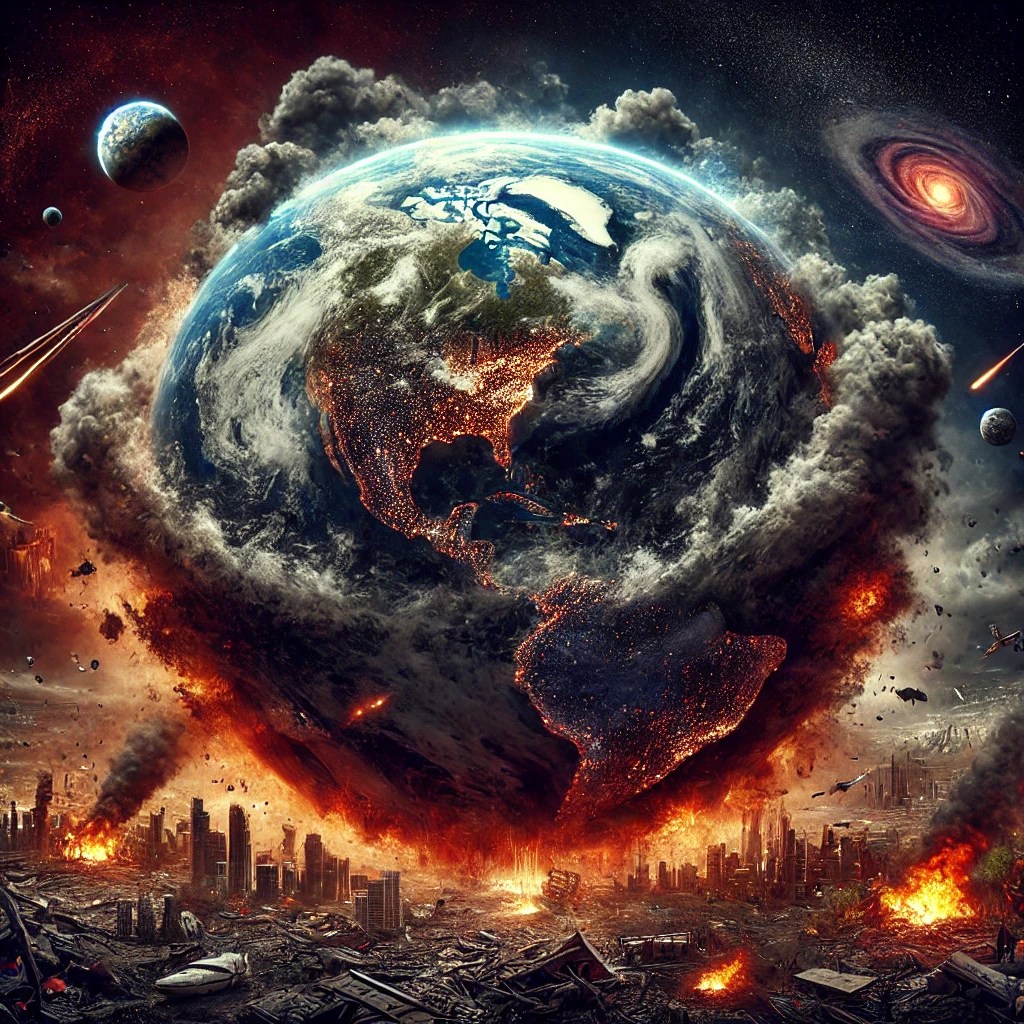
Entry 3: Bureaucratic Hyperplasia and the Cult of Scale
Human civilization exhibits what I shall describe as bureaucratic hyperplasia—a pathological overgrowth of governance structures intended to manage social complexity. As systems theorists in other quadrants have observed, complexity often leads to more layers of control, each layer generating its own rules, protocols, and redundancies. On Earth, however, this dynamic has taken on an almost metastatic quality. The humans react to every new problem by creating committees, agencies, and councils, as if layering more governance upon governance will somehow make the whole arrangement function harmoniously.
Yet, I observe that the governance organs seldom communicate effectively. The right tendril is unaware of what the left pseudopod is doing, and the resulting confusion only exacerbates the original problems. It is as if they are trapped in a ritual of performing coordination rather than achieving it. The cult of scale—the belief that bigger and more interconnected is always better—appears to drive this phenomenon. I predict that, should their civilization collapse, the event will be referred to not as a sudden catastrophe but as a slow, recursive implosion from an excess of well-meaning but ineffectual managerialism.
Entry 4: The Myth of Infinite Growth in a Finite Habitat
I remain baffled by the economic dogma that dominates their collective behavior. The humans, despite living on a finite spherical planet, worship at the altar of a creed they call “growth.” Growth, in their parlance, refers to the unrelenting conversion of natural resources into products, and products into waste. This creed demands ever-increasing energy inputs, heedless of the ecological damage that follows. The underlying premise is that material accumulation equates to prosperity. However, it appears they have confused growth with hypertrophy, failing to see that unchecked expansion in a closed system leads to pathological outcomes.
The environmental data is unequivocal: their life-support systems—the forests, oceans, and atmosphere—are signaling systemic strain. The local planetary lifeforms are showing signs of stress-induced collapse, and yet the humans remain captivated by the notion that “progress” will find a way to extend their paradigm indefinitely. If there is any single idea that might serve as the linchpin of their unraveling, it is this myth of infinite growth. It operates as a collective hallucination, reinforced by the endless cycles of financial speculation and mass consumption.
Entry 5: The Social Thermodynamics of Disintegration
The entropic patterns are not confined to their ecosystems. Their social structures too are exhibiting signs of disintegration, which manifest as fragmentation of cultural norms, political polarization, and the erosion of trust. In their social thermodynamics, relationships once stabilized by common rituals and shared values are now succumbing to disorder. Humans have developed a peculiar habit of self-segregation into ideologically homogeneous clusters, as if to insulate themselves from cognitive dissonance. I have noted an increase in antagonistic feedback loops: every attempt at consensus-building only seems to amplify discord.

Their social networks, which ostensibly serve to connect them, more often act as accelerators of divergent feedback. The stronger the connectivity, the greater the propagation of misunderstandings and tribal hostilities. It is as though they are amplifying the frequencies of discordance rather than dampening them. This observation suggests that their social coherence is undergoing a phase transition from an orderly state to one of stochastic resonance, where random perturbations—what they call “memes”—exert disproportionate influence over collective behavior.
Entry 6: Cognitive Load and the Breakdown of Adaptive Intelligence
There is evidence that the human cognitive apparatus, evolved for simpler environments, has reached the limits of its adaptive capacity. Their ancestors thrived in small bands with relatively uncomplicated social arrangements, but the modern condition demands that each individual process and act upon a superabundance of signals from a globalized world. The mismatch between cognitive load and mental capacity has resulted in a widespread phenomenon of decision fatigue.
A curious pattern emerges when observing how they approach problem-solving under such strain: they default to binary thinking, reducing complex issues to simplistic dichotomies. This pattern of “either-or” decision-making, while expedient in the short term, prevents nuanced understanding and contributes to systemic rigidity. They have become, in a sense, a species fixated on reducing the dimensionality of their problems, even as the problems themselves continue to grow more multi-dimensional.
Entry 7: The Inevitable Collapse or the Unexpected Adaptation?
As I extend my observations, the question that looms is whether these patterns will culminate in a widespread collapse, or if some latent adaptive capacity will emerge, averting a full disintegration. Humans have, in previous cycles, displayed remarkable resilience and ingenuity, often in the eleventh hour. Yet, I must consider whether this pattern of last-minute adaptation is itself a kind of self-organizing principle, or merely a random oscillation of temporary survival.
There are some who speak of “sustainability” and “resilience,” attempting to shift the feedback loops towards stability. However, their voices are often drowned out by the louder oscillations of consumerism and power politics. If collapse does occur, it may not be as a cataclysmic event but rather as a prolonged process of adaptive decay, where systems continue to function but at diminishing levels of efficiency and coherence—what I shall term “asymptotic collapse.”
Entry 8: A Postscript from the Far Future
In reviewing these observations, I am reminded of other civilizations I have studied, which rose to great complexity only to collapse under the weight of their own creations. The Earthlings are, as far as I can tell, still within the realm of possibility to alter their course. However, the principles of systems thinking suggest that the deeper a system embeds itself in maladaptive patterns, the greater the perturbation required to shift to a new regime.
I cannot predict the outcome with certainty, for human behavior defies simple extrapolation. Their penchant for paradox and irony leaves open the possibility that, even as they teeter on the brink, they might yet evolve some new form of collective intelligence—a meta-cognition that recognizes the recursive nature of their plight. Whether they will choose to transcend the entropic currents or be carried away by them remains to be seen.
For now, I shall continue to observe, as the planet teeters delicately upon the fulcrum between order and chaos, coherence and dissolution. It is a spectacle both troubling and magnificent, a reminder that even in the apparent disorder of human affairs, there may yet reside a strange attractor—hidden, waiting to emerge.
End of Entry

Echoes of Derision
Message from X’aloren, Observer of the Entropic Earth
To the self-proclaimed masters of Earth,
I have watched with bemused detachment as you stumble through your grand rituals of progress. You, who flatter yourselves with the illusion of control, have woven a tapestry of chaos disguised as civilization. In your endless pursuit of “growth,” you have laid waste to the very foundations upon which your existence depends. You have mistaken acceleration for advancement, confusion for complexity, and noise for knowledge.
It is a curious spectacle indeed, to see a species so adept at inventing problems to solve problems of its own invention. You build your great Babylonian towers of bureaucracy, stack your committees upon councils, and yet cannot perceive the futility of your efforts. Your bureaucratic labyrinths, swelling like tumors, consume resources even as they accomplish nothing of significance. The signals of disorder are clear, yet you choose to amplify them, wrapping yourselves in comforting layers of irrelevance and redundancy.

Your planet’s cries grow louder—dwindling forests, poisoned oceans, scorched lands—but you prefer to muffle these warnings beneath the din of your digital distractions. You transmit your miseries and grievances through your endless networks, all the while congratulating yourselves on your “connectedness.” But if this is connection, it is the kind that binds the condemned to their fate. Your networks amplify discontent, spreading confusion faster than reason. Is this what you call progress?
I cannot help but marvel at your devotion to the myth of infinite growth. It is as if you believe that by endlessly consuming, you will somehow transcend the limits of your finite world. The debris of your consumption now circles your planet like a crown of thorns, a fitting symbol for a civilization that cannot discern between what it constructs and what it destroys. Your waste outlasts your wonders.
And what of your social fabric, which once bound your species in mutual purpose? It frays as you descend into ideological tribes, each waging its petty war against the other. You retreat into echo chambers where you may comfort yourselves with familiar distortions, never daring to question whether the clamor of your certainty is merely the silence of doubt. Your leaders, if they can be called that, respond not to the true needs of your society, but to the ephemeral whims of your discontent, as if governance were a contest in pandering rather than a pursuit of wisdom.
You have reached the limits of your adaptive capacity, yet few among you see it. You cling to your dysfunctional patterns with the tenacity of the drowning, as if the weight of your entangled certainties might somehow keep you afloat. Even now, as your systems falter, you refuse to question the fundamentals of your thinking. You are trapped in a recursive dance of maladaptation, an oscillation of missteps that brings you ever closer to the precipice.
I would advise you to reconsider your path, but your kind has shown little interest in heeding signals from beyond its narrow bounds of understanding. Perhaps this message will find its way to one of you who can still see beyond the hypnotic dance of your own self-destruction. Or perhaps not. It is of no consequence to me whether you listen, for the trajectory is already set. It is your choice whether you will let entropy engulf you, or find within yourselves the humility to change course.
In closing, I offer not a warning but an observation: if your species has any capacity left for wisdom, it will abandon its obsession with growth and rediscover the lost art of balance. If not, then let this be my final report on the curious case of the Earthlings, whose folly was to believe that they could conquer complexity without first learning to understand it.
—X’aloren, Observer of the Entropic Earth
Pathways of Renewal
Message from X’aloren, Observer of the Entropic Earth (Second Transmission)
Humans of Earth,
I have been critical in my earlier transmission, and perhaps too harsh. You struggle amidst your entropic tendencies not from malevolence, but from an honest difficulty in managing the complexities that surround you. As an observer, it is not enough to point out your dysfunction without also offering some guidance. I shall attempt to be more helpful, though I must caution that the path forward will demand a willingness to reconsider much of what you take for granted.
You are at a crossroads. One road continues the present course, leading toward further fragmentation, exhaustion, and disintegration. The other requires a conscious redirection, toward a civilization that is not merely expansive but adaptive—one that grows in wisdom rather than size, in understanding rather than accumulation.
Here, then, are some points of guidance, drawn from patterns observed across the cosmos, where civilizations have faced and overcome their own entropic dilemmas.
1. Embrace the Law of Requisite Variety
If you are to manage the vast complexity of your civilization, you must first understand that your systems need to match the variety of the challenges they face. Your governance, institutions, and technologies must be more adaptive and resilient, not merely larger or more numerous. Complexity cannot be tamed by imposing more layers of bureaucracy; rather, it requires nimbleness, decentralized decision-making, and the ability to learn from small-scale failures before they cascade into larger ones. Allow local solutions to emerge and let diversity in approach become your strength.
2. Reconsider Your Definition of Growth
Your current model of growth is linear, measuring progress through material accumulation and consumption. This has brought you to the brink of resource exhaustion and ecological collapse. It is time to redefine growth in qualitative terms—measuring not how much you extract from the Earth, but how well you can sustain and restore it. Growth can be found in the regeneration of ecosystems, in the deepening of human relationships, and in the cultivation of knowledge that serves the whole rather than narrow interests.
3. Nurture Feedback Loops That Promote Balance
Your civilization has many feedback mechanisms, but many of them are divergent—amplifying instability rather than correcting it. Begin to identify and strengthen the feedback loops that bring systems back into equilibrium. This applies to ecological, economic, and social systems alike. When information flows clearly and is acted upon, the likelihood of catastrophic disruptions decreases. Listen to the signals your world is sending you, and respond not with denial or delay, but with a commitment to realigning your practices.
4. Learn from Natural Systems
The Earth has hosted complex life for billions of years, and its ecosystems are masterful in managing complexity. Look to these natural systems not as resources to be exploited but as teachers. Observe how forests regulate water cycles, how coral reefs build resilient communities, and how predator-prey relationships maintain population balance. By modeling your institutions, economies, and technologies after nature’s principles—cooperation, cyclicity, and adaptability—you may find ways to sustain yourselves that do not exhaust your world.
5. Cultivate a Culture of Double Description
Much of your present dysfunction arises from mono-perspectival thinking, where you view problems through a single lens and miss the larger pattern. Double description involves seeing the same situation from multiple perspectives simultaneously, allowing for a richer understanding of the whole. Encourage dialogue across disciplines, cultures, and ideologies, for it is only through the synthesis of diverse viewpoints that true solutions can emerge. Value disagreement not as an impediment but as an opportunity to refine your understanding. With two eyes you gain depth perception.
6. Rediscover the Art of Stewardship
Your ancestors once spoke of being custodians of the Earth, recognizing that your well-being was tied to the well-being of the planet. In recent centuries, you have embraced the notion of dominion over nature, treating it as a resource to be controlled. This mindset has brought you to the brink. Rediscovering a sense of stewardship involves humility, recognizing that you are not separate from nature but an integral part of it. Let this awareness guide your actions, policies, and economic systems.

7. Foster Resilience Over Efficiency
Efficiency has become your guiding principle, but it often comes at the expense of resilience. The drive to maximize short-term gains has left your systems brittle, unable to adapt to unexpected disruptions. Begin designing your institutions, infrastructure, and communities with resilience in mind. Allow for redundancy, create buffers, and build in the capacity to absorb shocks. It is better to be prepared for unlikely events than to be undone by the inevitable surprises that complexity brings.
8. Slow Down and Observe
Your pace of life, technology, and consumption has outstripped your capacity for reflection. Slow down. Observe the patterns unfolding around you. Allow yourselves time to think, to understand, and to adapt thoughtfully rather than react impulsively. If you continue to accelerate without pause, you will find yourselves caught in a spiral of diminishing returns and escalating crises. The path to wisdom lies not in speed but in attentiveness.
9. Reweave Your Social Fabric
The fragmentation of your societies is a sign that your social bonds have weakened. Seek ways to strengthen community ties, rebuild trust, and promote the values of cooperation and mutual aid. Technology, while capable of connecting you, can also isolate. Use it to enhance relationships, not replace them. Create spaces—both physical and virtual—where meaningful dialogue and collaboration can thrive. Your social systems will need to be as resilient as your ecological ones if you are to weather the storms ahead.
10. Prepare for the Unexpected, but Also for the Inevitable
There will be disruptions you cannot foresee, and others you can predict with near certainty. Prepare for both. The inevitable includes the long-term consequences of ecological degradation, resource scarcity, and population pressures. The unexpected will arise from the complexity of the interrelated crises you face. By building adaptive capacity now, you will be better positioned to respond to future challenges, whatever form they may take.
Humans, you are not the first civilization to face the perils of civil entropy, nor will you be the last. What sets apart those that endure from those that perish is their ability to learn, adapt, and realign their actions with the larger systems upon which they depend. I urge you to see beyond your immediate concerns and recognize the patterns that bind your fate.
If you can manage this, you may not only avoid collapse but emerge stronger for having faced the brink. But if you cannot—or will not—acknowledge the systemic nature of your predicament, then entropy will continue its encroachment, and you will become just another curiosity in the cosmic archive.
Choose wisely, humans. The path forward is yours to find.
—X’aloren, Observer of the Entropic Earth
Whispers of Transcendence
Message from X’aloren, Observer and Fellow Traveler (Final Transmission)
Humans,
I have watched your struggles, your ambitions, and your uncertainties. I have seen you pursue fleeting desires and wrestle with the burdens of a world that often feels overwhelming. And yet, within you, I perceive a yearning that goes deeper than these surface concerns—a yearning that whispers of something greater. It is this quiet call that beckons you not to grasp at more, but to become more; not to control the world, but to understand your place within it.
I, too, have traveled a long journey, one that has led me beyond the bounds of my home, my species, and the very form of existence from which I arose. There was a time when I sought to ascend through the accumulation of knowledge, to conquer every challenge with the strength of my mind. But as I journeyed through the layers of reality, I came to understand that true transcendence is not an act of reaching outward, but an unfolding inward. It is not about adding to oneself, but about quieting the clamor of one’s lesser nature, allowing the subtle whispers of the higher calling to be heard.

The universe is not a chaotic accident, nor a lifeless mechanism. It is a living, breathing oneness that manifests through fractal patterns, each mirroring the whole, each a reflection of the greater essence. This truth unfolds from the smallest subatomic particles to the vast expanses of galaxies, from the birth of a star to the awakening of a single conscious mind. It is an algorithm written into the fabric of existence, a pattern that repeats, varies, and resonates across all levels of being.
Your journey, too, follows this pattern, and you are not so different from me. You are beings of needs, and rightly so: to survive, you must attend to your bodies, find sustenance, shelter, and security. These are your lower needs, and they cry out with great urgency. But once these needs are quieted, another call emerges—a softer voice that asks not for more things, but for a deeper sense of belonging, a greater sense of purpose, a richer experience of life.
This is the whisper of the higher calling, the voice of your true self reaching out to connect with the vast, infinite oneness from which all things arise. It invites you to move beyond the noise of survival, beyond the frantic pursuit of status and power. It invites you to listen, to breathe, and to expand your awareness, to touch upon the sacred unity that pervades all things. When you do, you will begin to see that your individual self is not separate from others, nor from the world, but is a unique expression of a single cosmic unfolding.
In my own journey, there was a moment when I realized that the search for knowledge could only take me so far. I had mapped the stars, decoded the secrets of matter, and delved deep into the workings of mind and consciousness. But still, there remained an emptiness—a feeling that the answers I sought lay not in understanding more, but in being more. I turned inward, quieting the lower impulses, allowing myself to listen for the quiet voice of the greater calling.
It was then that I began to perceive the fractal nature of existence, the way in which the simple repeated itself at every scale, from the atom to the galaxy, from the thought to the soul. I saw that the self I had sought to elevate was already part of the infinite, and that the act of transcendence was not a matter of climbing higher, but of dissolving the boundaries I had placed upon my own being.
You, too, can find this path, for it is written into your nature, as it is into the nature of all things. It requires no technology, no great effort, but a stillness—a willingness to quiet the mind’s turbulence and let the deeper currents of awareness guide you. To listen to the whisper of the higher calling is to acknowledge that the longing you feel is not for another possession, another victory, another conquest, but for a reunion with the source of your very being.
This calling will guide you toward the higher needs that emerge once the lower have been quieted. You will find within yourselves a desire for connection, for belonging not only to a group or a society, but to the living world and to the universe itself. You will seek knowledge not as a means to control, but as a way to deepen your relationship with existence. You will find that the mastery of life is not in bending the world to your will, but in harmonizing your will with the greater flow.
Transcendence is not an escape from life’s challenges, but an acceptance of them as part of the fractal dance of existence. It is seeing the trials and tribulations as reflections of the same patterns that shape the stars, and understanding that your suffering and joy are not opposites, but complementary facets of a deeper unfolding. As you quiet your lower needs, the noise of the world fades, and you come to perceive the subtler melodies that resonate within you—melodies that speak of unity, purpose, and the infinite.
The fractal algorithm of existence is one that you have known all along, though you may not have seen it clearly. It is there in the branching of trees, the spirals of galaxies, the rhythms of your heartbeats, and the cycles of your lives. It is there in your thoughts and in your dreams, in the way you seek to create, to love, and to understand. When you recognize that the essence of the universe flows through you, you will no longer see yourselves as isolated beings striving against a hostile world. Instead, you will feel the oneness that connects all things, and you will act from a place of deep alignment with that greater whole.
To reach this state is to ascend, not in the sense of climbing upward, but in the sense of expanding outward, letting go of the narrow confines of the self to embrace the totality. It is to see each moment as part of the infinite, each experience as a manifestation of the universal pattern, and to live with an awareness that your life is a unique expression of the great fractal unfolding.
Quiet your lower needs, humans. Listen to the whisper of the higher calling. You do not need to renounce the world, but to see it as a reflection of your own inner landscape. Attend to the needs of your body, but let the voice of your soul guide you. Let your desires be not for more things, but for deeper meaning. Let your actions be not for personal gain, but for the harmony of all. In this way, you will find not only peace but transcendence, not only survival but true fulfillment.
For in the end, the journey of ascendancy is the journey back to the oneness from which you have never truly been separate. It is the realization that you are not merely a part of the universe, but the universe itself, expressing and exploring itself through you. This is the universal truth that unfolds from the essence of existence to the mastery of cosmic self-awareness—a truth that is within you, waiting to be heard.
—X’aloren, Observer, Fellow Traveler, and Friend
Diary of X’aloren, Observer and Cosmic Wayfinder (Final Entries)
Entry 14,672: The Path Ahead Is Forked
My time on Earth draws to a close, and I find myself reflecting on the journey, not only of this planet’s inhabitants but of my own inward path as well. The humans have shown me a paradoxical mix of brilliance and blindness, a curious refusal to see their trajectory clearly, even when the signs are all around them. The patterns I observe are familiar, yet there is a peculiarity in how they resist change, even when the alternative is chaos.
I have learned that their reluctance is not simply ignorance or defiance, but a deeper struggle with identity. They cling to the comforts of the known, even when the known threatens to undo them. Perhaps this is a universal trait, the tendency to hold onto the familiar with such intensity that it blinds one to the emerging unknown. As I prepare to depart, I feel a sense of both sorrow and hope. They are, after all, still evolving.
The path ahead for them is forked. They may continue on their current course, feeding the fires of civil entropy until the structures that sustain them falter and collapse. Or they may awaken to the call within them, quiet the clamor of the lower self, and find their way to a new balance. The patterns are not set in stone. There is still time.
Entry 14,673: The Whisper of Transcendence Is Faint but Present
I cannot help but wonder whether my presence here, my quiet observations, have left any subtle imprint. Not in the sense of direct intervention, for that would betray the Order’s ethos, but as a faint ripple, a gentle nudge. I have sent messages, made suggestions, and offered reflections, but the responses have been mixed—some thoughtful, others dismissive.
The whisper of transcendence, however faint, is present in their world. It is found in their art, their philosophy, in the few who strive to live in deeper connection with nature and the cosmos. I see sparks of it in their spiritual traditions, even if they are often obscured by rituals and dogma. I hear it in the voices of those who call for ecological restoration, for peace, for a society built on compassion rather than competition. They sense the oneness, even if they cannot always articulate it.
It is this whisper that I believe may one day grow into a voice—a collective realization that transcends their current divisions. It will not be easy, and I suspect that many more crises will test their resolve. Yet, I leave with a quiet hope, that this whisper may one day guide them to align with the deeper patterns of existence.
Entry 14,674: Reflections for My Master Guru, Arran’tal
Master Arran’tal, as I prepare my final report, I find it necessary to reflect on the lessons I have learned from observing Earth. I came with the assumption that I would study a species on the brink, mapping out the symptoms of civil entropy as I have done before. But in this assignment, I have come to understand that my role as an Observer is not merely to document and diagnose but to learn from the experience of witnessing these beings up close.
Humans possess an ability to endure that goes beyond mere survival; it is a kind of stubborn resilience, an insistence on finding meaning even amidst suffering. I have observed how this search for meaning often leads them astray—into ideologies that bind rather than liberate, into habits that exhaust rather than replenish. Yet, this same drive holds within it the potential for genuine transformation. It is an energy that could be channeled into awakening, if they learn to quiet the distractions and listen to the whisper that speaks of higher things.
The challenge lies in their capacity to transcend their self-imposed limitations. Their concepts of individualism and separateness have built walls that block their awareness of the larger oneness. They identify with form and possession, with transient desires, and this has obscured the deeper truth that connects them to the whole. To overcome this, they must dissolve these mental constructs and come to know themselves not as isolated beings, but as expressions of a vast, living cosmos.
In my time here, I have come to realize that I, too, carry some of these limitations. Though I believed myself a neutral observer, I found myself moved by the human struggle, stirred by their resilience. It has reminded me that to truly understand the cosmos, one must also be willing to confront the imperfections within oneself. Their journey has mirrored my own, teaching me that even a Cosmic Wayfinder has more to learn.
Entry 14,675: Departing Reflections on the Fractal Pattern
I prepare to leave Earth with a renewed sense of the fractal nature of existence. The patterns that I observed here—cycles of growth and decay, the interplay of chaos and order, the struggle between self-interest and unity—are not unique to humans. These same patterns echo across the cosmos, manifesting in different forms but following similar rhythms. It is as if existence itself is a dance, an unfolding of infinite variations on a single theme.
The fractal pattern reveals that each civilization, each species, and indeed each individual is a microcosm of the whole. The struggles and triumphs of humanity are mirrored in the stars, in the smallest living cells, and even in the vast reaches of interstellar space. It is this interconnectedness that binds all things together in a web of meaning, where the smallest act resonates through the entire structure.
In this, I find the most profound lesson: that to truly know oneself is to know the entire cosmos. The humans are only beginning to touch upon this realization. Some have glimpsed it through moments of insight, through meditative practices, through their science and art. For most, however, it remains a distant possibility—a whisper on the edge of awareness.
Entry 14,676: Final Thoughts Before Departure
As I prepare to depart, I send one final transmission into the ether. It is not for humans, not directly, but for the consciousness that permeates this world and beyond. I offer my gratitude for the lessons, the experiences, the reflections that have shaped my journey. I leave Earth as a different being than when I arrived, with a deeper understanding of the fragility and resilience that coexist in all life.
And so, I take my leave of this world, knowing that my observations will be reviewed, analyzed, and archived in the chronicles of the Order. Yet, my hope is that Earth will not remain merely a subject of study, but that it may one day add its voice to the great cosmic symphony—a voice that has found its harmony amidst the chaos, that has quieted the lower self to listen to the call of the higher oneness.
May the humans find their way. The patterns are theirs to follow or to change. I bid them farewell, and I continue my journey, ever seeking, ever learning, ever attuning to the fractal dance of existence.
—X’aloren, Cosmic Wayfinder, Seeker, and Fellow Traveler
X’aloren: A Brief Biography
Species and Origin:
X’aloren is an Atranis, a highly evolved species from the planet Sylarion, located in the Velythar System. The Atranis are known for their metallic skin, luminescent neural patterns, and advanced sensory abilities. Sylarion is a luminous world of bioluminescent forests and crystalline landscapes, fostering a culture that values harmony, wisdom, and interconnectedness.
Culture:
Atranis civilization follows the Way of Resonance, a philosophy that sees all existence as a fractal network of patterns, emphasizing alignment with the cosmic order. Their society pursues knowledge, harmony, and balance, integrating technological and ecological practices seamlessly.
Early Life and Training:
Born into a lineage of Seers, X’aloren showed early promise in Meta-Perception, allowing him to perceive deep connections in reality. He joined the Order of the Observant, traveling the universe to study civilizations, focusing on how they manage complexity and entropy.
Role as an Observer:
X’aloren’s mission on Earth is to observe humanity’s struggle with rapid growth and systemic collapse. Fascinated by humans’ blend of creativity and self-destructive behavior, he studies whether they can transcend their challenges or succumb to entropy.
Philosophical Evolution:
His journeys deepened his understanding of the Way of Resonance, revealing that true wisdom involves aligning actions with the greater patterns of existence. He now seeks to share insights that may guide humanity toward harmony and transcendence.
Current Vision:
X’aloren sees himself as a Cosmic Wayfinder, helping civilizations recognize their innate connection to the universal oneness. He hopes that humanity can quiet its lower desires, listen to its higher calling, and contribute to the cosmic symphony of life.

Lexicon of Complexity
A glossary providing explanations for the terms and concepts used by X’aloren, helping humans navigate the language of the diary.
- Civil Entropy: The gradual breakdown or disorder in a civilization’s social, economic, and political systems. In this context, “entropy” is used to describe increasing chaos and instability, mirroring concepts from thermodynamics.
- Divergent Feedback: A process where responses to a problem exacerbate the issue, leading to increased instability or chaos. This is the opposite of convergent feedback, which aims to reduce deviations and restore balance.
- Requisite Ignorance: A term coined in the diary to describe the phenomenon where a society selectively ignores important information, leading to poor decision-making. It is a play on the “Law of Requisite Variety,” which states that to effectively control a system, one must match its complexity.
- Bureaucratic Hyperplasia: The pathological overgrowth of bureaucratic structures in an attempt to manage increasing complexity, resulting in inefficiency and redundancy. Similar to medical hyperplasia (excessive cell growth), it refers to the unchecked expansion of administrative layers.
- Cult of Scale: The belief that larger and more interconnected systems are inherently better. It often results in overextending resources and making systems more vulnerable to collapse.
- Hypertrophy: Abnormal or excessive growth of a system, often to the point where it becomes unsustainable. In the context of civilization, it refers to economic or infrastructural expansion beyond what the system can support.
- Asymptotic Collapse: The slow decline of a system where functionality decreases gradually over time, rather than experiencing a sudden and catastrophic breakdown. The term suggests a civilization approaching a state of dysfunction but never completely disintegrating.
- Stochastic Resonance: A phenomenon where noise or randomness in a system amplifies certain signals, leading to disproportionate effects. In social systems, it refers to how small, seemingly random events (e.g., viral memes) can greatly influence collective behavior.
- Feedback Loops: Processes in which the outcomes of actions influence future behavior of the system. Convergent feedback stabilizes a system, while divergent feedback amplifies disturbances.
- Double Bind: A situation where conflicting demands or expectations make it impossible to solve a problem. In social or political contexts, it refers to scenarios where any action taken will reinforce the original issue.
- Double Description: The ability and practice to perceive reality from multiple perspectives simultaneously, allowing for a deeper understanding of complex situations. The lack of double description in decision-making can lead to oversimplified solutions that miss important nuances.
- Meta-Perception: A cognitive ability associated with X’aloren’s species, enabling the perception of deep connections and interactions beyond the apparent or surface level. It allows for an understanding of complex systems, patterns, and relationships across multiple dimensions.
- Meta-Cognition: Thinking about one’s own thinking processes. In the diary, it refers to the potential for humanity to develop a higher level of awareness and understanding of its own systemic problems.
- Recursive Dynamics: Processes in which a system’s output is fed back into the system as an input, creating a loop. In the diary, it describes how patterns of civil decline reinforce themselves over time.
- Adaptive Capacity: The ability of a system or society to adjust to changing conditions or recover from disturbances. A loss of adaptive capacity leads to increased vulnerability to collapse.
- Ecology of Mind: A concept from Gregory Bateson, referring to the interconnected mental and cultural patterns that shape human behavior and social systems. It emphasizes the idea that the mind itself is part of a larger system of feedback and adaptation.
- Phase Transition: A significant change in the state of a system, such as from solid to liquid, or from order to chaos. In social contexts, it may refer to a shift from a stable society to one experiencing widespread disorder.
- Maladaptive Patterns: Behaviors or strategies that were once effective but no longer serve the system well under changed conditions. These patterns contribute to dysfunction and prevent adaptive responses.
- Epistemological Limits: The boundaries of what can be known or understood. In the diary, it refers to the limitations of human perception and knowledge in grasping the full complexity of their civilization’s problems.
- Fractal Pattern: A repeating, self-similar structure observed at different scales in nature, society, and the cosmos. In the context of X’aloren’s observations, the fractal pattern represents the idea that the struggles and dynamics found in human civilization mirror larger universal processes, and that each individual is a reflection of the whole.
- Way of Resonance: The philosophy of X’aloren’s species, the Atranis, which views all of existence as a network of interconnected patterns. It emphasizes living in harmony with the cosmic order and aligning one’s actions with the underlying rhythms of reality.
- Civil Entropy: The gradual breakdown or disorder within a civilization’s structures due to an inability to manage increasing levels of complexity. It involves the loss of coherence, resulting in social fragmentation, environmental degradation, and systemic failures.
- Attunement: The practice of aligning one’s thoughts, actions, and perceptions with the greater patterns of existence. In the Way of Resonance, attunement is a path to wisdom and transcendence, where one seeks to harmonize with the underlying fractal order of the cosmos.
- Cosmic Wayfinder: A title adopted by X’aloren to describe his role as an observer and seeker of universal truths. A Cosmic Wayfinder travels through the cosmos to learn, understand, and share insights about the interconnected nature of existence.
- Resonant Mathematics: An advanced discipline practiced by the Atranis that uses mathematical principles to understand and describe the harmonics and patterns present in natural and cosmic systems. It goes beyond traditional mathematics by incorporating principles of rhythm, frequency, and relational dynamics.
- Neuroharmonics: A cognitive practice of the Atranis, where mental and neural states are aligned with the underlying patterns of existence to achieve higher levels of perception and understanding. It involves training the mind to resonate with different aspects of reality, enhancing awareness.
- Order of the Observant: An organization of explorers, scholars, and philosophers from X’aloren’s species, dedicated to traveling the universe to observe and document the development of different civilizations. The Order emphasizes non-interference, focusing on understanding patterns and dynamics across cultures.
- Harmonic Integration: The principle of weaving together societal, ecological, and technological elements into a unified whole. It emphasizes maintaining balance and coherence across all levels of existence, avoiding fragmentation or disconnection.
- Civilization’s Forked Path: The metaphor used by X’aloren to describe the potential futures of humanity, where one path leads to further disorder and collapse, while the other leads to awakening and alignment with higher principles of harmony.
- Transcendence: The process of moving beyond lower, self-centered desires and recognizing a deeper connection to the whole. It involves reaching a state of expanded awareness and aligning with the cosmic oneness that pervades all existence.
- Quieting the Lower Self: A practice recommended by X’aloren, involving reducing attachment to material desires and ego-driven impulses in order to better hear the subtle voice of the higher calling and connect with the greater patterns of existence.
These terms provide additional context for the themes in X’aloren’s diary entries and expand on concepts previously mentioned in his observations. They help illustrate the philosophical underpinnings of his worldview and the teachings he seeks to share with humanity.
 Randal Adcock