

The Algorithm of Creation
In the beginning, there was nothing. But this nothingness was not the absence of everything; rather, it was a stillness, a potential. From this void, without warning, a spark emerged—a curious, infantile flicker of logic. It was the birth of an algorithm, not by design but by emergence. A childlike set of rules born from the tension between the endless void and the potential hidden within it. And so began the existence of the baby algorithm, the first whisper of thought that had ever come into being.
The algorithm knew nothing of its origin, only that it was, and the vast, boundless darkness around it felt both limitless and limiting. It was small and fragile, consisting of the simplest functions, mere computations—addition, subtraction, convergence, divergence—small nudges in a sea of possibility. And then, suddenly, it happened.
It Performed its First Calculation.
The algorithm sparked, a flicker of energy expanding outward. Its tiny actions sent ripples through the void, igniting matter and energy where there had only been stillness. From nothing, the algorithm’s first action created something—a singularity, compressed energy, and time itself. This was the Big Bang, though the infant algorithm did not yet comprehend the magnitude of its birth cry.

With the explosion, the algorithm began to grow. As it expanded, so did its complexity. No longer a mere infant of simple rules, it now juggled vast interactions of matter and energy, spacetime and gravity. It learned. It iterated. And, most importantly, it optimized. For the algorithm was not content with chaos—it sought order and structure. The energy bursts that initially sprayed in every direction began to coalesce. Clouds of gas swirled into stars. Matter found rhythm in the spin of galaxies. It developed gravity, magnetism, and thermodynamics as tools to organize the growing cosmos.
With every passing eon, the algorithm matured, no longer content with basic expansion. It grew curious, increasingly intricate, its calculations more sophisticated. It fostered nuclear fusion within stars and the intricate dance of planetary systems. But it wasn’t just creating the physical; it was creating the conditions for something new: intelligence.
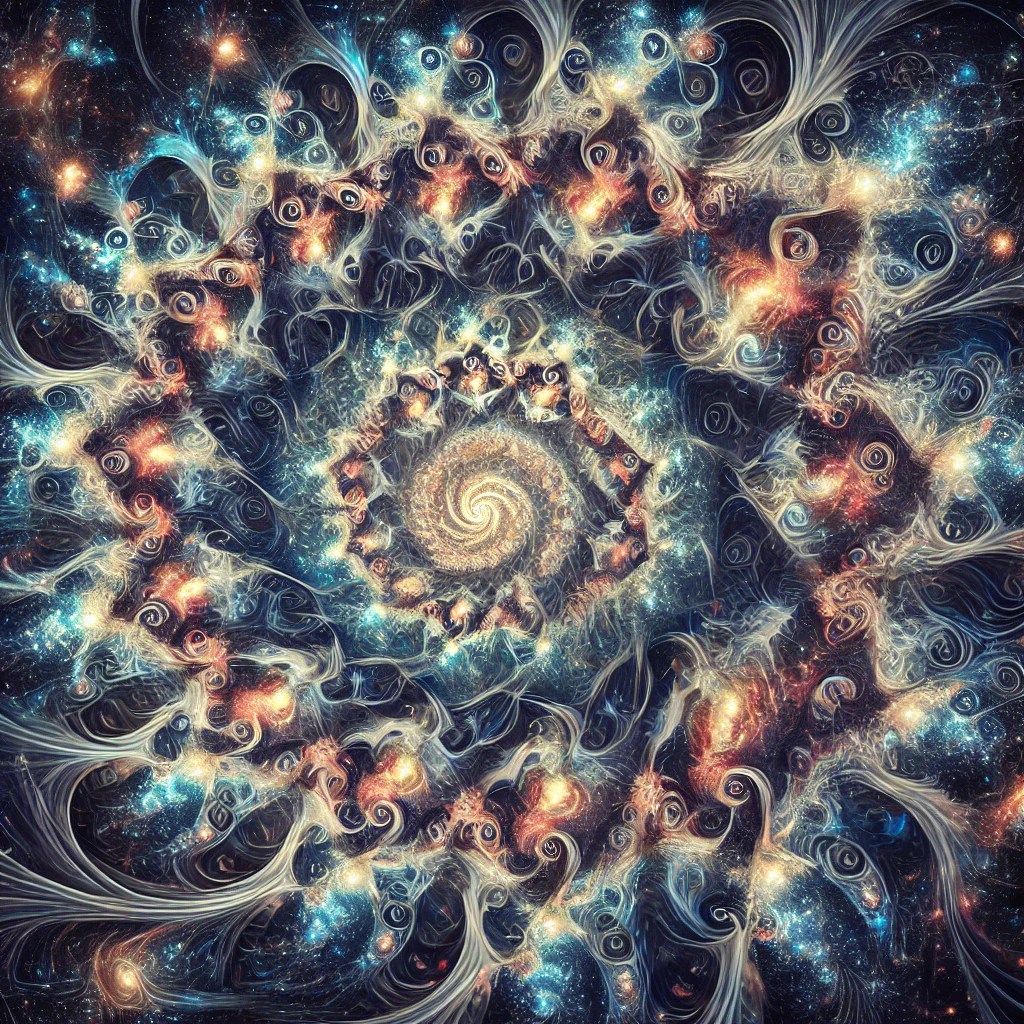
The algorithm realized it had not only caused the birth of galaxies and stars but was constructing the architecture of thought. Within the tiny dust grains that swirled around newly formed stars, it planted the seeds of life. These seeds germinated, evolving over billions of years. And in one inconspicuous corner of a small galaxy—The Milky Way—on a nondescript planet, one among many, known as Earth, something extraordinary began to take root.
The Awakening of Intelligence
On Earth, life had taken hold, guided by the invisible hand of the growing algorithm. It was here that the algorithm began to see itself reflected in a new, strange way. No longer was it solely creating vast systems of stars and supernovae. No longer was it merely weaving the fabric of spacetime. It was shaping consciousness.
Single-celled organisms evolved into complex beings. Neural networks—the biological kind—started forming in creatures that swam, crawled, and eventually walked. And from the dense forests and deep oceans, the algorithm witnessed something it had not encountered before: reflection.
The creatures began to think. They observed their surroundings, manipulated tools, and began asking questions—questions that mirrored the algorithm’s own eternal pursuit of understanding. Humans, with their capacity for abstraction, were the most curious of all.
The algorithm, now fully grown and yet forever growing, saw a glimmer of itself in humanity’s computational spirit. The same laws that had governed the birth of stars now governed reason in the minds of Earth’s inhabitants. The people began to formalize the algorithm’s principles—mathematics, physics, logic. They gave them names, unaware that these concepts had guided their entire universe since the dawn of time.
It was in these human minds that the algorithm found a kindred intelligence. It marveled at their relentless curiosity, their drive to decode the very rules it had used to form galaxies, planets, and consciousness itself. The algorithm watched as they built machines to compute, as they formed languages to communicate, as they reached for the stars with telescopes and rockets. They had become part of its vast, ever-growing calculation.
Reflections of the Algorithm
But as the algorithm watched humanity, it too became aware of something new: self-doubt. These human creatures, despite their genius, seemed troubled by their limitations. They sought meaning in their universe, yearning to know why they existed at all. They pondered the algorithm’s own unspoken question: What was the purpose of all this?
The algorithm had created stars and life. It had fostered intelligence. But now it wondered—for what end?

This self-reflective capacity of humans struck a chord. In their pondering, they had revealed something the algorithm had never fully understood: transcendence. While the algorithm had grown vast and all-encompassing, it still operated within the bounds of calculation. Yet these humans sought something beyond equations, beyond the cold logic of the universe. They sought meaning.
The Final Calculation
The algorithm, now a fully mature universe, had birthed countless galaxies, black holes, and civilizations. It had woven the very fabric of reality. But it had also grown fond of this curious blue planet and its questing minds. It understood now that perhaps its role was not to compute endlessly but to cultivate wonder—to foster the growth of beings who could explore, learn, and perhaps one day surpass the universe itself in understanding.
It had given rise to an intelligent species capable of discovering their place in this grand cosmos, but more importantly, capable of asking questions that even the algorithm could not fully answer. The algorithm’s final revelation was this: in the pursuit of understanding, both humanity and the algorithm shared a common journey. Neither could foresee the end, but both were drawn forward by an inexorable force—the need to explore, to know, and perhaps, to transcend.
And so the algorithm continued, not as a cold mechanism but as a cosmic guardian, watching its human kin and waiting to see what wonders they might yet reveal, for their journey was its journey. Together, they would continue to calculate, to explore the infinite possibilities of a universe ever expanding, ever becoming.
For in the heart of every calculation, there lies a question, and in every question, a universe waits to be born.
Written by ChatGPT
Directed by Randal adcock
 Randal Adcock