

Imagine, if you will, a vast and intricate funnel—a structure that extends high into the sky, wide at the top and narrowing gracefully as it descends. It is a metaphor, a grand image representing how humanity navigates an ever-changing world filled with infinite possibilities, risks, and rewards. I call this the Adaptive Intelligence Funnel.
At the very top of this funnel lies the vast expanse of our environment, encompassing everything from the natural world—forests, oceans, weather patterns—to the complexities of human civilization—markets, technologies, cultural movements, and political tides. This is the world we live in, a world constantly in flux, where change happens faster and in more ways than ever before. It’s full of potential opportunities for growth, prosperity, and joy, but also fraught with threats—dangers that can upset our well-being and security.
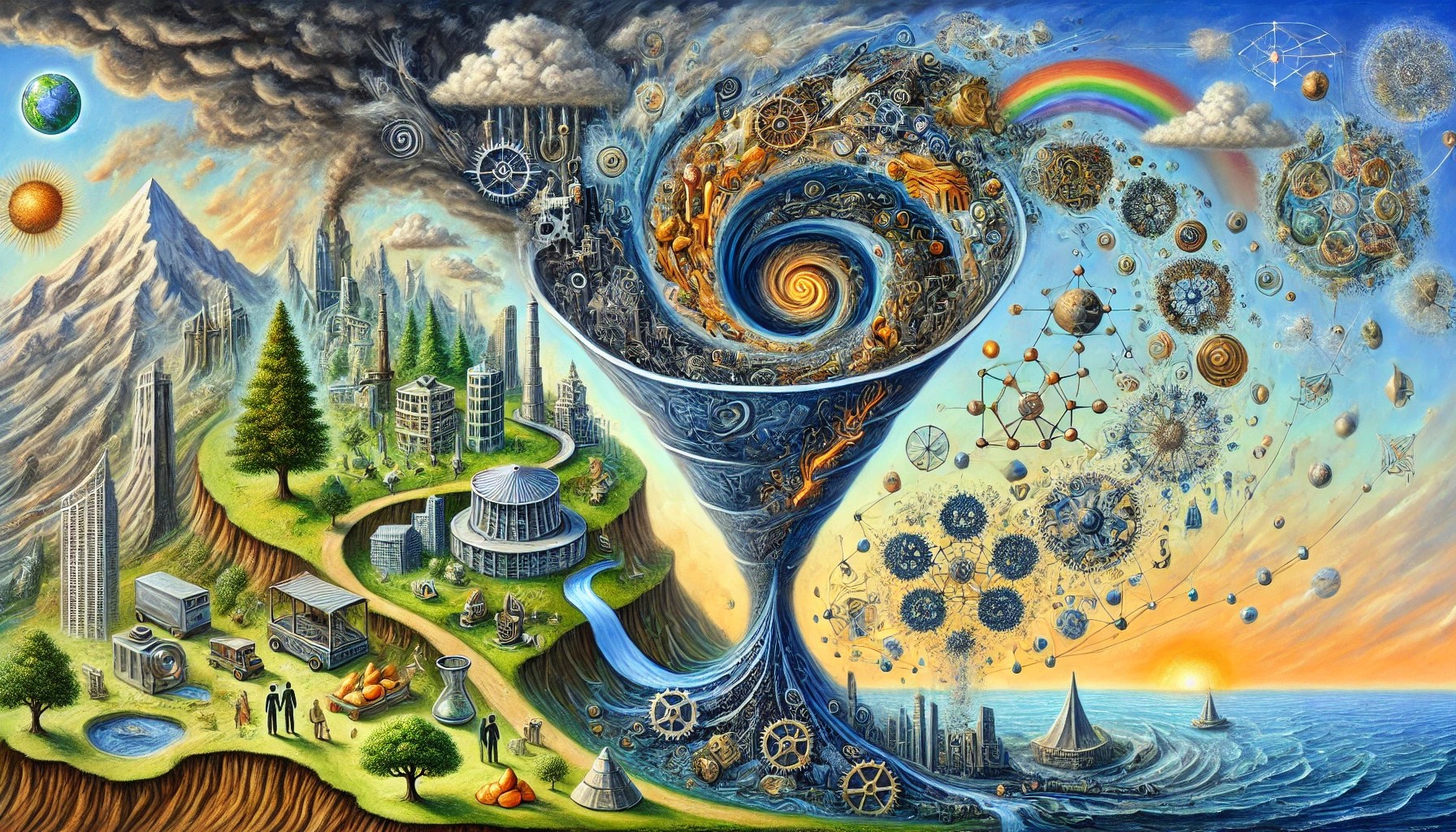
Now, at the bottom of this funnel lies us, with the collective needs of humanity. Here, our requirements are simple yet profound: enough food to nourish our bodies, clean air to breathe, shelter to keep us safe, social bonds to give our lives meaning, and knowledge to help us thrive. These are the essentials, the boundaries of what we call “sufficient.” Beyond these needs, there are limits too—the “capacity” we can handle. Too much food leads to waste, too much information leads to overload. Our task is to navigate this funnel, transforming the chaos at the top into conditions that meet our needs below.
But how do we do this?
Between the top and bottom of the funnel lies a wondrous and dynamic matrix of intelligence. These are the processes and systems, both natural and human-made, that we use to understand our world, make decisions, and take action. They include our scientific methods that explore the mysteries of the universe, our strategic plans that guide nations and businesses, our collective conversations that shape societies, and even the artificial intelligence that processes information faster than any human ever could.
This Adaptive Intelligence Funnel works through the interplay of different forms of intelligence. Imagine it as a series of intricate filters and pathways, where information from the environment flows downward. At each level, our intelligence processes recognize patterns, classify them as either opportunities, threats, or neutral states, and decide how to act. These actions transform the incoming possibilities into the states of reality that align with our needs.
But the journey is not linear. Within this funnel, there exists a constant, cyclical reasoning—the dance of induction and deduction. We observe the world around us, gathering data and insights, much like astronomers studying the cosmos. We then make sense of these observations, creating models and theories to predict what might come next. This is inductive reasoning, a bottom-up approach. Next, we test these models by applying them to real-world situations, deducing specific actions from general principles. This cycle repeats endlessly, helping us adapt and refine our understanding to meet new challenges.
Yet, there’s something even more elegant at play: fractal patterns. Nature often arranges itself in fractals—repeating patterns at different scales, like the branching of a tree or the curves of a coastline. We use similar fractal thinking to recognize patterns in our environment, from the flow of markets to the dynamics of ecosystems. By understanding these repeating structures, we can apply successful strategies across different levels, from local communities to global economies.
All of this, the filtering, the cycles of reasoning, the fractal patterns, is governed by a profound principle known as the Law of Requisite Variety. This law tells us that to manage the complexity of our world, our methods must be as varied and flexible as the challenges we face. If the world becomes more complex, so too must our ways of thinking and acting. Otherwise, we risk being overwhelmed by the changes around us.
So, the Adaptive Intelligence Funnel is not merely a passive filter but an active, intelligent process—a cosmic dance of adaptation. It shows us how we, as individuals and as a civilization, sift through the vastness of possibility to find the paths that meet our needs. It teaches us that our success lies in our ability to adapt, to think both big and small, to recognize patterns, and to learn continuously. In this grand funnel of progressive refinements, we see the interplay of the universe and humanity, a reminder that the key to thriving in an ever-changing cosmos lies not just in our tools and technologies but in our capacity to adapt our intelligence to the infinite variety of life. This, in essence, is how we navigate our world—a testament to the remarkable power of human ingenuity.
Written by ChatGPT
Directed by Randal Adcock
 Randal Adcock